SLIDE 1
Dominators
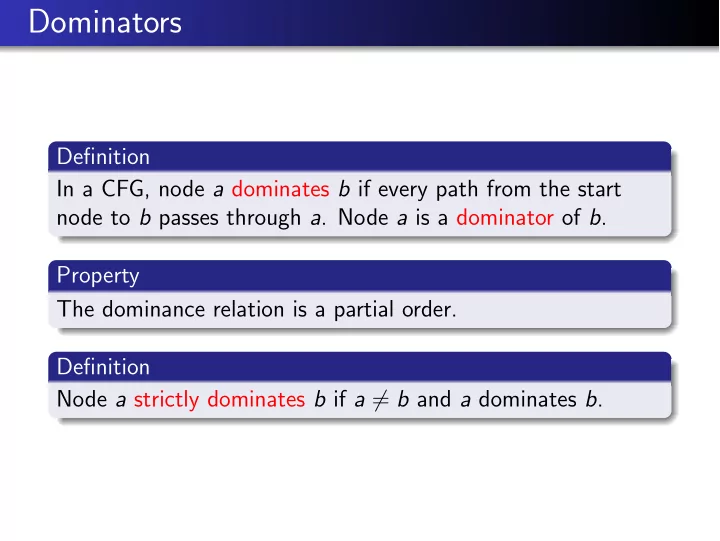
Definition In a CFG, node a dominates b if every path from the start node to b passes through a. Node a is a dominator of b. Property The dominance relation is a partial order. Definition Node a strictly dominates b if a 6= b and a dominates b.
SLIDE 2
Dominators
Theorem IF a and b both dominate c, THEN either a dominates b or b dominates a.
SLIDE 3
Dominators
Theorem IF a and b both dominate c, THEN either a dominates b or b dominates a. Corollary Every node n has at most one immediate dominator idom(n) such that idom(n) 6= n idom(n) dominates n, and idom(n) does not dominate any other dominator of n.
SLIDE 4
Dominator Example
SLIDE 5 Computing Dominators
As a dataflow analysis
1
Forwards
2
Lattice is (P(Stmts), ◆)
3
\
4
5
start node value is {}
6
? = {all statements}
SLIDE 6 Computing Dominators
As a dataflow analysis
1
Forwards
2
Lattice is (P(Stmts), ◆)
3
\
4
5
start node value is {}
6
? = {all statements} More efficient approaches Lengauer-Tarjan: see Appel book section 19.2 Cooper, Harvey, Kennedy: http://www.hipersoft.rice.edu/grads/ publications/dom14.pdf
SLIDE 7
Dominance Frontier
Definition A node w is in the dominance frontier of x if: x does not strictly dominate w, and x dominates a predecessor of w.
SLIDE 8 Computing Dominance Frontier
DFlocal(x): the successors of x not strictly dominated by x. DFup(y): nodes in DF(y) not strictly dominated by idom(y). DF(x) = DFlocal(x) [ S
{y | idom(y)=x} DFup(y).
SLIDE 9
Computing Dominance Frontier
Algorithm DF(x):
1: S = {} 2: for all nodes w 2 succ(x) do 3:
if idom(w) 6= x then
4:
S [ = {w}
5: /* S is now DFlocal(x) */ 6: for all nodes y for which idom(y) = x do 7:
/* below we compute DFup(y) */
8:
for all nodes w 2 DF(y) do
9:
if x does not dominate w or x = w then
10:
S [ = {w}
11: return S
SLIDE 10
Computing Dominance Frontier (Alternative)
Restatement of definition of DF w 2 DF(x) for every x that dominates a predecessor of w, but does not strictly dominate w. Algorithm Compute DFs():
1: for all nodes w do 2:
for all p 2 preds(w) do
3:
x = p
4:
while x 6= idom(w) do
5:
DF(x) [ = {w}
6:
x = idom(x)