Dominator Model Partnership Model The gender revolution has - - PowerPoint PPT Presentation

dominator model partnership model the gender revolution
SMART_READER_LITE
LIVE PREVIEW

Dominator Model Partnership Model The gender revolution has - - PowerPoint PPT Presentation

PAID EMPLOYMENT AND HOUSEHOLD WORK FT employed couples after birth of first child measured household/childcare time PARTNERSHIP Women increased 21 hours a week Men increased 12.5 hours Women shouldered the majority of physical and


slide-1
SLIDE 1

PARTNERSHIP FAMILIES

Julie de Azevedo Hanks, PhD, LCSW

Organizing Families to Support the Aspirations of Mormon Women

1

PAID EMPLOYMENT AND HOUSEHOLD WORK

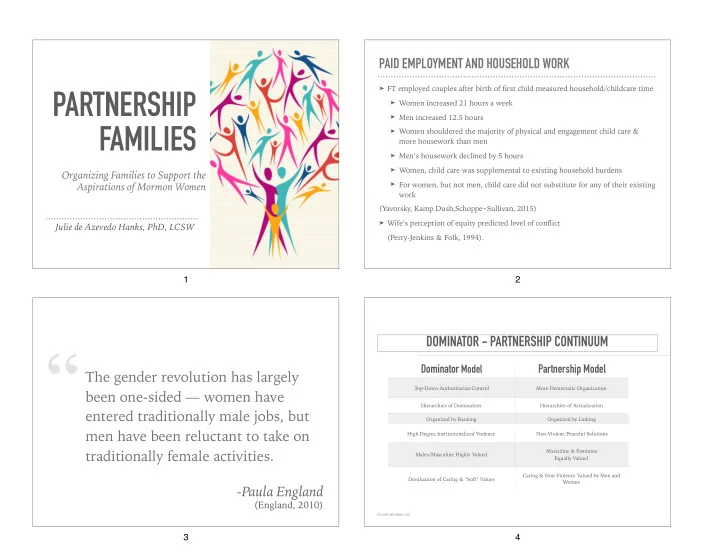
➤ FT employed couples after birth of first child measured household/childcare time ➤ Women increased 21 hours a week ➤ Men increased 12.5 hours ➤ Women shouldered the majority of physical and engagement child care & more housework than men ➤ Men’s housework declined by 5 hours ➤ Women, child care was supplemental to existing household burdens ➤ For women, but not men, child care did not substitute for any of their existing work (Yavorsky, Kamp Dush,Schoppe-Sullivan, 2015) ➤ Wife’s perception of equity predicted level of conflict (Perry-Jenkins & Folk, 1994).

2

The gender revolution has largely been one-sided — women have entered traditionally male jobs, but men have been reluctant to take on traditionally female activities.

  • Paula England

(England, 2010) 3

(C) 2016 Julie Hanks, LLC

DOMINATOR - PARTNERSHIP CONTINUUM

Dominator Model Partnership Model

Top-Down Authoritarian Control More Democratic Organization Hierarchies of Domination Hierarchies of Actualization Organized by Ranking Organized by Linking High Degree Institutionalized Violence Non-Violent/Peaceful Solutions Males/Masculine Highly Valued Masculine & Feminine Equally Valued Devaluation of Caring & “Soft” Values Caring & Non-Violence Valued by Men and Women

4

slide-2
SLIDE 2

DOMINATION IS PRIDE / RANKING

➤ 2 Nephi 28:24-26 lifted up in pride wearing of costly

apparel, goods and their substance no more common among them, divided into classes, build up churches unto themselves to get gain, deny the true church of Christ.

➤ Mormon 8:28 lifted up in the pride of their hearts, leaders of

churches and teachers shall rise in the pride of their hearts

➤ 3 Nephi 6:15 iniquity, puffing them up with pride,tempting

them to seek for power, and authority, and riches, and the vain things of the world.” 5

PARTNERSHIP IS ZION

➤ 4 Nephi 1:15 no contention, love of God which did dwell in the hearts of the people ➤ 4 Nephi 1:16 no envyings, nor strifes, nor tumults, nor whoredoms, nor lyings, nor murders, nor any manner of lasciviousness, could not be a happier people ➤ Mosiah 27:4 “That they should let no pride nor haughtiness disturb their peace; that every man should esteem his neighbor as himself, laboring with their own hands for their support.” ➤ Alma 1:30 did not send away any who were naked, hungry, thirsty or sick, did not set their hearts upon riches; therefore they were liberal to all, having no respect to persons as to those who stood in need ➤ D&C 121:41 “No power or influence can or ought to be maintained by virtue of the priesthood, only by persuasion, by long-suffering, by gentleness and meekness, and by love unfeigned.” 6

6

DEFINING “THE FAMILY”

as of December 2014, less than half of American children lived with a married heterosexual couple (Livingston, 2014) Only 16% of households consist of a married male and female raising their own biological children (Krogstad, 2014).

“Family” is broadly defined as a group of people living in the same household who self identify as a family.

7

THE LADDER

Dominator Families

➤ Hierarchies of Domination with male “in charge” ➤ Authoritarian parenting style - fear & force ➤ Members needs and value are ranked ➤ Emotional and physical violence used to resolve conflict ➤ Boys/masculine strength valued ➤ Nurturing others is devalued and is
  • nly “women’s work”

8

slide-3
SLIDE 3

THE FIELD

Partnership Families

➤ Democratic Structure ➤ Led by Hierarchies of Actualization ➤ Organized by Linking ➤ Prioritize Caring for Others ➤ Non-Violent Solutions ➤ “Masculine” & “Feminine” are valued ➤ Diversity is seen as a strength ➤ High level of differentiation of self

9

MINOAN CRETE 3650-1400 BCE

10

PARTNERSHIP MODEL OF FAMILY ORGANIZATION

8 C’s of Partnership Families(PMFO)TM 11

“ As a microcosm of society, the family can act as a crucible for the creation of partnership. It seems the most obvious place to start, with the people we love most and are closest to.” (Montouri & Conti, 1993, p. 126)

12

slide-4
SLIDE 4

1) COOPERATIVE ADULT LEADERSHIP

➤Actualization

hierarchy

➤Equal partnership

marriage

➤Authoritative

parenting style

13

ACTUALIZATION HIERARCHY

➤ The term “self-actualization,” people who are actively creating

meaning and are fully engaged in the use of talents, capacities, and the development of their potentialities (Maslow, 1973).

➤ Actualization is the realization of our highest human potential

to inspire, support, and empower others and ourselves (Eisler, 2008a)

➤ Family members’ values and needs do not need to be ranked

in order of importance or power, but decisions are made with the welfare of all in mind

➤ Moses 1:39 For behold, this is my work and my glory—to

bring to pass the immortality and eternal life of man. 14

1) COOPERATIVE ADULT LEADERSHIP - REFLECTION QUESTIONS

➤Who decides which roles and responsibilities

are assigned to whom?

➤How can we make sure adults have equal

access to economic power?

➤How can adults work together to help each

family member grow and reach potential?

➤In what ways are we using fear, force, or shame

to control others? How can we improve?

15

EQUAL PARTNERSHIP MARRIAGE

➤ "Marriage requires a full partnership where wives and

husbands work side by side to meet the needs of the family.” (Cook, 2011, May).

➤ “

A marriage of equal partners is also one in which the partners help one another in their stewardships, indeed, are “obligated to help one another as equal partners.” This partnership extends to housework and childcare. President Packer has said, “There is no task, however menial, connected with the care of babies, the nurturing of children, or with the maintenance of the home that is not [the husband’s] equal

  • bligation.”(Husdon & Miller, 2013, April)

16

slide-5
SLIDE 5

2) CONNECTION ORIENTATION

➤Secure attachments ➤Process-oriented ➤Interconnection

with larger systems

17

LINKING INSTEAD OF RANKING

18

SECURE ATTACHMENTS

➤ Attuned parents and affectionate touch buffers an infant’s stress

response Increased oxytocin levels have been reported in fathers after play with their infants (Feldman, et al., 2010)

➤ During face-to-face interactions, mothers and infants coordinate

heart rhythms, the beginnings of regulation (Feldman, et al, 2011)

➤ Parents are neurologically wired to feel good when nurturing each
  • ther and their children (Holt-Lunstad, Birmingham, & Light,

2014).

➤ A caregiver’s healthy predictable, repetitive, nurturing responses

enable a young child’s neurophysiology to develop the capacity to regulate stress and to form healthy attachments (Ludy-Dobson & Perry, 2010). 19

EMOTIONAL AWARENESS

➤ Emotions are viewed as important equal to cognition ➤ Emotion coaching parenting ➤ Awareness of intangibles

20

slide-6
SLIDE 6

2) CONNECTION ORIENTATION - REFLECTION QUESTIONS

➤ What ties the family members together? ➤ Is the process more important than the

  • utcome?

➤ How does your family honor interconnections

with extended family, church, community, global community, earth?

21 22

3) CAREGIVING EMPHASIS

➤Caring for others is highly

valued

➤All family members participate

in caring for each other

➤Recognize and value emotional

labor

➤Value caring for community

and the earth

23

SYSTEMIC DEVALUATION OF CAREGIVING

➤ GDP doesn’t count caring as productive work. ➤ If included, care work at home would add another 30-50% to

reported GDP

➤ Is the only developed nation with no national funding for paid

parental leave and invests the least in early childhood care and education.

➤ The ROI for early childhood education is between $7 to $16 per

dollar invested

➤ 1 in 3 U.S. women is living below or on the brink of poverty

largely because they are the bulk of underpaid & unpaid caregivers CaringEconomy.org 24

slide-7
SLIDE 7

SEEING THE INVISIBLE EMOTIONAL LABOR (EMOTION WORK)

Surface acting involves employee’s (women) simulating emotions that are not actually felt, by changing their outward appearances(i.e, facial expression, gestures, or voice tone) when exhibiting required emotions. Deep acting occurs when employee's (woman’s) feelings do not fit the situation; then they use their training or past experience to work up appropriate emotions. (Choi & Kim, 2015) “I often talk about emotional labor as being the work of caring. And it’s not just being caring, it’s that thing where someone says “I’ll clean if you just tell me what to clean!” because they don’t want to do the mental work of figuring it out. Caring about all the moving parts required to feed the occupants at dinnertime, caring about social
  • management. Caring about noticing that something has changed - like, it’s not there anymore, or
it’s on fire, or it’s broken. It’s a substantial amount of overhead, having to care about everything. It ought to be a shared burden, but half the planet is socialized to trick other people into doing more of the work.” http://www.themarysue.com/emotional-labor-pdf/ Metafilter thread

25

INVOLVED FATHERING

➤ Involved fathers improve child outcomes ➤ Fathers who increased their involvement with their children

experienced increase in self-confidence in their parenting abilities, in satisfaction with the fathering role, and in overall self-esteem.

➤ “Defining these characteristics as central to the new

masculinity requires that fathering be redefined to emphasize the intimacy, care, and connection that previously characterized what we have thought of as “mothering.” (Silverstein, L. B.,1996) 26

ALL FAMILY MEMBERS PARTICIPATE IN CARING

➤ Do we also teach our sons and daughters there is no

greater honor, no more elevated title, and no more important role in this life than that of mother or father?

➤ All of us—women, men, youth, and children, single or

married—can work at being homemakers. We should “make our homes” places of order, refuge, holiness, and safety.

  • President Bonnie Oscarson
https://www.lds.org/general-conference/2015/04/defenders-of-the-family-proclamation?lang=eng

27

3) CAREGIVING EMPHASIS - REFLECTION QUESTIONS

➤In what ways do we unintentionally perpetuate

the devaluation of caregiving? How can we improve?

➤How can we include all family members in direct

caregiving?

➤How can we recognize and value emotional

labor?

➤How can we demonstrate care for our

community and for nature?

28

slide-8
SLIDE 8

29

4) COLLABORATIVE ROLES & RULES

➤ Fluidity in gender

expectations

➤ Moving from roles to

rules(process)

➤ Expansion of acceptable

behaviors for males and females

30

FLUIDITY IN GENDER EXPECTATIONS

31

EXPANSION OF ACCEPTABLE BEHAVIORS FOR MALES & FEMALES

➤ We eagerly teach our children to aim high in

this life. We want to make sure that our daughters know that they have the potential to achieve and be whatever they can imagine. We hope they will love learning, be educated, talented, and maybe even become the next Marie Curie or Eliza R. Snow.

  • President Bonnie Oscarson

(Oscarson, 2015)

32

slide-9
SLIDE 9

“When two people get together they immediately exchange clues as to how they are defining the nature of the relationship; this set of behavioral tactics is modified by the other person by the manner in which he responds…this definition of who each is in relation to the other can best be expressed as quid pro quo.”

  • Don Jackson

(Jackson, 1965) 33

4) COLLABORATIVE ROLES & RULES

➤ How can we support flexibility and integration of

masculinity and femininity

➤ How are we unintentionally discouraging, punishing,

shaming when members express behavior or characteristics stereotypically assigned to the other gender?

➤ How can we help family members move through

family roles instead of staying stuck?

➤ How can we increase awareness of the unspoken

emotional rules of engagement?

34

5) CELEBRATION OF ALL CONTRIBUTIONS

➤ Contributions of males and

females in family life are celebrated

➤ De-emphasis on gender

differences and stereotypes

➤ Integration of "masculine" and

"feminine" in each individual

35

VALUING MASCULINE AND FEMININE

➤ Every person is seen as making a contributions ➤ How can you celebrate a child who is acting out? ➤ Acknowledge physical and emotional labor ➤ Acknowledge leadership and nurturing ➤ No rigid gender stereotypes ➤ Strength and vulnerability honored ➤ Leading and yielding

36

slide-10
SLIDE 10

INTEGRATION IS A SIGN OF HEALTH

37

5) CELEBRATION OF ALL CONTRIBUTIONS - REFLECTION QUESTIONS

➤ How can we foster development of a variety of

different skills, strengths, and “smarts”?

➤ How can we consciously create rituals and

celebrations for female milestones?

➤ How can we focus on similarities of men and

women and human family?

38

6) COMPASSIONATE COMMUNICATION

➤HOW you

communicate and resolve conflict and tension

➤Non-violent

Communication

➤Practice of self-

compassion

39

NON-VIOLENT COMMUNICATION SKILLS

  • 1. Differentiating observation from evaluation
  • 2. Differentiating feeling from thinking
  • 3. Connecting with the universal human needs/values (e.g.

sustenance, trust, understanding) in us that are being met or not met in relation to what is happening and how we are feeling; and

  • 4. Requesting what we would like in a way that clearly and

specifically states what we do want (Rosenberg, 2003) 40

slide-11
SLIDE 11

COMPASSION & SELF-COMPASSION

➤ Neff (2011) ➤ Mindfulness ➤ Self-kindness ➤ Common humanity

41

EMPATHY RESEARCH

➤ Examined links between two distinct facets of empathy and relationship satisfaction: ➤ Empathic accuracy ➤ Perceived empathic effort ➤ Findings ➤ Men’s relationship satisfaction was related to the ability to read their partners’ positive emotions accurately ➤ Women’s relationship satisfaction was related to their partners’ ability to read women’s negative emotions accurately. ➤ Women’s ability to read their husbands’ negative emotions was positively linked to both men’s and women’s relationship satisfaction. ➤ “Findings suggest that the perception of a partner’s empathic effort—as distinct from empathic accuracy—is uniquely informative in understanding how partners may derive relationship satisfaction from empathic processes.” (Cohen, Schulz, Weiss, Waldinger, 2012)

42

I FEEL_______________________________. WHEN YOU____________________________. BECAUSE I THINK________________________. IT WOULD MEAN A LOT TO ME IF _______________.

43

6) COMPASSIONATE COMMUNICATION - REFLECTION QUESTIONS

➤ What can we do to improve our ability to

resolve differences and conflict peacefully?

➤ How can we practice and model self-

compassion?

➤ Are there ways that we unintentionally use

intimidation, fear, or shame in our communication patterns?

44

slide-12
SLIDE 12

7) CONSCIOUS LANGUAGE USE

➤WHAT you say ➤Words choices reflect

awareness of diversity and gender inclusion

➤Language includes shared

responsibility for caring

➤Circularity and

complexity are acknowledged and embraced

45

WORDS HAVE THE POWER TO CREATE

➤ Jacob 4:9 “For behold, by the power of his

word man came upon the face of the earth, which earth was created by the power of his word.

➤ D&C 38:3 “I am the same which spake, and

the world was made, and all things came by me."

46

SHARED RESPONSIBILITY

My —> Our My children —> Our children

Thanks for loading the dishwasher for me—> Thanks for

loading the dishwasher for our family That’s not my job, it’s mom’s job —-> This is our job My house —> Our house Thanks for taking us to dinner, Dad —-> Thanks Dad and Mom Head of household—> heads of household 47

DIVERSITY AND GENDER INCLUSION, CIRCULARITY & COMPLEXITY

➤ Avoid phrases like “man up,” “don’t be such a girl” ➤ Refer to women as women, not “girls” or “chicks” ➤ Speak respectfully of all nations, races, religious groups ➤ Avoid categorizing people with differences as “other” ➤ Relationships are circular an co-created, not linear ➤ Eliminates shame and blame and promotes responsibility for

each persons contribution

➤ Avoid reductionism and oversimplifying situations ➤ Move from binary thinking to complex thought

48

slide-13
SLIDE 13

7) CONSCIOUS LANGUAGE USE - REFLECTION QUESTIONS

➤ Are we unintentionally using words that

demonstrate respect all people?

➤ Do we use language that includes shared

responsibility for family life?

➤ What can we do to improve our awareness of

  • ther’s perspectives?

➤ How can recognizing circularity and

complexity shift our language?

49

8) CREATION & COLLECTION OF PARTNERSHIP STORIES

➤Inclusion of

partnership themed in media

➤Inclusion of feminine

divine

➤Encouragement of

creativity as an approach to life

➤Supporting women’s

creativity and art

50

INCLUSION OF PARTNERSHIP THEMES BOOKS/MEDIA

➤ Reduce exposure to violence ➤ Seek stories with strong female characters ➤ Seek stories that illustrate peaceful problem solving ➤ Seek media that highlights caring and connecting themes

51 52

slide-14
SLIDE 14

8) CREATION & COLLECTION OF PARTNERSHIP STORIES - REFLECTION QUESTIONS

➤ How can we include more stories that embody

connection, compassion, collaboration?

➤ In what ways can we integrate our belief in

Heavenly Mother into our lives?

➤ How can we bring play, absurdity, humor, and

spontaneity into our family?

➤ What can we do to support women’s creative

work?

53

Unfortunately, many of the stories we inherited from earlier times teach that dominating or being dominated are the only alternatives. That there are today stories offering a partnership alternative of relations built on mutual benefit, mutual respect, and mutual accountability is a sign of a major revolution in consciousness… We need a concerted effort through the arts, music, and literature, as well as through science, to show that a partnership way of structuring human society is a viable possibility. …we need the new language for describing societies offered by the partnership system and domination system.

(Eisler, 2008b, p. 7)

54 55

PRESENTATION SLIDES

DRJULIEHANKS.COM/AMW

56

slide-15
SLIDE 15

Since implementing partnership principles I feel more in control of my own life. We hope to heal the multigenerational dysfunction that has stunted the growth and development of our families. We are exhausted but feel we are moving in the right

  • direction. I expect the work we are doing now will

pay enormous dividends in the future.

  • Beth (38)

57

(C) 2016 Julie Hanks, LLC

CONTACT / RESOURCES

➤ DrJulieHanks.com ➤ PartnershipFamilies.com ➤ HighlyCreativeWomen.com ➤ @DrJulieHanks.com on social media ➤ Email julie@drjuliehanks.com

58

(C) 2016 Julie Hanks, LLC

RESOURCES AND REFERENCES

Bateson, M. C. (2001). Composing a life. New York: Penguin Books. Bartley, S. J., Blanton, Priscilla W. & Gilliard, J. L. (2005) Husbands and Wives in Dual-Earner Marriages: Decision-Making, Gender Role Attitudes, Division of Household Labor, and Equity, Marriage & Family Review, 37:4, 69-94, DOI: 10.1300/1.J002v37n04_05 Bishop, R. S. (1990). Mirrors, windows, and sliding glass doors. Perspectives: Choosing and Using Books for the Classroom, 6(3). Retrieved from http://www.rif.org/us/literacyresources/multicultural/ mirrors-windows-and-sliding-glass-doors.htm Bowlby, J. (1988). A secure base: Clinical applications of attachment theory. New York, NY: Routledge. Choi, Y. G., & Kim, K. S. (2015). A Literature Review of Emotional Labor and Emotional Labor
  • Strategies. Universal Journal of Management, 3(7), 283-290.
Cook, Q. L. (2011, May). LDS Women Are Incredible!. In Talk delivered in the General Conference of the Church of Jesus Christ of Latter-day Saints. April. https://www. lds. org/general-conference/ 2011/04/lds-women-are-incredible. Eisler, R. (1987). The chalice and the blade: Our history, our future. San Francisco, CA: Harper & Row. Eisler, R. (2008). The real wealth of nations: Creating a caring economics. San Francisco, CA: Berrett- Koehler. Eisler, R. (1996). Creating partnership futures. Futures, 28(6), 563-566.

59

(C) 2016 Julie Hanks, LLC

RESOURCES AND REFERENCES

Eisler, R. T., & Loye, D. (1990). The partnership way: New tools for living & learning: A practical companion for the Chalice and the blade healing our families, our communities, and our world . San Francisco, CA: Harper. England, P. (2010). The gender revolution uneven and stalled. Gender & society, 24(2), 149-166. Feldman, R., Magori, Cohen, R., Galili, G., Singer, M., & Louzoun, Y. (2011). Mother and infant coordinate heart rhythms through episodes of interaction synchrony. Infant Behavior and Development, 34, 569–577. Hanks, J. A. (2015). Bringing Partnership Home: A Model of Family Transformation Interdisciplinary Journal of Partnership Studies: Vol. 2: Iss. 1, Article 4. Available at: http://pubs.lib.umn.edu/ijps/vol2/ iss1/4 Holt-Lunstad, J., Birmingham, W., & Light, K. (2014). Relationship quality and oxytocin Influence of stable and modifiable aspects of relationships. Journal of Social and Personal Relationships, 32(4),472-490. doi: 10.1177/0265407514536294 Jackson, D. D. (1965). Family rules: Marital quid pro quo. Archives of General Psychiatry, 12, 589-594. Luyckx, K., Tildesley, E. A., Soenens, B., Andrews, J. A., Hampson, S. E., Peterson, M., & Duriez, B. (2011). Krogstad, J. M. (2014). 5 facts about the modern American family. Pew Research Center. Retrieved from http://www.pewresearch.org/facttank/ 2014/04/30/5-facts-about-the-modern-american-family/ Livingston, G. (2014). Less than half of US kids today live in a traditional family. Pew Research Center. Retrieved from http://www.pewresearch.org/facttank/2014/12/22/less-than-half-of- u-s-kids-today-live-in-a-traditionalfamily/

60

slide-16
SLIDE 16 (C) 2016 Julie Hanks, LLC

RESOURCES AND REFERENCES

Ludy-Dobson, C.,& Perry, B. (2010). The Role of healthy relational interactions in buffering the impact of childhood trauma. In Gil, E. (Ed.) Working with children to heal interpersonal trauma: The Power of play. The Guilford Press. (Chapter 3). Luyckx, K., Tildesley, E. A., Soenens, B., Andrews, J. A., Hampson, S. E., Peterson, M., & Duriez, B. (2011). Parenting and trajectories of children's maladaptive behaviors: A 12-year prospective community study. Journal of Clinical Child and Adolescent Psychology, 40 (3), 468-478. Maslow, A. H. (1973). On dominance, self-esteem, and self-actualization. Monterey, CA: Brooks/Cole. McCarthy, G., & Maughan, B. (2010). Negative childhood experiences and adult love relationships: The role of internal working models of attachment. Attachment & Human Development, 12 (5), 445-461. Miller, J. B. (1986). Toward a new psychology of women. Boston, MA: Beacon. Miller, E. M., & Cohen, L. M. (2012). Engendering talent in others: Expanding domains of giftedness and
  • creativity. Roeper Review, 34 (2), 104-113. doi:10.1080/02783193.2012.660684
Miller, J. B. (1986). Toward a new psychology of women. Boston, MA: Beacon.

61

(C) 2016 Julie Hanks, LLC

RESOURCES AND REFERENCES

Neff, K, (2011). Self-compassion, self-esteem, and well-being. Social and Personality Psychology Oscarson, B. (2015). Defenders of the Family Proclamation https://www.lds.org/general- conference/2015/04/defenders-of-the-family-proclamation? Compass, 5(1), 1–12. doi:10.1111/j.1751-9004.2010.00330.x Parenting and trajectories of children's maladaptive behaviors: A 12-year prospective community study. Journal of Clinical Child and Adolescent Psychology, 40(3), 468-478. Rando, Licia (2016) "Partnership Cultures: Beginning at the Beginning through Parenting," Interdisciplinary Journal of Partnership Studies: Vol. 3: Iss. 2, Article 1. Available at: http://pubs.lib.umn.edu/ijps/vol3/iss2/1 Siegel, D. J. (2001). Toward an interpersonal neurobiology of the developing mind: Attachment relationships,“mindsight,” and neural integration. Infant mental health journal, 22(1-2), 67-94. Silverstein, L. B. (1996). Fathering is a feminist issue. Psychology of Women Quarterly, 20, 3-37. Yavorsky, J. E., Kamp Dush, C. M., & Schoppe-Sullivan, S. J. (2015). The production of inequality: The gender division of labor across the transition to parenthood. Journal of Marriage and Family, 77(3), 662-679.

62