Assignment 1 1. Intra Procedural Dominator Analysis Dominator - - PDF document

assignment 1
SMART_READER_LITE
LIVE PREVIEW

Assignment 1 1. Intra Procedural Dominator Analysis Dominator - - PDF document

Assignment 1 1. Intra Procedural Dominator Analysis Dominator analysis is an important problem, with applications ranging from optimizing compilers to network flow analysis. The analysis determines for each node in a directed graph by which


slide-1
SLIDE 1

Assignment 1

  • 1. Intra Procedural Dominator Analysis

Dominator analysis is an important problem, with applications ranging from

  • ptimizing compilers to network flow analysis. The analysis determines for

each node in a directed graph by which other nodes it is dominated by. Here we use the Control Flow Graph (CFG) of programs to detetermine for each node the set of dominating nodes. A number of compiler optimizations rely

  • n dominator analysis to determine guaranteed execution relationships of

blocks in a CFG. Let labels of statements and expressions denote the corresponding nodes in the Control Flow Graph (CFG):

  • Assume every CFG has start node s0 with no predecessors.
  • Node d dominates node n if every path of directed edges from s0 to n

must go through d.

  • Every node dominates itself

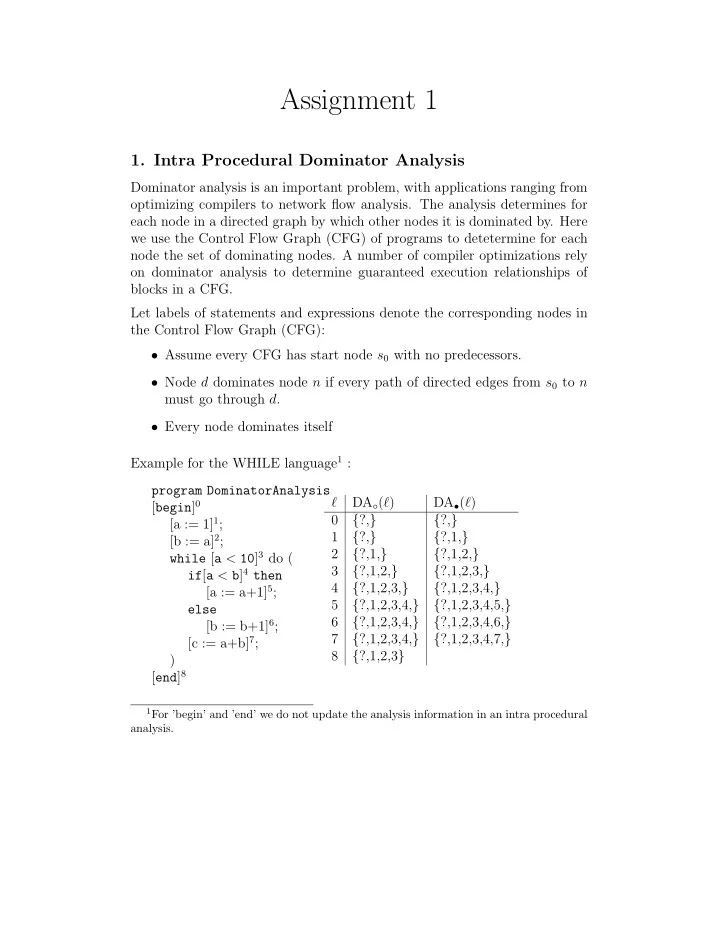
Example for the WHILE language1 : program DominatorAnalysis [begin]0 [a := 1]1; [b := a]2; while [a < 10]3 do ( if[a < b]4 then [a := a+1]5; else [b := b+1]6; [c := a+b]7; ) [end]8 ℓ DA◦(ℓ) DA•(ℓ) {?,} {?,} 1 {?,} {?,1,} 2 {?,1,} {?,1,2,} 3 {?,1,2,} {?,1,2,3,} 4 {?,1,2,3,} {?,1,2,3,4,} 5 {?,1,2,3,4,} {?,1,2,3,4,5,} 6 {?,1,2,3,4,} {?,1,2,3,4,6,} 7 {?,1,2,3,4,} {?,1,2,3,4,7,} 8 {?,1,2,3}

1For ’begin’ and ’end’ we do not update the analysis information in an intra procedural

analysis.

slide-2
SLIDE 2

Specify the Dominator Analysis for WHILE: a) Define killDA(ℓ) and genDA(ℓ). b) Define the equations for DA◦(ℓ), DA•(ℓ) : Lab⋆ → P(Lab?

⋆)

  • 2. Intra Procedural Dominator Analysis with PAG

Specify a Dominator Analysis for the language SL1 with PAG and create an analyzer ’da’ that takes as input an SL1 program and generates as output a gdl file, describing the CFG and the analysis result for each program point, named ’da result.gdl’. The language SL1 is defined as a subset of C++. Every SL1 program is a legal C++ program. The SL1 language corresponds to the WHILE language by representing all WHILE language constructs with the corresponding C++

  • constructs. In contrast to WHILE, in SL1 all variables must be declared

before they can be used. The only types that are allowed for variables in SL1 are ’int’ and ’bool’. There exists only one function without parameters, called ’main’ with a return type of ’int’. The function main should return an int value as last statement. SL1 Example: (corresponding program to the WHILE example) int main() { int a,b,c; a=1; b=a; while(a<10) { if(a<b) { a=a+1; } else { b=b+1; } c=a+b; } return 0; } 2

slide-3
SLIDE 3
  • 3. Hand in
  • Send your answers for questions 1a, 1b, and the PAG specification for

2 per e-mail to markus@complang.tuwien.ac.at

  • The e-mail must have as subject “OPTUB:Assignment 1, <LastName>”

where <LastName> is replaced with your last name. The PAG spec- ification should be attached as tgz file containing all required files for creating the analyzer. The answers should be provided as text in the email body or alternatively as attached postscript or pdf files (included in the tgz file).

  • Deadline: 2pm October 31, 2007.

For further information on how to create a new analysis, additional informa- tion on the program representation, and how to view analyses read the FAQ

  • n the OPTUB website.

3