dolphins in the GBR and Torres Strait: perceptions and reality - - PowerPoint PPT Presentation

dolphins in the gbr and
SMART_READER_LITE
LIVE PREVIEW

dolphins in the GBR and Torres Strait: perceptions and reality - - PowerPoint PPT Presentation

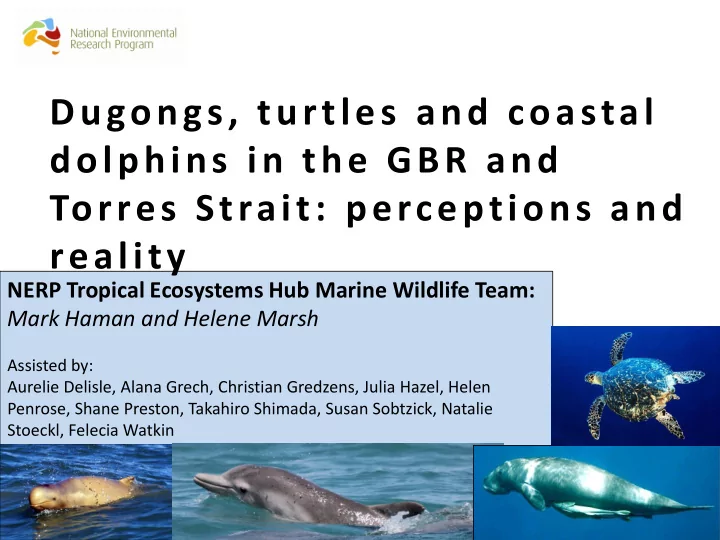
Dugongs, turtles and coastal dolphins in the GBR and Torres Strait: perceptions and reality NERP Tropical Ecosystems Hub Marine Wildlife Team: Mark Haman and Helene Marsh Assisted by: Aurelie Delisle, Alana Grech, Christian Gredzens, Julia


slide-1
SLIDE 1

NERP Tropical Ecosystems Hub Marine Wildlife Team: Mark Haman and Helene Marsh

Assisted by: Aurelie Delisle, Alana Grech, Christian Gredzens, Julia Hazel, Helen Penrose, Shane Preston, Takahiro Shimada, Susan Sobtzick, Natalie Stoeckl, Felecia Watkin

Dugongs, turtles and coastal dolphins in the GBR and Torres Strait: perceptions and reality

1

slide-2
SLIDE 2

Call for change to Native Title Act to ban hunting of threatened species

Perception: hunting is the problem – especially for dugongs

2

slide-3
SLIDE 3

5,000 10,000 15,000 20,000 25,000 30,000 2000 2001 2002 2003 2004 2005 2006 2007 2008 2009 2010 2011 2012 2013

Dugong relative abundance

Northern Great Barrier Reef Southern Great Barrier Reef Torres Strait

Reality: >>> dugongs in Torres Strait & NGBR (where most hunting occurs) than SGBR

Sobztick et al. 2014

3

slide-4
SLIDE 4

Reality: Area high dugong density Torres Strait>> NGBR>> SGBR

Grech et al. 2012

4

slide-5
SLIDE 5

Reality: Proportion of area of high dugong density much higher in Torres Strait and NGBR than SGBR

Survey area Dugong relative density % survey units Low +medium High +very high Torres Strait 51.5 48.5 NGBR 58 42 SGBR 98.5 1.5

5

slide-6
SLIDE 6

Reality: Status dugong population better in Torres Strait than GBR

Results for most recent in time series of aerial surveys SGBR (2011) NGBR (2013) Torres Strait (2013) Relative abundance (since 2000)

worst worst best

Relative density (since 2000)

worst worst best

% calves (since 1980s)

worst worst best

6

slide-7
SLIDE 7

7

Protecting dugong habitat protects green turtles e.g. Shoalwater Bay SGBR

Green turtles and dugongs have high habitat overlap

Gredzens et al. 2014

slide-8
SLIDE 8

Reality: Turtle harvest western and central Torres Strait <1% abundance ‘harvested’ turtles

Aerial survey sightings of turtles November 2013

Estimated abundance large female green turtles in survey area = 395,000

(potential range 283,000 – 657,000)

Torres Strait turtle harvest similar magnitude to swale deaths at Raine Island in big nesting year

Data from Skewes et al. 2005; Sobtzick et al 2014; Fuentes et al. 2014; Dunstan 2014 8

slide-9
SLIDE 9

9

Green turtle futures: SGBR and NGBR stocks

Population in SGBR healthy

(~3% annual increase) QDEHP data

Urban coast largely SGBR stock e.g. Low Isles– 95% greens from SGBR stock Long-term concerns for NGBR stock (NGBR and Torres Strait)

  • Raine Is recruitment failure
slide-10
SLIDE 10

10

Rookeries have normal hatching rates & nesting success Juvenile recruitment <<< expected –Raine Island recruitment failure Dauar Is only non sand cay nesting site: buffer to climate change

NGBR green turtles: Torres Strait

Dauar (near Mer) – nesting beaches Bramble Cay TS – cover of remote cameras

slide-11
SLIDE 11

Reality: Export of meat from Torres Strait no unlikely to be sustainability problem

  • Dugong and turtle <1% annual meat

consumption of Queensland mainland Diaspora

  • Average per person per year:

– 125 – 450g dugong – 160 - 580 g turtle

  • Used for home consumption and ceremonies

If can’t source meat from Torres Strait – Islanders seek legally from SGBR TOs

Delisle et al. 2014

11

slide-12
SLIDE 12

Policy implications of research

Further protection required for dugongs in SGBR

Protect remaining dugong hotspots in SGBR will protect green turtles too

Shoalwater Bay Port Clinton

12

slide-13
SLIDE 13

Policy implications of research

13

Give Raine Island issues high priority

Dunstan 2014

slide-14
SLIDE 14

Policy implications of research: Defined take areas = tractable hunting management

Grayson (2011)

Dugong Sanctuary

14

35 40% 22% Dugong Sanctuary 38% hunted 40% unofficial sanctuary 62% of high density dugong areas not hunted Community based management in hunted areas

Grayson & Grech data

slide-15
SLIDE 15

Policy implications of research:

Sharing of turtle and dugong meat between remote communities and Diaspora reduces pressure on SGBR stock

15

slide-16
SLIDE 16

16

Policy implications of research: Need to inform the convertible

slide-17
SLIDE 17

Snubfin and humpback dolphins: very small isolated inshore populations

17

Under-reported killer

Modelled by Alana Grech Isabel Beasley records

Under-reported killer

Both species mostly occur in isolated populations < 100 animals that can sustain only one human-caused mortality every few years but…………………

slide-18
SLIDE 18

Reality: Most remaining populations close to ports ?affinity for river mouths

18

Cagnazzi et al.(2013). PLOS ONE

<100 dolphins Planned development 14-25% core habitat

Townsville port 2014

Bathurst Bay 2014 Port Alma

slide-19
SLIDE 19

Policy implications of research

Buffer

Critical habitat: 1.no new ports 2.no large mesh netting

  • 3. measures to

minimize vessel strike etc

Buffer zone where managers work with fishers to implement ‘legitimate’ measures to minimize dolphin bycatch

Need to identify and protect critical habitat of ‘protectable’ populations of coastal dolphins in GBR

19

slide-20
SLIDE 20

Environment and Heritage Protection

Questions ?

20 CONTACT Name: Helene Marsh Organisation: JCU Phone: 47814793 Email: helene.marsh@jcu.edu.au