Doing More with Less: The Evolution of a Peer Mentoring Program - - PowerPoint PPT Presentation

doing more with less the evolution of a peer mentoring
SMART_READER_LITE
LIVE PREVIEW

Doing More with Less: The Evolution of a Peer Mentoring Program - - PowerPoint PPT Presentation

Doing More with Less: The Evolution of a Peer Mentoring Program Jenna Seabold Purdue University October 9, 2011 1 Session Agenda Why Mentoring? Program Overview History of Purdue Promise Mentoring in Purdue Promise


slide-1
SLIDE 1

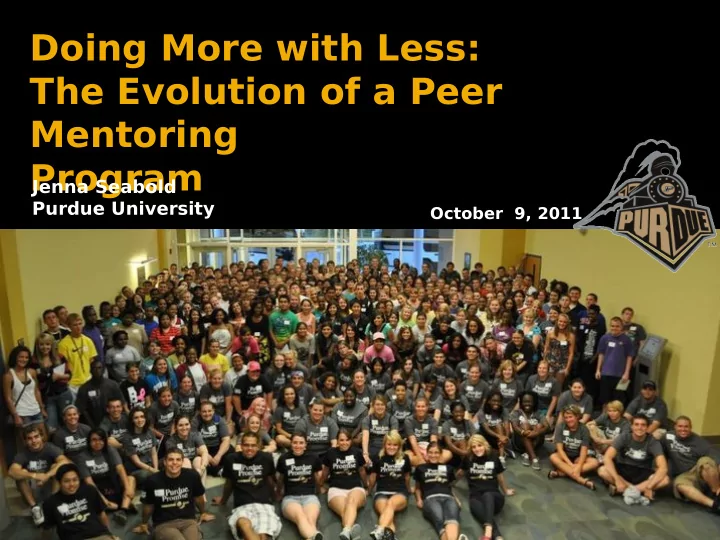
Doing More with Less: The Evolution of a Peer Mentoring Program

Jenna Seabold Purdue University

1

October 9, 2011
slide-2
SLIDE 2

Session Agenda

 Why Mentoring?  Program Overview

  • History of Purdue Promise
  • Mentoring in Purdue Promise
  • Stretching our dollars

 Assessment

  • How we assess our program

 How it can be replicated

slide-3
SLIDE 3

Why Mentoring?

slide-4
SLIDE 4

Importance of Mentoring

 Literature & Research

  • Peer groups are primary forces influencing college

student development - Chickering, 1969

  • “The most potent environmental influence on student

development in college is the peer group.” – Brown, 1972 (p. 31)

  • “interaction with peers is probably the most pervasive

and powerful force in student persistence and degree completion.” – Pascarella & Terenzini, 2005

slide-5
SLIDE 5

Importance of Mentoring

Benefits to the

Program/Institution

  • Cost effective
  • Personal touch without staff

burnout

  • Creates leadership
  • pportunities (More benefits!)
  • Evidence of increasing

student satisfaction and retention

slide-6
SLIDE 6

History of Purdue Promise’s Mentoring Program

slide-7
SLIDE 7

Background Information

 In Fall 2006, a mentoring program was

created for Purdue Opportunity Awards Scholars

  • For low-income and first-generation students from

the state of Indiana who are receiving the Purdue Opportunity Award financial aid

  • Served 80-90 incoming first-year students each

year

  • Mentoring program grew from about 25 mentors to

45 mentors by 2008

slide-8
SLIDE 8

Background Information

 In Fall 2009, Purdue Opportunity Awards

Program evolved into the Purdue Promise Program

  • For low-income and first-generation students from the

state of Indiana area who are receiving the Purdue Promise Scholarship and Purdue Opportunity Award

  • Initial cohort had 171 incoming students
  • Mentoring program continued with about 55 mentors
  • Added students receiving the Emerging Urban Leader

Scholarship in Fall 2010

  • Program is very successful and thus continues to

grow…

slide-9
SLIDE 9

Growth Continues…

Year Number of Mentees Mentors 2007 87 40 2008 90 44 2009 171 54 2010 223 28 2011 253 44

Unforeseen growth has created strain on financial resources.

slide-10
SLIDE 10

More Background: Purdue Promise

The intentional combination of

financial support and academic programming to enhance Purdue’s access and success of Twenty-first Century Scholars, Emerging Urban Leaders, and Purdue Opportunity Awards Scholars.

slide-11
SLIDE 11

The support services are designed to help students succeed both academically and socially in a structured academic and co-curricular success effort.

Support

slide-12
SLIDE 12

Three Major Areas

Academic Enhancement Social Integration and Mentoring Leadership Development

slide-13
SLIDE 13

Staf

Associate Director Assistant Director: Academic Success Assistant Director: Mentoring & Social Integration Assistant Director: Special Projects Peer Facilitators Peer Facilitators 15 College Mentors 10 Academic Resource Guides SST: Academic Success Peer Facilitators

SST: Mentoring & Social Integration

Peer Facilitators SATS Ambassadors

SST: Leadership Development and Success Initiatives

Peer Facilitators 44 Peer Mentors 6 Mentor Leaders Senior Assistant Director 4 Peer Tutors College Access Advocates

SST = Student Success Team

slide-14
SLIDE 14

Purdue Promise Mentoring Program: What we do

slide-15
SLIDE 15

Mentoring in Purdue Promise

 Mentors serve as trained

student leaders who help their mentees successfully transition to Purdue by:

▪ Being a welcoming & approachable role model ▪ Helping mentees access resources at Purdue ▪ Encouraging academic success ▪ Providing a listening ear ▪ Creating community within Purdue Promise and the University at-large

slide-16
SLIDE 16

Position Responsibilities

 Mentors will:

  • Have 3 contacts a month.

▪ One must be in person. ▪ One must encourage personal well- being. ▪ One must encourage academic success.

  • Hold one office hour a week in the office
  • Attend bi-weekly mentor meetings
  • Attend all trainings
  • Aid in completing Passport to Success
  • Meet 2 - 4 times throughout the year one-
  • n-one with mentees
  • Attend all large social events
  • Make time and be available for mentees
slide-17
SLIDE 17

Mentoring Expectations

 Expectations:

  • Meet all position responsibilities
  • Maintain a 2.5 GPA
  • Abide by all University & Program policies
  • Be a good role model
  • Maintain a positive attitude
  • HAVE FUN!!!
slide-18
SLIDE 18

Staffjng Structure

slide-19
SLIDE 19

Mentor Leader Position

 Mentor Leaders

  • Supervise/Mentor the Mentors
  • Plan & Implement Large Social

Events

▪ In charge of 1-2 events a year ▪ Assists with running all large events

  • Communicates between SST/P-

Staff and Mentees

▪ Answers questions ▪ Assists with paperwork

  • Meets once a week

▪ Bi-weekly with SST and P-Staff ▪ Opposite weeks with Mentor Team

  • Holds 2 office hours a week
slide-20
SLIDE 20

Mentor Recruitment & Selection

 Recruitment

  • Advertise in classes
  • Nominations from other mentors and

staff

  • Facebook
  • Youtube videos
  • Callouts

 Selection

  • Online Application

▪ Include important dates on the application: interview days, trainings, large fall events

  • Interviews
  • Upper level student leaders involved
slide-21
SLIDE 21

Recruitment & Selection

 Interviewing

  • We interview all candidates who meet initial criteria
  • Peer Mentors & Student Success Team interview the

mentors

  • Interview Set-up

 Selection & Notification

  • P-Staff involved in selection
  • We over select the number we need
  • No waitlist or alternatives
  • Power in not accepting 100%
slide-22
SLIDE 22

Timeline

 Recruitment begins the moment mentees meet

their mentors

 November – Official Recruitment Begins  Early January - Callouts  Mid January - 8 days to apply & sign up for

interviews

 Late January – Mentor Leaders Interview & are

selected and notified

 February – Mentors Interview & are selected and

notified

 March & April

  • Mentors have 3 evening 3 hour trainings
  • Mentor Leaders have an additional 2 trainings and a summer retreat
slide-23
SLIDE 23

Trainings

Mentors will…

  • Understand the role and responsibility of being

a peer mentor

  • Learn important skills to needed to be an

effective mentor

  • Understand the University and Program

policies & expectations of a peer mentor

  • Begin developing relationships with the other

mentors

slide-24
SLIDE 24

Mentors & Mentees

 Matching Form

  • Mentors fill out in April
  • Mentees fill out online over the

summer or at orientation in June/July

 Matching Day

  • End of July
  • P-Staff take all the info & match
  • Excel spreadsheets & a large

white board

  • Takes us about 6-8 hours
  • Results are worth it!
slide-25
SLIDE 25

Mentors & Mentees

 Introductions

  • Early August – Notifications
  • Mentors expected to contact

mentees at least once before mentors return to campus

 Week Before Classes

Begin

  • Thursday before classes

begin

▪ Mentor Leaders & Mentors move in early for training

  • Friday before classes begin

▪ Fall Kickoff

slide-26
SLIDE 26

Fall Kickof

 Goals of the Event

  • Get all the incoming cohort of students together for the

first-time

  • Share important information with all incoming students
  • Mentors & Mentees get to know each other and start to

build community!

 Changed over time due to budgets, number of students, etc

slide-27
SLIDE 27

Mentoring & Social Integration

 Social Events Then

  • First Week Catered

Dinner

  • Trips to Indianapolis
  • Concerts
  • Go Carts & Lazer Tag
  • Plays & Musicals
  • Dinners

 Social Events Now

  • First Week Ice Cream Social
  • Trip to local corn maze
  • Game & Craft Nights
  • Lazer Tag
  • Cookouts
  • Movie Nights
  • Holiday Parties
  • Intramurals

Involvement & Retention have increased!

slide-28
SLIDE 28

Motivation

 Compensation for our mentors

  • Scholarship recipients so many

see this as a way to give back

  • Free T-Shirts
  • Professional Development

Opportunities

▪ Mentoring Symposium in Indianapolis ▪ Nominations to participate in on- campus leadership opportunities

  • Letters of

recommendation/references

  • Recognition Opportunities
slide-29
SLIDE 29

What Have We Found?

slide-30
SLIDE 30

Assessment Methods

 Current Methods  Mentor Meeting Database  Mini Evaluations  Social Event Attendance  Focus Groups  Future Plans  Mentor Reflections  End of Semester Satisfaction Surveys

slide-31
SLIDE 31

First Year Social Attendance Fall 2010

1 2 3 4 5 6 7 8 10 20 30 40 50 60 70 80

Purdue Promise First Year Social Attendance

Frequency Number of Events Number of Students

slide-32
SLIDE 32

First Year Mentor Contact Hours

Approximately 4 hours per student And 31.5 hours per mentor

Fall Semester 2010 Minutes Hours Sept 23,715 395.25 Oct 16,545 275.75 Nov 13,005 216.75 Total 53,265 887.75

slide-33
SLIDE 33

Focus Groups

Held one at the end of Fall Semester

2010

Ofgered free pizza About 8 mentors showed Some fjndings

slide-34
SLIDE 34

Retention Rates

Cohort Year Comparison Groups Original Cohort One Year Retention Count 1st to 2nd Yr Percent Retained Two Year Retenti

  • n

Count 2nd to 3rd Yr Percent Retained 2009- 2010 Purdue Promise 171 149 87.13% 141 82.46% TfCS not in Purdue Promise 166 137 82.53% 126 75.90% All TfCS 337 286 84.87% 267 79.23% Pell w/TFI < $40k 895 753 84.13% 686 76.65% University Retention Rate 6166 5486 88.97% 5089 82.53% 2010- 2011 Purdue Promise 223 205 91.93% TfCS not in Purdue Promise 130 111 85.38% All TfCS 353 316 89.52%

slide-35
SLIDE 35

Assessment Results: Maintaining

Matching Mentees with Mentors based on

interest sheets

Mentor Leader/Mentor Working Relationship Bi-Weekly Meetings Trainings Mentoring connection to class

slide-36
SLIDE 36

Assessment Results: Changes

Better online tracking contact log Added the mentoring one-on-ones Trying to increase number of mentors May add a mentoring retreat to increase

training effectiveness

slide-37
SLIDE 37

Applications for other campuses

slide-38
SLIDE 38

New programs

 Get buy-in from University for funding  Look for ways to collaborate  Potential obstacles? Face them  Start small with some really energetic and dedicated

mentors

 Look for hidden leaders.  Give the mentors opportunities for ownership – they

will make it great!

slide-39
SLIDE 39

Programs facing budget restrictions

 Be creative. Is there a more economical way to meet

the same objective?

 Can be a great time to refocus program goals. Is this

still important to us?

 Look for ways to collaborate with others  Look for sponsorship opportunities  If you have reached a tipping point of successful

programming, voice your concerns

slide-40
SLIDE 40

Wrap-Up

 Program has evolved to meet funding challenges  We discovered that we can still meet goals with

SOME budget reductions

 Creative solutions helped us meet our same

  • bjectives

 Through recent program outcomes and promotion of

successes, may actually be receiving more funding to continue our program goals.

slide-41
SLIDE 41

References

 Brown, R.D. (1972). Student development in tomorrow’s higher education:

A return to the academy. Alexandria, VA. American College Personnel Association.

 Chickering, A.W. (1969). Friends, groups, and student culture. In Education

and identity (pp. 253-279). San Francisco: Jossey-Bass.

 Latino, J. (2010). Peer Education: An Overview. Presented at the National

Resource Center’s Institute on Peer Educators in Indianapolis, IN.

 Pascarella, E.T., & Terenzini, P.T. (2005). How College Affects Students:

Volume 2 A Third Decade of Research. San Francisco: Jossey Bass. ‐

slide-42
SLIDE 42

Questions?

slide-43
SLIDE 43

Contact Us

43

Thank you! Student Access, Transition and Success Programs (765) 494-9328 www.purdue.edu/sats Email: sats@purdue.edu Jenna’s direct email: jlaub@purdue.edu