Draft Fishery Management Plan for Spotted Seatrout in North Carolina - - PowerPoint PPT Presentation

draft fishery management plan for spotted seatrout in
SMART_READER_LITE
LIVE PREVIEW

Draft Fishery Management Plan for Spotted Seatrout in North Carolina - - PowerPoint PPT Presentation

Draft Fishery Management Plan for Spotted Seatrout in North Carolina Joint Legislative Commission on Seafood and Aquaculture Pine Knoll Shores September 15, 2010 FMP GOAL Determine the status of the stock and ensure long-term sustainability

slide-1
SLIDE 1

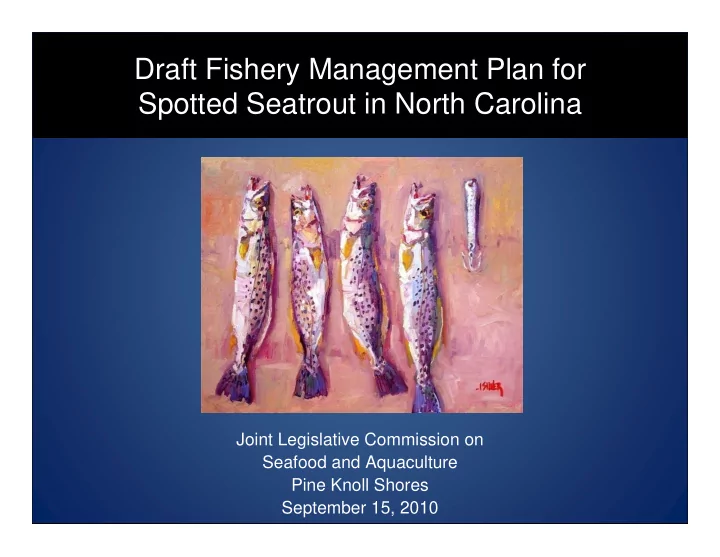
Draft Fishery Management Plan for Spotted Seatrout in North Carolina

Joint Legislative Commission on Seafood and Aquaculture Pine Knoll Shores September 15, 2010

slide-2
SLIDE 2

FMP GOAL

Determine the status of the stock and ensure long-term sustainability for the spotted seatrout stock in North Carolina

slide-3
SLIDE 3

FMP Objectives

  • 1. Develop an objective management program that

provides conservation of the resource and sustainable harvest in the fishery 2.Ensure the spawning stock is of sufficient capacity to prevent recruitment-overfishing 3.Address socio-economic concerns for all user groups

slide-4
SLIDE 4

FMP Objectives (cont)

  • 4. Restore, improve, and protect important

habitats that affect growth, survival, and reproduction of the stock.

  • 5. Evaluate, enhance, and initiate studies to

increase understanding of spotted seatrout biology and population dynamics in North Carolina.

  • 6. Promote public awareness regarding the status

and management of the stock.

slide-5
SLIDE 5

Status of the Stock

  • Age based statistical model
  • 2009 stock assessment indicated the spotted

seatrout stock in NC/VA has been overfished and overfishing occurring throughout the entire 18-year time series (1991-2008)

  • Spawning Potential Ratio (SPR) is a

measurement of the spawning potential of a population after the impacts of fishing mortality

  • SPRs are below the DMF benchmark threshold

and ASMFC recommended criteria of 20%

slide-6
SLIDE 6

FMP Purpose

Recommend or maintain management measures that prevent overfishing and provide the long-term sustainable harvest for the fishery Areas to be addressed:

  • Habitat and water quality
  • Socioeconomic factors
  • Management strategies
  • Insufficient data and research needs
slide-7
SLIDE 7

Issues Addressed in the FMP

  • Achieving sustainable harvest
  • Impacts of cold stun events on the

population

  • Enforcement of size, creel limit and gear

regulations in joint, coastal or inland fishing waters

  • Management measures to address user

group competition

  • Closing the gig fishery Dec. - March 31
slide-8
SLIDE 8

Sustainable Harvest

Background

  • 2009 stock assessment indicated the stock in NC/VA has

been overfished and overfishing has been occurring throughout the 18-year time series.

Issue

  • Establish harvest reductions that achieve sustainable

harvest by rebuilding the spawning stock biomass above the threshold level and end overfishing within 10 years.

slide-9
SLIDE 9

Spawning Stock Biomass Overfished Status

slide-10
SLIDE 10

Fishing Mortality By Sector Overfishing Status

slide-11
SLIDE 11

Sustainable Harvest

Size Bag Limit

14 " 57%

REBUILD STOCK WITHIN 10 YEARS END OVERFISHING IMMEDIATELY

REDUCTION REQUIRED 2 fish 50 lbs

Trip Limit

MANAGEMENT OPTIONS

slide-12
SLIDE 12

Sustainable Harvest

28.5% 28.5% REQUIRED REDUCTION MANAGEMENT OPTIONS COMMERCIAL FISHERY

Minimum Size (TL)

14 " RECREATIONAL FISHERY REDUCTION REQUIRED MANAGEMENT OPTIONS

Minimum Size (TL)

14 "

slide-13
SLIDE 13

Sustainable Harvest

29.0% 29.7%

  • Weekend Closure- no possession on weekends

November-February: all gear out of water (including RCGL)

  • 6 fish bag limit

Commercial Fishery

MANAGEMENT OPTIONS

% REDUCTION

14-inch minimum size limit and:

Recreational Fishery

MANAGEMENT OPTIONS

% REDUCTION

14-inch minimum size limit and:

1/2 REDUCTION NEEDED TO END OVERFISHING - ASSESS IN 5 YRS

slide-14
SLIDE 14

Sustainable Harvest

DMF SST AC MFC

  • ½ reduction needed,

6 fish recreational bag, 14-inch minimum size for recreational and commercial , and weekend closure for commercial gears (no possession on weekends), gear will need to be removed on weekends, November- February

  • Western Albemarle

Sound and Currituck Sound exempt from weekend gear removal

  • Same as DMF

(commercial & recreational)

  • Promote the use of

barbless hooks

  • No use of gill nets

as RCGL gear to harvest spotted seatrout

  • ½ reduction needed,

6 fish recreational bag, 14-inch minimum size for recreational and commercial, and weekend closure for commercial gears year-round (no possession on weekends).

  • commercial gear will be

allowed to remain in the water on the weekends

  • A maximum of 3 fish over

24 inches for recreational fishermen

  • small mesh net attendance

requirement is extended to include weekends, December through February

Recreational = 29.0% Commercial = 29.7% Same as DMF Recreational = 29.0% Commercial = 13-26%

slide-15
SLIDE 15

Sustainable Harvest (cont)

DMF SST AC MFC

  • Regulations need to be in

place for a minimum of 3 years to assess their

  • effectiveness. The 5 year

FMP review schedule needs to be adhered to

  • The matter should be

revisited within 3 years due to problems with the stock assessment model (ie., inability to account for mortality associated with cold stun, and lack of a stock recruit relationship)

  • The matter should be

revisited within 3 years to determine if sustainable harvest measures are working

slide-16
SLIDE 16

Cold Stun Events

Background

  • Death of large numbers of spotted seatrout following severe cold

spells has been well documented. Periodic increases in mortality associated with cold stuns should be considered when implementing management measures.

Issue

  • Periodic increases in mortality associated with cold stun events can

have a negative impact on population size. Should information and quantification of cold stun events be considered for incorporation into fisheries models and/or management decisions?

slide-17
SLIDE 17

Impacts of Cold Stun Events on the Population

DMF SST AC MFC

  • Give the sustainable

harvest options the

  • pportunity to work in

rebuilding the stock to 20% SPR

  • Status quo with

the assumption that the director will intervene in the event of a catastrophic event and do what is necessary in terms

  • f temporary

closures by water body, but the director’s proclamation needs to be an informed decision based on quantifiable data and the outcome needs to be quantified post the closure

  • Remain status quo with the

assumption that the director will intervene in the event of a catastrophic event and do what is necessary in terms of temporary closures by waterbody

slide-18
SLIDE 18

Impacts of Cold Stun Events on the Population (cont)

DMF SST AC MFC

  • More extensive

research on cold stun events (DMF, universities, etc)

  • Same as DMF
  • Same as DMF
slide-19
SLIDE 19

Enforcement

Background

  • MFC is responsible for managing, protecting,

preserving and enhancing marine and estuarine resources, while WRC is responsible for regulating fishing activities in inland waters. Issue

  • Improving compliance with and agency

enforcement of management measures in joint and coastal or inland fishing waters

slide-20
SLIDE 20

Enforcement of Size, Creel Limit and Gear Regulations in Joint, Coastal or Inland Fishing Waters

DMF SST AC MFC

  • Development of a

mutual aid agreement between DMF Marine Patrol and WRC enforcement officers for inland fishing waters.

  • Same as DMF
  • Same as DMF
slide-21
SLIDE 21

User Group Competition

Background

  • Commercial gill net and recreational hook and line

fishermen have been in competition for seatrout, and in some instances, competition has escalated to conflict.

Issue

  • Determine management measures to reduce conflicts

between recreational and gill net fisheries

slide-22
SLIDE 22

Management Measures to address User Group Competition

DMF SST AC MFC

  • Move forward with the

mediation policy process to resolve conflict between spotted seatrout fishermen

  • Same as DMF
  • Same as DMF
slide-23
SLIDE 23

Closing the Gig Fishery

December 1 – March 31

Background

  • Operates in areas where water is clear during

the cold winter months and fish are lethargic Issue

  • AC voted for a closure of the commercial gig

fishery Dec. 1 – March 31

slide-24
SLIDE 24

Use of Gigs to Harvest Spotted Seatrout December-March

DMF SST AC MFC

  • Status quo. DMF to

continue to track contributions of gigs to

  • verall landings
  • Same as DMF
  • Same as DMF
slide-25
SLIDE 25

Research Needs

1. Develop juvenile abundance index for better understanding

  • f stock recruitment relationship

2. Research the feasibility of including measures of temperature or salinity into stock-recruitment relationship 3. Determine batch fecundity estimates for NC 4. Conduct area-specific spawning surveys 5. Investigate relationship of temperature with juvenile and adult mortality

slide-26
SLIDE 26

Research Needs

6. Define overwintering habitat requirements 7. Study impacts of cold stun events 8. Develop model to predict/estimate the impact of cold stun events on local and statewide abundances 9. Investigate distribution in nursery and non-nursery areas

  • 10. Further research on possible influences of salinity
  • n release mortality
slide-27
SLIDE 27

Research Needs

  • 11. Microchemistry, genetic, or tagging studies to verify

migration patterns, mixing rates, or origins between NC & VA

  • 12. Tagging studies to verify estimates of natural and

fishing mortality

  • 13. Tagging studies to determine if there are localized

populations within NC

  • 14. A longer time series and additional sources of

fishery independent information

slide-28
SLIDE 28

Research Needs

  • 15. Increased observer coverage in a variety of commercial

fisheries, and over a wider area

  • 16. Continue collecting fishery dependent information to

describe the size and age structure of harvested population

  • 17. Investigate the distribution in Inland Fishing Waters
  • 18. Survey of fishing effort in creeks with conflict

complaints

  • 19. Determine targeted species in nursery areas and

creeks with conflict complaints

slide-29
SLIDE 29

Comments/Recommendations?

slide-30
SLIDE 30

FMP TIMELINE

SST AC met

  • February- March 2009

Budget/travel restrictions

  • Updated SA (2007-2008)

SST AC reconvened

  • June 2009-April 2010

Draft FMP to MFC

  • March 2010

Public meetings

  • March-April 2010
slide-31
SLIDE 31

FMP TIMELINE (cont)

Review by DENR Secretary & JLCSA

  • Aug-Sept 2010

Draft FMP (with DENR & JLCSA comments) • November 2010 to MFC; consider implementation by proclamation Public Hearings

  • October 2011

Final draft FMP and rules to MFC for approval • November 2011 Earliest possible effective date of rules

  • February 2012
slide-32
SLIDE 32

Current Conditions

2003-2008 2010

average

Number 66,248 26,791 Weight 94,963 53,552 2009 2010 Number 211,605 26,791 Weight 329,257 53,552

*Jan-Jun only; 15% of the recreational harvest is taken Jan-Jun.

RECREATIONAL

% Difference

  • 59.6
  • 43.6
  • 87.3

% Difference

  • 83.7

2003-2008 2010

average

Landings 84,819 121,779 2009 2010 Landings 150,925 121,779

*Jan-June only; 35% of the commercial harvest is taken Jan-Jun.

% Difference 43.6

  • 19.3

% Difference

COMMERCIAL

slide-33
SLIDE 33

Cold Stun Landings

Non-Cold Stun Year compared to Cold Stun Years (2009) (2003 & 2010)

MONTH

2009 2010 2003 1 26,848 64,033 56,700 2 28,681 33,570 8,206 3 10,383 6,806 2,117 4 17,275 5,124 3,629 5 40,957 8,296 6,368 6 26,780 3,951 9,356 ALL 150,925 121,779 86,376

COMMERCIAL LANDINGS, by month

YEAR