
SLIDE 1
Doing IT Security
Organizational challenges
1
Laura Kocksch Fraunhofer Institute for Secure Information Technologies/Ruhr University Bochum
RISCS Developer-Centred Security Workshop: 24th November 2016
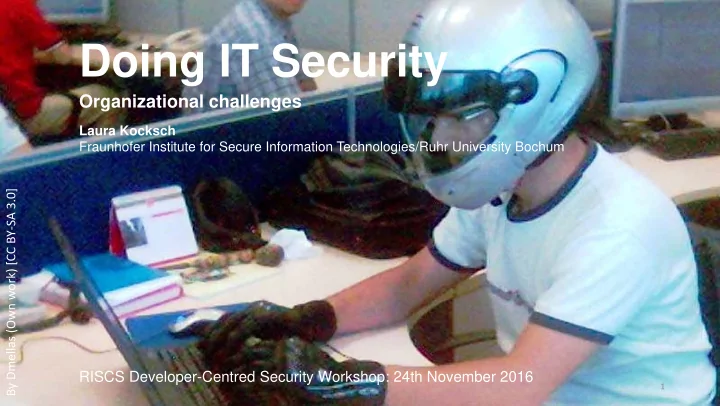
Doing IT Security Organizational challenges Laura Kocksch - - PowerPoint PPT Presentation
Doing IT Security Organizational challenges Laura Kocksch Fraunhofer Institute for Secure Information Technologies/Ruhr University Bochum RISCS Developer-Centred Security Workshop: 24th November 2016 1 Study I: Can security become an
Organizational challenges
1
Laura Kocksch Fraunhofer Institute for Secure Information Technologies/Ruhr University Bochum
RISCS Developer-Centred Security Workshop: 24th November 2016
2
3
4
5
Penetration Test Submission of found Security defects (internal tracking system) Face-to-face Workshop Training In depth presentation of vulnerability types Hands-On Hacking exercises „Hacking Challenge“ Fixing of found security defects Long-term change?
6
7
8
Radschläger (Eigenes Werk) [CC BY‐SA 2.5‐2.0‐1.0] via Wikimedia Commons
The ostensive [structural] aspect of a routine is […] useful in that it helps us describe what we are doing in ways that make sense of our activities. It enables us to ask others to account for actions that seem unusual, and to provide reasonable accounts when we are called to explain.
(Feldman and Pentland 2003)
9
“[any added feature] is gonna have to have security baked into it,'' “I would say, because we are working Scrum‐like, every team should take up these questions [of security].” “There exists no rule book saying `for finishing this feature please spend two hours on security' [...] The idea is to set up teams to be self‐learning so that they consider it in the process from the very beginning, kind of trying to channel the `‐ilities.’” “Actually I don't want that [strict guidelines] ... I don't wanna say it is necessary that someone from the top starts asking us to do certain things.”
10
``But if we only develop security features [...], the product manager has nothing [...] for the next sales training. [...] he has no shiny new features to show [...] no further checkbox to tick in a sales brochure. This is the mindset these folks are thinking in.'' “[...] if security is not on the list [of features], then is it really worth the time and extra energy to do it?
“I mean we are developers because we enjoy it, I don't think any software developer does it because they are just making a paycheck [...] what you really enjoy is putting something together and seeing it work. [...] Security is not one of those things for most people I think, but it does need to be emphasized and we do need to prevent something from happening [...].” Security lacks a „story line“ “Apart from the findings from the workshop there was never any feedback from the customer [...] That [feedback] would definitely motivate us.”
11
12
Make security work accountable and tangible for all actors… Make security interesting… Establish security stakeholder respecting the
13
14
https://technet.microsoft.com/en‐us/security/hh855044.aspx By Chris Creagh (Own work) [CC BY‐SA 3.0]
15
Boundary Objects are objects which are both plastic enough to adapt to local needs and the constraints of the several parties employing them, yet robust enough to maintain a common identity across sites. They are weakly structured in common use, and become strongly structured in individual use […]
(Star and Griesemer 1989)
16
What are the IT security constraints for the software solution we want to build? What shall the IT system look like that we need to secure?
By Sun Ladder (Own work) [CC BY‐SA 3.0] via Wikimedia Commons By Thegreenj (Own work) [CC‐BY‐SA‐3.0] via Wikimedia Commons
17
By Sun Ladder (Own work) [CC BY‐SA 3.0] via Wikimedia Commons By Thegreenj (Own work) [CC‐BY‐SA‐3.0] via Wikimedia Commons
What IT system can you build? What IT system do you need?
user´s side (e.g. nudging/Soft-Paternalism)
18
Become a Routine? A Study of Organizational Change in an Agile Software Development Group. Forthcoming: Proc. CSCW'17, Portland, OR, February 25–March 1, 2017.
Practices? Organizational Challenges and Implications in a Software Development Team. SOUPS´16, Denver, CO, Juni 22-24, 2016.
Analyzing Stakeholder Collaborations Instead of Threats to Assets. Proc. NSPW'14, Victoria, BC, September 15-18, 2014.
19
20
Andreas Poller & Sven Türpe {andreas.poller, sven.türpe}@sit.fraunhofer.de Laura Kocksch (RUB Bochum) laura.kocksch@rub.de lkocksch@gmail.com
GESIS-Leibniz-Institut für Sozialwissenschaften katharina.kinder-kurlanda@gesis.org
Fraunhofer-Institute for Secure Information Technology Rheinstrasse 75 64295 Darmstadt, Germany www.sit.fraunhofer.de