DOCTRINES OF RES JUDICATA, ESTOPPEL, BINDING PRECEDENT, MERGER Mr. - - PDF document

doctrines of res judicata estoppel binding precedent
SMART_READER_LITE
LIVE PREVIEW

DOCTRINES OF RES JUDICATA, ESTOPPEL, BINDING PRECEDENT, MERGER Mr. - - PDF document

DOCTRINES OF RES JUDICATA, ESTOPPEL, BINDING PRECEDENT, MERGER Mr. Subhash Shetty, Advocate Precedent means a legal decision or form of proceedings serving as an authoritative rule in future for similar or analogues cases. It


slide-1
SLIDE 1

DOCTRINES OF RES JUDICATA, ESTOPPEL, BINDING PRECEDENT, MERGER

  • Mr. Subhash Shetty, Advocate

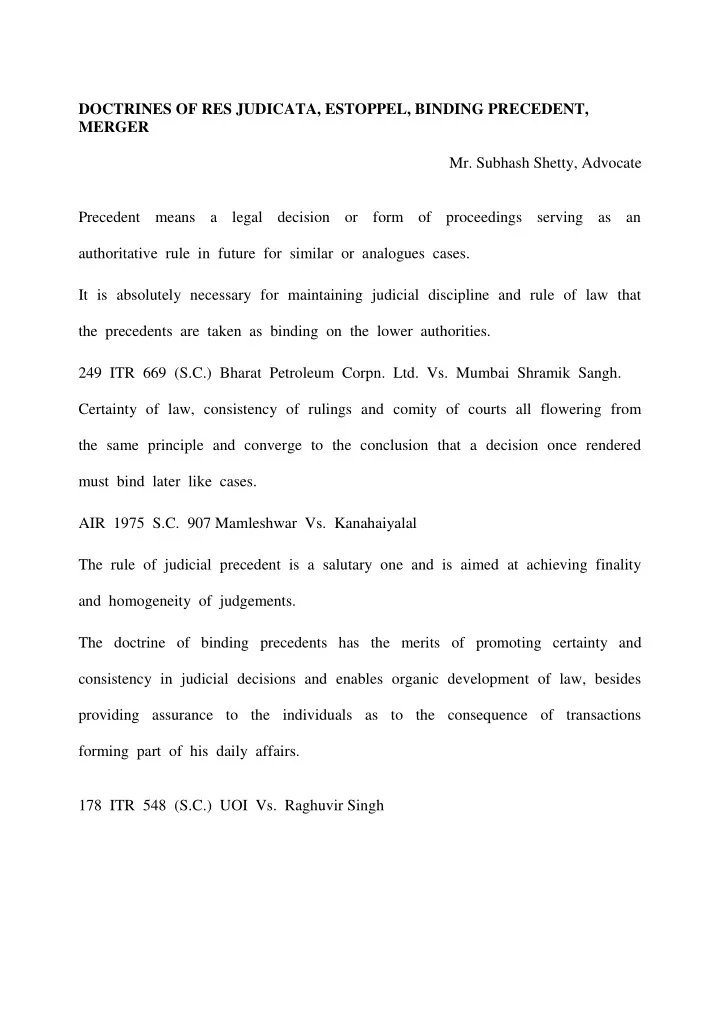
Precedent means a legal decision or form of proceedings serving as an authoritative rule in future for similar or analogues cases. It is absolutely necessary for maintaining judicial discipline and rule of law that the precedents are taken as binding on the lower authorities. 249 ITR 669 (S.C.) Bharat Petroleum Corpn. Ltd. Vs. Mumbai Shramik Sangh. Certainty of law, consistency of rulings and comity of courts all flowering from the same principle and converge to the conclusion that a decision once rendered must bind later like cases. AIR 1975 S.C. 907 Mamleshwar Vs. Kanahaiyalal The rule of judicial precedent is a salutary one and is aimed at achieving finality and homogeneity of judgements. The doctrine of binding precedents has the merits of promoting certainty and consistency in judicial decisions and enables organic development of law, besides providing assurance to the individuals as to the consequence of transactions forming part of his daily affairs. 178 ITR 548 (S.C.) UOI Vs. Raghuvir Singh

slide-2
SLIDE 2

Doctrine of Stare Decisis This doctrine simply means to abide by the former precedents. It is an established rule to abide by former precedents where the same points come again in litigation, as well as to keep the scale of justice even and steady and not liable to waver with every new judges opinion. What before was uncertain and perhaps indifferent, now become a permanent rule which is not in the hands of any subsequent judge to alter or vary from, according to his private sentiments. The doctrine of stare decisis is one of policy grounded on theory that security and certainty requires that accepted and established legal principle, under which rights may accrue, be recognized and followed, though later found not legally sound, but whether a previous holding of the court shall be adhered to, modified

  • r overruled is within the courts discretion under the circumstances of the case

before it. 216 ITR 176 (Mad.) Price leslie & Co. Vs. CIT It should be invariably applied and should not ordinarily be departed from where decision is of long standing and rights have been acquired under it, unless consideration of public policy demands it. (1990) 4 SCC 207 Krishna Kumar Vs. UOI

slide-3
SLIDE 3

Ratio Decidendi It is not the judgement as such but its ratio that constitutes a binding precedent. It is trite to say that a decision is binding not because of its conclusion but in regard to its ratio and the principles laid down therein. Supreme Court held in the case of CIT Vs. Balkrishna Malhotra, 81 ITR 579 that if a decision has held the field for long and citizens as well as tax department have acted upon it, the court will not disturbe the law so laid down even if it comes to the conclusion that the earlier decision was worng. Every new discovery or argumentative novelty can not undo or compel reconsideration of binding precedents. A decision does not lose its authority merely because it was badly argued, inadequately considered or fallaciously reasoned. AIR 1980 S.C. 1762 Ambika Prasad Mishra Vs. State of UP To be the ratio decidendi amongst other, the minimum requirement are i) that the matter was directly in issue ii) that the issue needs to have been decided and iii) that the matter has been decided by giving reasons. (2000) 99 Company Cases 181 ICICI Vs. D. D. Ruparelia. Every judgement must be read as applicable to the particular facts proved or assumed to be proved, since the generality of the expressions which may be found there, are not intended to be expositions of the whole law, but governed and qualified by the particular facts of the case in which such expressions are found and a case is only an authority for what it actually decides. 217 ITR 514 (Bom) Blue Stars Ltd. Vs. CIT

slide-4
SLIDE 4

Exception to the doctrine of precedents Though exceptions do not prove the rule, they do help us to understand the scope and nature of the rule. The courts and the jurists while trying to avoid uncertainty of law, recognizes the need to make law grow hand in hand with the society which is in constant state

  • f flux. Hence, exception to the rule of doctrine of precedents.

a) Abrogated Decisions : A decision ceases to be a precedent if a statute or statutory rule is enacted subsequently which is inconsistent with the decision. It may however be noted that an enactment with retrospective effect cannot make ineffective, a judicial pronouncement delivered which is binding upon the parties to a dispute, even if the later provision, in substance, overrules that provision of the statute on which the judgement was based. b) If it is reversed or over ruled by a higher court. c) Affirmation or reversal on another ground : When the judgement of the lower court is affirmed or reversed on another ground, the ground on which the decision of lower court is based, is deprived of its binding nature. d) Judgement is per incurium : If a decision has been given in ignorance of relevant statutory provision or some authority binding on the court that has resulted in reasons which are apparently

slide-5
SLIDE 5

and demonstrably unsustainable, the court may be left with no option but to treat such decision per incurium and not a binding decision. e) Precedent is sub-silentio : A court may decide in favour of one party because of issue ‘A’ which it considers and decides. It may be shown, however, that the court should not have decided in favour of that party unless it also decides issue ‘B’ in his favour. But the issue ‘B’ was not argued or considered by the court. In such circumstance, although issue ‘B’ was logically involved on facts, and although the case had specific outcome the decision is not an authority on issue ‘B’. Issue ‘B’ is said to pass sub-silentio. f) When it is an erroneous decision i.e. a decision conflicting with the fundamental principles of law. C) Obiter dicta An observation or opinion by a judge on an issue immaterial to the ratio decidendi which is unnecessary for the decision of the particular case is called an

  • biter dicta. An obiter dicta of any court other than of the Supreme Court has

no binding effect on lower courts. Binding force of Supreme Court Judgement Article 141 of the Constitution of India provides that the law declared by the Supreme Court shall be binding on all courts in India.

slide-6
SLIDE 6

a) If the Supreme Court has construed the meaning of a section, then any decision to the contrary given by any other authority must be held to be erroneous and such error must be treated as an error apparent on the record. 221 ITR 557 (S.C.) Poothendu Vs. Ag. ITO b) When the Supreme Court declares the law and holds either a particular levy to be valid or invalid, the law laid down by the Supreme Court in that judgement would bind not only those parties who where before the court but also

  • thers in respect of whom appeal has not been filed.

259 ITR 321 (S.C.) UP Pollution Board Vs. Kanoria c) In case of conflict between the decisions of the SC, the decision of the larger bench should be followed. 253 ITR 396 CIT Vs. Sundram Between two decisions of benches of equal strength of SC, the later decision should be followed, provided the earlier decision is considered. (Same principle applies for High Court decisions.) 238 ITR 119 (Del) Bhika Ram Vs. UOI 206 ITR 727 (Bom) CIT Vs. Thane Electric Supply Ltd. d) Decision of a Constitution Bench of SC binds a division bench of that court, regardless of doubts about its correctness. Similarly, a division bench of the S.C. should also follow a decision of a bench of three judges.

slide-7
SLIDE 7

A decision in a Judgement of the SC can not be assailed on the ground that certain aspects were not considered or the relevant provisions were not brought to the notice of the Court. A judgement of the High Court which refuses to follow the decision and direction of the SC is a nullity. Even the obiter of the SC is binding on the lower courts since it carries considerable weightage and respect. Reconsideration and overruling A larger bench of the SC may reconsider and overrule a decision of a smaller bench but normally if it is clearly erroneous and not otherwise. If a bench feels that a decision of a co-ordinate or larger bench is erroneous, it should not express its dissent but may refer the matter to a larger bench. 178 ITR 548 (SC) UOI Vs. Raguvir Singh. Effect of admission or rejection of Petition for Special Leave to Appeal When there is a refusal of a special leave to appeal in limini i.e., non-speaking

  • rder, it does not amount to a declaration of the law as laid down by the SC,

since there in no law that has been declared. On the other hand, if the refusal is in the form of a speaking order, it then becomes a declaration of law binding not only on the parties but also on all judicial fora in the country. In either case, the doctrine of merger is not attracted. 245 ITR 360 (S.C.) Kunhayammed Vs. State of Kerala.

slide-8
SLIDE 8

But once special leave to appeal from an order has been granted by the SC, the

  • rder passed thereafter by the SC would be an appellate order and could then

attract the doctrine of merger whether the order reverses, modifies or affirms the decision of the lower court. Thus, the mere fact that the S.C. refuses to grant special leave to appeal against a judgement does not necessarily imply that it accepts the impugned judgement as correct. 243 ITR 283 (S.C.) V. M. Salgaocar Vs. CIT Conversely, the mere filing of a special leave petition or grant of leave to appeal

  • r pendency of appeal against the High Court judgement does not denude that

judgement of its binding effect. 245 ITR 360 (SC) Kunhayammed Vs. State of kerala. Binding force of a High Court Judgement A decision of a High Court would have binding force in the state in which the court has jurisdiction but not outside that state. Decisions of the High Court are binding on subordinate courts, authorities and tribunals situated within its jurisdictional territory. It will also be just and proper for the Tribunal to follow a decision of a different High Court when there is no decision of the jurisdictional High Court or no contrary decision of another High Court. 113 ITR 589 (Bom) CIT Vs. Godavaridevi Saraf 217 ITR 234 CIT Vs. Highway.

slide-9
SLIDE 9

The Position in regard to the binding nature of the decision of a High Court on different benches of the same court is similar to that of S.C. dealt with earlier. The decision of one High Court is not binding precedent upon another High Court and at best can only have persuasive value. 387 ITR 421 (Bom) Humayun Suleman Merchant Vs. CCIT Uniformity of construction In CIT Vs. Thane Electricity Supply Ltd., 206 ITR 727, the Bombay High Court, reviewing the statutory provisions and the earlier decisions, held that a judgement

  • f one High Court cannot be given the status of a binding precedent so far as
  • ther High Courts are concerned, and observed that the fact that there is only
  • ne decision of any one High Court on a particular point or that a number of

different High Courts have taken identical views in that regard is not at all relevant. The view prevailing earlier was that this being an all-India statute, uniformity of construction by the various High Courts is eminently desirable, and the considered

  • pinion of another High Court should be followed unless there are overriding

reasons for taking a divergent view; and that the principle of stare decisis (‘let it stand as decided’) should also be borne in mind. Tribunal Orders The order passed by the Tribunal are binding on all tax authorities functioning under the jurisdiction of the tribunal.

slide-10
SLIDE 10

257 ITR 235 (MP) Agrawal Warehousing and Leasing Ltd. Vs. CIT Supreme Court in UOI Vs. Kamlakshi Finance Corporation Ltd AIR 1992 SC 711 ruled thus “The principles of judicial discipline requires that the order of the higher appellate authorities should be followed unreservedly by the subordinate

  • authorities. The mere fact that the order of the appellate authority is not

‘acceptable’ to the department - in itself an objectionable phrase - and is subject matter of an appeal can furnish no ground for not following it unless its

  • peration has been suspended by a competent appellate court. If this healthy rule

is not followed, the result will only be undue harassment to assessee and chao in administration of tax laws” Full Bench or Special Bench decision to bind on other benches. One bench of the Tribunal should normally follow the decision of another bench on same facts. If a bench wants to take an opinion different from that of an earlier bench, it should place the matter before the President so that he can refer the matter to a full bench. Otherwise it will lead to destruction of the institutional integrity.” Judgement of any High Court has to be preferred over the judgement of a Special Bench of the Tribunal.