DNA and Replication DNA: The Primary Source of Heritable - - PowerPoint PPT Presentation

dna and replication dna the primary source of heritable
SMART_READER_LITE
LIVE PREVIEW

DNA and Replication DNA: The Primary Source of Heritable - - PowerPoint PPT Presentation

DNA and Replication DNA: The Primary Source of Heritable Information Genetic information is transmitted from one generation to the next through DNA or RNA Chromosomes Non-eukaryotic (bacteria) organisms have circular chromosomes


slide-1
SLIDE 1

DNA and Replication

slide-2
SLIDE 2

DNA: The Primary Source of Heritable Information

  • Genetic information is transmitted from one

generation to the next through DNA or RNA

slide-3
SLIDE 3

Chromosomes

  • Non-eukaryotic (bacteria) organisms have

circular chromosomes

  • Eukaryotic organisms have multiple linear

chromosomes

  • Exceptions:

– Some bacterial cells have linear chromosomes – Mitochondria and chloroplasts have been found to have circular and linear chromosomes

slide-4
SLIDE 4
slide-5
SLIDE 5

Plasmids

  • Prokaryotes, viruses and eukaryotes (yeast)

may contain plasmids

  • Plasmids are small extra-chromosomal,

double-stranded circular DNA molecules

  • Plasmids make excellent cloning vectors
slide-6
SLIDE 6

Plasmids as Cloning Vectors

slide-7
SLIDE 7

Important Historical Experiments

  • The proof that DNA is the carrier of genetic

information involved a number of important historical experiments, including: –Frederick Griffith –Avery-MacLeod-McCarty –Hershey-Chase –Watson, Crick, Wilkins and Franklin

slide-8
SLIDE 8

Frederick Griffith

  • 1928 - Experiments in bacterial transformation
  • Smooth (S) pathogenic bacteria
  • Rough (R) nonpathogenic bacteria
slide-9
SLIDE 9

Frederick Griffith

  • Living bacterial cells were converted to

disease causing bacteria (transformation)

  • “Transforming factor”

ANIMATION

slide-10
SLIDE 10

Avery-MacLeod-McCarty Experiments

  • Experiments demonstrated that DNA is the

“transforming” material, not protein

slide-11
SLIDE 11

Avery-MacLeod-McCarty Experiments

  • Used different enzymes to destroy protein,

RNA or DNA in separate tubes to determine if transformation occurs

slide-12
SLIDE 12

Hershey-Chase Experiment

  • 1952 - Concluded that DNA, not protein,

functions as the genetic material of phage T2

slide-13
SLIDE 13

Hershey-Chase Experiment

  • Tagged protein coat with radioactive sulfur
  • Tagged viral genome with radioactive

phosphorus

ANIMATION

slide-14
SLIDE 14

Erwin Chargaff

  • 1952 - Nitrogenous base

composition

  • % of adenine is equal to %
  • f thymine
  • % of guanine is equal to %

cytosine

  • Composition of DNA varies

from species to species

slide-15
SLIDE 15

Maurice Wilkins and Rosalind Franklin

  • 1951 - Worked with a technique called X-ray

diffraction

  • Determined the helical nature of DNA
slide-16
SLIDE 16

James Watson and Francis Crick

  • 1953 – Determined the structure of DNA

using Chargaff’s and Franklin’s data

  • Franklin’s picture showed two strands of

nucleotides

slide-17
SLIDE 17

DNA (Deoxyribonucleic acid)

  • Nucleic acid
  • Consists of monomers called nucleotides
  • Stores genetic information, determines an
  • rganisms traits by synthesizing proteins
  • Each organisms genome is unique
slide-18
SLIDE 18
slide-19
SLIDE 19

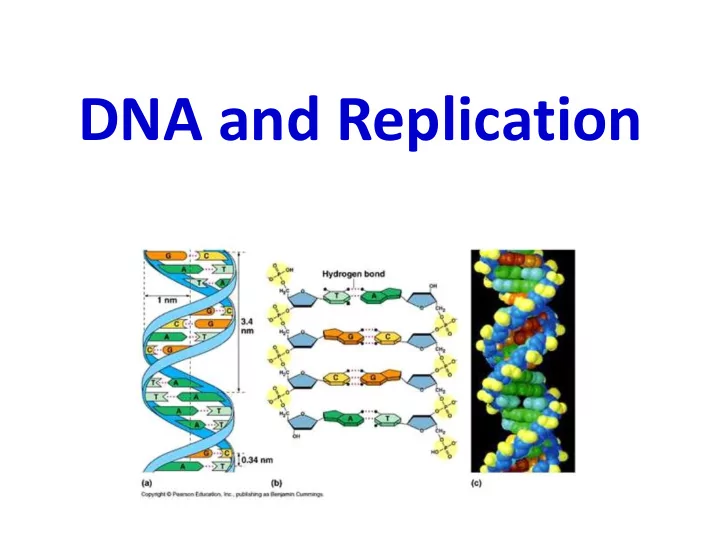
Structure of DNA

  • Double helix
  • Consists of a double strand of nucleotides
  • Two strands are anti-parallel: strands are
  • riented in opposite directions

–5’ to 3’ –3’ to 5’

ANIMATION

slide-20
SLIDE 20
slide-21
SLIDE 21

Nucleotide Composition

  • Three parts of a nucleotide

– 5 carbon sugar called deoxyribose –Phosphate group –A single nitrogenous base

slide-22
SLIDE 22

Four Nitrogenous Bases

  • Purines (double ring)

– Adenine (A) – Guanine (G)

  • Pyrimidines (single ring)

– Thymine (T) – Cytosine (C)

slide-23
SLIDE 23

Purines pair with Pyrimidines

slide-24
SLIDE 24

Chargaff’s Rules

  • A-T (2 hydrogen bonds)
  • C-G (3 hydrogen bonds)
slide-25
SLIDE 25
slide-26
SLIDE 26

DNA Replication

slide-27
SLIDE 27

Why do cells need to replicate DNA?

slide-28
SLIDE 28

Semi-Conservative Replication

  • New DNA molecules have one original

template strand and one new strand

  • Follows complementary base pair rules and

begins at sites called origins of replication

  • “Leading strand” – continuously synthesized
  • “Lagging strand” – synthesized in fragments

ANIMATION

slide-29
SLIDE 29

Semi-conservative Replication

slide-30
SLIDE 30

Origin of Replication - Prokaryotes

slide-31
SLIDE 31

Origins of Replication - Eukaryotes

slide-32
SLIDE 32

Replication Bubbles

slide-33
SLIDE 33

Enzyme Functions

  • Helicase
  • RNA Primase
  • DNA Polymerase III
  • DNA Polymerase I
  • DNA Ligase
  • Topoisomerase
  • Single-strand binding proteins (not an

enzyme)

slide-34
SLIDE 34

Replication Direction

  • Replication proceeds in the 5’ to 3’ direction
  • DNA polymerase can only add free

nucleotides to the 3' end of the newly forming strand

slide-35
SLIDE 35

DNA Replication Animation Steps of DNA Replication

More animations for your viewing pleasure….

ANIMATION