
SLIDE 1
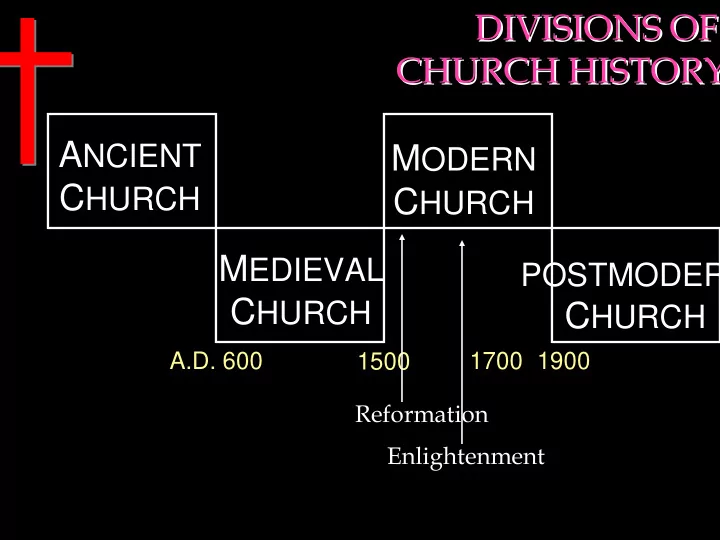
ANCIENT CHURCH MEDIEVAL CHURCH MODERN CHURCH
POSTMODER
CHURCH DIVISIONS OF CHURCH HISTORY DIVISIONS OF CHURCH HISTORY
A.D. 600 1500 1900 1700 Reformation Enlightenment
DIVISIONS OF DIVISIONS OF CHURCH HISTORY CHURCH HISTORY A NCIENT M - - PowerPoint PPT Presentation
DIVISIONS OF DIVISIONS OF CHURCH HISTORY CHURCH HISTORY A NCIENT M ODERN C HURCH C HURCH M EDIEVAL POSTMODER C HURCH C HURCH A.D. 600 1500 1700 1900 Reformation Enlightenment THE ANCIENT CHURCH THE ANCIENT CHURCH A.D. 100-600 A.D.
A.D. 600 1500 1900 1700 Reformation Enlightenment
AGE OF THE APOSTOLIC FATHERS AGE OF THE APOSTOLIC FATHERS
A.D.
100
A.D.
100 AGE OF THE APOLOGISTS AGE OF THE APOLOGISTS
A.D.
150
A.D.
150 AGE OF THE THEOLOGIANS AGE OF THE THEOLOGIANS
A.D.
300
A.D.
300
A.D.
600
A.D.
600
Doctrine=teaching Doctrine=policy, procedures Doctrine= abstract theology
THE COMPONENTS OF DOCTRINAL FORMULATION A QUESTION-ANSWER EXERCISE
THE SCRIPTURES QUESTIONS-------CHURCH REFLECTION-----FORMULATED REPLIES DOCTRINE
Autonomous Systems Of Perception Divine Viewpoint
SYSTEM STARTING POINT METHOD
RATIONALISM Innate ideas Faith in human ability. Independent use
EMPIRICISM Sense perceptions External experience; Scientific method; Faith in human ability Independent use of logic & reason MYSTICISM Inner, private experience; intuition Faith in human ability Independent, Nonlogical, nonrational, nonverifiable. REVELATION Objective revelation of God Dependent use of logic and reason TRADITION Combination of above; institutional, creaturely authority Historical validation
Divine Omniscience
Human Knowledge: Derivative, Dependent
(Pure Spirit) (Pure Spirit)
APOSTLES THE APOSTLES’ SUCCESSORS
A succession of bishops from God through Christ in the churches. A single apostolic successor in each church (a bishop). An emphasis on a linearly passed tradition of doctrine.
I believe in God the Father Almighty, maker of heaven and earth. And in Jesus Christ, His only Son, our Lord who was conceived by the Holy Ghost, born of the Virgin Mary, who suffered under Pontius Pilate, was crucified, dead, and buried; He descended into Hades, the third day He rose from the dead, ascended into heaven, and sitteth on the right hand of God the Father Almighty; from thence he shall come to judge the quick and the dead. And I believe in the Holy Ghost; the holy catholic Church; the communion of saints; the forgiveness of sins The resurrection of the body: and the life everlasting. [italics are the later additions]