Division of Criminal Justice Services 2009 Drug Law Reform Update - - PowerPoint PPT Presentation

division of criminal justice services 2009 drug law
SMART_READER_LITE
LIVE PREVIEW

Division of Criminal Justice Services 2009 Drug Law Reform Update - - PowerPoint PPT Presentation

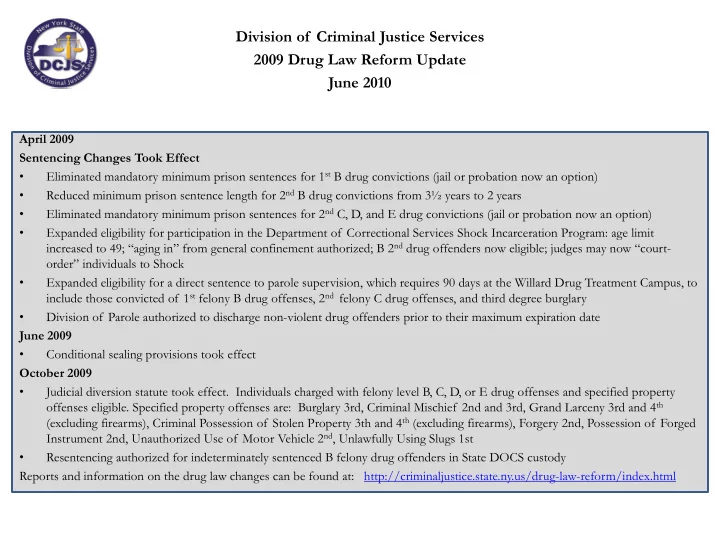
Division of Criminal Justice Services 2009 Drug Law Reform Update June 2010 April 2009 Sentencing Changes Took Effect Eliminated mandatory minimum prison sentences for 1 st B drug convictions (jail or probation now an option) Reduced


slide-1
SLIDE 1

Division of Criminal Justice Services 2009 Drug Law Reform Update June 2010

April 2009 Sentencing Changes Took Effect

  • Eliminated mandatory minimum prison sentences for 1st B drug convictions (jail or probation now an option)
  • Reduced minimum prison sentence length for 2nd B drug convictions from 3½ years to 2 years
  • Eliminated mandatory minimum prison sentences for 2nd C, D, and E drug convictions (jail or probation now an option)
  • Expanded eligibility for participation in the Department of Correctional Services Shock Incarceration Program: age limit

increased to 49; “aging in” from general confinement authorized; B 2nd drug offenders now eligible; judges may now “court-

  • rder” individuals to Shock
  • Expanded eligibility for a direct sentence to parole supervision, which requires 90 days at the Willard Drug Treatment Campus, to

include those convicted of 1st felony B drug offenses, 2nd felony C drug offenses, and third degree burglary

  • Division of Parole authorized to discharge non-violent drug offenders prior to their maximum expiration date

June 2009

  • Conditional sealing provisions took effect

October 2009

  • Judicial diversion statute took effect. Individuals charged with felony level B, C, D, or E drug offenses and specified property
  • ffenses eligible. Specified property offenses are: Burglary 3rd, Criminal Mischief 2nd and 3rd, Grand Larceny 3rd and 4th

(excluding firearms), Criminal Possession of Stolen Property 3th and 4th (excluding firearms), Forgery 2nd, Possession of Forged Instrument 2nd, Unauthorized Use of Motor Vehicle 2nd, Unlawfully Using Slugs 1st

  • Resentencing authorized for indeterminately sentenced B felony drug offenders in State DOCS custody

Reports and information on the drug law changes can be found at: http://criminaljustice.state.ny.us/drug-law-reform/index.html

slide-2
SLIDE 2

6/23/2010 1

Research and Evaluation Plan

  • Division of Criminal Justice Services (DCJS) coordinating with

Office of Court Administration (OCA), Office of Alcoholism Office of Court Administration (OCA), Office of Alcoholism and Substance Abuse Services (OASAS), Department of Correctional Services (DOCS), Division of Parole (DOP) and Division of Probation and Correctional Alternatives (DPCA) to monitor and report on all aspects of reform

  • Excellent cooperation among agencies
  • Research will link criminal justice treatment and diversion data

Research will link criminal justice, treatment and diversion data for the first time

  • Will greatly improve what we know about diversion and

treatment outcomes

  • Research uses calendar year 2008, the last full year of processing

prior to law changes, to be “baseline year”

Criminal Justice Consent Form

  • TRS-49 form with the NYSID should be used by all

b i d l ffi di i ffi probation departments, parole offices, district attorneys offices and courts that are referring individuals to treatment as a condition of supervision or as an alternative to incarceration.

  • The form allows OASAS to match cases by New York State

Identification Number (NYSID) to criminal justice records for confidential research purposes.

  • NYSID must be provided to study treatment outcomes for

criminal justice clients – and understand what works.

  • This form should be used for all criminal justice referrals in the

adult system age 16+, not just drug law reform cases.

2

TRS-49 Criminal Justice Consent Form

PROBATION OASAS

Form Can Be Accessed At:

http://www.oasas.state.ny.us/mis/forms/trs/TRS-49.pdf

OASAS Consent Form

FOR CRIMINAL JUSTICE CLIENTS

Client’s New York State Identification Number (NYSID)

□ □ □ □ □ □ □ □ □

Referring Entity Type [ ] District Attorney [ ] Court [ ] Probation [ ] Parole - General [ ] Parole - Release Shock [ ] Parole - Release Willard [ ] Parole - Release Resentence

IPRS CDS OCA UTA PAROLE CMS DOCS FPMS DCJS CCH

slide-3
SLIDE 3

6/23/2010 2

Today’s Presentation: Data Caveats and Limitations

Data Challenges

  • Still fine-tuning data matching methodologies among agencies
  • Working to incorporate diversion activity outside of drug courts

(DTAP, TASC, etc) into the analysis

  • Criminal justice consent forms needed for treatment records to

be matched with criminal justice records; many are still not coming in Still Very Early in Implementation and All Data is Preliminary!

  • Sentencing changes and judicial diversion in place a short time
  • Early trends may not represent longer term trends
  • Counts will be adjusted as data is fine-tuned

5

Since 1990, Statewide Crime Declined 60.5% with 688,796 Fewer Crimes Reported in 2009

711,556 426,133 260,536

300,000 400,000 500,000 600,000 700,000 800,000

NYC (-73.5%)

6

188,357

100,000 200,000 1990 1995 2000 2005 2009 New York City Rest of State

Source: DCJS, Uniform Crime/Incident Based Reporting systems (5/13/10)

Rest of State (-39%)

In 2009, Crime Down (-3.3%) From 2008

2008 2009 % Change 2008-2009 Index Total 464,304 448,893

  • 3.3%

Violent Total 77,450 74,856

  • 3.3%

Murder 834 782

  • 6.2%

Rape 2,782 2,572

  • 7.5%

Robbery 31,772 28,063

  • 11.7%
  • Agg. Assault

42,062 43,439 3.3%

7 Source: DCJS, Uniform Crime/Incident Based Reporting systems (5/13/10)

gg , , % Property Total 386,854 374,037

  • 3.3%

Burglary 65,367 62,420

  • 4.5%

Larceny 296,411 289,861

  • 2.2%

MV Theft 25,076 21,756

  • 13.2%

New York State Crime Trends and Public Safety

  • DCJS monitors the number of index crimes

d f h U if C i reported as part of the Uniform Crime Reporting program

  • Crime continued to decline in 2009
  • Drug Law Reform will be monitored and

evaluated in terms of public safety impacts evaluated in terms of public safety impacts

  • Long-term effort

8

slide-4
SLIDE 4

6/23/2010 3

Statewide Felony Drug Trends

Felony Drug Arrests, Indictments and Commitments to Prison 1973-2009

14,679 62,293 36,758 36,524 13 114 20,000 30,000 40,000 50,000 60,000 70,000

1973-2009

9 Source: DCJS Felony Processing File, Criminal History File, DOCS Admission file and Crime and Justice Report Note: Indictments only available since 1974.

4,679 6,461 13,114 834 10,000 0,000 Arrests Indictments Commitments 4,319 11,225

Steep Increases from 1970s to 1989 in Felony Drug Activity; Declines Since Then

  • Felony drug arrests increased from 14,679 in 1973 to

62,293 in 1989

  • Indictments increased from 6,461 in 1974 to 36,524 in

1989, steady decline since then.

  • Drug commitments to State prison increased from 834

in 1973 to 11,225 in 1992, declined to 4,319 in 2009.

  • Contributed to major increase in DOCS inmate

population, from 13,437 in 1973 to 71,472 in 1999.

  • Drug offenders in DOCS custody down 60%

10

Drug Offenders in Prison Peaked in 1996, Prison Population Peaked in 1999

80,000

Drug Offenders and Total Offenders Under DOCS Custody 1973-2009

20,000 30,000 40,000 50,000 60,000 70,000 10,000 1973 1974 1975 1976 1977 1978 1979 1980 1981 1982 1983 1984 1985 1986 1987 1988 1989 1990 1991 1992 1993 1994 1995 1996 1997 1998 1999 2000 2001 2002 2003 2004 2005 2006 2007 2008 2009

Drug Offenders Under Custody Non-Drug

11 Source: DOCS

Drug Offenders in Prison Declined 60% since Peak in 1996; Down 2,628 in past 17 months

25 000

Drug Offenders Under DOCS Custody (Year End)

23,511 22,266 18,363 14,249 11,936 10,319 9,308 10,000 15,000 20,000 25,000

)

12 Source: DOCS

5,000 1996 1999 2002 2005 2008 2009 May 31, 2010

slide-5
SLIDE 5

6/23/2010 4

NYC 10-Year Felony Drug Trends

Felony Drug Trends NYC: 2000-2009

10,000 15,000 20,000 25,000 30,000 35,000 40,000

13

2000 2001 2002 2003 2004 2005 2006 2007 2008 2009 Arrests 37,409 30,284 29,167 23,711 25,507 27,231 29,053 31,169 28,764 25,957 Indictments 13,932 12,095 11,613 9,388 9,149 9,474 8,896 8,962 7,606 7,563 Commitments 5,877 4,619 4,433 4,149 3,317 3,183 3,254 3,241 2,484 2,339 5,000 ,

Closer Look at Regional Felony Drug Processing Trends – Recent Years

  • NYC felony drug arrests declined through 2003 then increased

to 2007, and have been declining since.

  • NYC indictments showed fairly steady decline from 2000

through 2009 despite increase in arrests, with drug commitments to prison trending downward along with indictments

  • Rest of State showed increase in felony drug arrests through

2006, then showed three years of decreases.

  • Rest of State indictments followed the felony drug arrest trend.
  • Rest of State commitments dropped substantially in 2009 – a

trend that was underway before the drug law changes were enacted.

14

Rest of State 10-Year Felony Drug Trends

Felony Drug Trends Rest of State: 2000-2009

4,000 6,000 8,000 10,000 12,000 14,000

15

2000 2001 2002 2003 2004 2005 2006 2007 2008 2009 Arrests 10,131 9,958 10,929 10,644 11,456 11,880 13,223 12,804 11,455 10,801 Indictments 5,451 5,442 5,724 6,008 6,001 6,375 7,139 7,109 6,423 5,551 Commitments 2,350 1,989 2,211 2,392 2,350 2,656 2,806 2,907 2,706 1,980 2,000

Felony Drug Trends in First Qtr 2010 Compared to First Qtr 2009

  • Felony drug arrests down (-11%) in NYC; up

y g ( ) ; p (+3%) in the rest of the state

  • Felony drug indictments down (-3%) in NYC

and down (-14%) in the rest of the state

  • Felony drug commitments to State prison are

down (-28%) in NYC and down (-21%) in the rest of the state.*

*Commitments trend is for Jan-May 09 vs Jan-May 10

16

slide-6
SLIDE 6

6/23/2010 5

Changes in Drug Commitments to Prison 2008 vs. Recent 6 Months Annualized

Felony Class Commitment Year Felony Class 2008 Oct 09-Mar 10 Annualized* % Change A 1st and 2nd 276 312 13% B 1st 1,198 812

  • 32%

B 2nd 743 898 21% C 2nd 1,012 486

  • 52%

D 2nd 945 484

  • 49%

E 2 d 180 132 27%

17

Offenses no longer requiring a mandatory prison sentence are presented in bold. *Represents the six month period of Oct 2009-Mar 2010 multiplied by 2.

Source: DOCS

E 2nd 180 132

  • 27%

C 1st 421 252

  • 40%

D 1st 378 258

  • 32%

E 1st 37 36

  • 3%

Total 5,190 3,670

  • 29%

What is Driving the Annualized 1,500 Decline in Drug Commitments to Prison?

  • 400 – Multi-year decline in felony drug arrests,

indictments and resulting commitments Decline began indictments, and resulting commitments. Decline began in 2007; not related to law changes.

  • 500 - Elimination of mandatory prison sentences for 1st

B, 2nd C, D, and E convictions (effective 4/09). Instead

  • f prison, offenders sentenced to jail or probation.
  • 600 - Judicial diversion option (effective 10/09)

600 Judicial diversion option (effective 10/09). Estimated number of individuals entering drug court programs who were diverted from prison. (The increase in admissions is larger than 600 because not every additional admission would have gone to prison).

18

Judicial Diversion – How DCJS is Defining Drug Law Reform (DLR) Cases

  • Counting rules developed to allow comparisons of similar

cases before and after Oct 2009

  • Counts includes cases involving felony class B-E drug
  • ffenses and property offenses specified in Article 216 of

the Criminal Procedure Law

  • Eligible cases include some felony drug charges that do not

require a prison sentence (1st Bs, 1st and 2nd C, D and Es) q p ( , , )

  • Cases must remain in felony court to be counted
  • Cases counted by DCJS in “post-reform” group (after

10/09) are not always identified as Article 216 diversion type by the courts

19

DLR Drug Court Screenings

864 1000

January 2009 - April 2010

441 379 457 337 362 407 387 429 435 864 812 633 698 599 695 699 200 300 400 500 600 700 800 900

20

100 200

Jan 09 Feb 09 Mar 09 Apr 09 May 09 Jun 09 Jul 09 Aug 09 Sep 09 Oct 09 Nov 09 Dec 09 Jan 10 Feb 10 Mar 10 Apr 10

Source: OCA UTA

slide-7
SLIDE 7

6/23/2010 6

NYC: DLR Drug Court Admissions

(Preliminary Data Subject to Change)

140

April 2009 - April 2010

40 60 80 100 120

21

Source: OCA UTA

20

Apr 09 May 09 Jun 09 Jul 09 Aug 09 Sep 09 Oct 09 Nov 09 Dec 09 Jan 10 Feb 10 Mar 10 Apr 10

NYC: DLR Drug Court Admissions

  • In NYC, DLR drug court admissions averaged

about 100 per month since DLR began, compared to about 70 per month prior to reform

  • This is an increase of about 30 admissions per

month 9 f 10 f h NYC DLR d

  • 9 out of 10 of the NYC DLR drug court

admissions were indicted on a drug offense; the rest were indicted for one of the specified property offenses

22

Rest of State: DLR Drug Court Admissions

(Preliminary Data Subject to Change)

200

April 2009 - April 2010

40 60 80 100 120 140 160 180

23

20

Apr 09 May 09 Jun 09 Jul 09 Aug 09 Sep 09 Oct 09 Nov 09 Dec 09 Jan 10 Feb 10 Mar 10 Apr 10

Source: OCA UTA

Rest of State: DLR Drug Court Admissions

  • In the Rest of State, DLR admissions averaged 140

per month since October 2009, compared to about 60 p th b f th f per month before the reform

  • This is an increase of about 80 admissions per month
  • 64% of the DLR drug court admissions were

indicted for a drug offense, and 36% for a property

  • ffense
  • ffense
  • A few counties show substantial increases, but most

have shown modest increases

  • County specific data will be provided after data issues

are resolved

24

slide-8
SLIDE 8

6/23/2010 7 DA Consent For Drug Court Admissions As Reflected On OCA Database Oct 09-Apr 10

NYC Rest of State

89.8% 2.2% 8.0% 83.4% 2.3% 14.3% Yes Don't Know No Yes Don't Know No

Source: OCA UTA

DA Consent for Drug Court Admissions

  • In large majority of cases that are admitted to

Drug Court District Attorneys’ Offices are Drug Court, District Attorneys Offices are consenting to participation

  • DAs objected to participation in 8% of cases

admitted in New York City and 14% of cases admitted in the Rest of the State

26

DLR Drug Court Admissions By Treatment Modality – Preliminary Data

Treatment Level of Care Provided Oct 2009 - Mar 2010 DLR Admissions Residential 39% Unknown 14%

27

Outpatient 47%

residential

  • utpatient

missing

Source: OCA UTA and OASAS

Treatment Modality for Drug Court Admissions

  • 39% of DLR admissions reported a residential

l treatment placement

  • 47% reported an outpatient treatment placement
  • When the percentages are adjustment for

missing information, 45% of known placements went into residential treatment went into residential treatment

28

slide-9
SLIDE 9

6/23/2010 8

NYC Criminal Justice Admissions to Treatment (Includes Drug Court and Other Adult Criminal Justice Admissions): Pre and Post Reform

20,000

8,099 7,968

6,000 8,000 10,000 12,000 14,000 16,000 18,000

( - 2%) (+9%)

29 Source: OASAS

2,159 2,355

2,000 4,000 Residential Outpatient Oct 08-Mar 09 Oct 09-Mar 10

Rest of State Criminal Justice Admissions to Treatment (Includes Drug Court and Other Adult Criminal Justice Admissions) : Pre and Post Reform

17 095 17,749

20,000

(+ 4%)

17,095 17,749

6,000 8,000 10,000 12,000 14,000 16,000 18,000

30 Source: OASAS

915 1,051

2,000 4,000 Residential Outpatient Oct 08-Mar 09 Oct 09-Mar 10

(+ 15%)

Counting Criminal Justice Admissions to Treatment

  • Because the drug law reforms have the potential for

many system changes DCJS and OASAS are many system changes, DCJS and OASAS are monitoring all criminal justice admissions to treatment

  • About half of non-crisis admissions to OASAS certified

programs are criminal justice involved

  • Charts show the number of admissions referred from

drug court other courts ATI programs parole offices drug court, other courts, ATI, programs, parole offices, probation departments and district attorneys’ offices

  • Counts exclude clients under 16, family court referrals

and DWIs

31

Majority of Felony Drug Arrests and Indictments In New York State are Class Bs

Felony Offense Class of Drug Arrests and Indictments, 2009 Felony Offense Class of Drug Arrests and Indictments, 2009 Arrests Indictments Felony Offense Class # % # % Class A-I 910 2.5% 375 2.8% Class A-II 932 2.5%

319 2.4%

Class B 25,737 70.0% 8,983 67.9%

32

, , Class C 2,339 6.4% 1,251 9.5% Class D 5,644 15.4% 1,960 14.8% Class E 1,204 3.3% 348 2.6% Total 36,766 100.0% 13,236 100.0%

Source: DCJS – Felony Processing File and Criminal History file

slide-10
SLIDE 10

6/23/2010 9

1st Felony B Drug Indictments in NYC: Convicted and Sentenced

237 1 000 1,200

291 Prison (26%) 222 Prison (24%)

502 397 103 186 72 237 231 200 400 600 800 1,000

33 Note: Excludes all diversion. Includes only cases convicted and sentenced.

313 200 Oct 08 - Mar 09 (N=1,133) Oct 09 - Mar 10 (N=908) B 1st C 1st D/E 1st Misd or Lesser Conviction

NYC: 1st Felony B Indictments

Comparison of first 6 months of full implementation with prior year shows: shows:

  • Number of 1st felony B indictments convicted and sentenced

declined by 20% (from 1,133 to 908)

  • Proportion of 1st B indictments convicted of B felonies increased

from 28% (313 of 1,133) to 55% (502 of 908)

  • Proportion convicted of misdemeanors increased from 21% to

25% 25%

  • Proportion convicted of Cs and Ds decreased dramatically
  • Number sentenced to prison decreased (from 291 to 222);

proportion also declined (from 26% to 24%)

34

1st Felony B Drug Indictments in Rest of State: Convicted and Sentenced

85 96 800 900 357 309 198 235 153 96 200 300 400 500 600 700

345 Prison (40%) 235 Prison (29%)

35 Note: Excludes all diversion. Includes only cases convicted and sentenced.

232 100 Oct 08 - Mar 09 (N=861) Oct 09 - Mar 10 (N=804) B 1st C 1st D/E 1st Misd or Lesser Conviction

Rest of State: 1st B Indictments

  • Number of convicted and sentenced declined by 7%

(from 861 to 804) (from 861 to 804)

  • Proportion of 1st B indictments convicted of B felonies

increased from 27% (232 of 861) to 44% (357 of 804)

  • Proportion convicted of misdemeanors increased from

9% to 11% P i i d f C d D d d

  • Proportion convicted of Cs and Ds decreased
  • Number sentenced to prison decreased (from 345 to

235); proportion also declined (from 40% to 29%)

36

slide-11
SLIDE 11

6/23/2010 10

2nd B Felony Drug Indictments in NYC: Convicted and Sentenced

309 1,200 1,400 310 435 362 195 318 235 309 283 200 400 600 800 1,000 ,

854 Prison (66%) 626 Prison (55%)

37 Note: Excludes all diversion. Includes only cases convicted and sentenced.

310 Oct 08 - Mar 09 (N=1,299) Oct 09 - Mar 10 (N=1,148) B 2nd C 2nd D/E 2nd Misd or Lesser Conviction

NYC: 2nd Felony B Indictments

  • Number of 2nd felony B indictments convicted and

sentenced declined by 12% (from 1 299 to 1 148) sentenced declined by 12% (from 1,299 to 1,148)

  • Proportion of 2nd B indictments convicted of B

felonies increased from 24% (310 of 1,299) to 38% (435 of 1,148)

  • Proportion convicted of misdemeanors remained about

the same (24%) the same (24%)

  • Proportion convicted of Cs and Ds decreased
  • Number sentenced to prison decreased (from 854 to

626); proportion also declined (from 66% to 55%)

38

2nd B Felony Drug Indictments in Rest of State: Convicted and Sentenced

56 50 600 700 242 281 240 179 155 117 50 200 300 400 500 600

566 Prison (82%) 433 Prison (69%)

39 Note: Excludes all diversion. Includes only cases convicted and sentenced.

242 100 Oct 08 - Mar 09 (N=693) Oct 09 - Mar 10 (N=627) B 2nd C 2nd D/E 2nd Misd or Lesser Conviction

Rest of State: 2nd Felony B Indictments

  • Number of 2nd felony B indictments convicted and

sentenced declined by 10% (from 693 to 627) sentenced declined by 10% (from 693 to 627)

  • Proportion of 2nd B indictments convicted of B

felonies increased from 35% (242 of 693) to 45% (281

  • f 627)
  • Proportion convicted of misdemeanors remained the

same (8%) same (8%)

  • Proportion convicted of Cs and Ds decreased
  • Number sentenced to prison decreased (from 566 to

433); proportion also declined (from 82% to 69%)

40

slide-12
SLIDE 12

6/23/2010 11 NYC Sentences for 1st B, C, D, and E Felony Drug Convictions (Excludes Diversions)

2008 (2,599) Oct 09-Mar 10 (940)

Jail 25% Split 9% Probation 35%

(2,599)

Jail 30% Split 7% Probation 31%

( )

Prison 28% Willard 0% Other Felony Sent 3%

41

Source: DCJS – Felony Processing File Prison 29% Willard 0% Other Fel Sent 3%

NYC: Sentences are Changing for 1st Felony Drug Convictions

  • Charts do not include persons entering diversion or

l i di i l h i d d d completing diversion – only those convicted and sentenced for a 1st felony B, C, D or E drug offense

  • 1st felony B-E convictions are combined to show overall

sentence changes given shifts in plea practices

  • In NYC, the proportion of 1st felony drug convictions

who received prison increased from 28% to 29%, but fewer

  • verall were convicted
  • Proportion sentenced to jail increased from 25% to 30%
  • Proportion sentenced to probation decreased from 35% to

31%

42

Rest of State Sentences for 1st B, C, D, and E Felony Drug Convictions (Excludes Diversions)

2008

Oct 09-Mar 10

Willard Jail 14% Split 25%

(3,082)

Willard % Jail 16% Split 25%

(1,102)

Prison 34% 0% Probation 25% Other Felony Sent 2%

43

Source: DCJS – Felony Processing File Prison 27% 2% Probation 28% Other Fel Sent 2%

Rest of State: Sentences are Changing for 1st Felony Drug Convictions

  • Rest of State – proportion sentenced to prison

p p p decreased from 34% to 27%

  • The proportion sentenced to probation increased from

25% to 28%

  • The proportion sentenced to jail increased from 14% to

16%

  • Willard sentences increased from 0% to 2%, given that

1st felony B convictions are now eligible

  • Total number of convictions decreased

44

slide-13
SLIDE 13

6/23/2010 12 NYC Sentences for 2nd B, C, D, and E Felony Drug Convictions (Excludes Diversions)

2008 (2 450) Oct 09- Mar 10 (1 092)

Prison 81% Willard 1% Jail 8% Split 3% Probation

(2,450)

Prison Willard 1% Jail 22% Split

(1,092)

6% Other Felony Sent 1%

45

Source: DCJS – Felony Processing File Prison 69% Split 1% Probation 7% Other Fel Sent 0%

NYC: Elimination of Mandatory Minimums for 2nd C, D, E Convictions Means Fewer to Prison

  • Fewer overall cases resulting in felony conviction due to

i d di i d l i d increased diversions and more pleas to misdemeanors

  • For those convicted of 2nd felony drug crimes, the

decrease in the proportion sentenced to prison is significant, both within and outside NYC

  • The NYC proportion sentenced to prison decreased

from 81% to 69% from 81% to 69%

  • NYC proportion to jail increased from 8% to 22%
  • These changes appear unrelated to judicial diversion
  • ption; solely related to sentencing changes for those

convicted of drug felonies

46

Rest of State Sentences for 2nd B, C, D, and E Felony Drug Convictions (Excludes Diversions)

2008 (2 093)

Oct 09-Mar 10 (823)

Prison Willard 8% Jail 3% Split 3%

(2,093)

Prison 68% Willard 7% Jail 13% Split

(823)

83% 3% Probation 3% Other Felony Sent, .3%

47

Source: DCJS – Felony Processing File 68% 5% Probation 6% Other Fel Sent 1%

Rest of State also Impacted by Changes to Mandatory Minimums for 2nd C, D and E

  • For 2nd felony drug convictions, sentences to prison

id f N Y k Ci d d f 83% 68%

  • utside of New York City decreased from 83% to 68%
  • The proportion sentenced to jail increased from 3% to

13%

  • Sentences to probation for 2nd drug convictions

increased from 3% to 6%

  • Split sentences increased from 3% to 5%

48

slide-14
SLIDE 14

6/23/2010 13

NYC Felony Drug Sentences to Probation Apr 2008 - Mar 2010

50 100 150

Source: DCJS – Felony Processing file

49

Apr May Jun Jul Aug Sep Oct Nov Dec Jan Feb Mar # B Post-DLR # C,D,E Post-DLR Pre-DLR

Changes in Probation Sentences New York City

  • 1st B and 2nd C, D and E drug offenders now eligible

for probation sentences (these convictions formerly for probation sentences (these convictions formerly required a prison sentence)

  • The proportion of felony drug convictions sentenced

to probation has not changed much, but the number of cases has declined

  • Total number of NYC felony drug sentences to

y g probation down (-24%), but higher proportion are Bs

  • B felonies are now 48% of all drug offenders sentenced

to probation in New York City

50

Rest of State Drug Sentences to Probation Apr 2008-Mar 2010

50 100 150 200 250

Source: DCJS – Felony Processing file

51

50 Apr May Jun Jul Aug Sep Oct Nov Dec Jan Feb Mar # B Post-DLR # C,D,E Post-DLR Pre-DLR

Changes in Probation Sentences Rest of State

  • Outside New York City, fewer indictments have meant

fewer dispositions So although the proportion of fewer dispositions. So, although the proportion of convictions resulting in a probation sentence is up, the number is down

  • 23% of felony drug sentences to probation outside

New York City are now class B felonies

  • Rest of State sentences to probation have declined by
  • Rest of State sentences to probation have declined by

9%; but trend varies from county to county

  • 24 counties are showing some increase in the number
  • f felony drug sentences to probation

52

slide-15
SLIDE 15

6/23/2010 14

B-E First Felony Drug Commitments Median Sentence in Months

NYC Rest of State

18 18 24 12 18 18 18

CLASS D CLASS C CLASS B

18 24 30 18 24 24

CLASS D CLASS C CLASS B

53

Source: DOCS Admission file Note: There were only 2 1st E felonies from NYC, median not shown

12

6 12 18 24 30 36 CLASS E 2008 Oct 09 - May 10

12 18

6 12 18 24 30 36 CLASS E 2008 Oct 09-May 10

Changes in Prison Sentence Length for 1st Felony Drug Commitments

  • 1st B determinate sentence range is 1 to 9 years
  • Prison is no longer required for 1st Bs and 32% fewer

1st Bs are entering prison

  • In both regions, sentences for 1st B commitments

increased by 6 months

  • When prison was mandatory for 1st Bs, there were a

larger number of commitments that received the 1 year larger number of commitments that received the 1 year minimum.

  • 1st Bs committed after sentencing change are more

likely than before to get a longer sentence

54

B-E Second Felony Drug Commitments Median Sentence in Months

NYC Rest of State

30 30 30 18 30 42

CLASS D CLASS C CLASS B

30 36 42 24 36 48

CLASS D CLASS C CLASS B

55

Source: DOCS Admission file

24 24

6 12 18 24 30 36 42 48 54 CLASS E 2008 Oct 09 - May 10

24 18

6 12 18 24 30 36 42 48 54 CLASS E 2008 Oct 09-May 10

Changes in Prison Sentence Length for 2nd Felony Drug Commitments

  • In April 2009, the minimum prison sentence allowable

for second felony Bs was reduced from 3½ to 2 years for second felony Bs was reduced from 3½ to 2 years.

  • Median sentences for second felony Bs decreased 12

months in NYC and 6 months in the Rest of State

  • The number of 2nd D felons committed to prison

declined by 49% F h D f l i d f O 09 M 10

  • For those D felons committed from Oct 09-May 10,

the average sentences increased by 12 months in NYC and 6 months in the Rest of State

56

slide-16
SLIDE 16

6/23/2010 15

B Felony Drug Offenders Resentenced as

  • f June 18, 2010 (365 To Date)

County Number County Number County Number Albany 18 Monroe 18 Richmond 3 Albany 18 Monroe 18 Richmond 3 Allegany 1 Montgomery 1 Rockland 9 Bronx 68 Nassau 11 Saratoga 2 Broome 6 New York 60 Schenectady 14 Clinton 2 Oneida 1 Suffolk 9 Columbia 5 Onondaga 23 Tompkins 2 Erie 4 Ontario 9 Ulster 3 Fulton 5 Orange 13 Warren 5 Greene 1 Oswego 2 Wayne 2 Kings 37 Queens 22 Westchester 2 Livingston 1 Rensselaer 5 Wyoming 1

57

Resentencing Update As of 6-18-10

  • Original eligibility estimates: 1,100 possible, 700

lik l li ibl likely eligible

  • 365 individuals resentenced & 271 released
  • 19 of the 271 were women
  • So far: 74% released to post-release supervision;

for others, time already served in DOCS covered , y the newly imposed sentence and the post-release supervision period

  • Cases still being resentenced at a pace of 5 to 10

a week

58

DOCS Shock Population January 2008-May 2010

1,100 800 850 900 950 1,000 1,050

59

Source: DOCS 600 650 700 750 Jan 08 Feb 08 Mar 08 Apr 08 May 08 June 08 July 08 Aug 08 Sep 08 Oct 08 Nov 08 Dec 08 Jan 09 Feb 09 Mar 09 Apr 09 May 09 Jun 09 Jul 09 Aug 09 Sep 09 Oct 09 Nov 09 Dec 09 Jan 10 Feb 10 Mar 10 Apr 10 May 10

Expanded Eligibility for DOCS Shock Incarceration Program

  • 888 Shock participants on May 31, 2010

p p y ,

  • 184 (21%) are in Shock due to expanded eligibility:
  • 84 (incl. 6 age 40+) “aged-in” from general confinement
  • 31 second felony B drug offenders
  • 69 new commitments age 40+
  • Shock population declined after the one-time

“retro” pool, who moved into Shock from general confinement when reforms were enacted, graduated the program

60

slide-17
SLIDE 17

6/23/2010 16

Conditional Sealing

  • Effective June 7, 2009, upon successful

completion of a judicial diversion program the completion of a judicial diversion program, the court may conditionally seal the instant offense and up to three prior misdemeanors. If the defendant is re-arrested, the records are unsealed

  • Fifteen conditional seals have been processed by

OCA and DCJS as of 6-7-10

  • Saratoga (3), Rensselaer (2), Schenectady (3),

Suffolk (1), Steuben (1), Kings (1), Albany (1), Onondaga (1), New York (1), Warren (1)

61

Statewide Direct Judicial Sentences to Willard Are Up (+22%)

Willard Admissions - Statewide A 2008 M 2010

20 30 40 50 60

Apr 2008 - Mar 2010

62

Source: DOCS Willard Admissions

10 Apr May Jun Jul Aug Sep Oct Nov Dec Jan Feb Mar NYC Non-NYC Pre-DLR

Statewide Interim Probation Supervision Up (+36%)

Felony Drug and Specified Property Admissions to Interim Supervision - Statewide

10 20 30 40 50 60

Admissions to Interim Supervision - Statewide Apr 2008 - Mar 2010

63

Source: DPCA IPRS

Apr May Jun Jul Aug Sep Oct Nov Dec Jan Feb Mar Apr09 - Mar10 38 35 31 55 30 47 26 39 29 40 28 53 Apr08 - Mar09 25 27 33 32 22 24 24 22 27 23 36 36

Parole Merit Termination

  • Effective April 7, 2009, the Division of Parole

di h t i i l t d ff d can discharge certain nonviolent drug offenders from supervision prior to their maximum expiration date

  • As of May 31, 2010, 1,505 non-violent parolees

who were under supervision for drug offenses di h d were discharged

64

slide-18
SLIDE 18

6/23/2010 17

Rikers Sentenced Drug Felony Offenders Population Stable

NYC Jail Population - Sentenced Drug Offenders Jan 2009 - Apr 2010

50 100 150 200 250 300 350 400

J p

65

Jan Feb Mar Apr May Jun Jul Aug Sep Oct Nov Dec 2010 318 315 315 312 2009 281 305 324 323 325 322 314 325 331 330 340 330

Source: NYCDOC

Impact on Jail Populations

  • The average daily census for jails outside of

N Y k Ci i i d b DCJS b l New York City is monitored by DCJS, but only summary data is reported; the trend for drug

  • ffenders only is not known
  • NYCDOC has provided average daily

population data for drug offenders who are in p p g custody

66

Rikers Felony Drug Offenders Unsentenced Population Down

2,500

NYC Jail Population - Unsentenced Drug Offenders Jan 2009 - Apr 2010

500 1,000 1,500 2,000 ,

67

Jan Feb Mar Apr May Jun Jul Aug Sep Oct Nov Dec 2010 1,961 1,971 1,955 1,927 2009 2,271 2,253 2,250 2,180 2,165 2,123 2,078 2,083 2,078 2,116 2,103 1,987

Source: NYCDOC

Impact on Jail Populations

  • Although there was an increase in the

i f d ff d d j il proportion of drug offenders sentenced to jail in New York City, the number of sentenced drug offenders under NYCDOC custody in April 2010 (312) was lower (-3%) than April 2009

  • The unsentenced drug offender population in

NYC is down (-12%) from April 2009

68

slide-19
SLIDE 19

6/23/2010 18

Summary

  • Reforms enacted when felony drug arrests, indictments and

drug commitments to prison were declining drug commitments to prison were declining.

  • Due to judicial diversion - more individuals participating in drug

court and community treatment instead of prison.

  • Due to elimination of mandatory minimum prison sentences -

more individuals receiving sentences in the community (local jail

  • r probation) instead of prison.
  • There have been shifts in plea practices as a result of the reform.
  • Two baseline reports with county specific detail are available at

http://criminaljustice.state.ny.us/drug-law-reform/index.html

  • Additional reports with county specific data will be available in

the future

69