Distribution of city child dependency ratios (0-14 y.o./15-64 - - PowerPoint PPT Presentation

distribution of city child dependency ratios 0 14 y o 15
SMART_READER_LITE
LIVE PREVIEW

Distribution of city child dependency ratios (0-14 y.o./15-64 - - PowerPoint PPT Presentation

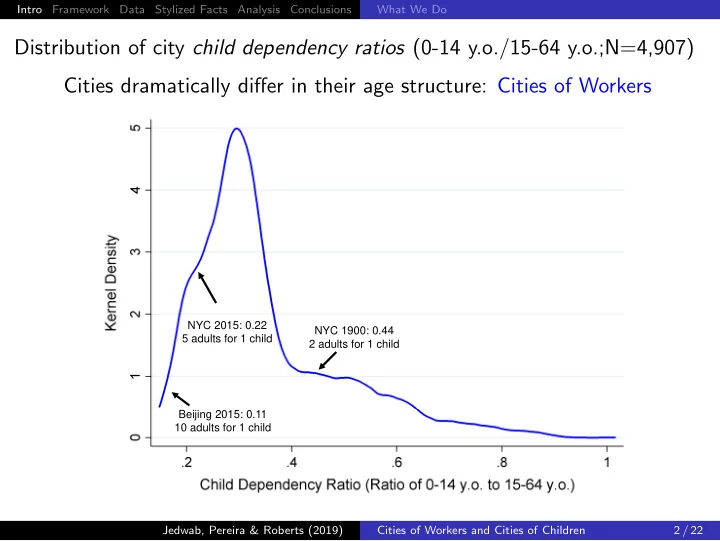
Intro Framework Data Stylized Facts Analysis Conclusions What We Do Distribution of city child dependency ratios (0-14 y.o./15-64 y.o.;N=4,907) Cities dramatically differ in their age structure: Cities of Workers NYC 2015: 0.22 NYC 1900:


slide-1
SLIDE 1

Intro Framework Data Stylized Facts Analysis Conclusions What We Do

Distribution of city child dependency ratios (0-14 y.o./15-64 y.o.;N=4,907) Cities dramatically differ in their age structure: Cities of Workers

Beijing 2015: 0.11 10 adults for 1 child NYC 2015: 0.22 5 adults for 1 child NYC 1900: 0.44 2 adults for 1 child Jedwab, Pereira & Roberts (2019) Cities of Workers and Cities of Children 2 / 22

slide-2
SLIDE 2

Intro Framework Data Stylized Facts Analysis Conclusions What We Do

Distribution of city child dependency ratios (0-14 y.o./15-64 y.o.;N=4,907) Cities dramatically differ in their age structure: Cities of Children

Beijing 2015: 0.11 10 adults for 1 child NYC 2015: 0.22 5 adults for 1 child NYC 1900: 0.44 2 adults for 1 child Dhaka 2015: 0.67 1.5 adult for 1 child Bamako 2015: 0.85 1 adult for 1 child Jedwab, Pereira & Roberts (2019) Cities of Workers and Cities of Children 3 / 22

slide-3
SLIDE 3

Intro Framework Data Stylized Facts Analysis Conclusions What We Do

What We Do

  • 1. Document the rise of cities of children or seniors:

◮ Build a novel database on urban age structures. ◮ Historically, cities of workers (low dependency ratios). ◮ Now, some cities of children or seniors (high dependency ratios).

  • 2. Investigate economic consequences for cities:

◮ 351 mega-cities with age structure data ca. 1990 and night light

intensity 1996-2011 as proxy for city economic development.

◮ Evidence of agglomeration effects (population → growth). ◮ But cities with more children or seniors grow relatively slower. ◮ The demographic composition of cities matters. Jedwab, Pereira & Roberts (2019) Cities of Workers and Cities of Children 4 / 22

slide-4
SLIDE 4

Intro Framework Data Stylized Facts Analysis Conclusions Conceptual Framework

Conceptual Framework

◮ Per capita income can be represented as:

y = ωChCrC + ωW ,HhW ,HrW ,H + ωW ,NHhW ,NHrW ,NH + ωShSrS C, W and S denote children, working-age residents and seniors. Among working-age residents: caregivers (H) and non-caregivers (NH). ω pop. share of each group; h hours worked; r output per hour.

◮ Direct effects (negative):

◮ Children and seniors work less, are less productive.

◮ Indirect intra-household effects (ambiguous):

◮ Children/seniors affect labor supply and productivity of caregivers. Jedwab, Pereira & Roberts (2019) Cities of Workers and Cities of Children 5 / 22

slide-5
SLIDE 5

Intro Framework Data Stylized Facts Analysis Conclusions Conceptual Framework

Conceptual Framework

◮ Indirect city-wide effects (negative or ambiguous):

◮ Human capital externality effects (negative): ◮ For any given conversation, the knowledge exchanged is likely to have

less impact on the working-age resident’s productivity.

◮ Crowding effects (negative or ambiguous): ◮ Children: Traffic congestion during “school run” hours. ◮ Children: More crowded classrooms and pediatrician clinics. ◮ Seniors: Crowding of health services, but less traffic congestion. ◮ Public expenditure effects (negative): ◮ Public expenditure not targeted to workers’ productivity directly. Jedwab, Pereira & Roberts (2019) Cities of Workers and Cities of Children 6 / 22

slide-6
SLIDE 6

Intro Framework Data Stylized Facts Analysis Conclusions Description

City-Specific Age Structure Dataset

◮ Identified list of 655 mega-cities (UN, 2015) ◮ Five main sources (census or surveys):

◮ IPUMS (1787-2011) ◮ Census Reports (1920-1950) ◮ OECD Metropolitan Areas Database (1990-2015) ◮ Demographic and Health Surveys (1990-2014) ◮ I2D2: The International Income Distribution Database (1990-2014) ◮ Other Sources (1990-2014)

◮ For each megacity-year-source, obtain the number of residents

in each age category: 0-4, 5-9, 10-14, . . .

◮ Final sample: 4,907 city-year-source observations. ◮ 139 countries, between 1787-2016.

Jedwab, Pereira & Roberts (2019) Cities of Workers and Cities of Children 7 / 22

slide-7
SLIDE 7

Intro Framework Data Stylized Facts Analysis Conclusions Child Dep. Aged Dep.

Stylized Facts: Cities of Workers vs. Children

Notes: Evolution of the population-weighted mean child dependency ratio (ratio of 0-14 to 15-64 y.o.) for all mega-cities in high-income countries (N = 3,249 city-years), middle-income countries (N = 1,466) and low-income countries (N = 161). We use as weights the population of each mega-city in decade t. Jedwab, Pereira & Roberts (2019) Cities of Workers and Cities of Children 8 / 22

slide-8
SLIDE 8

Intro Framework Data Stylized Facts Analysis Conclusions Child Dep. Aged Dep.

Stylized Facts: Cities of Workers vs. Seniors

Notes: Evolution of the population-weighted mean aged dependency ratio (ratio of 0-14 to 15-64 y.o.) for all mega-cities in high-income countries (N = 3,249 city-years), middle-income countries (N = 1,466) and low-income countries (N = 161). We use as weights the population of each mega-city in decade t. Jedwab, Pereira & Roberts (2019) Cities of Workers and Cities of Children 9 / 22

slide-9
SLIDE 9

Intro Framework Data Stylized Facts Analysis Conclusions Data Spec. Results Causality Robust Mechanisms

Data: Night Lights and Urban Boundaries

◮ Sample: 351 mega-cities with age structure ca 1990. ◮ Night light intensity, fine resolution, 1996-2011.

Source: Defense Meteorological Satellite Program (DMSP), in the National Geophysical Data Center (NGDC).

◮ Urban extent boundaries from GRUMP 1995.

Night light intensity aggregated up at agglomeration level.

◮ Measure: Growth of mean night light intensity 1996-2011.

Standard measure used in literature (Henderson et al 2012).

Jedwab, Pereira & Roberts (2019) Cities of Workers and Cities of Children 10 / 22

slide-10
SLIDE 10

Intro Framework Data Stylized Facts Analysis Conclusions Data Spec. Results Causality Robust Mechanisms

Main Specification

◮ Long-difference regressions for 351 mega-cities c:

∆LogNLc,r,96−11 = α + β × CDRc,r,90 + γ × ADRc,r,90 + Xcζ + µc ∆LogNLc,96−11 change in log mean night light intensity 1996-2011 CDRc,r,90, ADRc,r,90 child & age dep. ratios ca. 1990 (1985-1996)

◮ We add three core controls and continent or country FE:

◮ Log city population size ca. 1990 ◮ Log city mean night light intensity in 1996 ◮ Log city population growth between 1995 and 2010

◮ β and γ capture effects on night light per capita.

Jedwab, Pereira & Roberts (2019) Cities of Workers and Cities of Children 11 / 22

slide-11
SLIDE 11

Intro Framework Data Stylized Facts Analysis Conclusions Data Spec. Results Causality Robust Mechanisms

Within vs. Between Regressions

◮ Three issues with within-country regressions:

◮ Cities within any given country have very similar age structures

(within component = only about 10% of the CDRs & ADRs)

◮ Given free mobility, wages across cities equalized at the margin.

Any increase in wage offered in one location induces in-migration that offsets the initial wage increase. Long-run: City economic growth measured by population growth only.

◮ Free mobility also encourages sorting across cities in ways likely

to endogenously influence the age structure of cities.

◮ Between-country regressions:

◮ Restrict sample to largest city of each country, since no (or very

little) mobility between them.

Jedwab, Pereira & Roberts (2019) Cities of Workers and Cities of Children 12 / 22
slide-12
SLIDE 12

Intro Framework Data Stylized Facts Analysis Conclusions Data Spec. Results Causality Robust Mechanisms

Baseline Results: CDR & ADR

Going from 10th percentile to 90th percentile in CDR—one extra child—reduces growth rate of night lights by 28-50%. For ADR, the corresponding decrease is 17-20%.

Jedwab, Pereira & Roberts (2019) Cities of Workers and Cities of Children 13 / 22

slide-13
SLIDE 13

Intro Framework Data Stylized Facts Analysis Conclusions Data Spec. Results Causality Robust Mechanisms

Investigation of Causality:

◮ We compare cities with same initial pop. size, economic

development, pop. growth, and within same continent.

◮ There could still be endogeneity.

  • 1. Exploiting granularity of the age structure data.

Worse effect for younger children (0-9) & older seniors (75+).

  • 2. Exploiting demographic cycles.

Children only have negative effect when they are children. Se- niors have less negative effects later, probably because die.

  • 3. Past age structure (1960s) as instrumental variable.

Assumption: not correlated with factors affecting growth 96-11.

Jedwab, Pereira & Roberts (2019) Cities of Workers and Cities of Children 14 / 22

slide-14
SLIDE 14

Intro Framework Data Stylized Facts Analysis Conclusions Data Spec. Results Causality Robust Mechanisms

Robustness Checks:

◮ Controlling for “college share” ca. 1990. ◮ Using city per capita GDP as alternative outcome (source:

Oxford Economics 2019, not sure it is reliable).

◮ Panel data using per cap. GDP from Oxford Economics, since

gives per cap. GDP and dep. ratios every 4 yrs from 2000-16.

◮ Rural areas and secondary cities:

◮ Need to control for correlation with dep. ratios there. ◮ Different effect of dependency ratios there? Smaller. ◮ Cities disproportionately suffer from high dep. ratios. Jedwab, Pereira & Roberts (2019) Cities of Workers and Cities of Children 15 / 22

slide-15
SLIDE 15

Intro Framework Data Stylized Facts Analysis Conclusions Data Spec. Results Causality Robust Mechanisms

Mechanisms:

◮ Labor supply & productivity (I2D2) & time use (U.S.):

Large negative effects of children and seniors in urban areas. Smaller negative effects of children and seniors in rural areas. May affect the growth trajectory of the cities.

◮ Other data sets:

Possibly larger effects for business & financial services. Possibly larger effects for larger cities. Effects not different across different areas within cities.

Jedwab, Pereira & Roberts (2019) Cities of Workers and Cities of Children 16 / 22

slide-16
SLIDE 16

Intro Framework Data Stylized Facts Analysis Conclusions Data Spec. Results Causality Robust Mechanisms

◮ I2D2 database (World Bank): 835 household surveys in 122 countries. ◮ Direct effects of children/seniors on own labor supply and earnings? ◮ Urban obs., country-year sample FE, standard Mincerian controls. ◮ Children/seniors work less and earn much lower wages when do.

Jedwab, Pereira & Roberts (2019) Cities of Workers and Cities of Children 17 / 22

slide-17
SLIDE 17

Intro Framework Data Stylized Facts Analysis Conclusions Data Spec. Results Causality Robust Mechanisms

◮ Indirect intra-household effects of household CDR & ADR? ◮ Same sample and specification but restrict to 18-67 y.o. ◮ Higher household CDR/ADR → reduced labor supply and wages.

Jedwab, Pereira & Roberts (2019) Cities of Workers and Cities of Children 18 / 22

slide-18
SLIDE 18

Intro Framework Data Stylized Facts Analysis Conclusions Data Spec. Results Causality Robust Mechanisms

◮ Effects of city CDR & ADR on working-age members. ◮ Higher city CDR/ADR → labor supply and wages.

Jedwab, Pereira & Roberts (2019) Cities of Workers and Cities of Children 19 / 22

slide-19
SLIDE 19

Intro Framework Data Stylized Facts Analysis Conclusions Data Spec. Results Causality Robust Mechanisms

◮ Effects of HH CDR & ADR on time use for working HH members? ◮ Source: US Time Use Survey. Day/hour FE, Mincerian controls. ◮ CDR increases “care”, reduces “work”, “sleep” and “leisure” ◮ ADR increases “leisure”, reduces “care” but also “work”

Jedwab, Pereira & Roberts (2019) Cities of Workers and Cities of Children 20 / 22

slide-20
SLIDE 20

Intro Framework Data Stylized Facts Analysis Conclusions Data Spec. Results Causality Robust Mechanisms

◮ Effects of city CDR & ADR on time use. ◮ Source: US Time Use Survey. Day/hour FE, Mincerian controls. ◮ City CDR & ADR increase care, city CDR reduces sleep.

Jedwab, Pereira & Roberts (2019) Cities of Workers and Cities of Children 21 / 22

slide-21
SLIDE 21

Intro Framework Data Stylized Facts Analysis Conclusions

Concluding Discussion

◮ We have built a novel new database on the age structure of

cities for as many cities and years as possible.

◮ We document the rise of cities of children or seniors, i.e. cities

with high population shares of children or seniors.

◮ Negative effects of children, especially younger children. These

effects tend to disappear as children get older.

◮ Negative effects of seniors, especially older seniors. ◮ Effects not necessarily causal & lack of data on mechanisms. ◮ No policy recommendations.

Jedwab, Pereira & Roberts (2019) Cities of Workers and Cities of Children 22 / 22