INTERNATIONAL RATIOS INTERNATIONAL RATIOS TELL A STORY: 2005 by - - PDF document

international ratios international ratios tell a story
SMART_READER_LITE
LIVE PREVIEW

INTERNATIONAL RATIOS INTERNATIONAL RATIOS TELL A STORY: 2005 by - - PDF document

INTERNATIONAL RATIOS INTERNATIONAL RATIOS TELL A STORY: 2005 by Mark E. Haskins 1 Reasons for Variation Between Companies in Financial Statement Results (1) An income statement conveys the results of operations of a company for a An


slide-1
SLIDE 1

INTERNATIONAL RATIOS INTERNATIONAL RATIOS TELL A STORY: 2005

by Mark E. Haskins

1

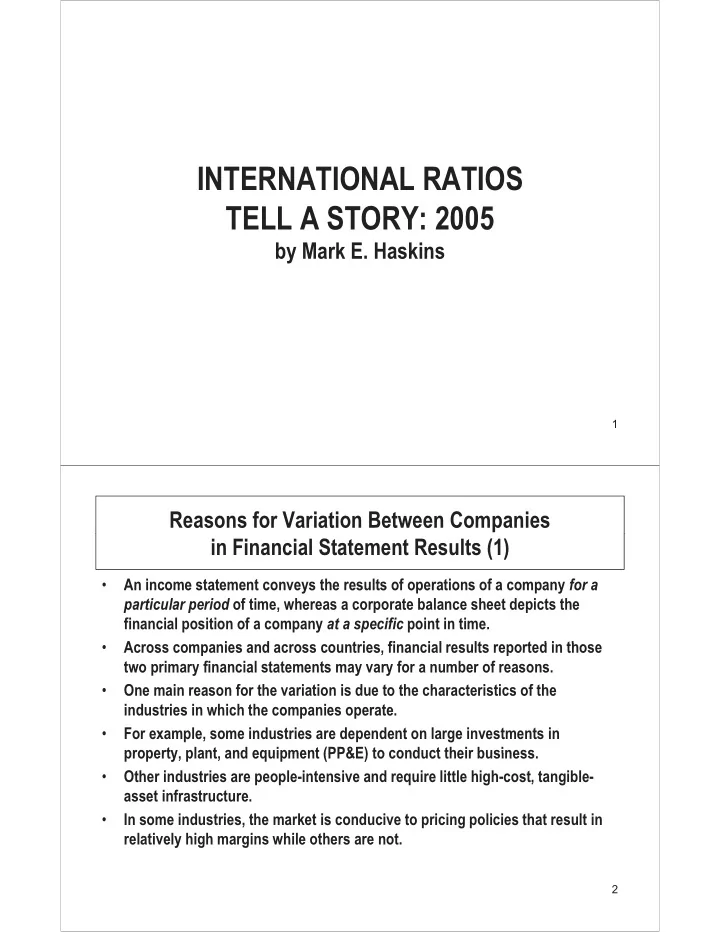
Reasons for Variation Between Companies in Financial Statement Results (1)

  • An income statement conveys the results of operations of a company for a

An income statement conveys the results of operations of a company for a particular period of time, whereas a corporate balance sheet depicts the financial position of a company at a specific point in time. A i d t i fi i l lt t d i th

  • Across companies and across countries, financial results reported in those

two primary financial statements may vary for a number of reasons.

  • One main reason for the variation is due to the characteristics of the

industries in which the companies operate.

  • For example, some industries are dependent on large investments in

property plant and equipment (PP&E) to conduct their business property, plant, and equipment (PP&E) to conduct their business.

  • Other industries are people-intensive and require little high-cost, tangible-

asset infrastructure.

  • In some industries, the market is conducive to pricing policies that result in

relatively high margins while others are not.

2

slide-2
SLIDE 2

Reasons for Variation Between Companies in Financial Statement Results (2)

Diff i l f f h i i

  • Different management strategies may also account for some of the variation

in financial results between companies.

  • Some corporate managers prefer to finance assets with borrowed funds,

p g p , while others avoid such leverage and choose to finance assets with the

  • wners’ invested capital.
  • In other instances companies may differ in regard to the credit arrangements
  • In other instances, companies may differ in regard to the credit arrangements

they enter into with their customers—some preferring short-term debt over long-term debt and/or lessor financing over bank borrowing.

  • Similarly, some companies may choose to grow primarily through the

acquisition of other companies, while others prefer to grow through the expansion of existing product portfolios. p g p p

3

Reasons for Variation Between Companies in Financial Statement Results (3)

  • Of course, another reason for some of the variation in reported

financial results between companies is the differing competencies of management competencies of management.

  • Given the same industry characteristics and the same

management strategies different companies may report management strategies, different companies may report different financial results simply because their managements are more or less successful in executing plans, seizing

  • pportunities, and avoiding problems.

4

slide-3
SLIDE 3

Reasons for Variation Between Companies in Financial Statement Results (4)

  • A fourth reason contributing to differences between balance sheets

A fourth reason contributing to differences between balance sheets and income statements pertains to the underlying accounting methods used by companies.

  • As an example, one company may choose to account for its inventory

using the last in, first out (LIFO) method, while a competitor may use first in first out (FIFO) first in, first out (FIFO).

  • In such a situation, both sets of financial statements would differ even

if actual operating events and performance were the same. p g p

  • Moreover, when comparing companies domiciled in different

countries, it is sometimes not a mere matter of management choosing ti th d th diff i ti

  • ne accounting method over another, differences in accounting

methods may be due to different country regulations.

5

Reasons for Variation Between Companies in Financial Statement Results (5)

  • Another possible root cause for financial statement variation
  • Another possible root cause for financial statement variation

across companies, and in particular across country borders, pertains to the different contexts wherein companies operate, p p p , and the basic role companies have in those contexts.

  • For example, it may be argued that a Swedish company
  • perates in a much more egalitarian, socialistic context and

manner than an American company. Th f l j b i d l b fi b

  • Therefore, employee job security and employee benefits may be
  • f a different type and magnitude for the Swedish company with

a commensurate differential effect on the personnel-related a commensurate differential effect on the personnel-related financial statement accounts.

6

slide-4
SLIDE 4

Reasons for Variation Between Companies in Financial Statement Results (6)

  • Any one, or any combination, of those factors can contribute to the different

Any one, or any combination, of those factors can contribute to the different financial results depicted in the corporate balance sheets and income statements. F th f thi i l t l t diff i l i l t d

  • For the purposes of this exercise, let us rule out differences in legislated

accounting principles as a source of the differences in financial results.

  • Indeed, all of the financial data presented in Exhibit 1 is the result of applying

, p pp y g

  • U. S. generally accepted accounting principles.
  • Thus, the differences in the financial results depicted in Exhibit 1 are

attributable to various combinations of the other factors attributable to various combinations of the other factors.

  • Without knowing any more details of the companies than those depicted in

Exhibit 1, it is difficult to ascribe the financial result differences to anything

  • ther than industry characteristics and, to some degree perhaps, country

context.

  • For this exercise, it is best to primarily contemplate industry characteristics

7

For this exercise, it is best to primarily contemplate industry characteristics as the primary reason for the financial differences.

The Use of Financial Ratios The Use of Financial Ratios

  • The differences in industry characteristics, in

company policies, and in management p y p , g performance are reflected in the financial statements published by publicly held statements published by publicly held companies, and can be highlighted through the use of financial ratios use of financial ratios.

8

slide-5
SLIDE 5

10 Different Companies 10 Different Companies

A t f t i (G ) H lth & lif t l t h l

  • Auto manufacturing (Germany)
  • - Daimler-Chrysler
  • Bank (Panama) -- Banco
  • Healthcare & lifestyle technology

and products (Netherlands) -- Philips Group ( ) Latinoamericano de Exportaciones S.A.

  • Business process outsourcing
  • Integrated oil/gas, coal mining,

and chemical company (South Africa) -- Sasol Ltd.

  • Business process outsourcing

(India) -- Tata Consultancy Services Ltd. Africa) Sasol Ltd.

  • Internet retailer (United States) --

Amazon.com

  • Discount general-merchandise

store chain (United States) -- Wal-Mart Stores, Inc.

  • Low-fare airline (Ireland) –

Ryanair Holdings, Plc.

  • Pharmaceutical (Switzerland) --

,

  • Electric utility (Germany) --

E.ON AG Pharmaceutical (Switzerland) Actelion Ltd.

9

Exhibit 1: INTERNATIONAL RATIOS TELL A STORY— 2005

1 2 3 4 5 6 7 8 9 1 0 Y e a r e n d M a r c h J u n e D e c D e c J a n u a r y D e c D e c M a r c h D e c D e c A s s e ts : C a s h 4 2 .0 % 3 .3 % 1 5 . 6 % 3 . 8 % 4 .6 % 5 4 .1 % 5 5 .3 % 5 .4 % 1 1 . 9 % 7 .3 % A c c ts . r e ce iv a b le 0 .5 % 1 4 .6 % 1 5 . 2 % 3 . 8 % 1 .4 % 7 .4 % 2 2 .1 % 4 1 .6 % 6 .5 % 8 1 .2 % In v e n to r y 0 .7 % 1 2 .0 % 1 0 . 3 % 9 . 5 % 2 4 .5 % 1 5 .3 % 3 . 7 % 0 .7 % 1 .9 % 0 .0 % O th e r C A 0 .6 % 0 .2 % 3 .5 % 2 0 .1 % 1 .5 % 2 .4 % 1 . 7 % 1 5 .1 % 8 .7 % 0 .0 % T o ta l cu r r e n t a s s e ts 4 3 .9 % 3 0 .1 % 4 4 . 6 % 3 7 .2 % 3 2 .0 % 7 9 .2 % 8 2 .7 % 6 2 .8 % 2 9 . 1 % 8 8 .5 % N e t P P & E 5 5 .1 % 5 7 .9 % 1 4 . 5 % 3 5 .2 % 5 7 .0 % 9 .4 % 7 . 0 % 2 2 .2 % 3 2 . 7 % 0 .1 % G o o d w ill 0 .9 % 2 .5 % 8 .1 % 0 . 9 % 9 .0 % 4 .3 % 3 . 8 % 0 .9 % 1 2 . 1 % 0 .0 % O th e r 0 .1 % 9 .4 % 3 2 . 8 % 2 6 .7 % 2 .0 % 7 .0 % 6 . 4 % 1 4 .1 % 2 6 . 1 % 1 1 .4 % T o ta l a s s e ts 1 0 0 . 0 % 1 0 0 . 0 % 1 0 0 .0 % 1 0 0 .0 % 1 0 0 . 0 % 1 0 0 . 0 % 1 0 0 .0 % 1 0 0 . 0 % 1 0 0 .0 % 1 0 0 . 0 % L ia b ilit ie s : A c c ts . p a y a b le 2 .4 % 6 .4 % 1 1 . 4 % 7 . 2 % 1 8 .0 % 3 7 .0 % 9 . 5 % 5 .6 % 4 .2 % 3 3 .1 % S T d e b t 0 .2 % 6 .7 % 3 .4 % 1 8 .1 % 6 .5 % 0 .1 % 0 . 0 % 3 .9 % 1 .5 % 2 4 .1 % O th e r 1 4 .5 % 7 .9 % 1 5 . 8 % 1 7 .5 % 1 1 .2 % 1 5 .2 % 1 5 .1 % 2 1 .4 % 1 4 . 2 % 3 .5 % T o t a l c u r re n t lia b ilitie s 1 7 .1 % 2 1 .0 % 3 0 . 6 % 4 2 .8 % 3 5 .7 % 5 2 .2 % 2 4 .6 % 3 0 .9 % 1 9 . 8 % 6 0 .7 % T o t a l c u r re n t lia b ilitie s 1 7 .1 % 2 1 .0 % 3 0 . 6 % 4 2 .8 % 3 5 .7 % 5 2 .2 % 2 4 .6 % 3 0 .9 % 1 9 . 8 % 6 0 .7 % L T d e b t 3 3 .7 % 1 5 .4 % 9 .8 % 2 2 .0 % 1 9 .7 % 4 1 .2 % 2 2 .4 % 0 .0 % 8 .3 % 1 6 .9 % O th e r 6 .7 % 1 2 .7 % 1 0 . 3 % 1 7 .0 % 3 .6 % 0 .0 % 7 . 9 % 3 .7 % 3 6 . 7 % 2 .7 % T o ta l lia b ilitie s 5 7 .6 % 4 9 .1 % 5 0 . 8 % 8 1 .9 % 5 8 .9 % 9 3 .3 % 5 4 .8 % 3 4 .6 % 6 4 . 9 % 8 0 .3 % E q u ity : E q u ity : P re fe r r e d s t o c k 0 .0 % 0 .0 % 0 .0 % 0 . 0 % 0 .0 % 0 .0 % 0 . 0 % 0 .0 % 0 .0 % 0 .2 % C o m m o n s t o c k 1 5 1 %

  • 0 4 %
  • 7 6 %

5 4 % 2 4 % 6 1 3 % 5 6 7 % 4 5 1 % 1 0 5 % 1 2 8 % C o m m o n s t o c k 1 5 .1 %

  • 0 .4 %
  • 7 .6 %

5 . 4 % 2 .4 % 6 1 .3 % 5 6 .7 % 4 5 .1 % 1 0 . 5 % 1 2 .8 % R e ta in e d e a r n in g s 2 7 .3 % 5 1 .3 % 5 6 . 8 % 1 2 .7 % 3 8 .7 %

  • 5 4 .7 %
  • 1 1 .5 %

2 0 .3 % 2 4 . 6 % 6 .8 % T o ta l e q u ity 4 2 .4 % 5 0 .9 % 4 9 . 2 % 1 8 .1 % 4 1 .1 % 6 .7 % 4 5 .2 % 6 5 .4 % 3 5 . 1 % 1 9 .7 % T o ta l lia b . & e q u ity 1 0 0 . 0 % 1 0 0 . 0 % 1 0 0 .0 % 1 0 0 .0 % 1 0 0 . 0 % 1 0 0 . 0 % 1 0 0 .0 % 1 0 0 . 0 % 1 0 0 .0 % 1 0 0 . 0 % R O S 2 1 .2 % 1 4 .5 % 9 .4 % 1 . 9 % 3 .6 % 4 .2 % 1 8 .9 % 2 1 .1 % 1 4 . 3 % 6 8 .6 % A s s e t tu rn o v e r 0 3 5 0 8 4 0 9 0 0 7 4 2 4 0 2 3 0 0 9 3 1 9 9 0 4 1 0 0 4 A s s e t tu rn o v e r 0 . 3 5 0 .8 4 0 .9 0 0 .7 4 2 .4 0 2 .3 0 0 . 9 3 1 .9 9 0 .4 1 0 .0 4 R O A 7 .4 % 1 2 .2 % 8 .5 % 1 . 4 % 8 .5 % 9 .7 % 1 7 .6 % 4 2 .0 % 5 .9 % 2 .5 % F in a n c ia l le v e r a g e 2 . 3 6 1 .9 6 2 .0 3 5 .5 3 2 .4 3 1 5 .0 2 2 . 2 1 1 .5 3 2 .8 5 5 .0 8 R O E 1 7 .4 % 2 3 .9 % 1 7 . 2 % 7 . 8 % 2 0 .8 % 1 4 5 . 9 % 3 9 .0 % 6 4 .2 % 1 6 . 7 % 1 2 .9 % C u r r e n t r a tio 2 . 5 7 1 .4 4 1 .4 6 0 .8 7 0 .9 0 1 .5 2 3 . 3 6 2 .0 3 1 .4 7 1 .4 6 R e c e iv a b le s c o lle c tio n 6 6 4 6 2 1 9 2 1 2 8 6 7 6 5 8 8 0 1 4 I t t / 4 2 5 9 6 4 7 5 1 1 4 2 5 / 1 6 6 /

10

I n v e n t o r y tu rn o v e r n /a 4 .2 5 . 9 6 . 4 7 .5 1 1 . 4 2 .5 n / a 1 6 . 6 n / a G r o s s m a r g in n /a 3 9 .7 % 3 2 . 3 % 1 7 .9 % 2 2 .9 % 2 4 .0 % 8 9 .9 % n / a 2 1 . 3 % 3 8 .7 % D iv id e n d p a y o u t 0 .0 % 2 9 .2 % 1 7 . 6 % 5 5 .3 % 2 1 .6 % 0 .0 % 0 . 0 % 1 7 .4 % 2 0 . 9 % 1 2 5 . 9 %
slide-6
SLIDE 6

Case Instructions Case Instructions

  • Study the balance sheet profiles and the financial ratios listed for each of the
  • Study the balance sheet profiles and the financial ratios listed for each of the

10 companies as presented in Exhibit 1.

  • Your assignment is to match each column in the exhibit with one of the
  • Your assignment is to match each column in the exhibit with one of the

industries listed above.

  • You are to prepare (at least) 10 PPT slides each presenting a match (between
  • You are to prepare (at least) 10 PPT slides, each presenting a match (between

an industry and a balance sheet column) and the reasons for that match (paying particular attention to the ratios).

  • Be prepared to give the reasons for your pairings, citing the statistics that

seem to be consistent with the characteristics of the industry you selected.

  • Ours is not a perfect world, however, and for our discussion it will be helpful

if you will also identify those pieces of data that seem to contradict the pairings you have made.

11

p g y

Ratios (1) Ratios (1)

Net Income Net Sales

1. ROS

(return on sales)

=

Net Sales

  • Avg. total assets

2. Asset Turnover =

  • Avg. total assets

Net Income

ROA

(return on assets)

=

  • Avg. Total Assets

ROS X Asset Turnover

3.

(return on assets)

  • r

=

ROS X Asset Turnover

  • r

=

12

slide-7
SLIDE 7

Ratios (2) Ratios (2)

  • Avg. Total Assets
  • Avg. Total Owners' Equity

4. Financial Leverage =

Net Income A T t l O ' E it

ROE

(return on equity)

=

  • Avg. Total Owners' Equity

ROA X Financial Leverage

5.

(return on equity)

  • r

=

ROA X Financial Leverage

  • r

=

Total Current Assets Total Current Liabilities

6. Current Ratio =

13

Ratios (3) Ratios (3)

  • Avg. Accts Receivable

7 Receivables =

Net Sales/365 days

7. collection

Cost of Goods Sold Avg Ending Inventory

8. Inventory turnover =

Net Sales - Cost of Goods Sold Net Sales

9. Gross margin =

Net Sales

14

slide-8
SLIDE 8

Ratios (4) Ratios (4)

This year's Net Sales - Last year's Net Sales Last year's Net Sales

  • 10. Revenue growth

=

Cash flow from operations

11 Operating funds =

Last year s Net Sales Net Income

11. ratio

15

Selected Financial Ratios Framework Selected Financial Ratios Framework

Liquidity Debt Mgmt Asset Mgmt Profitability Return to Investors q y g g y Investors

Current ratio Long-term debt / Total capitalization Avg collection period Gross profit margin Return on total assets Avg collection period Financial Leverage Inventory turnover Return on equity Return on equity Inventory turnover Debt average Total asset turnover Return on sales Divident payout R t t t l t R th R th Return on total assets Revenue growth Revenue growth Return on total assets Operating funds ratio Operating funds ratio

16

slide-9
SLIDE 9

17

10 Commandments of Financial Statement Analysis

1 Thou shalt not use financial statements in isolation 1. Thou shalt not use financial statements in isolation. 2. Thou shalt not use financial statements as the only source of firm-specific information. 3. Thou shalt not avoid reading footnotes. 4. Thou shalt not focus on a single number. 5. Thou shalt not overlook the implications of what is read. 5. Thou shalt not overlook the implications of what is read. 6. Thou shalt not ignore events subsequent to the financial statements. 7 Thou shalt not overlook the limitations of financial statements 7. Thou shalt not overlook the limitations of financial statements. 8. Thou shalt not use financial statements without adequate knowledge. 9 Th h l h f i l h l 9. Thou shalt not shun professional help.

  • 10. Thou shalt not take unnecessary risks.

18