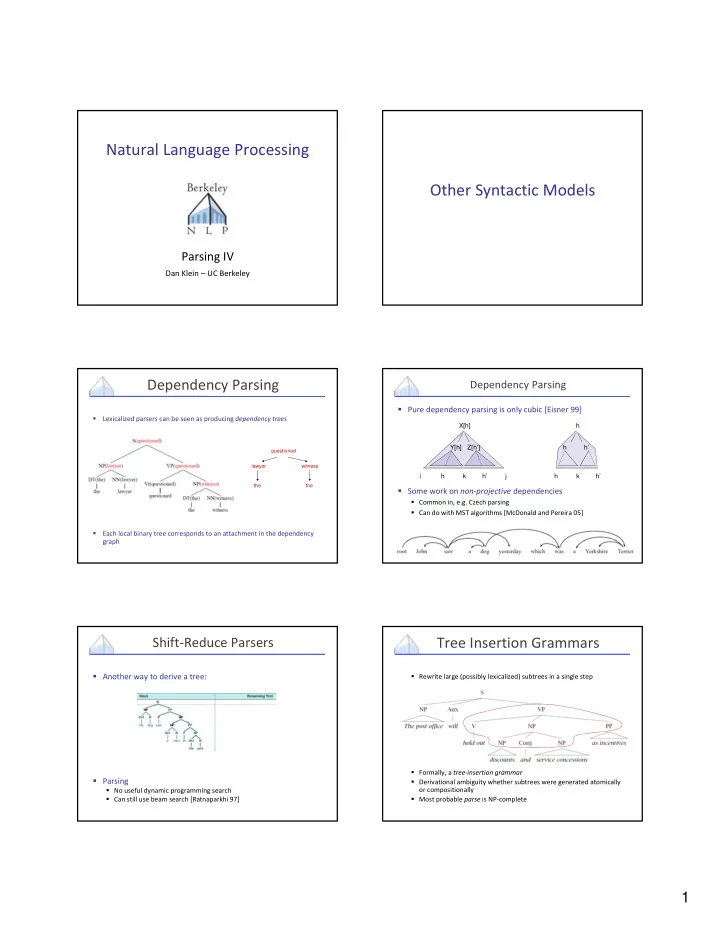
Natural Language Processing Other Syntactic Models Parsing IV Dan - - PDF document

natural language processing other syntactic models
SMART_READER_LITE
LIVE PREVIEW

Natural Language Processing Other Syntactic Models Parsing IV Dan - - PDF document

Natural Language Processing Other Syntactic Models Parsing IV Dan Klein UC Berkeley Dependency Parsing Dependency Parsing Pure dependency parsing is only cubic [Eisner 99] Lexicalized parsers can be seen as producing dependency trees


slide-1
SLIDE 1

1

Natural Language Processing

Parsing IV

Dan Klein – UC Berkeley

Other Syntactic Models

Dependency Parsing

  • Lexicalized parsers can be seen as producing dependency trees
  • Each local binary tree corresponds to an attachment in the dependency

graph

questioned lawyer witness the the

Dependency Parsing

  • Pure dependency parsing is only cubic [Eisner 99]
  • Some work on non‐projective dependencies
  • Common in, e.g. Czech parsing
  • Can do with MST algorithms [McDonald and Pereira 05]

Y[h] Z[h’] X[h] i h k h’ j h h’ h h k h’

Shift‐Reduce Parsers

  • Another way to derive a tree:
  • Parsing
  • No useful dynamic programming search
  • Can still use beam search [Ratnaparkhi 97]

Tree Insertion Grammars

  • Rewrite large (possibly lexicalized) subtrees in a single step
  • Formally, a tree‐insertion grammar
  • Derivational ambiguity whether subtrees were generated atomically
  • r compositionally
  • Most probable parse is NP‐complete
slide-2
SLIDE 2

2

TIG: Insertion Tree‐adjoining grammars

  • Start with local trees
  • Can insert structure

with adjunction

  • perators
  • Mildly context‐

sensitive

  • Models long‐distance

dependencies naturally

  • … as well as other

weird stuff that CFGs don’t capture well (e.g. cross‐serial dependencies)

TAG: Long Distance

CCG Parsing

  • Combinatory

Categorial Grammar

  • Fully (mono‐)

lexicalized grammar

  • Categories encode

argument sequences

  • Very closely related

to the lambda calculus (more later)

  • Can have spurious

ambiguities (why?)

Empty Elements

Empty Elements

  • In the PTB, three kinds of empty elements:
  • Null items (usually complementizers)
  • Dislocation (WH‐traces, topicalization, relative clause and

heavy NP extraposition)

  • Control (raising, passives, control, shared argumentation)
  • Need to reconstruct these (and resolve any

indexation)

slide-3
SLIDE 3

3

Example: English Example: German Types of Empties A Pattern‐Matching Approach

  • [Johnson 02]

Pattern‐Matching Details

  • Something like transformation‐based learning
  • Extract patterns
  • Details: transitive verb marking, auxiliaries
  • Details: legal subtrees
  • Rank patterns
  • Pruning ranking: by correct / match rate
  • Application priority: by depth
  • Pre‐order traversal
  • Greedy match

Top Patterns Extracted

slide-4
SLIDE 4

4

Results

Semantic Roles

Semantic Role Labeling (SRL)

  • Characterize clauses as relations with roles:
  • Says more than which NP is the subject (but not much more):
  • Relations like subject are syntactic, relations like agent or message are

semantic

  • Typical pipeline:
  • Parse, then label roles
  • Almost all errors locked in by parser
  • Really, SRL is quite a lot easier than parsing

SRL Example PropBank / FrameNet

  • FrameNet: roles shared between verbs
  • PropBank: each verb has its own roles
  • PropBank more used, because it’s layered over the treebank (and so has

greater coverage, plus parses)

  • Note: some linguistic theories postulate fewer roles than FrameNet (e.g.

5‐20 total: agent, patient, instrument, etc.)

PropBank Example

slide-5
SLIDE 5

5

PropBank Example PropBank Example Shared Arguments Path Features Results

  • Features:
  • Path from target to filler
  • Filler’s syntactic type, headword, case
  • Target’s identity
  • Sentence voice, etc.
  • Lots of other second‐order features
  • Gold vs parsed source trees
  • SRL is fairly easy on gold trees
  • Harder on automatic parses

Empties and SRL