
SLIDE 1
1 /// DISPOSABLE JOURNALISTS?
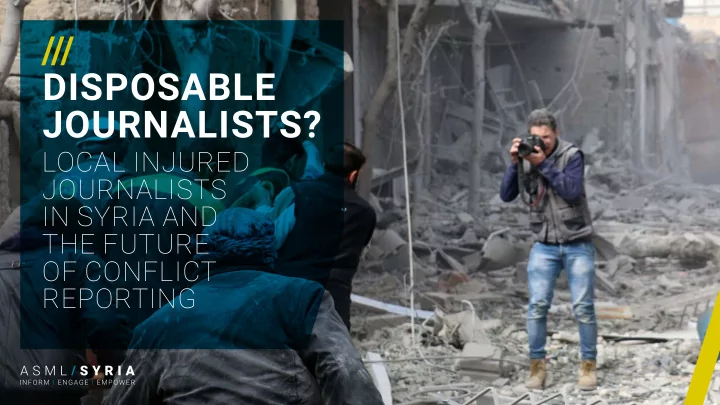
/// DISPOSABLE JOURNALISTS? LOCAL INJURED JOURNALISTS IN SYRIA - - PowerPoint PPT Presentation
1 /// DISPOSABLE JOURNALISTS? /// DISPOSABLE JOURNALISTS? LOCAL INJURED JOURNALISTS IN SYRIA AND THE FUTURE OF CONFLICT REPORTING 1 /// DISPOSABLE JOURNALISTS? From the start of the revolution in March 2011 through May 2019, the Syrian
1 /// DISPOSABLE JOURNALISTS?
1 /// DISPOSABLE JOURNALISTS?
From the start of the revolution in March 2011 through May 2019, the Syrian Network for Human Rights documented that 695 journalists have been killed in the Syrian confmict, most of them local. Hundreds of local journalists who survive their injuries remain permanently handicapped, and receive little or no help from their
journalists in Syria were not all unavoidable, and the blame is shared globally among various parties.
2 /// DISPOSABLE JOURNALISTS?
There is a broad-based consensus across multiple separate international initiatives about the responsibilities of employers toward journalists working for them in war zones, regardless of their contractual status. Existing charters and institutions converge on certain principles: ▶ News organizations should ensure the journalist is appropriately equipped and trained to cover the story. If they are not, the organization should provide him/her with the appropriate safety and fjrst aid training, protective equipment. ▶ Media organizations should take responsibility to provide the necessary support in the event of injury or kidnap of a journalist who is currently working for them. ▶ Editors and news
the same concern for the welfare of local journalists and freelancers that they do for staff journalists. ▶ Finally, journalists should not be obliged, against their will, to cover dangerous assignments that involve serious recognizable risk.
3 /// DISPOSABLE JOURNALISTS?
This study investigated the safety conditions under which Syrian journalists were working when they were injured, and whether their employer at the time respected the international consensus around minimum safety standards.
STUDY REPORT/// DISPOSABLE JOURNALISTS?
L O C A L I N J U R E D J O U R N A L I S T S I N S Y R I A A N D T H E F U T U R E O F C O N F L I C T R E P O R T I N G
4 /// DISPOSABLE JOURNALISTS?
The study included 72 local Syrian journalists (including community media workers and citizen journalists) who had incurred a total of 119 injuries while working. ▶ 11% had one injury ▶ 44% had two injuries ▶ 44% had three or more injuries In addition to the survey about their experiences, full interviews were conducted with: ▶ 11 injured journalists ▶ 4 senior members of media organizations
▶ 3 representatives of media support
had received
had received three or more injuries had received two injuries
5 /// DISPOSABLE JOURNALISTS?
Across 119 recorded injuries, the journalists only received support from their employer after the injury in 24% of cases. Only in 22% of cases did the journalists receive a security training prior to the injury, and this was provided by the employer in only 12% of cases. Similarly, only 16% had any protection equipment, provided by the employer in 8%
cases did the journalist have a contract with their employer.
Finally, in only
have a contract with
their employer
Only in
received support from
their employer after the injury
journalists had not received any security training
84%
injured journalists did not have any protection equipment
6 /// DISPOSABLE JOURNALISTS?
This has serious and sometimes dramatic consequences on these journalist’s lives, with 85% of the journalists having still not recovered from one or multiple injuries. A shrapnel pierced my hand, cutting a nerve and sensory tendons. I am suffering from a 50% or more
and I cannot straighten or move them. I am suffering a lot because of my hand. We are in winter and I am suffering a lot. I cannot do anything with it. I can write but my handwriting is very bad and I cannot write fast. Also, when it is sunny I have to wear sunglasses because I feel heavy discomfort.... I don’t have headaches, but a pain in the eyes as if you were
Taym al Youssef, Syrian journalist injured in Hama in 2013.
7 /// DISPOSABLE JOURNALISTS?
▶ Media organizations that have a transparent, offjcial request and decision-making process for providing injury support and have budgeted this support into their operation are more likely to provide overall better safety conditions to their journalists. ▶ While cost is certainly a factor the problem is not a simple issue of resources; many local Syrian media
at protecting and supporting their journalists than international media with access to more funding and connections.
8 /// DISPOSABLE JOURNALISTS?
▶ The core of the problem lies within the purchase of unsolicited content from freelance journalists. Media professionals and journalists agree
towards freelance journalists when the stringer was not commissioned by the media. However, this is a common and widespread practice. ▶ The widespread acceptance of non- commissioned content creates an incentive for the least experienced, least equipped freelancers - who are not covered by any employer’s insurance and generally do not receive any injury support - to take the most risks. ▶ Accepting unsolicited content and refraining from commissioning local journalists is a deliberate practice for the employer to avoid their
the legal risk – and reduce their costs.
9 /// DISPOSABLE JOURNALISTS?
To better ensure that the rights of local journalists are protected and the basic
media organizations should: ▶ Strengthen efforts to ensure that local staff or freelance journalists are appropriately trained and equipped, and institute clear, transparent protocols for the process of requesting support. They should proactively make journalists they work with aware of them, and reserve fjnancial resources for this in contexts where the security risks are well- known, like Syria. If security conditions make it diffjcult for international news
collaborate with local media and civil society organizations for ground
fjnancial means to provide this should collaborate with international news
costs. ▶ Refrain from accepting content from journalists to whom they cannot meet these basic obligations, regardless of the status or nature
Therefore if they cannot meet these
freelancers, media organizations should minimize the amount of content that they accept on a non- commissioned basis, or ideally stop the practice entirely.
10 /// DISPOSABLE JOURNALISTS?
NGOs and organizations interested in the protection of journalists should: ▶ Educate journalists and especially local journalists, about the rights and protections to which they are
most local journalists did not study journalism and entered the profession under extraordinary circumstances, part of the responsibility lies with NGOs to promote awareness among journalists
by the ACOS Alliance and other similar initiatives, and explain these rights and obligations to journalists through well- mapped outreach activities. ▶ Include the issue of the purchase of unsolicited material at the core of the discussions regarding journalists’ safety, prioritizing this for renewed commitments by media and international bodies, and the evolution
journalists’ safety. ▶ Continue working together with the media industry (through multi-stakeholder platforms like ACOS) to develop research and evidence-based standards and protocols for requesting and delivering support to journalists in confmict zones.