disea eases ses bu burde rden n th throu ough gh nat ational - - PowerPoint PPT Presentation

disea eases ses bu burde rden n th throu ough gh nat
SMART_READER_LITE
LIVE PREVIEW

disea eases ses bu burde rden n th throu ough gh nat ational - - PowerPoint PPT Presentation

Si Signifi nificant cant re reduction ction in en end-stage stage live ver r disea eases ses bu burde rden n th throu ough gh nat ational onal vira ral l he hepa pati titis tis th ther erapy apy pr program ram in T


slide-1
SLIDE 1

Si Signifi nificant cant re reduction ction in en end-stage stage live ver r disea eases ses bu burde rden n th throu

  • ugh

gh nat ational

  • nal vira

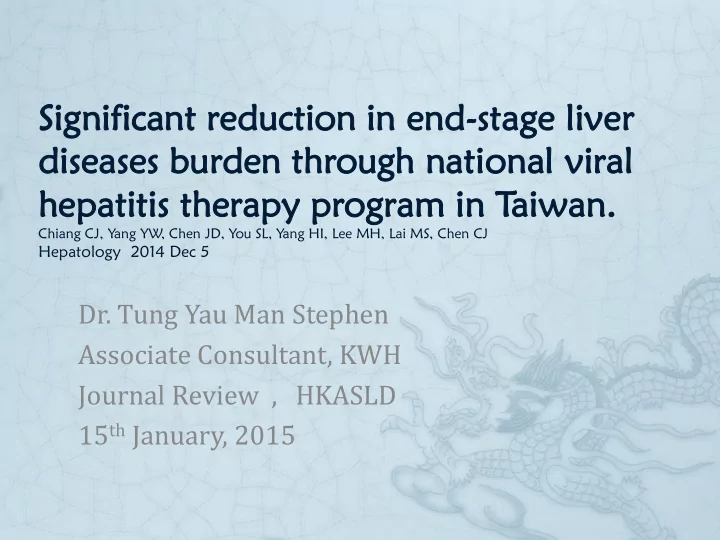
ral l he hepa pati titis tis th ther erapy apy pr program ram in T ai aiwan an.

Chiang CJ, Yang YW, Chen JD, You SL, Yang HI, Lee MH, Lai MS, Chen CJ

Hepatology 2014 Dec 5

  • Dr. Tung Yau Man Stephen

Associate Consultant, KWH Journal Review , HKASLD 15th January, 2015

slide-2
SLIDE 2

Introduction

 There were estimated 350 million people

with chronic HBV infection and 170 million people infected by HCV worldwide

 Taiwan CDC : 2.5M CHB patients and 0.7M

HCV infected people in 2012.

 Cohort study : lifetime risk of cirrhosis and

HCC was 42% and 22% for CHB patients

 Cumulative lifetime risk of HCC was 20% for

CHC patients.

slide-3
SLIDE 3

 A national viral hepatitis therapy program

was launched in Taiwan in October 2003.

 This study aimed to assess the impact of the

program on reduction of end-stage liver disease burden.

 Profiles of national registries of households,

cancers and death certificates were used to derive incidence and mortality of end-stage liver diseases from 2000 to 2011.

slide-4
SLIDE 4

Reimbursement Program

 CHB:

 IF-a and lamivudine reimbursement since 10-

2003

 Peg IFa since 11-2005; adefovir as rescue since

9-2006

 Entecavir and telbivudine since 8-2008  Tenofovir since 6-2011

 CHC:

 PegIF and ribavarin 10-2003

slide-5
SLIDE 5

 The age-gender-adjusted incidence and

mortality rates of hepatocellular carcinoma (HCC) and chronic liver diseases and cirrhosis

  • f adults aged 30-69 years were compared

before and after launching the program using Poisson regression models.

 A total of 157,570 and 61,823 patients (15-

25% of the eligible for reimbursed treatment) received therapy for chronic hepatitis B and C, respectively, by 2011

slide-6
SLIDE 6

Method

 National health insurance 1995- mandatory,

99% resident

 Eligibility for reimbursement ( see table)  Liver cirrhosis defined by sonography in the

presence of either splenomegaly or esophageal/ gastric varices, or by histology

 Since 2009, Eligible CHB patients received

36m , instead of 18m

slide-7
SLIDE 7

 HBeAg+ patients could receive another one

year medication if seroconversion of HBeAg was successfully documented during the 36m treatment period.

 For HepC treatment, reimbursed

therapeutic course could be extended from 16 wk to 24 wk and even to 48 wk based on the viral kinetic response to therapy.

slide-8
SLIDE 8

Eligibility Criteria of antiviral therapy for CHB & CHC

slide-9
SLIDE 9

T 1.Eligibility Criteria and 1st line antiviral therapy for CHB & CHC

slide-10
SLIDE 10
  • F1. Cumulative numbers of anti-

HBV/HCV therapy

slide-11
SLIDE 11

Mortality and incidence rates derived from National Registration Profiles

 Death and migration event must be

registered in the governmental household registration officers and regularly checked by registration officers.

 Year end population obtained by annual

reports of demographic statistics.

slide-12
SLIDE 12

 All death certificate coded by medical

registrars according to ICD9.

 National cancer registry since 1979  HCC coded under ICD-O-3 code C220.

slide-13
SLIDE 13

Statistical Analysis

 Mortality and incidence rates were derived

by diving the number of deaths or incident cases by the number of population.

 Stratified by gender and age (30-39,40-49,

50-59 and 60-69 years ) groups.

 Poisson regression models, rate ratios with

95% confidence intervals were calculated.

 2 sided test, p<0.05 was considered

statistically significant.

slide-14
SLIDE 14

Result

 There were 42,526 chronic liver diseases and

cirrhosis deaths, 47,392 HCC deaths, and 74,832 incident HCC cases occurred in 140,814,448 person- years from 2000 to 2011.

 Male gender and elder age were associated with a

significantly increased risk of chronic liver diseases and cirrhosis and HCC.

 The mortality and incidence rates of the end-stage

liver diseases decreased continuously from 2000- 2003 (before therapy program) through 2004-2007 to 2008-2011 in all age and gender groups.

slide-15
SLIDE 15

F2 . CLD and cirrhosis mortality HCC mortality

slide-16
SLIDE 16

HCC incidence rate

slide-17
SLIDE 17
  • T2. Mortality and Incidence rates and Adjusted rate

ratio of CLD, cirrhosis and HCC

slide-18
SLIDE 18

 Significant decreasing trend of mortality and

incidence rates in both genders.

 Reduction in mortality rates of CLD and

cirrhosis and HCC , and incidence rates of HCC was more striking in both genders in 2008- 2011.

 The decreases in adjusted RR were more

striking for mortality rates than incidence rates.

 Decreasing trends in age adjusted rate ratios

were more striking in females than males.

slide-19
SLIDE 19

Gender adjusted rate ratios of CLD, cirrhosis and HCC among four 10-year age groups.

slide-20
SLIDE 20

 The decreasing trends in gender adjusted

mortality and incidence rate ratios were consistently observed in all 4 age groups.

slide-21
SLIDE 21
  • T4. Adjusted RR of CLD, cirrhosis and HCC

in adults aged 30-69 years from 2000-2011

slide-22
SLIDE 22

 Male gender was associated with a 4 fold

risk of age period adjusted mortality and incidence rates of end stage liver diseases.

 Increasing age was significantly associated

with an increasing trend of HCC incidence and mortality

slide-23
SLIDE 23

Discussion

 Significant reduction of end stage liver

disease burden resulted from a national viral hepatitis therapy program at the population level.

 Showed the decreasing trend of rate ratios

after adjustment for age and gender for all age groups in both genders.

slide-24
SLIDE 24

 More significant reduction of 12-19 % in incidence

and mortality of HCC, and mortality of CLD and cirrhosis was observed after 2007, when more antivirals including entecavir and tenofovir for CHB were approved .

 More striking reduction in 08-11 , as result from

latent period between reimbursed therapy and reduced risk of end stage liver diseases.

 May prevent the HCC recurrence and therefore the

reduction in HCC mortality was greater than the HCC incidence reduction.

slide-25
SLIDE 25

 More striking reduction in end stage liver

diseases in females and elderly - higher proportion of hepatitis C, which may be more effectively treated by the combination therapy than CHB.

slide-26
SLIDE 26

Limitation

 Pre/post treatment HBV DNA level , HCV

RNA levels

 Type and duration of anti viral agents  Cost effectiveness  Confounding factors : Eligible untreated

patients, other factors that may have reduce the mortality, e.g. surgical Mx, reduced post

  • perative decompensation, HCC surveillance

 Lack of control group

slide-27
SLIDE 27

HCC cases by year (by diagnosis code search)

100 200 300 400 500 600 0 - 14 15 - 44 45 - 49 50 - 54 55 - 59 60 - 64 65 - 69 70 - 74 75 - 79 80 - 84 85+ 2008 2011 2014

Statistics from HA

slide-28
SLIDE 28

HA HCC Death Cases by year

(by diagnosis code search)

50 100 150 200 250 300 350 0 - 14 15 - 44 45 - 49 50 - 54 55 - 59 60 - 64 65 - 69 70 - 74 75 - 79 80 - 84 85+ 2008 2011 2013 2014

slide-29
SLIDE 29

Summary of HCC Case# and death# by diagnosis code search

 HCC Death Cases

Age 2008 2011 2014

0 - 14 4 13 10 15 - 44 160 167 147 45 - 49 188 160 122 50 - 54 316 325 288 55 - 59 372 445 515 60 - 64 341 507 519 65 - 69 360 379 459 70 - 74 357 390 382 75 - 79 294 381 406 80 - 84 187 261 337 85+ 98 143 190 Total 2678 3172 3375

HCC Total Cases by year

Age

2008 2011 2013

2014 0 - 14 1 3 3 2 15 - 44 131 103 80 61 45 - 49 146 101 61 48 50 - 54 246 220 148 104 55 - 59 290 287 245 171 60 - 64 259 316 273 162 65 - 69 292 269 203 141 70 - 74 304 298 221 145 75 - 79 273 302 229 155 80 - 84 179 224 206 167 85+ 96 129 135 127 Total 2217 2252 1804 1283

slide-30
SLIDE 30

Anti-viral treatment patient headcount 2014

Adefovir 1420 Entecavir 22800 Lamivudine 4700 Telbivudine 2950 Tenofovir 4460 Total drug expenditure ~ 381 M