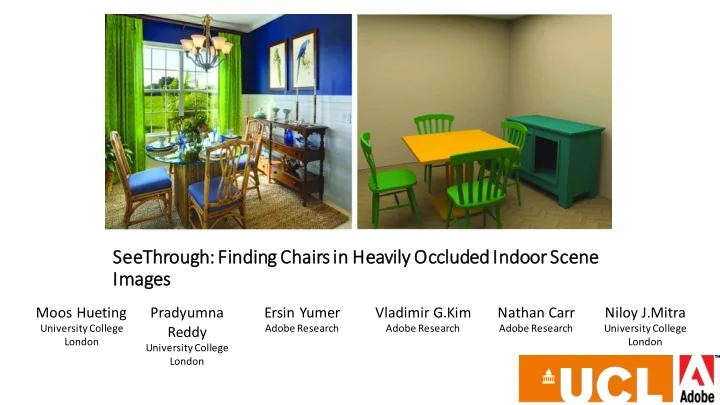
SLIDE 1 SeeTh Throu
inding Cha hair irs in Heavily ily Occlud luded d Ind ndoor
ne Images
Moos Hueting
University College London
Pradyumna Reddy
University College London
Ersin Yumer
Adobe Research
Vladimir G.Kim
Adobe Research
Nathan Carr
Adobe Research
Niloy J.Mitra
University College London
SLIDE 2
SLIDE 3
SLIDE 4
SLIDE 5 Goal: extract 3D scene mock up from single image (focused on chairs and other highly occluded
SLIDE 6
Context is Important
SLIDE 7
Context is Important
SLIDE 8
Pipeline
SLIDE 9
Pipeline
SLIDE 10
Pipeline
SLIDE 11
Pipeline
SLIDE 12
Pipeline
SLIDE 13
Pipeline
SLIDE 14
Pipeline
SLIDE 15
Keypoint estimation
SLIDE 16 Keypoint Dataset
cvgl.stanford.edu/projects/objectnet3d/ Selecting Vertices of the overlaid CAD model Objectnet3D Ground truth annotation Input image
SLIDE 17
Keypoint thresholding
SLIDE 18
Keypoint thresholding
SLIDE 19
Pipeline
SLIDE 20
Vanishing point estimation
SLIDE 21
Pipeline
SLIDE 22
PCA template
SLIDE 23
Fit parameters
SLIDE 24
Candidate Set
SLIDE 25
Pipeline
SLIDE 26 Candidate selection
Unary Costs: measure how well the key points explain the object Pairwise Costs: Capture relationship between objects
SLIDE 27 Relative transform
Relative Rotation Relative Translation
SLIDE 28
Candidate selection
SLIDE 29
Pipeline
SLIDE 30 Results
http://geometry.cs.ucl.ac.uk/projects/2018/seethrough/
SLIDE 31 Results and Dataset
http://geometry.cs.ucl.ac.uk/projects/2018/seethrough/
SLIDE 32 Results and Dataset
http://geometry.cs.ucl.ac.uk/projects/2018/seethrough/
SLIDE 33 Results
Real World Images SeeingChairs Im2CAD Ours
http://geometry.cs.ucl.ac.uk/projects/2018/seethrough/
SLIDE 34 Results
Real World Images SeeingChairs Im2CAD Ours
http://geometry.cs.ucl.ac.uk/projects/2018/seethrough/
SLIDE 35 Results
Real World Images SeeingChairs Im2CAD Ours
http://geometry.cs.ucl.ac.uk/projects/2018/seethrough/
SLIDE 36
Performance comparison
SLIDE 37
Goal: extract 3D scene mock up from single image (focused on chairs and other highly occluded objects) Main insight: cases with significant occlusion can be improved by using high-level contextual knowledge about how scenes “work” Main result: resulting scene mock ups significantly better than combinations of state-of-the-art methods which are reliant on object detection algorithms.
SLIDE 38 Limitations
- First, we plan to extend the evaluation to more classes of objects beyond
those considered.
- Second, one can explore higher fidelity models to better recover fine scale
features in the recovered models.
- Finally, we would like to explore templates that can express a broader
understanding of the multi-object spatial relationships including symmetry and regularity.
SLIDE 39 This work is in part supported by the Microsoft PhD fellowship program, and ERC Starting Grant SmartGeometry (StG-2013-335373). Also, special thanks to Aron Monszpart, James Hennessey, Carlo Innamorati, Paul Guerrero, and other group members for invaluable help at various stages of the project.
Acknowledgement
SLIDE 40 Thank You
Code available: geometry.cs.ucl.ac.uk/projects/2018/seethrough/paper_docs/Code_Data.zip