Vect ector B Borne D Disea eases What Texas S School ool N - - PowerPoint PPT Presentation

vect ector b borne d disea eases what texas s school ool
SMART_READER_LITE
LIVE PREVIEW

Vect ector B Borne D Disea eases What Texas S School ool N - - PowerPoint PPT Presentation

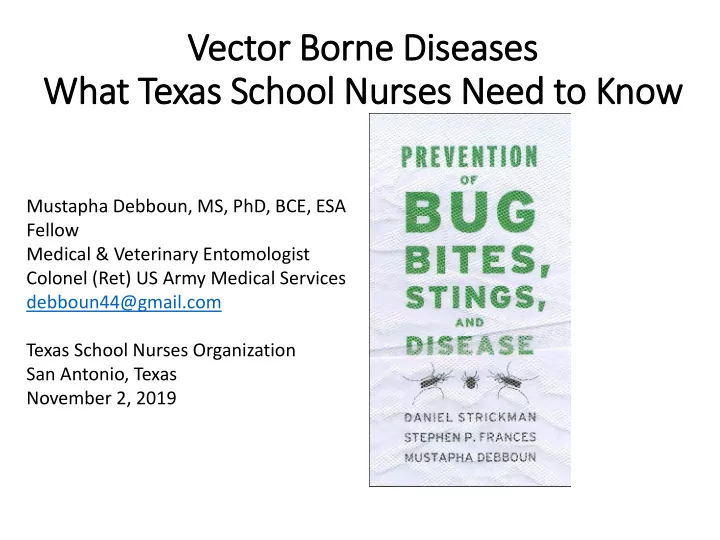
Vect ector B Borne D Disea eases What Texas S School ool N Nurses es N Need eed t to Know Mustapha Debboun, MS, PhD, BCE, ESA Fellow Medical & Veterinary Entomologist Colonel (Ret) US Army Medical Services debboun44@gmail.com


slide-1
SLIDE 1

Vect ector B Borne D Disea eases What Texas S School

  • ol N

Nurses es N Need eed t to Know

Mustapha Debboun, MS, PhD, BCE, ESA Fellow Medical & Veterinary Entomologist Colonel (Ret) US Army Medical Services debboun44@gmail.com Texas School Nurses Organization San Antonio, Texas November 2, 2019

slide-2
SLIDE 2

Introduction

slide-3
SLIDE 3

Source: AVMA and One Health Initiative

Roughl hly 3 o

  • ut of 4

4 ( (Re)Emerging ng Inf nfections ns are Ve

Vector-Bo Borne ne or

  • r Zoon
  • onot
  • tic
slide-4
SLIDE 4

The new Texas

  • Has profound pockets of

intense poverty (Blue Marble Health)

  • Poverty highest in the

south along Mexico border (Colonias)

  • Poverty in major urban

centers: Dallas and Houston

  • Children poverty rate

>33%.

Fig 1. Percentage of children in poverty ages 0 to 17 by county in Texas in 2015. Accessed at http://www.census.gov/did/www/saipe/data/statecounty/data/2015.html.

slide-5
SLIDE 5

The new Texas

  • One of the fastest growing US states

with population projected to exceed 30 million by 2020

  • Contains 11 fastest growing small

cities & 5 of 8 fastest growing large cities

  • Growth is due to immigration &

economic opportunities

  • 3rd among US states in % foreign-

borne populations

slide-6
SLIDE 6

Fig 2. Colonia Mi Sueño, Rio Grande Valley, Texas. Photo by Shaghayegh Tajvidi.

slide-7
SLIDE 7

Geographic distribution of the major Texas NTDs

Fig 3. Approximate geographic distribution of the major Texas NTDs. The major diseases include the vector-borne NTDs (blue) located in South Texas, Gulf Coastal Texas, North Central Texas, the Panhandle, and West Texas, as well as non-vectorborne NTDs (green) that concentrate in the three urban areas that constitute the “Texas triangle”, i.e., Dallas, Houston, and San Antonio. NCC, neurocysticercosis; WNV, West Nile virus.

slide-8
SLIDE 8

Culex quinquefasciatus

Primary vector of St. Louis Encephalitis (SLE) and West Nile virus (WNV) in Texas

…Day and

Night!

Vectors of Yellow fever, Dengue, Chikungunya, and Zika viruses

Aedes albopictus Aedes aegypti

slide-9
SLIDE 9

Environments That Favor More Mosquitoes

  • Stored water and discarded containers accumulate rain

water and create abundant mosquito development sites

slide-10
SLIDE 10

Mosquito Breeding Sites

slide-11
SLIDE 11

Mosquito Breeding Sites

slide-12
SLIDE 12

Assess Screen Conditions

slide-13
SLIDE 13

Malaria Worl rldwide

  • 3 to 4 Billion People at risk
  • Prevalent in tropical and subtropical areas
  • 300 to 500 Million Cases & 1 to 3 Million Deaths
  • Every 30 seconds, one person dies from Malaria
slide-14
SLIDE 14

Malaria in the United States

  • 1,500 to 2,000 cases reported every year
  • Usually immigrants or travelers
  • “Airport Malaria”
  • Local Mosquito-Borne Transmission
  • Congenital Malaria
  • Transfusion Transmitted Malaria
slide-15
SLIDE 15

Dengue Virus Types 1-4: Approximate Geographic Distribution

slide-16
SLIDE 16

Chikungunya Virus:

slide-17
SLIDE 17

OTHER VECTORS

  • Mosquitoes are not the only vector-borne threat
  • Other vectors capable of transmitting pathogens to

humans in TX are:

  • Kissing bugs
  • Ticks
  • Sand flies, fleas, gnats, etc…
slide-18
SLIDE 18

Common Ticks Found in Texas

slide-19
SLIDE 19

Tick-Born rne Diseases i in Texas

  • Rocky Mountain Spotted Fever (RMSF)
  • Lyme Disease
  • Human Ehrlichiosis
  • Tularemia
  • Ricketsia parkeri rickettsiosis
  • Anaplasmosis
  • Babesiosis
  • Heartland virus disease
  • Southern tick-associated rash illness (STARI)
  • Q fever
  • Tick-borne relapsing fever
slide-20
SLIDE 20
  • States along US-Mexico border have highest risk
  • Triatomine species (10 in US)
  • Autochthonous cases (20 since 2013 in TX) (Wozniak et al.

2015, TX DSHS)

Kissing Bugs (Triatoma)

kissingbug.tamu.edu

slide-21
SLIDE 21

Chagas disease in Texas

  • States along US-Mexico border =

highest risk

  • 8 species of kissing bugs have

been recorded in Texas

  • Peridomestic and sylvatic
  • Harris County: Triatoma

sanguisgua

  • Estimated burden in US:

300,000 – 1,000,000

  • Difficult to detect
  • 20-30% develop life-

threatening symptoms

Bern et al (2011)

Harris County

Kjos et al (2009)

slide-22
SLIDE 22

Topical Repellents

slide-23
SLIDE 23

Common Effective Repellents in the US

Deet Picaridin IR 3535 PMD 2-Undecanone

slide-24
SLIDE 24

Deet

N,N-diethyl-3-methyl benzamide N,N-diethyl-m-toluamide

  • USDA & DoD Collaboration

in 1940’s

  • Released commercially in

1956

  • Broad-Spectrum
  • Gold Standard Repellent
  • Safety
slide-25
SLIDE 25

Picaridin

2-(2-hydroxylethyl)-1-piperidine Carboxylic acid 1-methylpropyl ester

  • KBR, icaridin, bayrepel,

Saltidin

  • Modern Efficacy & Safety

Tests

  • Registered in over 50

countries

  • Excellent Effectiveness
  • Safe repellent
slide-26
SLIDE 26

IR 3535

ethyl butylacetylaninopriopionate

  • r EBAAP
  • Beta-alanine, a naturally occurring amino

acid

  • Merck & Co. developed it by molecular

modeling of other repellent compounds in 1970’s

  • Used in over 150 consumer products sold

worldwide

  • US registered it in 1999
  • Repels a wide variety of biting pests
  • Excellent against ticks
  • Very Safe
slide-27
SLIDE 27

PMD

p-menthane-3,8-diol

  • Major component of Chinese repellent,

Quwenling which is the steam distillate from lemon eucalyptus

  • Effective against mosquitoes
  • 2005 – CDC added it to the list of

repellents for use against WNV mosquito vectors

  • Safety: skin sensitization & eye irritation
slide-28
SLIDE 28

Area or Spatial Repellents

  • Mosquito Coils
  • Electrically Heated, Butane

powered mats/pads impregnated with insecticides

  • Candles
  • Chemically impregnated Curtains

& Screens

  • Wrist-band impregnated with

Deet

  • Deet Anklets
slide-29
SLIDE 29

Example of Spatial Repellents

  • ThermaCELL Patio

Lantern

  • Therma CELL Mosquito

Repellent System

slide-30
SLIDE 30

Example of Spatial Repellents

  • OFF! Powered Pad Lamp
  • OFF! Clip-on with

metofluthrin

slide-31
SLIDE 31

Example of Spatial Repellents

  • Mosquito Beater
  • Terminix ALL CLEAR

Tabletop Mosquito Repellent

slide-32
SLIDE 32

Arthropod Repellent Clothing

  • Permethrin
  • Impregnated Bed Nets
  • Insect Shield
slide-33
SLIDE 33

Thank You For Listening

slide-34
SLIDE 34

QUESTIONS?

debboun44@gmail.com