Discussion Items August 22, 2013 Tom George Director of Surface - - PowerPoint PPT Presentation

discussion items
SMART_READER_LITE
LIVE PREVIEW

Discussion Items August 22, 2013 Tom George Director of Surface - - PowerPoint PPT Presentation

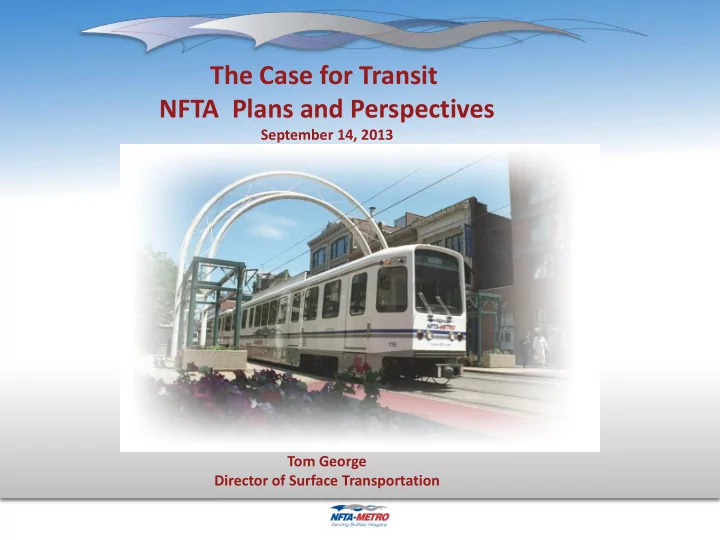
The Case for Transit NFTA Plans and Perspectives September 14, 2013 Discussion Items August 22, 2013 Tom George Director of Surface Transportation The NFTA Today - Service Metro Bus 64 routes with 14 express 80,860 average weekday


slide-1
SLIDE 1

Discussion Items

August 22, 2013

The Case for Transit NFTA Plans and Perspectives

September 14, 2013 Tom George Director of Surface Transportation
slide-2
SLIDE 2
  • 64 routes with 14 express
  • 80,860 average weekday riders
  • 1,566 square miles served
  • 310 buses, 74 Vans
  • 10.7 million annual vehicle miles
  • 23.3 million annual passengers
  • 6.4 route miles
  • 21,400 average weekday riders
  • 27 light rail vehicles
  • 14 stations
  • 1 million annual vehicle miles
  • 6.3 million annual passengers

The NFTA Today - Service

Metro Bus Metro Rail

slide-3
SLIDE 3
  • Household annual income
  • 90% from households less than $50K per year
  • 37% from households less than $10K per year
  • Ethnicity of ridership
  • 42% African American,
  • 33% Caucasian
  • 8% Hispanic
  • Trip Purpose
  • 4 out of 10 riders’ origin or destination was home
  • 25% of origins or destinations was work
  • 94% of all riders walk to/from the their first/last bus or rail stop
  • Fare Transactions
  • 32% of all riders purchase a monthly pass
  • 89% of all riders are full-fare riders
  • 3% of all riders are over the age of 65 (discount fare)
  • 16% of all riders have their fare paid for by employer

The NFTA Today - Demographics / Travel Patterns

slide-4
SLIDE 4

2013 American Bus Benchmarking Group (ABBG)survey indicated

  • 88% Easy to board and disembark Metro buses.
  • 77% Convenient to purchase Metro bus fare media.
  • 72% Metro bus drivers are both helpful and professional.
  • 63% Metro bus stops are located in sensible areas, where riders feel safe

and secure waiting for their buses to arrive. 2013 New York Public Transit Association (NYPTA) survey indicated

  • 65% Desired an increased amount of Public Transit services.
  • 81% Support tax increase for Public Transit
  • 27% Local sales tax
  • 28% Federal Gasoline Tax
  • 14% State Gasoline

The NFTA Today – Customer Perspective

slide-5
SLIDE 5

The NFTA has a unique opportunity to build on the success of the Light Rail Rapid Transit (LRRT) system and its potential economic, social and environmental impact, which is higher than ever. The success of the system has created Transit-

  • riented Development to occur along the corridor which is serving as a catalyst

for economic growth Transit-oriented development is often defined as higher-density mixed-use development within walking distance – or a half mile – of transit stations.

  • As of the September 30, 2012 the NFTAs Metro Rail has the 4th most boarding

per mile of any light rail system in the United States

  • By supporting LRRT sustainability and enhanced service, transit related

economic development will continue to benefit the region and further increase ridership

Metro Rail – Economic Engine

slide-6
SLIDE 6

UB2020

slide-7
SLIDE 7

HarborCenter

slide-8
SLIDE 8

Buffalo Niagara Medical Campus

slide-9
SLIDE 9

LaSalle Station Development

slide-10
SLIDE 10

Enhance the catalyst of economic development opportunity

  • The NFTA is supporting the regional economic development opportunities

along the corridor:

  • $90M currently programmed investment
  • Rail Car rebuild
  • System escalator replacements
  • Cars returning to Main Street – trackbed replacement
  • Fare collection system
  • Systemic replacement and rehabilitation of infrastructure
  • Amherst – Buffalo Corridor Study
  • Canalside / Cobblestone District Study
  • UB School of Medicine
  • Cars returning to Main Street
  • Erie Canal Harbor Station - Revitalization

Metro Rail – Economic Engine

slide-11
SLIDE 11

Metro Rail – Economic Engine

slide-12
SLIDE 12

Amherst Buffalo Corridor Study

Identified Amherst-Buffalo Corridor as good candidates for “major transit investment” based on

  • Service effectiveness (productivity)
  • Market intensity (population and

employment forecast)

  • Development opportunities
  • Travel Patterns
  • Existing Ridership

Enhanced busing, Bus Rapid Transit, or Light Rail Extension

slide-13
SLIDE 13

Amherst Buffalo Corridor Study

Local Financial Commitment

  • Share of total project costs from

sources other than New Starts (Federal Money)

  • Local Match
  • Stability and reliability of the proposed

capital financing plan

  • Ability of sponsoring agency to fund
  • perations and maintenance of the

entire transit system

slide-14
SLIDE 14

Development of multiple community, event and business based facilities significantly increasing the profile of the area and opportunity for transit service to alleviate associated parking and traffic demand

Canalside / Cobblestone District Study

slide-15
SLIDE 15

Project requires reconstruction of ground level of Allen Medical Campus Station to integrate into new School of Medicine

UB School of Medicine

slide-16
SLIDE 16

NFTA project to replace trackbed in conjunction with City of Buffalo project ensures complete reconstruction of 500 and 600 block of Main Street including enhanced Fountain Plaza Station

Cars Returning to Main Street

slide-17
SLIDE 17

Erie Canal Harbor Station

Rendering Looking East

slide-18
SLIDE 18
  • Land use planning and implementation
  • State of Good Repair – aging infrastructure
  • Modernization & technology implementation
  • Perception – convenience, safety and security
  • Obtaining transit mode shift
  • Sustainable operations and capital funding

Public Transit Challenges

slide-19
SLIDE 19
  • Sustainable funding sources
  • Operational to maintain service and state of good

repair

  • Capital to continue support of community

initiatives and advancement of system and services

  • Amherst – Buffalo Corridor capital and
  • perational
  • Land use planning / development consistent with:
  • Framework for Regional Growth
  • One Region Forward
  • Partnerships with business, education and

government to leverage investments and create value

Public Transit Needs