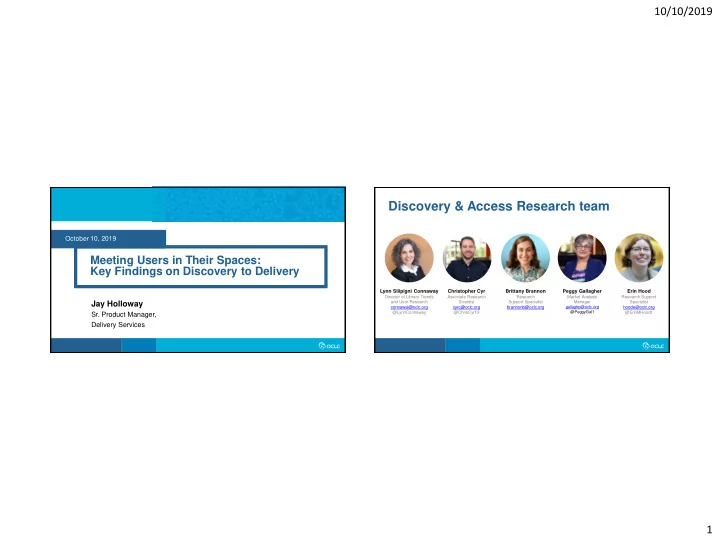
Discovery & Access Research team October 10, 2019 Meeting Users - - PowerPoint PPT Presentation

discovery access research team
SMART_READER_LITE
LIVE PREVIEW

Discovery & Access Research team October 10, 2019 Meeting Users - - PowerPoint PPT Presentation

10/10/2019 Discovery & Access Research team October 10, 2019 Meeting Users in Their Spaces: Key Findings on Discovery to Delivery Lynn Silipigni Connaway Christopher Cyr Brittany Brannon Peggy Gallagher Erin Hood Director of Library


slide-1
SLIDE 1

10/10/2019 1

October 10, 2019

Meeting Users in Their Spaces: Key Findings on Discovery to Delivery

Jay Holloway

  • Sr. Product Manager,

Delivery Services

Lynn Silipigni Connaway

Director of Library Trends and User Research connawal@oclc.org @LynnConnaway

Peggy Gallagher

Market Analysis Manager gallaghp@oclc.org @PeggyGal1

Christopher Cyr

Associate Research Scientist cyrc@oclc.org @ChrisCyr19

Erin Hood

Research Support Specialist hoode@oclc.org @ErinMHood1

Brittany Brannon

Research Support Specialist brannonb@oclc.org

Discovery & Access Research team

slide-2
SLIDE 2

10/10/2019 2

Discovery and Access Project: How do academic library users navigate the path from discovery through to access?

  • What do academic users do when searches don't result in

fulfillment?

  • What differentiates searches that lead to access from

searches that don’t?

  • What demographic characteristics influence the access of

users?

  • How does access correlate with success?

Methodology

  • We want to understand aggregate user behavior to inform

impact and roadmap prioritization

  • However, we also want to understand the ‘why’

How do we get the best of both quantitative and qualitative research methods? Combine them! Tandem use of log analysis and user interviews. Librarian Resource Sharing interviews, too.

slide-3
SLIDE 3

10/10/2019 3

HIGH LEVEL DISCOVERY AND ACCESS FINDINGS INTUITIVE

Convenience is king, queen, the whole court

slide-4
SLIDE 4

10/10/2019 4

  • Context dictates behavior
  • Library discovery must anticipate context
  • Systems need to do the heavy lifting

SMART

Context and situation matter

  • Context dictates behavior
  • Library discovery must anticipate context
  • Systems need to do the heavy lifting

SMART

Context and situation matter

PERSONAL

Delight users

slide-5
SLIDE 5

10/10/2019 5

UNIVERSAL

Share and share alike

INTUITIVE

Convenience is king, queen, the whole court

SMART

Context and situation matter

PERSONAL

Delight users

UNIVERSAL

Share and share alike

slide-6
SLIDE 6

10/10/2019 6

Library on-demand WORLDCAT DISCOVERY SEARCH LOG ANALYSIS

“Log analysis is everything that a lab study is not.”

(Jansen 2017, 349)

slide-7
SLIDE 7

10/10/2019 7

  • 1. Did a keyword search but

mistyped it

  • Had 0 results
  • 2. Redid keyword search with

correct spelling

  • Had 759,902 results
  • 3. Began typing in additional

keyword

  • 4. Selected one of the

autosuggested keyword phrases

  • Had 1,761 results

What do the raw logs tell us?

Ways of evolving a search

Corrected search Refined search Shows greater than 90% similarity with the previous search string Shows 80–90% similarity with the previous search string, with the first string contained in the second, or an index change Shows less than 80% similarity with the previous search string New search

slide-8
SLIDE 8

10/10/2019 8

Summary of results

  • Average of 5 minutes per session
  • Average of 2.2 searches per session
  • Average of 5.1 words per search
  • 12% of sessions had search refinements
  • 33% of sessions had multiple searches

n=282,307 sessions

Types of Requests

Search results Physical access

  • ptions

Online access attempt Attempt to save Physical access attempt

The user made a request for search results. This could include a new search, refinement of an existing search, or the addition of limiters. The user clicked an item or made a request to digitally access the full text of the item. The user attempted to export or otherwise save the citation. The user clicked an item or made a request to place a hold

  • n a physical copy of the item.

Some users left the system after looking at a holding, where they were able to identify the physical item call number and/or location. These users were categorized as having the option to physically access the item.

slide-9
SLIDE 9

10/10/2019 9

39% 54% 20% 19% 30% 16% 5% 6% 2% 2%

0% 10% 20% 30% 40% 50% 60% 70% 80% 90% 100%

Last requests (n=274,346 requests) All click events (n=1,961,168 events)

All click events vs. Last requests by type of request

Search results Physical access option Online access attempt

While search results account for over half (54%) of all click events, they account for just over a third (39%) of last requests

Probability of fulfillment

Number of searches 2 Number of search refinements Words per search 2 Results per search 1000 Keyword limiter (1 if yes, 0 if no) 1 Author limiter (1 if yes, 0 if no) Title limiter (1 if yes, 0 if no)

Chance of Fulfillment 69.09%

Number of searches 2 Number of search refinements Words per search 7 Results per search 1000 Keyword limiter (1 if yes, 0 if no) 1 Author limiter (1 if yes, 0 if no) Title limiter (1 if yes, 0 if no)

Chance of Fulfillment 70.32%

Number of searches 2 Number of search refinements Words per search 2 Results per search 1000 Keyword limiter (1 if yes, 0 if no) 1 Author limiter (1 if yes, 0 if no) 1 Title limiter (1 if yes, 0 if no)

Chance of Fulfillment 84.76%

slide-10
SLIDE 10

10/10/2019 10

USER INTERVIEWS

“User interviews can help capture search and discovery behavior as the user understands it, rather than as a computer system understands it.”

(Connaway, Cyr, Brannon, Gallagher, and Hood 2019)

Example questions

  • “Please tell us what you were looking for and why you

decided to do an online search.”

  • “Did the item you were searching for come up in your

search results? In other words, did you find it?”

  • “I’d like to understand how you felt about your search

experience overall. Would you say you were delighted with your search experience?”

slide-11
SLIDE 11

10/10/2019 11

What ‘just the logs’ told us:

  • Began keyword search but mistyped it
  • Had 0 results
  • Redid keyword search with correct

spelling

  • Had 759,902 results
  • Began typing in additional keyword
  • Selected one of the autosuggested

phrases

  • Had 1,761 results

What logs and interviews told us:

  • Just starting work on a paper on a broad topic;

didn’t yet have a direction for the paper

  • Was overwhelmed with number of search

results

  • Abandoned “library search” to do “Google

searching” to better determine a direction for the paper

  • Later came back to the library search and

found it useful

  • Also received help from student workers in the

library

  • Felt “prepared” to use the library search due to

1st-year library instruction

What do the interviews tell us? METHODOLOGY CHALLENGES AND BENEFITS

“The methodology used for this study also could be extended beyond discovery systems. Other computerized activities that leave digital traces could be studied using interview protocols based on log analysis.”

(Connaway, Cyr, Brannon, Gallagher, and Hood 2019)

slide-12
SLIDE 12

10/10/2019 12

Challenges of methodology

(Tandem use of log data and user interviews)

  • Resource intensive

Time consuming Multiple team members Multiple IRBs

  • High level of expertise required

Benefits of methodology

(Tandem use of log data and user interviews)

  • Provide context for quantitative data
  • Clarify qualitative data
  • Most effective when digital traces are

present

slide-13
SLIDE 13

10/10/2019 13

Impact of Study

  • Collaborate internally in new ways
  • Identify why and what users did during the search

and when acquiring resources

  • Develop a new methodology for studying user

behaviors

  • Influence product and system development

Thank you!

Jay Holloway