Disclosures UCSF School Department of Family Office of - - PowerPoint PPT Presentation

disclosures
SMART_READER_LITE
LIVE PREVIEW

Disclosures UCSF School Department of Family Office of - - PowerPoint PPT Presentation

Disclosures UCSF School Department of Family Office of Developmental of Medicine and Community Medicine Primary Care I have no relationships with commercial interests to disclose. Thank you to WITH and Stupski Foundations for your support.


slide-1
SLIDE 1

1 | [footer text here]

UCSF School

  • f Medicine

Department of Family and Community Medicine Office of Developmental Primary Care

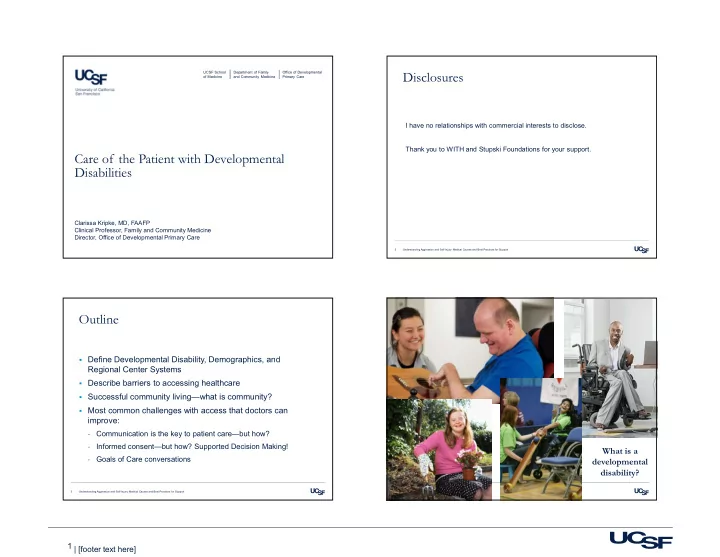
Care of the Patient with Developmental Disabilities

Clarissa Kripke, MD, FAAFP Clinical Professor, Family and Community Medicine Director, Office of Developmental Primary Care

Understanding Aggression and Self-Injury: Medical Causes and Best Practices for Support 2

Disclosures

I have no relationships with commercial interests to disclose. Thank you to WITH and Stupski Foundations for your support.

Understanding Aggression and Self-Injury: Medical Causes and Best Practices for Support 3

Outline

  • Define Developmental Disability, Demographics, and

Regional Center Systems

  • Describe barriers to accessing healthcare
  • Successful community living—what is community?
  • Most common challenges with access that doctors can

improve:

  • Communication is the key to patient care—but how?
  • Informed consent—but how? Supported Decision Making!
  • Goals of Care conversations

What is a developmental disability?

slide-2
SLIDE 2

2 | [footer text here]

Understanding Aggression and Self-Injury: Medical Causes and Best Practices for Support 5

Regional Center Eligibility

  • Originates before age 18, expected to continue indefinitely
  • Substantial disability for the individual
  • Self care
  • Language
  • Learning
  • Mobility
  • Self-direction
  • Independent living
  • Economic self sufficiency
  • Includes, intellectual disability, cerebral palsy, epilepsy, autism

Understanding Aggression and Self-Injury: Medical Causes and Best Practices for Support 6

What are Regional Centers?

Regional Centers are quasi-governmental agencies which develop and fund services and supports for people with DD

  • Administer California’s Entitlement to Services and Supports
  • Lifelong services to maximize potential (not medically necessary)
  • Every client has a service coordinator
  • Individual Program Plan Services and Supports determined

through negotiation based on: assessment, goal, individual preference, cost effectiveness

  • Disparities in resources. 24% of Regional Center clients have a

primary language other than English

  • Must not supplant generic services
  • Maximizes the use of natural supports

Understanding Aggression and Self-Injury: Medical Causes and Best Practices for Support 7

Other Government Agencies

  • Schools until age 22:
  • California Children’s Services until age 21
  • MediCal/SSI
  • In Home Support Services
  • SSDI/Medicare (when age 65 or parent retires or dies)
  • Department of Vocational Rehabilitation

Living Situation for People with DD California 2016

Children Family Home 97% Group Home 3% Adults Family Home 60% Own Home (Supported Living) 17% Group Home 16% Intermediate Care Facility 5% Institution 1%

Department of Developmental Services Fact Book, 14th Ed.

slide-3
SLIDE 3

3 | [footer text here]

Understanding Aggression and Self-Injury: Medical Causes and Best Practices for Support 9

What Is Community?

  • Prior to late 1970’s most people with developmental

disabilities lived in institutions

  • People in institutions died young of infectious disease, fire,

malnutrition, neglect

  • California had a program of state sponsored eugenics with

forced sterilization until 1979

  • When we started moving people out, they were mostly

moving into 6-person group homes with 24 hour care and sheltered workshops and day programs where people worked for less than minimum wage

  • The new CMS Home and Community Based Settings

regulations redefine community in terms of the ability to direct your own live and fully participate

Understanding Aggression and Self-Injury: Medical Causes and Best Practices for Support 10

Barriers to Accessing Health Care

  • Barriers can be physical (built environment and medical

equipment), programmatic, communication, financial, or attitudinal

  • Only 3% of Primary Care practices in CA even have a

wheelchair accessible scale!

  • Bridging the Gap: Improving Healthcare Access for People

with Disabilities: https://www.youtube.com/watch?v=fwhT1KFBDV4

Presentation Title 11 Understanding Aggression and Self-Injury: Medical Causes and Best Practices for Support 12

Improving Access to Health Care

Communication Access

  • Communication is the foundation of patient care
  • Everybody communicates
  • Just because I don’t talk, doesn’t mean I have nothing to say!
  • Ask. Find a way! Presume competence
  • Try auditory, visual, tactile, kinesthetic
  • http://odpc.ucsf.edu/advocacy/advice-from-self-advocates/non-

traditional-communicators

  • http://odpc.ucsf.edu/training/best-practices-communication
  • http://odpc.ucsf.edu/communications-paper
slide-4
SLIDE 4

4 | [footer text here]

Understanding Aggression and Self-Injury: Medical Causes and Best Practices for Support 13

Improving Access to Health Care

Supported Decision Making

  • Supported Decision Making (SDM) is a paradigm for

empowering people with cognitive, communication and physical disabilities to maintain their legal capacity, even if you need support to make decisions.

  • SDM is an alternative to conservatorship, power of attorney,
  • r protocols for unrepresented patients which transfer

decision-making to a third party

  • A decision is understanding the options, weighing them

against each other and communicating a choice

  • Capacity is not fixed (people can gain or lose it)
  • Capacity is determined for a specific decision at a specific

moment in time

Understanding Aggression and Self-Injury: Medical Causes and Best Practices for Support 14

Improving Access to Health Care

Supported Decision Making

Understanding Aggression and Self-Injury: Medical Causes and Best Practices for Support 15

Improving Access to Health Care

Goals of Care Conversations

  • The lives of people with disabilities are meaningful and valuable at

all stages and regardless of functional status

  • Accommodations, adaptive equipment, access, inclusion and

participation improve quality of life

  • Caregivers require resources and support
  • People with functional limitations are usually much happier and

capable than they are judged to be by others

  • Ability bias is pervasive and patients can internalize messages

(burden, suffering, unfortunate, tragic, bound, vegetable, heroic for simply being, childlike)

  • It is terrifying to be dependent for care and support on people who

do not think your life is worth living

Clinical Differences: Elders vs. People with Disabilities

Elders People with Disabilities Functional limitation (often but not always) = advanced vital organ damage Functional limitation = stable, often healthy vital organs Functional decline is often a sign illness is nearing terminal stages Functional decline may not indicate terminal illness at all Poorly adjusted to living with disability - need supports Adjusted to living with disability - function better - may have supports in place Often don’t benefit from aggressive medical care Often benefit from aggressive medical care Short term memory problems interfere with success of habilitation and rehabilitation Short term memory usually intact and can learn new skills, even with cognitive disability If the problem is advanced dementia, age, or illness, enteral feeding and ventilation support is unlikely to extend life or improve quality If the problem is neuromuscular or mechanical, enteral feeding and ventilation support is life sustaining and can support an active, full life- style

slide-5
SLIDE 5

5 | [footer text here]

Functional Status Time Elders People with Disabilities medical event medical event Medical events Recover to lower baseline function Predicts terminal decline Recover to previous baseline Sometimes slower process

Common Pitfalls Discussing Goals of Care

  • Pity
  • Abandonment
  • Misleading prognosis
  • Threat of institutionalization
  • Offering interventions without context
  • Dehumanization
  • Devaluing the life of a person with a disability
  • Stealing hope
  • Disrespecting autonomy

*Often well meaning and intent is to convey empathy Patients with Disabilities: Avoiding Unconscious Bias When Discussing Goals of Care. https://www.aafp.org/afp/2017/0801/p192.pdf

Community Living is for Everyone!

Understanding Aggression and Self-Injury: Medical Causes and Best Practices for Support 20

Office of Developmental Primary Care 500 Parnassus Avenue, Box 0900 Tel: 415-476-4641 | Fax: 415-476-6051 email: odpc@fcm.ucsf.edu web: http://odpc.ucsf.edu