Disclosures and the medical-industrial Consultant Trimed Co AO - - PowerPoint PPT Presentation

disclosures
SMART_READER_LITE
LIVE PREVIEW

Disclosures and the medical-industrial Consultant Trimed Co AO - - PowerPoint PPT Presentation

5/10/2013 Dr. J.W. Scott s parabola Disclosures and the medical-industrial Consultant Trimed Co AO Foundation complex Stock OHK Co Research AO foundation Reviewer Elsevier;Springer;


slide-1
SLIDE 1

5/10/2013 1

  • Dr. J.W. Scott’

’ ’ ’s parabola and the medical-industrial complex

Jesse B Jupiter MD Hansjorg Wyss/AO Professor Harvard Med

Disclosures

  • Consultant Trimed Co
  • AO Foundation
  • Stock OHK Co
  • Research AO foundation
  • Reviewer Elsevier;Springer; Walter Klower
  • Editor Walter Klower
  • Committess AAHS;ASSH;AAOS
  • All images in presentation are my own

I certify that, to the best of my knowledge, no aspect of my current personal

  • r profession situation might reasonably be expected to affect significantly

my views on the subject on which I am presenting.

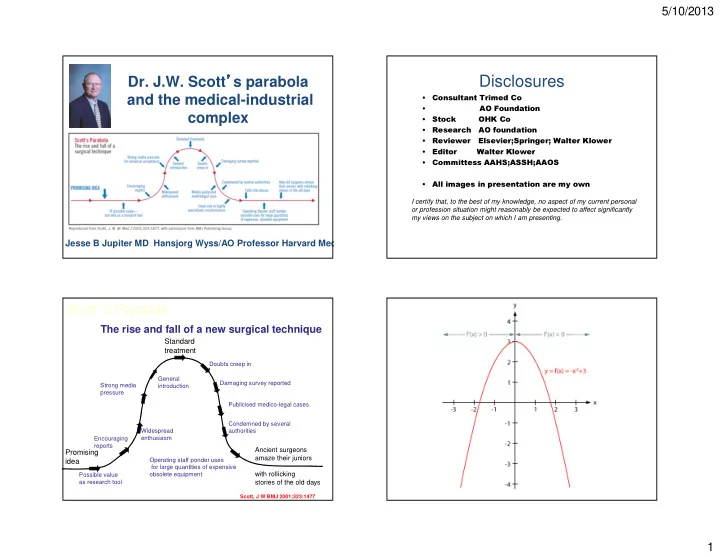
Scott’s Parabola

The rise and fall of a new surgical technique

Promising idea Standard treatment

Possible value as research tool Encouraging reports Widespread enthusiasm Strong media pressure General introduction Doubts creep in Damaging survey reported Publicised medico-legal cases Condemned by several authorities Operating staff ponder uses for large quantities of expensive

  • bsolete equipment

Ancient surgeons amaze their juniors with rollicking stories of the old days

Scott, J W BMJ 2001;323:1477

slide-2
SLIDE 2

5/10/2013 2

  • Dr. J.W. Scott’

’ ’ ’s parabola and the medical-industrial complex

AO/ASIF Hand Study Group Distal Radius Plate

Jesse B. Jupiter, MD Ueli Buchler, MD Jurg Brennauld, MD Hill Hastings, MD

Solution in the 1990’s

  • Precontoured but

flexible design

  • Option of butttress

pins anchored into plate

  • Recessed screw

holes

  • Self tapping

screws

Scott’s Parabola

The rise and fall of a new surgical technique

Promising idea

Possible value as research tool Encouraging reports

Scott, J W BMJ 2001;323:1477

slide-3
SLIDE 3

5/10/2013 3

10

Scott’s Parabola

The rise and fall of a new surgical technique

Promising idea Standard treatment

Possible value as research tool Encouraging reports Widespread enthusiasm Strong media pressure General introduction

Scott, J W BMJ 2001;323:1477

Scott’s Parabola

The rise and fall of a new surgical technique

Promising idea Standard treatment

Possible value as research tool Encouraging reports Widespread enthusiasm Strong media pressure General introduction Doubts creep in Damaging survey reported

Scott, J W BMJ 2001;323:1477

slide-4
SLIDE 4

5/10/2013 4

π Plate--problems

  • Design ??
  • Metallurgy ??

Scott’s Parabola

The rise and fall of a new surgical technique

Promising idea Standard treatment

Possible value as research tool Encouraging reports Widespread enthusiasm Strong media pressure General introduction Doubts creep in Damaging survey reported Publicised medico-legal cases Condemned by several authorities Operating staff ponder uses for large quantities of expensive

  • bsolete equipment

Ancient surgeons amaze their juniors with rollicking stories of the old days

Scott, J W BMJ 2001;323:1477

“ “ “ “Emerging” ” ” ” Orthopaedic Technologies

Chymopapain disc injections

  • Pioneered by Dr. Lyman Smith
  • 7000 US surgeons “

“ “ “trained” ” ” ”

  • Complications – paraplegia, stroke

Chymopapain 1984 Chymopapain 1986

slide-5
SLIDE 5

5/10/2013 5

“ “ “ “original industry-sponsored trials …were remarkable for the complete absence of reported rhBMP-2–related clinical adverse events…” “…some clinical researchers in the current ‘‘ ‘‘ ‘‘ ‘‘market environment’’ ’’ ’’ ’’ cannot be trusted to resist enormous financial forces that encourage biased reporting…” ” ” ” “…most cursory review shows that this was all about devices and drugs used in an off-label manner…” ” ” ” “ “ “ “…our patients remain our number one priority.We need to fulfill their trust.’’ ’’ ’’ ’’

OBJECTIVES

  • Examine existing problems with our

scientific studies

  • Bring into focus the “medical-industrial

complex” on health care

  • Evaluate perspectives on our

relationships with industry and research

OBJECTIVES

  • Examine existing problems with our

scientific studies

  • Bring into focus the “medical-industrial

complex” on health care

  • Evaluate perspectives on our

relationships with industry and research

Musculoskeletal Research System

  • Rewards positive results
  • Little motivation to perform negative

studies or those that duplicate prior published results

  • “Positive” trials and “negative” trials

take the same amount of time to conduct but “negative” trials take 2-4 years longer to be published

slide-6
SLIDE 6

5/10/2013 6

Musculoskeletal Research

“Evidence-based Triad” vs “Orthopaedic Triad”

Dr Freddie Fu

  • Famous surgeon
  • Famous athlete
  • Untested treatment
  • Combining best

available evidence with

  • Clinical expertise of

the physician

  • And the expectation

and value of the patient

Famous People’s Hip

Jack Jimmy Floyd Mary Lou

Douglas Jackson MD

Orthopaedics today, June 2012

  • “ Reproducibility of published work is only
  • ccasionally challenged by knowledgable

scientists and clinicians who work in the same field or by industry when it tries to duplicate results before proceding with product development”

“ In contrast, successful venture capitalists

will be more inclined to reproduce results by independent observers before committing to early funding”

Dr John P. Ioannidis

Stanford’s Prevention Reseach Center

‘In many different ways, much of what biomedical researchers conclude is misleading, exaggerated, and at times wrong’

slide-7
SLIDE 7

5/10/2013 7

  • Dr. John P. Ioannidis
  • 2005 landmark paper in PLoS Medicine,

demonstrated convincingly in # studies in different fields of medical research a) 80% of non-randomized turn out to be in error b) 25% randomized controlled trials also flawed c) 10% of “platinum” large clinical trials flawed

  • Dr. John P. Ioannidis

Stanford

  • In randomized controlled trials, he found

it was easy to manipulate results at every step

  • room to distort results
  • make a stronger claim
  • r select what is going to be concluded

“Intellectual conflict of interest”

David Freedman Lies, Damned Lies, and Medical Science The Atlantic 2012

  • Dr. John P. Ioannidis

Stanford

randomized controlled trials-- range of errors

  • What questions researchers asked
  • How they set up the study
  • Which patients were included
  • Which measurements used
  • How data analyzed
  • How results presented
  • How studies came to be published

David Freedman Lies, Damned Lies, and Medical Science The Atlantic 2012

  • Dr. John P. Ioannidis

Stanford

  • Studied 49 of most highly regarded research

findings in medicine over prior 13 yrs

  • 45 claimed to have uncovered effective

interventions

  • 34 had been retested with 14 or 41% shown to

be wrong or substantially exaggerated results

JAMA 2005

slide-8
SLIDE 8

5/10/2013 8

  • Dr. John P. Ioannidis

Stanford

  • Notes that much of the wrongness problem could be

solved if the world simply stopped expecting scientists to be right. But as long as careers remain contingent on producing a stream of research that is dressed up to seem more right than it is, scientists will keep delivering exactly that

  • “Science is a noble endeavor, but it is also a low-yield
  • endeavor. I’m not sure that more than a very small % of

medical research is ever likely to lead to major improvements in clinical outcomes and quality of life. We should be very comfortable with that fact”

David Freedman The Atlantic 2012

OBJECTIVES

  • Examine existing problems with our

scientific studies

  • Bring into focus the “medical-industrial

complex” on health care

  • Evaluate perspectives on our

relationships with industry and research

The Medical Industrial Complex: Understanding the Business of Medicine

Michael R. Mills, MD, MPH February 2012

Graph 1: Escalation of healthcare costs as a percentage of GDP

The American Health Enterprise: Power, Profits, and Politics

Barbara Ehrenreich

  • Among the first to introduce the term

“medical-industrial complex”

slide-9
SLIDE 9

5/10/2013 9

President Dwight D. Eisenhower

Farewell Address Jan 17, 1961

President Dwight D. Eisenhower

Farewell Address Jan 17, 1961

  • Warned the nation of the risks of an

emerging “military-industrial complex”

  • Growing dependence of universities

and research labs for federal funds

  • Potentials to compromise researchers

in their search for truth as well as reduce the “scholar” to an “obedient servant”

Dr Michael Mills Medical-Industrial Complex

  • 3 Trillion dollar

industry

  • One of fastest

growing business in USA

  • Interaction of MDs,
  • ther providers,

hospitals, nursing homes, insurance co., pharma et al.

Graph 2: Distribution of healthcare expenditures in the UnitedStates, 2008

The Social Transformation of American Medicine

Paul Starr 1982

  • Landmark study of the social and

economic development of medicine in America

  • Final chapter “The Coming of the

Corporation” describes the new corporate transformation of the United States health care system and its growing threat to the sovereignty of physicians

slide-10
SLIDE 10

5/10/2013 10

  • Dr. Arnold Relman
  • “Corporatization of medicine is a

challenge to physicians’ authority, and even legitimacy for doctors who become healthcare industry owners or with financial stake in industry”

NEJM 1980

  • Dr. Arnold Relman
  • “ Doctors are not saints, but not

sinners either. They are sensible, pragmatic, decent” “Argued that if physicians are to represent their patients interests in the new medical marketplace, they should have no economic conflict of interest”

Stanford U

San Jose Mercury News 2006

  • For # years most researchers in life

sciences had little to do with corporations

  • In 1970s the venture capital community

noticed advances in molecular biology

  • Dr Stanley Cohen working with Dr

Herbert Boyer at UCSF invented a technique that allowed mass production of human proteins giving birth to the new biotech industry.

Dr Paul Berg

Nobel Laureate

  • Over his objections Stanford in 1974

filed for patents on the Cohen-Boyer invention

  • Ultimately brought Stanford 225 million

in fees and royalties

  • Ushered in a new era of financial
  • pportunities for the school and its

scientists

slide-11
SLIDE 11

5/10/2013 11

Dr Paul Berg

Nobel Laureate

  • “like anything, there is an upside and
  • downside. What is happening is that

the lure of money begins to erode how careful you are guarding against the downside….I myself just think that things have shifted too far towards commercialization”

Stanford Medical School

  • 2001 established 10 member conflict of

interest to oversea how substantial conflicts that exceed certain thresholds are handled

  • Dr. Barbara Koenig

bioethics research Mayo Clinic

  • “ there is a focus on procedural

solutions and the magical belief that disclosure is the answer as opposed to dealing with the fact that many of these things should not be allowed”

  • Dr. Sidney Levitsky

Ann.Surg 2007

  • “ Corporatization and the need for

adjustment for financial survival has forced many academic centers to move the original mission from teaching, research, and clinical care to become outstanding profitable care providers using clinical research as a profit- center”

No Margin No Mission

slide-12
SLIDE 12

5/10/2013 12

Dean Kaman

  • “ If you listen to what a lot of our

political leaders say, they believe that industry is a bunch of people that get together every morning and say “what new innovation can we make that is more expensive, less effective, and maybe kill babies just gratuitously”

President Dwight D. Eisenhower

Farewell Address Jan 17, 1961

  • “We must guard against the acquisition
  • f unwarranted influence, whether

sought or unsought, by the military- industrial complex”

  • Ioannidis. “But as long as careers remain

contingent on producing a stream of research that is dressed up to seem more right than it is, scientists will keep delivering exactly that”

slide-13
SLIDE 13

5/10/2013 13

U.S. Senate Special Committee on Aging

Surgeons for Sale: Conflicts and Consultant Payments in the Medical Device Industry 3/27/2008 Senator Kohl Chairman Senator Grassley “These types of unethical payments… have been pervasive and industry-wide for far too long. “If these physicians are essentially putting their medical judgment up for sale, where does the patient’s well-being fit into the equation?”

Historic Regulation of Drugs and

Devices

1207 – 1272 Henry lll of England Decreed the Assize of Bread and Ale First regulated weight and purity bread, volume of Ale in 1266 The term “ “ “ “ Baker’ ’ ’ ’s Dozen” ” ” ”

  • riginated from this law

1813 Vaccine Control Act

guard against adulterated smallpox vaccine

1902 Biologic Control Act

passed in response to death of 13 children in St. Louis and 9 children in Camden due to improper vaccine preparation Edward Jenner Horse named Jim produced diphtheria anti-toxin serum contaminated with tetanus

slide-14
SLIDE 14

5/10/2013 14

1906 Pure Food and Drug Act

Upton Sinclair – exposed unbridled capitalism and corruption in meatpacking industry. Considered the founding date of FDA

1938 – Federal Food Drug and Cosmetic Act

The introduction of this act was influenced by the death of more than 100 patients due to a sulfanilamide medication was dissolved in diethylene glycol S E Massengil Co “Elixir Sulfanilimide”

The linked image cannot be displayed. The file may have been moved, renamed, or deleted. Verify that the link points to the correct file and location.

1962 Kefauver - Harris Amendment

Legislation in response to Thalidomide

  • Disaster. For the first time a drug must

be safe and effective. Thalidomide

  • Dr. Frances Oldham Kelsey

New hire to FDA. Resisted pressure from drug company WS Merrell for US approval. Awarded presidential medal by J F Kennedy phocomelia

Dalkon Shield

  • Intrauterine birth control device - Inventor Hugh J Davis MD –

Johns Hopkins professor of gynecology

  • Sold rights to A H Robbins in 1971 for $750,000. and 10% of

sales.

  • Heavily market on basis of single study by Davis
  • Study claimed 1.1% failure rate – actual rate 5.5 % - facts known

and concealed by company

  • Used by 2.8 million woman, 300,000 lawsuits
  • Flawed design responsible for birth defects, sepsis and death

Root Causes Dalkon Shield Disaster

  • Dishonesty – Dr. Davis claimed a 1.1% failure rate in

his study - actual rate 5.5%

  • Dr. Davis instructed study patients to use spermicide –

never disclosed. Dr.Davis later added copper to IUD to improve contraception rate - not dislcosed

  • Design Flaw – Only IUD on Market with a braided string

– caused wicking of bacteria.

slide-15
SLIDE 15

5/10/2013 15

Dalkon Shield

Billions in legal fees and settlement 2 billion dollar trust fund for patients over 15 years bankruptcy for AH Robbins

Dalkon Shield Disaster

  • Corporate Greed – AH Robbins knew almost

from the beginning of problems but marketed

  • heavily. Withheld and destroyed information.

Prompted Congress to enact Medical Device Amendment Act of 1976 For the first time the FDA regulated medical devices

The Medical Device Amendment Act of 1976

Congress gave FDA authority classify and regulate medical devices

Medical Device – A contrivance intended to affect the structure

  • r any function of the body of man, and which does not

achieve any of it's primary intended purposes through chemical action within or on the body insulin insulin pump total shoulder drug eluting stent drug, not a device medical devices combined device

FDA classification of Medical Devices

  • Class I – non critical devices

no premarket notification

  • Class II – premarket notification needed

may need premarket data may need post market surveilence usually approved with 510K process

  • Class III – critical devices, used to support life or

bodily function. Needs premarket approval (PMA) (with exception).

slide-16
SLIDE 16

5/10/2013 16

FDA Class I Medical Device

47% of medical devices are class I 95% are exempt form regulation

FDA classification of Medical Devices

  • Class I – non critical devices

no premarket notification

  • Class II – premarket notification needed

may need premarket data may need post market surveilence usually approved with 510K process

  • Class III – critical devices, used to support life or

bodily function. Needs premarket approval (PMA) (with exception).

FDA Class II Medical Device

Electric wheelchair total hip replacement infusion pump total knee replacement Highly cross-linked polyethylene

43% of all device Requires premarket notification

FDA classification of Medical Devices

  • Class I – non critical devices

no premarket notification

  • Class II – premarket notification needed

may need premarket data may need post market surveilence usually approved with 510K process

  • Class III – critical devices, used to support life or

bodily function. Needs premarket approval (PMA) (with exception).

slide-17
SLIDE 17

5/10/2013 17

FDA Class III Medical Device

heart valve pacemaker surface replacement mobile bearing knee ceramic total hip

10% of medical devices Requires premarket approval (PMA) 3 to 5 year costly process “ “ “ “The committee concludes that the 510(k) process lacks the legal basis to be a reliable premarket screen of the safety and effectiveness of moderate-risk devices and furthermore, that it cannot be transformed into one.” ” ” ”

Institute of Medicine Report Medical Devices and the Public health July 2011

OBJECTIVES

  • Examine existing problems with our

scientific studies

  • Bring into focus the “medical-industrial

complex” on health care

  • Evaluate perspectives on our

relationships with industry and research

TOO FAR???

slide-18
SLIDE 18

5/10/2013 18 Medicine’s industrial revolution

J.D Kleinke Wall St J 1995

  • “ Many physicians are understandably

threatened by this watershed in the history of medicine, this challenge to 2500 years of clinical hegemony. From unquestioned GOD to accountable production worker is a long way to fall in a few short years”

  • ” a small minority of voices is impeding

medical and scientific progress with their concerns regarding potential ‘conflicts of interest’ by decrying the beneficial relationships between industry and medicine”

Thomas J. Stossel M.D Professor of Medicine Harvard Medical School.

  • “It has gone from bad to worse.

Immense regulatory issues and massive confessions where we disclose our relationships to industry and these are used to initiate a whole variety of inhibitors in freedom of speech, freedom of association, and reward for excellence”

Thomas J. Stossel M.D.

  • “Believe that those in industry allegedly

live in a separate moral universe than

  • medicine. The idea that those who work

for industry are obligated to lie, cheat, and steal for profit and for investors”

Thomas J. Stossel M.D.

slide-19
SLIDE 19

5/10/2013 19

  • “ Medical care is incomparably better

today than when I received my MD degree in 1967—due primarily to the availability of products developed by industry in unencumbered collaboration with physicians and industry’s commitment to teach physicians how to use them”

Thomas J. Stossel M.D.

  • “Evidence that collaborations

“compromise integrity and patient care is ‘practically nonexistent’

  • 2009 Institute of Medicine report on

conflict of interest was unable to find evidence that relationships with industry adversely affect what really counts—patient outcomes

Thomas J. Stossel M.D.

“ Who doesn’t really care? Consumers don’t as few patients have the time, interest, or competence to interpret

  • disclosures. Most surveys show that

patients have few concerns regarding the physician-industry relationship”

Thomas J. Stossel M.D.

Patients’ Views on Surgeons’ Financial Conflicts of Interest

Camp MW et al Orthopaedic Forum JBJS 2013

Surveyed 251 post op patients in USA and Canada Few patients worried about financial relationships with industry (6%) Most thought appropriate for surgeons to receive payments for activities that could help patients ( US 69%; Canada 66%) Majority felt that their surgeon would hold patients’ interests paramount ( US 79%; Canada 74%) Most wanted professional organizations to ensure

  • versight ( US 83%; Canada 83%)
slide-20
SLIDE 20

5/10/2013 20

What can we do about this?

Compliance Regulations Disclosure Sunshine Act Ethical behaviour Scientific Integrity

  • Dr. J.W. Scott’

’ ’ ’s parabola and the medical-industrial complex

Regulations? Registry? “ “ “ “Yet harm has been done. And that fact creates a basic moral obligation. As John F. Kennedy stated, ‘‘ ‘‘ ‘‘ ‘‘This moral issue is as old as the scriptures and is as clear as the American Constitution.’’ ’’ ’’ ’’

slide-21
SLIDE 21

5/10/2013 21

“ “ “ “ use of media by some unscrupulous, megalomaniac orthopedists…. Is an example of the growing collapse of professionalism…” ” ” ” “ “ “ “medicine is no longer a profession but a business, were profit is the name

  • f the game…”

” ” ” “ “ “ “education of the orthopedist is primarily structured to satisfy the marketing needs

  • f industry…”

” ” ” “ “ “ “(orthopedists) lowered themselves to playing the role of agents for industry… (to help) the sales of products from which they receive royalties or kickbacks.” ” ” ” Past President The American Academy of Orthopedic Surgery

A J Cronin, M.D.

Andrew Manson, M.D. – A once idealist physician, now corrupted by a" Harley Street” ” ” ” avarice.

  • Mr. Joseph LeRoy – a pharmaceutical

industrialist , making a proposal to

  • Dr. Manson

…” ” ” ”we can enlist the help and sympathy of the whole medical profession, make every doctor, so to speak, a potential salesman” ” ” ” …” ” ” ”now this means scientific advertising, Doc, scientific approach and that’ ’ ’ ’s were I believe a young scientific doctor on the inside could help us along the road.” ” ” ”

  • Mr. LeRoy talking to Dr. Andrew Manson

The Citadel, A.J.Cronin 1937

Moral Hazzard

Economist Paul Krugman described moral hazard as: "...any situation in which one person makes the decision about how much risk to take, while someone else bears the cost if things go badly

Be not the first by whom the new are tried, nor yet the last to lay the old aside.

Alexander Pope, An Essay on Criticism, 1711

slide-22
SLIDE 22

5/10/2013 22 “ “ “ “One of the essential qualities of the clinician is interest in humanity, for the secret of the care

  • f the patient is in the

caring for the patient.” ” ” ”

JAMA March 19,1927 Francis Weld Peabody

The Care of The Patient

Jones NF, Swartz W, Mears DC, Jupiter J, Grossman A. The double-barre free vascularized fibular bone graft.

  • Plast. Reconstr. Surg. 1988; 81:378-85.
slide-23
SLIDE 23

5/10/2013 23

THANK YOU