Disclosures Updates on Oncologic I have nothing to disclose - - PowerPoint PPT Presentation

disclosures
SMART_READER_LITE
LIVE PREVIEW

Disclosures Updates on Oncologic I have nothing to disclose - - PowerPoint PPT Presentation

6/20/2019 Disclosures Updates on Oncologic I have nothing to disclose Emergencies, Including Side Effects of New Therapies Gerald Hsu, MD, PhD Assoc. Clinical Professor of Medicine University of California, San Francisco Hypercalcemia | Old


slide-1
SLIDE 1

6/20/2019 1

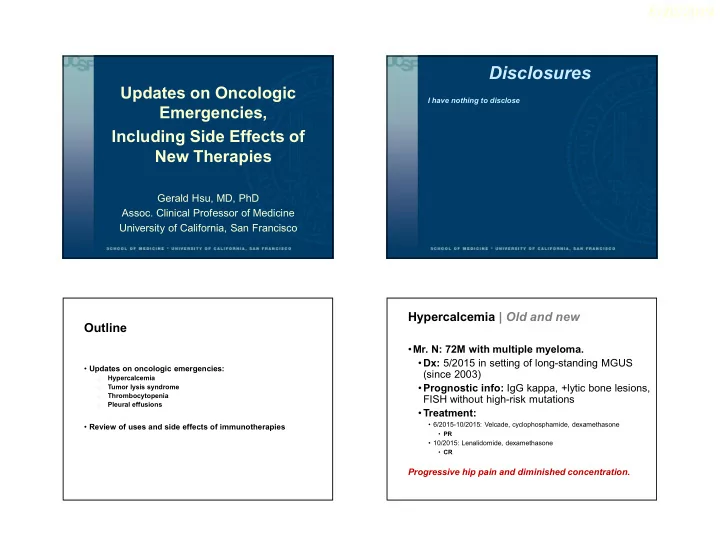
Updates on Oncologic Emergencies, Including Side Effects of New Therapies

Gerald Hsu, MD, PhD

  • Assoc. Clinical Professor of Medicine

University of California, San Francisco

Disclosures

I have nothing to disclose

Outline

  • Updates on oncologic emergencies:

Hypercalcemia

Tumor lysis syndrome

Thrombocytopenia

Pleural effusions

  • Review of uses and side effects of immunotherapies

Hypercalcemia | Old and new

  • Mr. N: 72M with multiple myeloma.
  • Dx: 5/2015 in setting of long-standing MGUS

(since 2003)

  • Prognostic info: IgG kappa, +lytic bone lesions,

FISH without high-risk mutations

  • Treatment:
  • 6/2015-10/2015: Velcade, cyclophosphamide, dexamethasone
  • PR
  • 10/2015: Lenalidomide, dexamethasone
  • CR

Progressive hip pain and diminished concentration.

slide-2
SLIDE 2

6/20/2019 2

Mild Moderate Severe Hypercalcemia | Manifestations

  • Progressive mental

impairment and renal failure.

  • A poor prognostic sign.
  • Treatment is indicated if

hypercalcemia is symptomatic or severe.

10.0 1.4 12.0 2.0 14.0 2.5

Ca2+ mg/dL ioniz Ca2+ mmol/L

Much less common:

  • 1,25(OH)2D secreting tumors (lymphomas)
  • PTH secreting tumors

Hypercalcemia | Mechanisms

type mechanism Associated cancers Humoral PTHrP

  • Squamous cancers (most

commonly lung)

  • Breast cancer
  • Renal cancer
  • Ovarian or endometrial cancer

Osteolytic Cytokine mediated and PTHrP

  • Multiple Myeloma
  • Breast cancer
  • Lymphoma

volume repletion and supportive care

  • NS 200-300 cc/hr
  • oral phos repletion (goal 2.5-3 mg/dL)

bring down the calcium

  • bisphosphonate +/- calcitonin
  • either pamidronate or zoledronate
  • response time: hours for calcitonin; about a day

with bisphophonate

  • duration: up to 4 weeks

treat underlying cause

Hypercalcemia | Review

slide-3
SLIDE 3

6/20/2019 3

Options for treating severe hypercalcemia in AKI (Cr >4.5)

  • Full dose bisphosphonate
  • Reduced dose bisphosphonate with slower

infusion rate

  • (eg. 4 mg zoledronic acid over 1 hour
  • r 30 mg pamidronate over 4 hours)
  • Calcitonin until kidney function improves
  • RANK ligand inhibitor (ie. denosumab) that is not

renally cleared.

Hypercalcemia | New(ish)! Outline

  • Updates on oncologic emergencies:

Hypercalcemia

Tumor lysis syndrome

Thrombocytopenia

Pleural effusions

  • Review of side effects of immunotherapies

Tumor Lysis Syndrome | Old and New

  • Mr. T: 70M with CLL with wbc count of

150,000/uL, progressive anemia and bulky adenopathy.

  • Prognostic info: FISH testing revealed

presence of deletion 17p.

  • Treatment: Considering ibrutinib or venetoclax

with or without rituximab.

Definition: A syndrome resulting from “the metabolic derangements that occur with tumour breakdown following the initiation of cytotoxic therapy.” — Cairo & Bishop Laboratory tumor lysis = 2 or more electrolyte abnl

  • K > 6 mEq/L
  • Phos > 4.5 mg/dL
  • UA > 8 mg/dL
  • Ca < 7 mg/dL

Clinical tumor lysis = laboratory tumor lysis AND

  • Cr 1.5x ULN or
  • cardiac arrhythmia/sudden death or
  • seizure
  • r 25% change from baseline

}

Tumor Lysis Syndrome | Review

slide-4
SLIDE 4

6/20/2019 4

HIGH MEDIUM LOW Burkitt lymphoma/leukemia High grade DLBCL ALL (wbc >100K) AML (wbc >100K) CLL NHL with elevated LDH ALL (wbc <100K) AML (wbc <100K) small cell lung cancer germ cell tumors Multiple Myeloma CML Other solid tumors

Tumor Lysis Syndrome | Review + new

CLL with high burden disease + venetoclax

  • Fluids
  • 2-3 L/m2/day. (D5 1/4 NS preferable)
  • Hypouricemic agents
  • allopurinol if uric acid is wnl
  • Caution with patients of Asian descent (due to inheritance of HLA allele that

predisposes to severe cutaneous rxns)

  • febuxostat (alternative to allopurinol)
  • rasburicase if high-risk or elevated uric acid in intermediate-risk

patients

  • exception is patients with G6PD deficiency
  • In practice, 3 mg dose is commonly used
  • Monitoring
  • For patients at high-risk, serum K, Cr, Ca, Phos, uric acid, LDH q4-

8H (in addition to 4 hours after first rasburicase dose)

  • Urine output (2 ml/kg/hr)

Tumor Lysis Syndrome | Review Outline

  • Updates on oncologic emergencies:

Hypercalcemia

Tumor lysis syndrome

Thrombocytopenia

Pleural effusions

  • Review of side effects of immunotherapies

Thrombocytopenia | Review

  • Mr. J: 54M with h/o hypertension, CKD, and sickle cell

trait presents with 2 weeks abdominal pain, nausea, and vomiting. MEDS:

Atorvastatin Amlodipine Carvedilol Labetalol Pantoprazole Senna

Smear: “Few schistocytes with additional RBC fragments and blister

  • cells. May be consistent with microangiopathic hemolytic anemia.”

IMAGING:

  • CT chest/abdomen

without acute findings.

  • U/S of kidneys with

moderate echogenicity bilaterally.

EXAM:

  • AF 192/130 116
  • Lungs with bibasilar

crackles bilaterally.

  • Abd soft, NT, ND.
  • Neuro non-focal.
  • Skin with petechiae.

LABS:

wbc 12.4 hb 7.9 plt 69 LDH 719 U (140-271) T bili 1.0 mg/dL (0.1-1.2) PT 14.2 s INR 1.1 PTT 31.4 s (wnl)

slide-5
SLIDE 5

6/20/2019 5

low plt

DIC TTP HIT

MAHA PT PTT nl VTE arterial thromb +PF4 Ab +SRA abnl PT/PTT fibrinogen elev D-dimer ADAMTS13

Thrombocytopenia | NEW! For TTP…

caplacizumab Median time to response: 2.7 days vs. 2.9 days 74% reduction in death, relapse, thromboembolic event Fewer days of plasma exchange Fewer days in hospital (9.9 vs. 14.4 days)

Outline

  • Updates on oncologic emergencies:

Hypercalcemia

Tumor lysis syndrome

Thrombocytopenia

Pleural effusions

  • Review of side effects of immunotherapies

Pleural effusion

  • Mr. T: 68M with CLL and new pleural effusion.
  • PET CT revealed fdg avid pleural nodules and

hilar adenopathy.

  • Thoracentesis performed and cytology revealed

atypical cells suspicious for adenocarcinoma that is confirmed with additional staining. How should we manage the pleural effusion?

slide-6
SLIDE 6

6/20/2019 6

N Engl J Med 378(14):1313-1322 April 5, 2018

Study question: Does talc administration through pleural catheter increase rates of pleurodesis compared with placement of catheter alone? Design: Randomized study. Primary outcome: Rates of pleurodesis. Secondary outcome: Quality of life. All-cause

  • mortality. Duration of hospitalization. Complexity of

pleural effusion. Number of therapeutic thoracenteses. Patients: 154 patients in the UK with malignant pleural effusions (from solid tumors) and a life expectancy of greater than 2 months. Other findings:

  • Talc group had significantly higher measures on

quality of life assessments.

  • No significant difference in mortality or difference in

number of days spent in hospital. Main finding: Talc group had higher rates of pleurodesis (43% vs. 23%; hazard ratio 2.2, p<0.008).

Outline

  • Updates on oncologic emergencies:

Hypercalcemia

Tumor lysis syndrome

Thrombocytopenia

Pleural effusions

  • Review of side effects of immunotherapies
slide-7
SLIDE 7

6/20/2019 7

Cancer cell Immune cell PD-1 receptor

“You don’t look like you’re from around here” “Leave me alone”

PD ligand-1 Cancer cell

pembrolizumab nivolumab atezolizumab CTLA-4 ipilimumab

2014 Melanoma 2016 Head & neck 2017 DNA repair deficiency, MSI-high Bladder 2015 Lung Renal cell 2018 Hepatocellular Cervical 2019 Breast Cancer (triple neg) Hodgkin lymphoma

2018 TOP 5 ONC DRUGS

  • 1. Lenalidomide
  • 2. Nivolumab (+31%)

$7.6 billion

  • 3. Pembrolizumab (+88%)

$7.2 billion

  • 4. Trastuzumab
  • 5. Bevacizumab

What are the most common side effects? And what are the side effects that are unique to checkpoint inhibitors? When do these side effects typically develop?

Checkpoint inhibitors | Adverse effects

How do I manage immune-related adverse events?

slide-8
SLIDE 8

6/20/2019 8 Checkpoint inhibitors | Adverse effects

  • Mr. S: 71M with metastatic melanoma.
  • Dx: 9/2014 in setting evaluation for anemia and

weight loss revealing lung and renal masses.

  • Staging: Metastatic. Lung, renal, small bowel,

brain, and spine lesions.

  • Treatment:
  • 10/2014-2/2015: Ipilimumab
  • PR with progression of disease in brain
  • 3/2015-presentation: Pembrolizumab

Maculopapular rash on back.

Checkpoint inhibitors | Adverse effects

RASH: The most common adverse event When? Usually within the first few weeks. Biopsy? Yes. Rule out TEN, DRESS, etc. Management:

  • If less than 30% BSA (grade 1 or 2), topical steroids

and emollients. Oral antihistamines.

  • If more than 30% BSA (grade 3), discontinue
  • immunotherapy. Consider oral systemic steroids.
  • If grade 4 (SJS, TEN), discontinue immunotherapy.
  • Admit. IV methylprednisolone 1-2 mg/kg.

Adverse events: General Skin (7%) GI (6%) Musculoskeletal (3%) Endocrine (2%) Nervous system (2%) Respiratory (1%) Blood/lymphatic (1%) Adverse events: Immune Skin (10%)

  • rash
  • pruritis
  • vitiligo

GI Musculoskeletal (2%) Endocrine (2%)

Checkpoint inhibitors | Adverse effects

  • Mr. T: 70M with metastatic lung cancer.
  • Dx: 4/2014 in setting of evaluation for anemia

and weight loss.

  • Staging: IIIA (4/2014); metastatic (7/2014).

Bilateral lungs, pleural with effusion.

  • Treatment:
  • 4/2014: Chemoradiation
  • 10/2014: Carboplatin/pemetrexed followed by pemetrexed maint.
  • SD
  • 8/2015: paclitaxel/trastuzumab
  • SD
  • 9/2016: nivolumab

Monitoring labs reveal a transaminitis (2.5 x ULN)

slide-9
SLIDE 9

6/20/2019 9 Checkpoint inhibitors | Adverse effects

IMMUNE RELATED HEPATITIS: Relatively common ~1-10%. When? Usually within the first few weeks. Management depends on degree:

  • Grade 1 (less than 3x ULN): No intervention.
  • Grade 2 (3-5x ULN), Recheck in 3 days. Steroids if

LFTs rising.

  • Grade 3 (5-20x ULN) AND normal bili/albumin: Stop
  • immunotherapy. Oral prednisolone 1 mg/kg/day.
  • Worse than above: Stop immunotherapy. IV

methylprednisolone 2 mg/kg/day. Adverse events: Pembro Skin (10%)

  • rash
  • pruritis
  • vitiligo

GI Musculoskeletal (2%) Endocrine (2%) Adverse events: Nivo Skin (24%) GI (15%) Hepatic (12%) Pulmonary (5%)

Checkpoint inhibitors | Adverse effects

  • Mr. T: 70M with metastatic lung cancer.
  • Dx: 4/2014 in setting evaluation for anemia and

weight loss.

  • Staging: IIIA (4/2014); metastatic (7/2014).

Bilateral lungs, pleural with effusion.

  • Treatment:
  • 4/2014: Chemoradiation
  • 10/2014: Carboplatin/pemetrexed followed by pemetrexed maint.
  • SD
  • 8/2015: paclitaxel/trastuzumab
  • SD
  • 9/2016: nivolumab
  • SD

Mild increase in fatigue and decreased appetite.

slide-10
SLIDE 10

6/20/2019 10

ORGAN FREQUENCY (all grades /severe) TIMING MANAGEMENT (mild / moderate / severe) Skin 33% / <3% weeks Topical steroids / oral systemic steroids / IV methylpred GI - colitis 33% / <7% or 1% weeks Loperamide / IV methylpred + consider infliximab GI- hepatitis <9% or <2% weeks Monitor / oral steroids / oral or IV steroids + consider MMF Endocrine (hypothalamus, thyroid) <5% months Hypothyroid: levothyroxine Hypophysitis: methylpred/pred, indefinite hormone replacement Lung 5% / <1% Median 2.5 months Monitor / methylpred + consider infliximab with slow steroid taper Kidney 2% Median 3 months Monitor / pred / methylpred + consider infliximab, aza, MMF with slow taper Eye (uveitis) variable variable Artificial tears / ophthalmic steroid / + systemic steroid with slow taper CNS 5% / < 1% Median 6 weeks Depends on specific condition CV - myocarditis 1% Median 4 weeks If severe, methylpred + consider infliximab with slow taper MSK - arthralgia variable variable NSAID / pred / methyl pred + consider infliximab with slow taper

Checkpoint inhibitors | Summary of irAEs

~ for additional detail, see nccn.org ~ What are the most common side effects? And what are the side effects that are unique to checkpoint inhibitors? When do these side effects typically develop? Like chemotherapy, fatigue, n/v/d, rash, cytopenias. Immune-related adverse events are unique:

Skin, GI/liver, Endocrine, Lung

Anytime; from weeks to months after start.

Checkpoint inhibitors | Adverse effects

How do I manage immune-related adverse events?

  • Depends. In general, steroids/immunosuppression.

Enlist multidisciplinary support.

  • New for oncologic emergencies:
  • Denosumab for hypercalcemia of malignancy
  • New therapies = new risks for TLS
  • Caplacizumab for TTP
  • Outpatient talc for malignant pleural effusions
  • Adverse effects of checkpoint inhibitors
  • Although conventional side effects are more common, have a

high degree of suspicion for immune-related adverse effects.

  • Most common: skin, GI, hepatic, endocrine, lung
  • Steroids and multidisciplinary care.

Summary