Disclosures None Thyroid Cases Case Based Discussion 69 yo - - PowerPoint PPT Presentation

disclosures
SMART_READER_LITE
LIVE PREVIEW

Disclosures None Thyroid Cases Case Based Discussion 69 yo - - PowerPoint PPT Presentation

6/18/2018 Disclosures None Thyroid Cases Case Based Discussion 69 yo healthy active man with abnormal thyroid tests PMH BPH, anxiety, mild hypertension, GERD FH Sister in her 60s being monitored for slightly elevated TSH


slide-1
SLIDE 1

6/18/2018 1

Thyroid Cases

Case Based Discussion

Disclosures

None

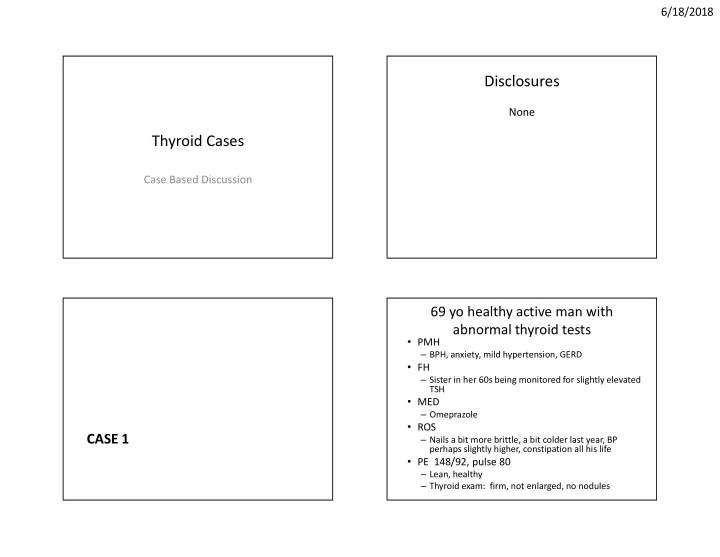
CASE 1 69 yo healthy active man with abnormal thyroid tests

  • PMH

– BPH, anxiety, mild hypertension, GERD

  • FH

– Sister in her 60s being monitored for slightly elevated TSH

  • MED

– Omeprazole

  • ROS

– Nails a bit more brittle, a bit colder last year, BP perhaps slightly higher, constipation all his life

  • PE 148/92, pulse 80

– Lean, healthy – Thyroid exam: firm, not enlarged, no nodules

slide-2
SLIDE 2

6/18/2018 2

69 yo healthy active man with abnormal thyroid tests

  • TSH 7.30 HI (0.45-4.12 mIU/L)
  • Free T4 10 (10-18 pmol/L),
  • Free T3 3.7 (2.6-5.7 pmol/L)
  • Diagnosis:

Should He?

SUBCLINICAL HYPOTHYROIDISM Patient - “Should I be treated?” Spontaneous Normalization of TSH Is Common Repeat TSH!

If TSH normal on 1st test 98% stayed normal If TSH > 10 on 1st test 28% had nl TSH on repeat If TSH 5.5 – 10 on 1st test 62% had nl TSH on repeat 35% stayed the same

Meyerovitch Arch Intern Med 2007 N=422,242 patients 2002-2006

TSH (0.45-4.12 mIU/L) Free T4 (10-18 pmol/L) Free T3 (2.6-5.7 pmol/L) 1/4/2018 6.89 (H) 11 9/7/2017 7.30(H) 10 3.7 3/29/2016 6.17(H) 10 6/3/2014 6.72(H) 9 (L) 4.0 4/24/2013 5.45(H) 10 4.4 7/23/2012 7.76(H) 10 9/21/2011 7.73(H) 10 5/11/2010 7.81(H) 10 2/23/2010 8.52(H) 9 2/9/2010 9.21(H) 4/15/2002 3.36 13 11/9/2000 2.70

Treat ? Any Additional Tests?

69 yo with subclinical hypothyroidism, asymptomatic 12/28/06 1/21/11 6/3/14 3/3/17

Cholesterol, Total <200 mg/dL

204 (H) 155 180 173

Triglycerides <200 mg/dL

134 69 74 98

HDL >39 mg/dL

65 55 74 60

LDL <130 mg/dL

112 86 91 93

Chol HDL Ratio <6.0

3.1 2.8 2.4 2.9

Non HDL <160 mg/dL

139 100 106 113

TPO > 830

Treat?

slide-3
SLIDE 3

6/18/2018 3

Should this 69 yo man with subclinical hypothyroidism be treated with levothyroxine?

  • A. Yes
  • B. No
  • C. Undecided

Y e s N

  • U

n d e c i d e d

68% 5% 28%

Subclinical Hypothyroidism

  • Definition: TSH > the upper limit of normal with

normal T4

  • Most common cause: autoimmune thyroiditis
  • Prevalence: 4 -10%*

– Increases with age – More common in women and in iodine sufficiency

*Hollowell JCEM 2002 *Biondi and Cooper Endo Rev 2008

Subclinical Hypothyroidism

  • Risk of progression to overt hypothyroidism

– TSH level, thyroid AB status

Whickham Survey *

Women: annual progression – 2.6% with elevated TSH – 2% if only anti-thyroid AB + – 4.3% with both elevated TSH /+AB Diez JCEM 2004 (older than 55 yo)** – Elevated TSH > 10mIU/L

  • 10mIU/L( Hazard Ratio 10) and 15mIU/L (HR 28)

Samworu et JCEM 2012 (older than 65 yo)** ‒ Elevated TSH > 10 mIU/L

*Vanderpump Clin Endocrinol 1995 ** JCEM 2004 & JCEM 2012

Subclinical Hypothyroidism

  • Not all elevated TSH (with normal T4)

represent mild thyroid failure

– Assay interferences

  • Heterophile AB

– Obesity – Recovery from thyroiditis or nonthyroidal illness – Medications: amiodarone/Lithium – Aging

slide-4
SLIDE 4

6/18/2018 4

TSH Range

No known thyroid disease/goiter and Antibodies Negative

NHANES III

NHANES III Distribution by Age

Hollowel J Clin Endocrinol Metab 2002 Surks J Clin Endocrinol Metab 2007

TSH 0.45 – 4.12 mIU/L = 2.5 to 97.5 percentile

TSH - 97.5 centile by Age Group

Surks J Clin Endocrinol Metab 2007

Back to the Patient More Questions…

  • What difference would I feel if I take the pill?
  • Could something bad happen to me if I don’t

take the pill?

slide-5
SLIDE 5

6/18/2018 5

Randomized Controlled Trial in Older Patients

  • Inclusion

– Population: 65 yo or older – Persistent subclinical hypothyroidism. TSH 4.60-19.99 mIU/L, 3 months to 3 years apart. Free T4 normal.

  • Exclusion

– Thyroid medications, lithium, amiodarone – Thyroid surgery, RAI in the previous 12 months – Hospitalization, surgery, acute coronary artery events in the previous 4 weeks – Dementia – Terminal illnesses

Did not look at TPO status

Randomized Controlled Trial in Older Patients

  • Primary outcomes

– Hypothyroid symptoms (ThyPro) – Tiredness score

  • Secondary outcomes

– Health related quality of life (EQ-5D) – Hand grip – Executive function – Weight, BMI, weight circumference – Blood pressure – Activities of daily living

  • Lack of power

– CV events

Characteristics Placebo (n=369) LT4 Group (n=368)

Age 74.8 ±6.8 yo 74 ± 5.8 yo Age range (65.1 ‒ 93.4) (65.2 ‒ 93) TSH 6.38 ± 2.01 mIU/L 6.41 ± 2.01 mIU/L Median 5.76 (5.10 ‒ 6.94) 5.73 (5.12 ‒ 6.83) Range 4.60 ‒ 17.60 4.60 ‒ 17.60 Outcome measures Hypothyroid Symptoms 16.9 ± 17.9 17.5 ± 18.8 Tiredness score 25.5 ± 20.3 25.9 ± 20.6

3.63±2.11 5.48±2.48

slide-6
SLIDE 6

6/18/2018 6

No Differences

Hypothyroid symptoms score Tiredness score Secondary outcomes ( including BP)

Back to the Patient More Questions…

  • What difference would I feel if I take the pill?
  • Could something bad happen to me if I don’t

take the pill?

Probably Not Much Controversies of Treating Subclinical Hypothyroidism

  • Literature massive, studies heterogeneous

– Age, degree of subclinical hypothyroidism, parameters studies, methods used

  • Outcome data mixed, some with uncertain

clinical significance

  • In the older population, mildly elevated TSH above

the usual normal reference range of 4-5mIU/L may be normal

  • Many negative studies in this population

Controversies of Treating Subclinical Hypothyroidism

Hypothyroid symptoms

  • Symptoms are nonspecific, also present in

euthyroid patients

  • Treatment has not always shown to

reverse/improve symptoms

– most studies showed no differences in mild subclinical hypothyroidism

Villar Cochrane Database 2007 Rugge Ann Intern Med 2015

slide-7
SLIDE 7

6/18/2018 7

Controversies of Treating Subclinical Hypothyroidism

Cardiovascular system

  • Impaired cardiac functions have been observed

(but not all)

– Carotid intima media thickness, diastolic function, smooth muscle relaxation, endothelial function, arterial stiffness, etc

  • Dyslipidemia has been observed but not all

– Treatment did not always reverse lipid abnormalities

  • Conflicting observational studies
  • Evidence of treatment to lower CV

events/mortality is lacking

Pearce JCEM 2012

Subclinical Hypothyroidism

  • TSH ≥ 10mIU/L

– More likely to develop hypothyroidism and more symptomatic – Large prospective epidemiologic cohort studies (Thyroid Studies Collaboration)

Associated with:

  • Increased heart failure (except for ≥ 80 yo)
  • Increased CHD events and mortality (except for ≥80 yo)
  • Probably also increased stroke risk and mortality in

younger patients (< 65 yo)

Treat

  • 25390 participants, median f/u 10.4 years, with a total f/u of

216248 person-years

  • Increased HF for TSH ≥ 10 but not in patients > 80 yo

Gancer et al Circulation 2012

  • 55287 pts in 11 prospective cohorts, median f/u ranged

from 2.5 to 20 years, total f/u of 542494 person-years

Rodondi JAMA 2010

TSH 0.5-4.49 4.5-6.9 7-9.9 >10

slide-8
SLIDE 8

6/18/2018 8

  • 47573 participants (17 cohorts), f/u from 1972 to

2014, a median f/u from 1.5 and 20 years and a total follow-up of 489192 person-years

  • No overall effects of subclinical hypothyroidism
  • n stroke
  • Subgroup and post-hoc analyses →

– Increased risk of stroke events in younger patients (younger than 65 yo) – Higher risk for fatal stroke for higher TSH 7-9.9

  • TSH 10-19.9 – no association, probably lack of power

Chaker et al JCEM 2015

Subclinical Hypothyroidism

  • TSH ≥ 10mIU/L
  • TSH < 10mIU/L Uncertainties (mixed results)

Treat

Subclinical Hypothyroidism

  • TSH < 10mIU/L Uncertainties (mixed results)

– TSH 7 - 9.9 mIU/L

  • may be associated with adverse CV outcomes (Thyroid Studies Collaboration)

– Increased CHD in younger patients (< 65yo)

  • Ravzi JCEM 2008

– Protective effects observed

  • Decreased mortality - Prospective study of > 85 yo from the

Netherlands (Gussekloo JAMA 2004 )

  • Decreased risk of all cause mortality - Retrospective study of 563700

individuals mean age 48.6 (SD±18.2) from Denmark (TSH 5-10mIU/L) (Selmer JCEM 2014)

– No adverse outcomes from studies in more recent years at various TSH levels

  • Cardiovascular Health Study ( >65 yo, 10 yr f/u) (JCEM 2013)
  • WHI (Thyroid 2013 and JCEM 2014)

– RCT: no clear benefits of treatment on non CV outcomes – No RCT on CV outcomes

Treatment Effects on CV Events & Mortality

Studies TSH levels (mIu/L) N of patients Mean Age Outcomes Razvi 2012

Retrospective

UK 5-10 40-70 yo

  • 1634 Tx
  • 1459 No Tx

>70 yo

  • 819 Tx
  • 932 No Tx

40-70 yo (F/U: 7.6 yr) >70 yo (F/U: 5.2 yr) Decrease in

  • Fatal and nonfatal CV

events

  • Death due to circulatory

disease

  • Cancer mortality

Only in 40-70 yo Andersen 2016

Retrospective

Denmark > 5 136 Tx 1056 No Tx 70 yo 74 yo No differences in all cause mortality in patients 18 yo or

  • lder with the diagnosis of

heart disease

No RCT

Razvi Arch Intern Med 2012 Andersen JCEM 2016

slide-9
SLIDE 9

6/18/2018 9

Back to the Patient

  • What difference would I feel if I take the pill?
  • Could something bad happen to me if I don’t

take the pill?

Probably Not Much

TSH (0.45-4.12 mIU/L) Free T4 (10-18 pmol/L) Free T3 (2.6-5.7 pmol/L) 1/4/2018 6.89 (H) 11 9/7/2017 7.30(H) 10 3.7 3/29/2016 6.17(H) 10 6/3/2014 6.72(H) 9 (L) 4.0 4/24/2013 5.45(H) 10 4.4 7/23/2012 7.76(H) 10 9/21/2011 7.73(H) 10 5/11/2010 7.81(H) 10 2/23/2010 8.52(H) 9 2/9/2010 9.21(H) 4/15/2002 3.36 13 11/9/2000 2.70

Should this 69 yo man with subclinical hypothyroidism be treated with levothyroxine?

  • A. Yes
  • B. No
  • C. Still undecided

Y e s N

  • S

t i l l u n d e c i d e d

21% 5% 74%

RCT of SubHypo on Non-CV Outcomes (Younger Patients)

  • Smaller RCT studies

– Age 32 yo to 70 yo – TSH 4.1 to 11.0 (most studies < 10) – Sample size 14-120 patients – Duration 3-12 months

  • Various outcomes being

measured

– BP – Cholesterol – BMI, weight – Quality of life – Cognition

  • No differences in most
  • utcomes
  • Exceptions:
  • Higher TSH levels (> 10)
  • Fatigue improved
  • In one study (TSH was treated

to 0.5 mIU/L)

  • In one study of TPO positive

population

  • Lipids
  • Mixed results on Total

cholesterol and LDL

  • Lower Triglyceride observed in

many studies, but p value not significant (sample size and clinical significance?)

Rugge et al Ann Intern Med 2015

slide-10
SLIDE 10

6/18/2018 10

Treatment Effects on BP

Studies Age TSH baseline (after Tx) N Outcomes P Monzani 2004 RCT 6 months 37 Tx 37 No Tx 6.03 Tx (→1.32) 5.68 No Tx BP 110s/60s-70s 22 Tx 23 SBP: -2 mmHg DBP: -3 mmHg NS Razvi 2007 RCT (crossover) 2.8 months 53 Tx 54 No Tx 5.4 Tx 100mcg (→0.5) SBP: 133 +/- 23 DBP: 79 +/- 10 5.3 No Tx SBP:135 +/- 23 DBP: 80 +/- 10 50 Tx 50 SBP: -2 mmHg DBP: -1 mmHg (Sig outcomes) LDL: -12 mg/dL Hip/W ratio FMD NS Nagasaki 2009 RCT 5 months 64 Tx 66 No Tx 7.3 Tx (→2.7) 7.3 no tx BP 129-132/73 48 Tx 47 SBP: -3 mmHg DBP: 0 mmHg NS Studies Age TSH -> TSH after Tx N Outcomes P Meier 2001 57.1 57.1 12.8 Tx →3.1 10.7 No Tx → 9.9 33 Tx 33 Billewicz & Zulewski scores 0.049 for TSH > 12 Kong 2002 RCT 6 months 53 45 8.0 Tx (→dec by 4.6) 7.3 No Tx (→dec by 1.7) 23 Tx 17 HADS anxiety/depression GHQ-30 NS Jorde 2006 RCT 12 months 62 63 5.8 Tx 109.7mcg → 1.52 5.3 No Tx 36 Tx 33 Beck Depression GHS-30 NS Razvi 2007 (crossover ) 2.8 months 53.5 54.2 5.4 Tx 100mcg →0.5 5.3 NoTx 50 50 Tiredness------------------ SF36, ThyTSQ,ThyDQoL <0.006 NS Parle 2010 RCT 12 months 73.5 74.2 6.6 Tx 50mcg 6.6 No Tx 52 Tx 42 HADS depression NS Abu-Helalah 2010(crossover) 2 months 58 4.1-9.0 Tx 72mcg (considered poor quality) 33/31 QOL – Odds of feeling better higher with higher pretreatment TSH Winther 2016 Prospective TPO/TSH> 4 46 8.1 Tx →TSH 3.0 @6 weeks →TSH 2.6 @6 months 61 63 ThyPro, SF Better

Treatment Effects on Quality of Life

Studies Age TSH → TSH aer Tx N Outcomes P Jaeschke 1996 RCT 6 months 68 68 12.1 Tx (68mcg)→ 4.3 9.4 No Tx → 10.6 Many with ‘hypothyroid’symptoms 18 Tx 19

  • Memory composite

score (small improvement only)

  • Cognition, mood,

energy, activity 0.01 NS Jorde 2006 RCT 12 months 62 63 5.8 Tx (109.7mcg)→ 1.52 5.3 No Tx 36 Tx 33 Cognitive functional score Trail making test NS Parle 2010 RCT 12 months 73.5 74.2 6.6 Tx 50mcg 6.6 No Tx 52 Tx 42 MEAMS, MMSE, SCOLP, Trail making test NS

Treatment Effects on Cognition

Studies Age TSH → TSH aer Tx N Outcomes P Kong 2002 RCT 6 months 53 8.0 Tx (→dec by 4.6) 23 Tx BMI change -0.3 NS 45 7.3 No Tx (→dec by 1.7) 17 Monzani 2004 RCT 6 months 37 6.03 Tx→1.32 22 Tx BMI 24.7 to 23.7 Tx NS 37 5.68 No Tx 23 24.2 to 24.9 Iqbal 2006 RCT 12 months 63 5.8 Tx (96mcg) →1 32 Tx BMI 28 NS 61 5.4 No Tx 32 27 Razvi 2007 (crossover ) 2.8 months 53.5 5.4 Tx (100mcg) → 0.5 50Tx Wt 75.9 to 75.8 kg Tx NS 54.1 5.3 No tx 50 77 to 76.5 kg Duman 2007 RCT 8 months 36 10.9 Tx (100mg ) →2.0 22Tx BMI 25 to 24.8 Tx NS 35 11 No Tx → 10.9 19 25 to 25.5 Nagasaki 2009 RCT 5 months 64 7.3 Tx (25.8mcg) →2.7 48 Tx BMI 22 to 21.8 Tx NS 66 7.3 No Tx 47 22.2 to 22.1

Treatment Effects on BMI & WT

slide-11
SLIDE 11

6/18/2018 11

TSH ATA/AACE ETA ≥ 10 (ETA) > 10 Yes (should be considered) Younger pts (≤70, <65-70)

  • Yes even without symptoms

Older patients (>70, 65-70)

  • Yes
  • if clear symptoms
  • If risks of vascular events high

< 10 (ETA) ≤ 10 Consider factors

  • Symptoms
  • TPO status
  • CVD or HF status
  • Risk factors for above

Younger pts (≤70, <65-70)

  • Consider a trial (if symptoms)

Older patients (>70, esp 80-85)

  • Observe & monitor

Recommendations from Consensus Groups

Peeters N Engl J Med 2017, Pearce et al Eur Thyroid J 2013, Jonklaas et al Thyroid 2014

TSH Goal on Treatment in Older Patients

  • TSH for the 97.5th percentile of the population

increases with increasing age groups

– 97.5% confidence interval for healthy 80 yo or

  • lder persons 7.5mIU/L
  • Target for TSH on treatment

– ATA - 4-6mIU/L as a reasonable target for 70-80 yo – European Society – 1-5mIU/L for > 70-75 yo

Pearce et al Eur Thyroid J 2013 Jonklaas et al Thyroid 2014

WOMEN DESIRE PREGNANCY

  • Data and consensus recommendations on subclinical hypothyroidism do

not apply

  • Pregnancy specific TSH range

– Internal established population/trimester specific reference range is recommended – Upper limit: 4mIU/L or 0.5mIU/L less than the normal reference

  • Subclinical hypothyroidism

Tx: – if attempting IVF or ICSI (goal < 2.5mIU/L) – if pregnant/+ TPO positive – if pregnant /– TPO but TSH > 10mIU/L Consider Tx: – If attempting natural conception – If pregnant /+ TPO and TSH > 2.5mIU/L – If pregnant /– TPO and TSH < 10mIU/L

  • Guidelines: Alexander et al Thyroid 2017.

CASE 2

slide-12
SLIDE 12

6/18/2018 12

76 yo Man with a 1.4 cm Papillary Thyroid Carcinoma

  • Found to have a right

thyroid nodule during evaluation for parotid swelling

  • Evaluation: US and US

guided FNA

  • PMH

– Mild HTN, PVC, RBBB

  • Meds

– Amlodipine and MVI

  • FH

– One brother with FTC

  • Lobectomy or total?

– Potential benefits of lobectomy

  • Decreased complications
  • Not needing life long T4

replacement?

After lobectomy – What is his risk of subclinical/hypothyroidism ? What is his risk of needing T4 to keep TSH < 2

76 yo man with rising TSH after lobectomy for 1.4 cm PTC

76 yo Man s/p Lobectomy for a low risk 1.4 cm PTC

  • Feb 2017: TSH 1.43 mIU/L
  • March 2017: Lobectomy

– Path: 1.9 cm PTC. No adverse features. One lymph node negative for metastasis. No evidence of thyroiditis.

  • May 2017: TSH 3.73 – 2 months postop
  • June 2017:

– Not feeling himself, more fatigued – TSH 4.99 / free T4 1.0

Subclinical Hypothyroidism

Treat?

76 yo man with rising TSH after lobectomy

50mcg alternating 75mcg 25 mcg started

slide-13
SLIDE 13

6/18/2018 13

Risk of Elevated TSH after Lobectomy

  • Meta-analysis of 32 studies

– Indeterminate nodules – Non-toxic nodules – MNG – Most studies did not specify subclinical or overt

  • Overall risk of hypothyroidism of both types – 22% (CI

19-27)

  • Based on 4 studies specifying subclinical vs overt

– 12% risk of subclinical hypothyroidism – 4% risk of overt hypothyroidism

Verloop et al. JCEM 2012

Risk of Elevated TSH after Lobectomy

  • Risk factors

– Old age in 4 studies not replicated in 8 studies – Higher preop TSH (still in normal range) in 12 studies – TPO positivity in 6 studies

  • (conflicting results for TgAB)

– Thyroiditis on pathology in 11 studies but not in 2 other studies

  • Timing of hypothyroidism

– In some patients, hypothyroidism is transient – Usually diagnosed first 6 months (in studies reporting time) – There can be late occurrences

Verloop et al. JCEM 2012

TSH Trend After Lobectomy in Euthyroidism

Patients who remained euthyroid

Tomoda et al (Kuma Hospital) 2010

Timing of Hypothyroidism In Long Term Follow up

  • Retrospective study of PTMC patients (335 pts) from Korea (iodine

sufficient ) with a median follow up of 56 months:

Park et al JCEM 2017

< 12 months >12 months Risk Factor TSH 3.1 at 1 yr

Meantime to recover 12.2 months

29 % needing T4 or sub Hypo TSH >1.7 risk factor Risk Factors: Preop TSH > 1.7 Peak TSH > 7.1 36%

slide-14
SLIDE 14

6/18/2018 14

Take Home Messages

  • Overall risk of elevated TSH after lobectomy 22%
  • Risk factors: higher preop TSH, older age, TPO

positivity, or evidence of thyroiditis on surgical pathology

  • About 2/3 of patients with mild asymptomatic

subclinical hypothyroidism postop can recover to

  • euthyroidism. Recovery can take 1 year
  • Many patients with low risk thyroid cancer (1-4

cm) may still need to take levothyroxine after lobectomy to keep TSH 0.5- 2mIU/L

CASE 3 63 yo Man with Weight Loss Suppressed TSH and Low normal T4

63 yo man previously healthy not feeling himself, with unintentional weight loss Exam

– Thyroid, not enlarged, somewhat firm, no nodules, no bruits

  • TSH < 0.01
  • Free T4 1.09 (0.9-1.8)
  • Free T3 4.40 (< 4.2)

Lab error or assay interferences (biotin)? Central Hypothyroidism? Taking T3 or supplements with T3? Euthyroid sick? T3 toxicosis? Recovery phase of hyperthyroidism/thyoiditis?

Differential Diagnoses Low TSH/ low or low normal T4

Endocrine pearl: This is a case of T3 toxicosis that can be seen in the early phase of hyperthyroidism due to Graves disease or toxic nodules. Infrequently frankly low free T4 with elevated T3 has been

  • bserved.

Thyroid Tasting Menu (Hyperthyroidism)

Anti TPO AB Anti Thyroglobulin AB TRAB (TSI or TBII ) Thyroglobulin Ultrasound Thyroid scan TSH < 0.01 Free T4 1.09 (0.9-1.8) Free T3 4.40 (< 4.2) Physical Exam unrevealing

slide-15
SLIDE 15

6/18/2018 15

What test would you order for additional evaluation?

  • A. Anti TPO AB
  • B. Anti Thyroglobulin AB
  • C. Thyroglobulin
  • D. TSI or TBII
  • E. Thyroid uptake scan
  • F. Neck ultrasound
  • G. All of the above

A n t i T P O A B A n t i T h y r

  • g

l

  • b

u l i n A B T h y r

  • g

l

  • b

u l i n T S I

  • r

T B I I T h y r

  • i

d u p t a k e s c a n N e c k u l t r a s

  • u

n d A l l

  • f

t h e a b

  • v

e 41% 15% 0% 0% 11% 30% 4%

Thyroid Tasting Menu (Hyperthyroidism)

 Anti TPO AB

– Autoimmune disease marker – Present in 50% of patients with subacute lymphocytic thyroiditis – Present in 70-90% of patients with Graves disease – Consider if TSH is elevated (AAE)

 Anti Thyroglobulin AB

– Autoimmune disease marker – Present in 70-90% of patients with Graves disease

 TRAB (TSI or TBII )

– Sensitivity and Specificity for GD > 90%

 Thyroglobulin

– Not helpful in diagnosing cancer – Not routinely recommended in the evaluation of thyroid nodule (ATA, ETA, AAE) – Consider if exogenous thyroid hormone use is suspected

 Ultrasound

– Evaluation of vascularity (ATA) – (please do not order routinely)

 Thyroid scan

– Differentiating various types of hyperthyroidism

  • Thyroiditis
  • Graves disease
  • Toxic nodule
  • Toxic MNG

Cooper et al Thyroid 2009 Gharib et al Endo Practice 2010 Pacini et al Euro J Endocrinol 2006 Paschke et al. Nat Rev Endocrinol 2011 *Borget JCEM 2007

TSI – Bioassay, measuring cAMP activity TBII – Immunoassay (inhibitory immunoassay)

63 yo Man with Hyperthyroidism

Diagnostic Test of Choice

  • TSH receptor antibody

testing

– TSI 433 (< 140 %)

  • TSH < 0.01
  • Free T4 1.09 (<1.8)
  • Free T3 4.40 (< 4.2)

– TPO antibody 101 (<34) – Thyroglobulin antibody positive – Iodine Uptake scan

  • Diffuse uptake
  • 4h 10% and 24 h 21%

Take Home Messages

  • T3 toxicosis is common in Graves (as well as

toxic nodules)

– Free T4 may be low normal or less likely low

  • TSH receptor antibody testing should be

considered as the first line of testing in the work up of hyperthyroidism, followed by iodine scan as appropriate

– Most common cause of hyperthyroidism in the US is Graves disease
slide-16
SLIDE 16

6/18/2018 16

CASE 4

28 yo Woman with Recurrent Graves Disease

  • First diagnosed in 2006

– Methimazole from 2006 to 1/2009

  • Recurrence in 2010
  • Seen in 2011 but lost for

follow up

  • Represented in April 2012

– TSH < 0.03, FT4 30 (< 24), FT3 534 (<348), TSI 405% – A bit tired and some racing heart rates 2 months prior

  • PMH: Graves Disease
  • FH: Thyroid disease (both

hyper and hypo) and RA

  • Medications: none
  • Physical Exam:

– No ophthalmopathy – Thyroid generous in size but not grossly enlarged, firm, with bruits in the right – Not tachycardic – Mild tremors on the

  • utstretched hands

28 yo Woman with Recurrent Graves Disease

How Should She be Treated? RAI Surgery Restart medication

  • Randomized controlled trials

– Dose, regimen (block and replacement vs titration), and duration of treatment

Conclusions

  • Limited evidence suggested 12–18 months of anti-thyroid drug

treatment being most optimal

– Shorter duration of therapy → higher risks of relapse – 2 studies: longer durations of therapy → not associated with increased rates of remission

  • The titration regimen and the Block-Replace regimen were equally

effective but the titration regimen had fewer adverse effects

  • Relapse rates > 50% and high participant drop-out rates in trials
slide-17
SLIDE 17

6/18/2018 17

ATD Beyond 18 Months

  • Low dose methimazole 2.5-5mg beyond 18 months may

improve remission rate

  • Mazza et al J Endocrinol Invest 2008
  • Konishi et Endocr J 2011
  • Recent systematic review (Azizi et al Thyroid 2017)

– Long term ATD led to long term remission rate of 57% (45-68%) – Positive correlation between time and remission

  • Estimated annual remission rate 16% (10-27%) – not linear

Longer Term ATD Use

  • Available data suggest long term low dose ATD is safe

– 71 months after 1st relapse (Villagelin et al Thyroid 2015) – Maintenance dose 2.5-10mg MMI for a mean of 14.2 years ± 2.9 years(5.7-20.3) vs RAI (Azizi et al Arch Iran Med 2012)

  • ATA 2016:

April 2017

Recurrent Graves Disease

  • Retrospective review - Median f/u 11 years (4-23.7 years)
  • 50% of the relapses developed within one year after ATD

discontinuation, and >90% of the relapses occurred within four years

  • 187 patients. Overall remission rate - 51.9% (97 patients)

– 64 (34.2%) after 1st course – 25 (25.5%) after 2nd course – 6 (17.1%) after 3rd course

  • Remission rates (10 year accumulative)

– Similar after 1st and 2nd courses – lowered after 3rd course or subsequent recurrences

  • 19 patients had accumulative

ATD duration of 12.3–17.3 years

slide-18
SLIDE 18

6/18/2018 18

  • 4/2012 – MMI
  • Responded to MMI quite well
  • 9/2014 –2.5mg QOD. Stopped MMI
  • 2/2018 ‒ TSH 0.96, FT4 1.3, FT3 2.6, TSI 161

Treatment Course

Take Home Messages

  • Beyond the 12-18 months of treatment with ATD may

be beneficial in improving remission

  • Graves disease relapse can be treated with a second

course of ATD with a similar remission rate

– For future relapses, longer term ATD may be needed

  • Long-term low-dose ATD has been found to be safe

(although in limited studies)

  • After stopping ATD, patients should continue to be

monitored routinely as relapse rates are high

– Important to discuss with women in reproductive age