Disclosures I have nothing to disclose New ALS diagnostics and - - PowerPoint PPT Presentation

disclosures
SMART_READER_LITE
LIVE PREVIEW

Disclosures I have nothing to disclose New ALS diagnostics and - - PowerPoint PPT Presentation

2/13/2020 Disclosures I have nothing to disclose New ALS diagnostics and Treatment Prevalence and Impact on Patients and Caregivers Catherine Lomen-Hoerth, MD, PhD Professor of Clinical Neurology, UCSF Recent Advances in Neurology 2020 1 2


slide-1
SLIDE 1

2/13/2020 1

New ALS diagnostics and Treatment

Prevalence and Impact on Patients and Caregivers

Catherine Lomen-Hoerth, MD, PhD Professor of Clinical Neurology, UCSF Recent Advances in Neurology 2020

Disclosures

I have nothing to disclose

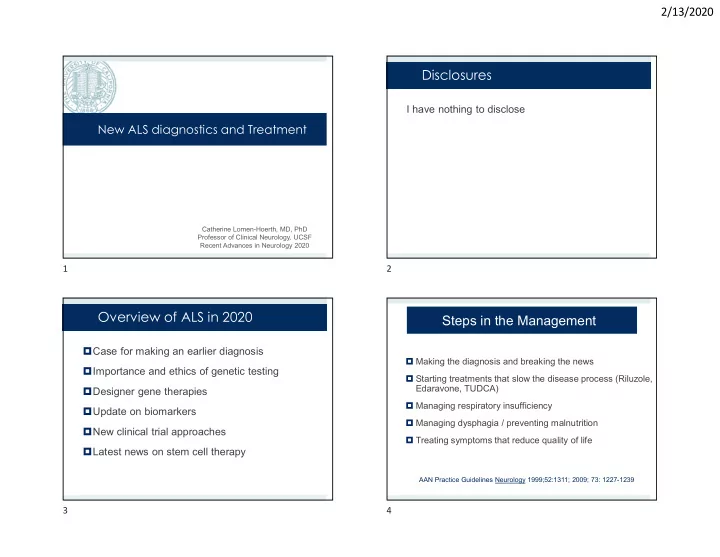
Overview of ALS in 2020

Case for making an earlier diagnosis Importance and ethics of genetic testing Designer gene therapies Update on biomarkers New clinical trial approaches Latest news on stem cell therapy

Steps in the Management

 Making the diagnosis and breaking the news  Starting treatments that slow the disease process (Riluzole, Edaravone, TUDCA)  Managing respiratory insufficiency  Managing dysphagia / preventing malnutrition  Treating symptoms that reduce quality of life

AAN Practice Guidelines Neurology 1999;52:1311; 2009; 73: 1227-1239

1 2 3 4

slide-2
SLIDE 2

2/13/2020 2

Treatable symptoms in ALS

Mayo Clin Proc. 2018 Nov;93(11):1617-1628.

Clinical Features of ALS

  • Upper motor neuron findings
  • Slow speech
  • Brisk gag and jaw jerk, brisk limb

reflexes

  • Spasticity
  • Lower motor neuron findings
  • Atrophy
  • Fasciculations
  • weakness

El Escorial Criteria to diagnose ALS

 UMN degeneration by clinical exam  LMN degeneration by clinical exam or EMG  Progressive spread of signs within a region or into other spinal

  • r brainstem regions

 Absence of evidence of other diseases by EMG or imaging to explain the findings

ALS-Mimic Syndromes

 Radiculopathies  CNS disorders (Stroke, Brain tumor, Parkinson’s disease, MS)  Post-poliomyelitis syndrome  Multifocal motor neuropathy  Endocrinopathies  hyperparathyroidism and hyperthyroidism  Lead intoxication  Infections  Lyme disease and HIV/AIDS  Paraneoplastic syndromes - lymphoma, MGUS

5 6 7 8

slide-3
SLIDE 3

2/13/2020 3

ALS is Heterogeneous

 The diagnosis is clinical and a process of exclusion  Patients vary in:

 Rate of progression  Regions affected during the disease course  Family history of degenerative disease

 Accurate categorization of patients into clinical categories is of utmost importance in facilitating research into targeted therapies  A key aspect of disease heterogeneity is cognitive-behavioral involvement including frontotemporal dementia

Benefits of an earlier ALS diagnosis

Ability to take newly approved ALS therapies Option to participate in clinical trials Access to multidisciplinary care Connection to ALS satellite clinics and telemedicine Quicker genetic testing CONSIDER REFERRAL TO AN ALS CENTER FOR ALL CASES OF PROGRESSIVE WEAKNESS OF UNCLEAR ETIOLOGY

Free genetic testing and counseling

ALS GAP provides clinical genetics services to pALS who are under the care of a registered NEALS clinician https://www.neals.org/als-trials/news/als-gap-update

New potential ALS therapy

Eur J Neurol. 2016 Jan;23(1):45-52.

9 10 11 12

slide-4
SLIDE 4

2/13/2020 4

Designer DNA therapy for ALS

Antisense oligonucleotide therapies for familial ALS Viral therapies such as designed for SMA Gene therapy studies targeting sporadic ALS

Curr Opin Neurol. 2018 Oct;31(5):648-654.

ALS biomarker update

https://www.frontiersin.org/articles/10.3389/f neur.2019.00291/full

Potential biomarkers for ALS

 Neurophysiological-MUNE/MUNIX/EIM/TMS  Neuroimaging-DTI, fMRI, VBM, iron sensitive sequences  Serum creatinine  Uric acid level  Urinary extracellular cleavage domain of neurotrophin receptor P75  CSF and plasma light and heavy chain neurofilament proteins

Addressing heterogeneity in amyotrophic lateral sclerosis CLINICAL TRIALS. Goyal NA, Berry JD, Windebank A, Staff NP, Maragakis NJ, van den Berg LH, Genge A, Miller R, Baloh RH, Kern R, Gothelf Y, Lebovits C, Cudkowicz M. Muscle Nerve. 2020 Jan 3.

New ALS clinical trial guidelines

Revised Airlie House consensus guidelines for design and implementation

  • f ALS clinical trials.

van den Berg LH1, Sorenson E2, Gronseth G2, Macklin EA2, Andrews J2, Baloh RH2, Benatar M2, Berry JD2, Chio A2, Corcia P2, Genge A2, Gubitz AK2, Lomen-Hoerth C2, McDermott CJ2, Pioro EP2, Rosenfeld J2, Silani V2, Turner MR2, Weber M2, Brooks BR2, Miller RG2, Mitsumoto H2; Airlie House ALS Clinical Trials Guidelines Group.

  • Neurology. 2019 Apr 2;92(14):e1610-e1623.

13 14 15 16

slide-5
SLIDE 5

2/13/2020 5

New ALS clinical trial guidelines

 Preclinical studies  Biological and phenotypic heterogeneity  Outcome measures  Disease modifying and symptomatic interventions  Recruitment and retention  Biomarkers  Clinical trial phases  Beyond traditional trial designs  Statistical considerations

  • Neurology. 2019 Apr 2;92(14):e1610-

e1623.

Changes in clinical trial design

Park, J.J.H., Siden, E., Zoratti, M.J. et al. Systematic review of basket trials, umbrella trials, and platform trials: a landscape analysis of master protocols. Trials 20, 572 (2019).

Changes in clinical trial design

Park, J.J.H., Siden, E., Zoratti, M.J. et

  • al. Systematic review of basket trials,

umbrella trials, and platform trials: a landscape analysis of master

  • protocols. Trials 20, 572 (2019).

First platform trial for ALS starting now

 ALS has the largest drug pipeline of any neuromuscular disease  Over 130 companies currently focusing on ALS  Need to accelerate trials for patients with ALS

“I lost the privilege of working on the human time clock on January 6, 2018 – the ALS clock is a lot faster” Sandy – Person with ALS

17 18 19 20

slide-6
SLIDE 6

2/13/2020 6

First five ALS platform trial drugs

 Zilucoplan

 Complement C5 inhibitor

 Verdiperstat

 Myeloperoxidase inhibitor

 CNM-Au8

 Gold nanocrystals

 Pridopidine

 Sigma 1 receptor agonist

 IC14

 Immunotherapy targeting CD14

Primary endpoint: ALSFRS-R

 Speech  Salivation  Swallowing  Handwriting  Cutting food and handling utensils  Dressing and hygiene  Turning in bed and adjusting clothes  Walking  Climbing Stairs  Dyspnea  Orthopnea  Respiratory Insufficiency

Stem cell update

NurOwn, phase 2 results promising Cells are modified and put back into the spinal fluid with no adverse events Results suggest there may be small reductions in the rate of disease Phase 3 trial results expected Fall 2020

NurOwn, phase 2, randomized, clinical trial in patients with ALS: Safety, clinical, and biomarker results. Berry JD, Cudkowicz ME, Windebank AJ, Staff NP, Owegi M, Nicholson K, McKenna-Yasek D, Levy YS, Abramov N, Kaspi H, Mehra M, Aricha R, Gothelf Y , Brown RH.

  • Neurology. 2019 Dec 10;93(24):e2294-e2305.

Effect of NurOwn stem cell therapy on ALSFRS-R

21 22 23 24

slide-7
SLIDE 7

2/13/2020 7

Right to try and expanded access

Need pharma approval to provide the drug FDA and IRB approval (accelerated for ALS<2 weeks) Need funding Provides a way to provide people not eligible for clinical trials to obtain drug

Caution about certain alternative therapies for ALS

 Expensive stem cell options in the US and other countries  Excessive supplement use  Detoxification programs  Unusual diets  Taking clinical trial medications off label http://alsuntangled.com/

Robotics and Communication trials

 Brain control of robotics and communication system (BRAVO) study (UCSF)  Brain Gate 2: Feasibility Study of an Intracortical Neural Interface System for Persons with Tetraplegia (Stanford)

Ethical and practical considerations

 Pre-symptomatic genetic testing  Access to newly approved therapies  Decisions about which therapies for which patients  Management of ALS patients living longer

25 26 27 28

slide-8
SLIDE 8

2/13/2020 8

SUMMARY

 Early referral to an ALS Center is critical in cases of progressive weakness of unclear etiology  Genetic testing is key for the new designer gene therapy trials  Biomarkers are helping predict prognosis and aid in diagnosis  The new platform design for ALS clinical trials allows more patients to receive active drug and ensures rapid testing of multiple drugs  Stem cells show promise in slowing ALS disease progression  Robotics and enhanced communication options are in trials now

29