Disclosures 17 17 Es Estr tradiol/P adiol/Prog oges esterone - - PDF document

disclosures
SMART_READER_LITE
LIVE PREVIEW

Disclosures 17 17 Es Estr tradiol/P adiol/Prog oges esterone - - PDF document

10/17/2017 Disclosures 17 17 Es Estr tradiol/P adiol/Prog oges esterone ne in in a Single ngle Or Oral al Softgel Cap Softg apsule (TX (TX 001H 001HR) R) Signific gnificantly ly Research support : Actavis, Bayer Healthcare,


slide-1
SLIDE 1

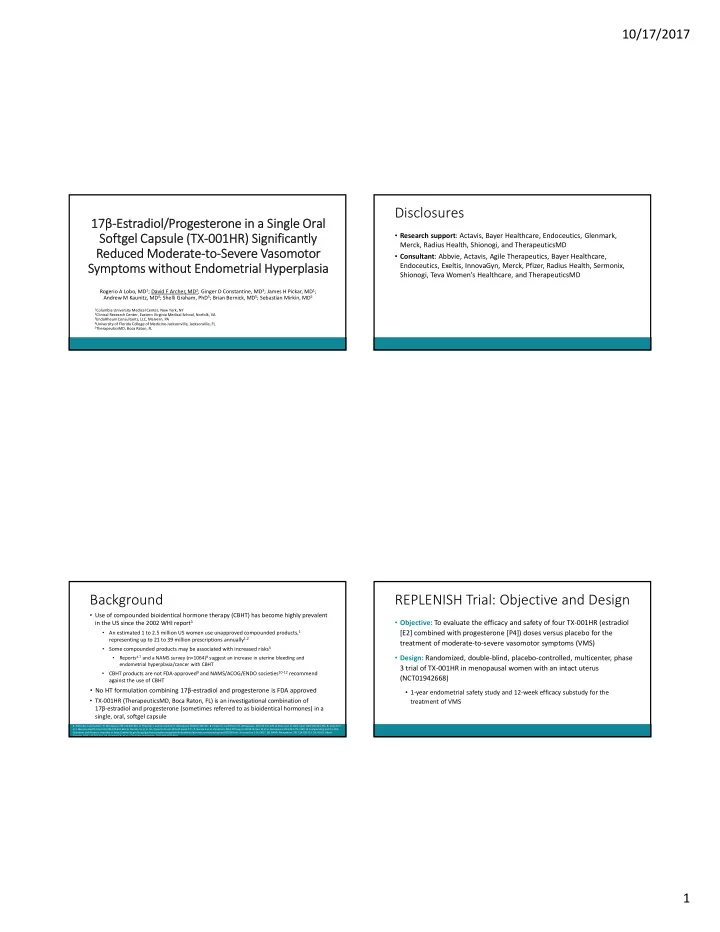
10/17/2017 1 17 17β‐Es Estr tradiol/P adiol/Prog

  • ges

esterone ne in in a Single ngle Or Oral al Softg Softgel Cap apsule (TX (TX‐001H 001HR) R) Signific gnificantly ly Reduce duced Moder Moderate‐to to‐Se Severe Vasomotor tor Sy Sympto mptoms ms with without Endom ndometria trial Hyperp Hyperplasia ia

Rogerio A Lobo, MD1; David F Archer, MD2; Ginger D Constantine, MD3; James H Pickar, MD1; Andrew M Kaunitz, MD4; Shelli Graham, PhD5; Brian Bernick, MD5; Sebastian Mirkin, MD5

1Columbia University Medical Center, New York, NY 2Clinical Research Center, Eastern Virginia Medical School, Norfolk, VA 3EndoRheumConsultants, LLC, Malvern, PA 4University of Florida College of Medicine‐Jacksonville, Jacksonville, FL 5TherapeuticsMD, Boca Raton, FL

Disclosures

  • Research support: Actavis, Bayer Healthcare, Endoceutics, Glenmark,

Merck, Radius Health, Shionogi, and TherapeuticsMD

  • Consultant: Abbvie, Actavis, Agile Therapeutics, Bayer Healthcare,

Endoceutics, Exeltis, InnovaGyn, Merck, Pfizer, Radius Health, Sermonix, Shionogi, Teva Women’s Healthcare, and TherapeuticsMD

Background

  • Use of compounded bioidentical hormone therapy (CBHT) has become highly prevalent

in the US since the 2002 WHI report1

  • An estimated 1 to 2.5 million US women use unapproved compounded products,1

representing up to 21 to 39 million prescriptions annually1,2

  • Some compounded products may be associated with increased risks3
  • Reports4‐7 and a NAMS survey (n=1064)8 suggest an increase in uterine bleeding and

endometrial hyperplasia/cancer with CBHT

  • CBHT products are not FDA‐approved9 and NAMS/ACOG/ENDO societies10‐12 recommend

against the use of CBHT

  • No HT formulation combining 17β‐estradiol and progesterone is FDA approved
  • TX‐001HR (TherapeuticsMD, Boca Raton, FL) is an investigational combination of

17β‐estradiol and progesterone (sometimes referred to as bioidentical hormones) in a single, oral, softgel capsule

  • 1. Pinkerton J and Santoro N. Menopause 2015;22:926‐936. 2. Pinkerton J and Constantine G. Menopause 2016;23:359‐367. 3. Pinkerton J and Pickar JH. Menopause. 2015;23:215‐223. 4. Eden JA et al. Med J Aust 2007;187:244‐245. 5. Davis R et
  • al. J Womens Health (Larchmt) 2014;23:642‐648. 6. Dezman VL et al. Int J Gynecol Cancer 2015;25 Suppl 1:71. 7. Gersak K et al. Climacteric 2014;17(Suppl 1):58‐59. 8. Gass M et al. Menopause 2015:22;1276‐1284. 9. Compounding and the FDA.

Questions and Answers. Available at https://www.fda.gov/drugs/guidancecomplianceregulatoryinformation/pharmacycompounding/ucm339764.htm. Accessed on 3 Oct 2017. 10. NAMS. Menopause. 2017;24:728‐753. 11. ACOG. Obstet

  • Gynecol. 2014;123:202‐216. 12. Stuenkel CA, et al. J Clin Endocrinol Metab. 2015;100:3975‐4011.

REPLENISH Trial: Objective and Design

  • Objective: To evaluate the efficacy and safety of four TX‐001HR (estradiol

[E2] combined with progesterone [P4]) doses versus placebo for the treatment of moderate‐to‐severe vasomotor symptoms (VMS)

  • Design: Randomized, double‐blind, placebo‐controlled, multicenter, phase

3 trial of TX‐001HR in menopausal women with an intact uterus (NCT01942668)

  • 1‐year endometrial safety study and 12‐week efficacy substudy for the

treatment of VMS

slide-2
SLIDE 2

10/17/2017 2

Key Inclusion Criteria

  • Healthy menopausal women aged 40‐65 years
  • Intact uterus
  • Body mass index ≤34 kg/m2
  • Vasomotor symptoms associated with menopause
  • Acceptable endometrial biopsy results

VMS Substudy

  • ≥7/day or ≥50/week moderate‐to‐severe hot flushes

Key Exclusion Criteria

  • History of hyperplasia or neoplasia of hormone dependent tissues
  • History of thrombosis of deep veins/arteries
  • Abnormalities of the gastrointestinal system
  • Abnormal function of other hormone producing glands
  • Prior use of estrogen‐, progestogen‐, androgen‐, SERM products
  • Medications known to induce or affect estrogen and/or progestogen drug

metabolism or activity

Study Design: Randomization

  • TX‐001HR was taken daily for 12 months (VMS substudy was 12 weeks)
  • Both populations were assessed for general and endometrial safety
  • All women completed a daily diary on the frequency and severity of their VMS

through week 12 Treatment Groups

 1.0 mg E2/100 mg P4  0.5 mg E2/100 mg P4  0.5 mg E2/50 mg P4  0.25 mg E2/50 mg P4  Placebo

VMS substudy

  • ≥7/day or ≥50/week

moderate‐to‐severe hot flushes

  • Randomized 1:1:1:1:1

General study

  • Did not qualify for

VMS substudy

  • Randomized 1:1:1:1

REPLENISH Trial: Study Endpoints

Endpoints Description Efficacy

  • VMS substudy

4 co‐primary endpoints VMS frequency (moderate‐to‐severe)

  • Mean change from baseline to week 4
  • Mean change from baseline to week 12

VMS severity

  • Mean change from baseline to week 4
  • Mean change from baseline to week 12

Secondary

  • Mean change in frequency and severity of moderate‐to‐

severe VMS from baseline for each week up to week 12 Safety

  • All women who

took ≥1 capsule Primary

  • Incidence of endometrial hyperplasia with up to 12

months of treatment (in women with endometrial biopsies) Secondary

  • Incidence of adverse events (AEs) and serious AEs
slide-3
SLIDE 3

10/17/2017 3

Statistical Analyses

  • Efficacy analyses were performed on the modified intent‐to‐treat (MITT)

population of the VMS substudy

  • MITT VMS substudy included women who took ≥1 dose of study treatment, had ≥5 days
  • f VMS diary data at baseline, and ≥4 days of VMS diary data for 1 on‐treatment week
  • Each TX‐001HR dose was compared with placebo and tested for the 4 co‐primary efficacy

endpoints at alpha level 0.05 (two‐tailed) using a mixed model repeated measures (MMRM) analysis

  • Endometrial safety was analyzed in women who took ≥1 capsule, had an

acceptable biopsy at baseline, and had a biopsy at month 12 or had a diagnosis of endometrial hyperplasia prior to month 12

  • AEs and serious AEs were descriptively summarized in all women who took ≥1

capsule (safety population)

Disposition

  • 89% of women completed

the VMS substudy at 12 weeks

Screen failures n=3175 Randomized to treatment n=1845 Subjects screened for eligibility n=5020 1.0 mg E2/ 100 mg P4 0.5 mg E2/ 100 mg P4 Placebo 0.5 mg E2/ 50 mg P4 0.25 mg E2/ 50 mg P4

Population, n (%) MITT VMS Completed at 12 weeks Safety Completed at 52 weeks Discontinued Adverse event Lost to follow‐up Subject withdrawal Other* Endometrial Safety 141 125 (88.7) 415 284 (68.4) 131 (31.6) 46 (11.1) 27 (6.5) 36 (8.7) 22 (5.3) 280 149 135 (90.6) 424 305 (71.9) 119 (28.1) 33 (7.8) 30 (7.1) 42 (9.9) 14 (3.3) 303 147 130 (88.4) 421 312 (74.1) 109 (25.9) 34 (8.1) 26 (6.2) 29 (6.9) 20 (4.8) 306 154 139 (90.3) 424 281 (66.3) 143 (33.7) 41 (9.7) 38 (9.0) 31 (7.3) 33 (7.8) 274 135 118 (87.4) 151 93 (61.6) 58 (38.4) 10 (6.6) 17 (11.3) 13 (8.6) 18 (11.9) 92

Did not take 1 capsule n=10

*Other included investigator decision, lack of efficacy, protocol deviation and other.

Demographics of VMS Substudy

  • Mean age: 55 years (range, 40 to 65) and mean BMI: 27 kg/m2
  • 67% of the women were white and 31% were black

Parameter Estradiol/Progesterone Placebo 1 mg/100 mg 0.5 mg/100 mg 0.5 mg/50 mg 0.25 mg/50 mg n 141 149 147 154 135 Age, y Mean ± SD 54.7 ± 4.8 54.9 ± 4.5 54.8 ± 4.6 54.5 ± 3.8 54.3 ± 4.3 Race, n (%) White Black Other 95 (67.4) 45 (31.9) 1 (0.7) 99 (66.4) 48 (32.2) 2 (1.3) 99 (67.3) 43 (29.3) 5 (3.4) 102 (66.2) 48 (31.2) 4 (2.6) 91 (67.4) 41 (30.4) 3 (2.2) BMI, kg/m2 Mean ± SD 26.5 ± 3.9 27.1 ± 4.3 26.6 ± 3.9 26.4 ± 4.0 26.6 ± 3.8

Weekly Reduction in VMS Frequency

  • All TX‐001HR doses provided

statistically significant and clinically meaningful1 reductions in the weekly frequency of moderate‐to‐severe VMS from baseline at weeks 4 and 12 versus placebo

  • Except for 0.5 mg E2/50 mg P4, which

reached significance at week 6

  • Mean daily number of moderate‐to‐

severe VMS decreased from 10–11/day at baseline to 2–4/day with TX‐001HR (5/day for placebo) at week 12

P<0.05 from *Weeks 3–12; †Weeks 4–12; ‡Weeks 6‐12 vs placebo.

‐60 ‐50 ‐40 ‐30 ‐20 ‐10 1 2 3 4 5 6 7 8 9 10 11 12 Mean reduction from baseline Week

1.0 mg E2/100 mg P4* 0.5 mg E2/100 mg P4 0.5 mg E2/50 mg P4 0.25 mg E2/50 mg P4* Placebo

† ‡

1Data presented in the Top Scoring Abstract Session: Constantine G, et al. TX‐001HR is associated with a clinically meaningful effect on vasomotor symptoms.

slide-4
SLIDE 4

10/17/2017 4

Weekly Improvement in VMS Severity

  • Doses 1.0 mg E2/100 mg P4 and

0.5 mg E2/100 mg P4 significantly improved the severity of VMS at weeks 4 and 12 compared with placebo

  • 0.5 mg E2/50 mg P4 was

significant at weeks 7, 9–12

  • 0.25 mg E2/50 mg P4 was

significant at weeks 6, 7 and 9

P<0.05 from *Weeks 3–12; †Weeks 7, 9–12; ‡Weeks 6, 7, 9 vs placebo.

‐1.2 ‐1.0 ‐0.8 ‐0.6 ‐0.4 ‐0.2 0.0 1 2 3 4 5 6 7 8 9 10 11 12 Mean reduction from baseline Week

1.0 mg E2/100 mg P4* 0.5 mg E2/100 mg P4* 0.5 mg E2/50 mg P4 0.25 mg E2/50 mg P4 Placebo † ‡

Responder Analysis

79 68 81 58 76 53 73 50 58 32

20 40 60 80 100 ≥50% responder ≥75% responder Responders (%)

1 mg E2/100 mg P4 0.5 mg E2/100 mg P4 0.5 mg E2/50 mg P4 0.25 mg E2/50 mg P4 Placebo Responders defined as ≥50% or ≥75% reduction in frequency of moderate‐to‐severe VMS from baseline to week 12.

* † † ‡ ‡ ‡ ‡ ‡

*P<0.05; †P<0.01; ‡P≤0.001 vs placebo.

  • Significantly more women had ≥50% or ≥75% reduction in their moderate‐

to‐severe VMS frequency with TX‐001HR than with placebo at 12 weeks

Endometrial Safety

  • Endometrial hyperplasia incidence was 0%
  • No endometrial malignancies detected with any TX‐001HR dose or placebo

at 12 months

Treatment, n (%) Estradiol/Progesterone Placebo 1 mg/100 mg 0.5 mg/100 mg 0.5 mg/50 mg 0.25 mg/50 mg n 280 303 306 274 92 Hyperplasia at 12 months Incidence rate 1‐sided upper 95% CI 0 (0) 1.06% 0 (0) 0.98% 0 (0) 0.97% 0 (0) 1.09% 0 (0) 3.20% Proliferative endometrium* Screening Month 12 2 (0.7) 8 (2.9) 5 (1.7) 5 (1.7) 2 (0.7) 1 (0.3) 1 (0.4) 3 (1.1) 0 (0) 0 (0) Endometrial polyps Screening Month 12 5 (1.8) 4 (1.4) 7 (2.3) 6 (2.0) 5 (1.6) 10 (3.3) 5 (1.8) 7 (2.6) 0 (0) 0 (0) *Includes proliferative endometrium and disordered proliferative endometrium.

Safety Endpoints

  • Incidence of TEAEs was low and most TEAEs were mild or moderate in

severity

  • Most frequently reported TEAEs (≥5%) were headache, nasopharyngitis, breast

tenderness, upper respiratory tract infection, nausea, back pain, abdominal pain

  • Serious AEs reported were low and consistent with the age and population

studied

  • 7 serious TEAEs were considered related to treatment
  • Minimal clinically meaningful changes in lipid, coagulation and glucose

parameters

  • No unexpected safety signals were observed

TEAE: treatment‐emergent adverse event.

slide-5
SLIDE 5

10/17/2017 5

Conclusions

Significant and clinically meaningful improvements versus placebo were

  • bserved with
  • TX‐001HR doses 1.0 mg E2/100 mg P4 or 0.5 mg E2/100 mg P4 in the

frequency and severity of moderate‐to‐severe VMS at weeks 4 and 12

  • TX‐001HR 0.5 mg E2/50 mg P4 in the frequency of moderate‐to‐severe VMS

by week 6 and severity at most time points from weeks 7 to 12

  • TX‐001HR 0.25 mg E2/50 mg P4 in the frequency, but not severity, of

moderate‐to‐severe VMS at weeks 4 and 12

Conclusions

  • This TX‐001HR clinical trial provided evidence of endometrial protection
  • TX‐001HR, if approved, would represent a new oral HT option for

menopausal women with moderate‐to‐severe VMS who have an intact uterus

  • TX‐001HR may be a new option for the estimated millions of women currently

using unapproved compounded BHT, which is associated with safety concerns