Disclosures UPDATES IN HIV NEUROLOGY Felicia Chow, MD, MAS I have - - PDF document

disclosures
SMART_READER_LITE
LIVE PREVIEW

Disclosures UPDATES IN HIV NEUROLOGY Felicia Chow, MD, MAS I have - - PDF document

12/7/17 Disclosures UPDATES IN HIV NEUROLOGY Felicia Chow, MD, MAS I have nothing to disclose. University of California, San Francisco December 7, 2017 Zayyad et al. Curr HIV/AIDS Rep 2015 Brain Compartment Overall proportion of persons


slide-1
SLIDE 1

12/7/17 1

UPDATES IN HIV NEUROLOGY

Felicia Chow, MD, MAS University of California, San Francisco December 7, 2017

Brain Compartment

Zayyad et al. Curr HIV/AIDS Rep 2015

Disclosures

  • I have nothing to disclose.

Clinical case: I saw a 54-year-old patient in clinic last week who was complaining of memory impairment for at least 1 year. He has been positive for 15 years and virologically suppressed for over a decade. Comorbidities include mild depression treated with sertraline, hypertension, and a history of meth use.

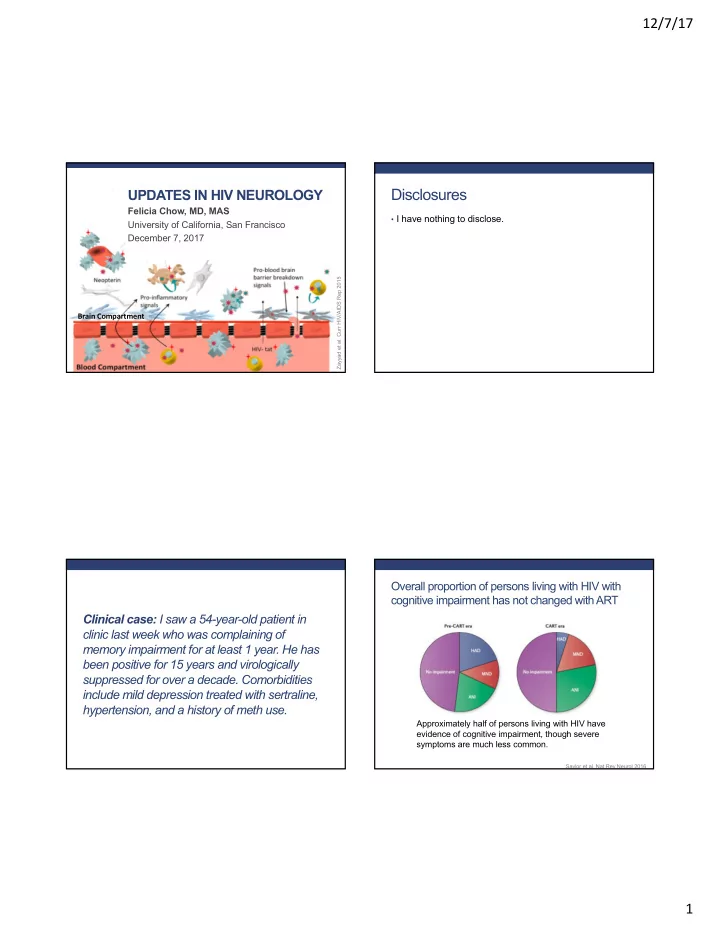
Overall proportion of persons living with HIV with cognitive impairment has not changed with ART

Saylor et al. Nat Rev Neurol 2016

Approximately half of persons living with HIV have evidence of cognitive impairment, though severe symptoms are much less common.

slide-2
SLIDE 2

12/7/17 2

Multiple mechanisms likely contribute to CNS injury and cognitive impairment in HIV

Adapted from slide courtesy of Serena Spudich

CNS injury early in infection not reversed by ART Persistent, compartmentalized CNS infection Ongoing CNS immune activation Inflammation and immune activation -> heightened vascular disease Inadequate antiretroviral exposure or toxicity within CNS Neurodegeneration of aging Co-morbidities (substance abuse, mood disorders, co- infections)

HIV entry into the CNS occurs early in infection

Spudich et al. J Infect Dis 2011, Valcour et al. J Infect Dis 2012

Resulting in CNS inflammation, immune activation and morphologic changes

Spudich et al. J Infect Dis 2011, Wright et al. AIDS 2016

Elevated CSF markers of macrophage and lymphocyte activation present in primary HIV infection (median 2.5 months from infection) and reduced putaminal brain volumes (median 3.33 months from infection)

CNS injury persists despite initiation of ART and virologic suppression

Price et al. J Neuroimmune Pharmacol 2013

Even after achieving virologic suppression on ART, markers of immune activation and inflammation are persistently elevated compared with uninfected controls

slide-3
SLIDE 3

12/7/17 3

Initiation of ART early in infection may mitigate inflammatory changes in the CNS

Young et al. Neurology 2014

*Evidence of progressive inflammation and gliosis present by MRS early in infection but attenuated after initiation of ART

But may not be adequate to prevent cognitive impairment

*Cognitive performance improved across the board after initiation

  • f ART in acute

infection, but only improvement in 1 test was significantly greater than controls *Of 8 participants with evidence of cognitive impairment at baseline, none improved after initiating ART

Kore et al. JAIDS 2015

The majority of persons living with HIV in the US are >50 years of age

http://www.positivelite.com/index.php/item/the-growing-invisible-majority-and-what-do-people-aging-with-hiv-really- need, https://www.cdc.gov/hiv/group/age/olderamericans/index.html

Aging HIV population at greater risk of cognitive impairment

Coban et al. AIDS 2017

After adjusting for expected effects of age using normative controls and other variables, odds of cognitive impairment increased by 20% per decade of advancing age

slide-4
SLIDE 4

12/7/17 4

Neurodegenerative diseases (e.g., Alzheimer’s, Parkinson’s)

Makitalo et al. AIDS Res Ther 2015, Turner et al. Alzheimers Dement 2016

And cerebrovascular disease

  • No. of strokes

54 3 17 20 14 Person-years 32,023 12,780 11,396 5,954 1,893

Rate (per 1000 PY)

1.69 0.23 1.49 3.36 7.39 years Chow et al. CROI 2016, manuscript under review

In ALLRT cohort, rates of stroke higher with each decade of advancing age.

Cerebrovascular risk factors are associated with worse cognitive function

In HAILO cohort, HDL >60 mg/dL ê

  • dds of cognitive impairment by 45%

(p=0.004)

Odds ratio

Per 10 mg/dL higher HDL

In Multicenter AIDS cohort, higher cholesterol and lower HDL associated with increased rate of longitudinal cognitive decline

Makanjuola et al. IAS 2017, Mukerji et al. Clin Infect Dis 2016

Greater burden of cerebral white matter disease in HIV associated with worse cognitive function

Watson et al. J Neurovirol 2017, Su et al. AIDS 2016

*ART-treated PLWH have greater burden of cerebrovascular disease compared with HIV-uninfected counterparts, which correlated with cognitive impairment *White matter hyperintensities mediate association between HIV and cognitive impairment

slide-5
SLIDE 5

12/7/17 5

Clinical case: He has been doing well on TDF/FTC/EVG/COBI for the past few years with excellent adherence. Would you recommend changing his ARVs to a regimen with better CNS penetration?

Adapted from Letendre Top Antivir Med 2011 Dolutegravi r Elvitegravir

Penetration of ARVs into CNS is highly variable

Better CNS penetration associated with virologic suppression in the CSF

*CPE score lower among those with detectable virus in the CSF

Marra et al. AIDS 2009, Cusini et al. JAIDS 2013 p=0.032* p=0.011*

The relationship between CNS penetration and cognitive impairment remains unclear

Carvalhal et al. J Neurovirol 2015

*Higher CNS penetration score correlated with lower prevalence

  • f cognitve impairment
slide-6
SLIDE 6

12/7/17 6

The relationship between CNS penetration and cognitive impairment remains unclear

Marra et al. AIDS 2009, Caniglia et al. Neurology 2014

  • High CPE

score (vs. low CPE score) associated with 75% higher hazard of HIV dementia (aHR 1.74, 95% CI 1.15- 2.65)

RCT of CNS-targeted ARVs demonstrated no significant benefit in cognitive function

Ellis et al. Clin Infect Dis 2014

*No significant improvement in global deficit score (lower values indicate improving performance) after 16 weeks among those who received CNS-targeted therapy

Neurotoxicity of ARVs may also impact cognitive function

De Boer et al. AIDS 2016, Hoffmann et al. HIV Med 2016, Elzi et al. AIDS 2017, Penafiel et al. J Antimicrob Chemother 2017

*Neuropsychiatric AEs (e.g., headache, insomnia, depression/anxiety) reported with DTG use (~2-10%), significantly higher than RAL and EVG use (1-2%) *DTG + ABC, DTG in women, and DTG in

  • lder age associated

with more than twice the risk of neuropsychiatric AEs

T

  • lerability, potency, and efficacy remain key considerations

when selecting ART for persons with cognitive impairment

TDF- FTC EFV ATV/r RAL

  • RAL CSF concentrations exceed 50%

inhibitory concentrations in all

EVG/c

  • No EVG CSF pharmacokinetic data*

DTG ABC-3TC

  • DTG CSF concentrations exceed 50%

inhibitory concentrations in all

  • Fewer CNS side effects than EFV
  • No ABC CSF pharmacokinetic data on daily

dosing

Slide courtesy of Scott Letendre, Last updated 17 Oct 2017; Available at http://www.aidsinfo.nih.gov/guidelines

RPV

  • RPV CSF concentrations do not consistently

exceed inhibitory concentrations

  • EFV short- and long-term neurotoxicity;

can exacerbate psychiatric symptoms

  • ATV CSF concentrations do not consistently

exceed inhibitory concentrations

  • Associated with CSF viral escape

Removed

DRV/r
slide-7
SLIDE 7

12/7/17 7

Clinical case: His ARV regimen was changed to ABC/3TC/DTG about 6 months ago, and he is tolerating this regimen well. His memory impairment is stable but not improved. Are there other adjunctive therapies to consider?

Most treatment trials for cognitive function in HIV have not demonstrated clear benefit

  • Anti-inflammatory & antioxidant agents
  • Selegiline (Schifitto et al. Neurology 2009)
  • Minocycline (Nakasujja et al. Neurology 2013, Sacktor et al. J Neurovirol 2013)
  • Statins (Erlandson et al. Clin Infect Dis 2017, observational)
  • Treatment intensification
  • Raltegravir (Dahl et al. J Infect Dis 2011)
  • Other
  • Memantine, NMDA antagonist (Zhao et al. HIV Clin Trials 2010)
  • Nimodipine (Navia et al. Neurology 1998)

n=30 n=32

Benefit of treatment intensification during acute HIV on cognitive function

Valcour et al. PLOS One 2015

*Initiation of ART + RAL + MVC during acute HIV associated with better cognitive performance at 24 weeks but not significantly different than non- intensified treatment arm

Moderate to large effect of maraviroc intensification

  • bserved at 6 and 12 mos
  • n global cognitive function

Gates et al. AIDS 2016, Ndhlovu et al. CROI 2017

Benefit of treatment intensification on global cognitive function

24-week cenicriviroc intensification improved global cognitive function, working memory and attention

slide-8
SLIDE 8

12/7/17 8

Paroxetine associated with improved cognitive function in a randomized, double-blind, placebo-controlled trial

Sacktor et al. J Neurovirol 2017

*Participants randomized to paroxetine performed better on most neuropsych testing at Week 24

Physical activity associated with better brain integrity

*Physically active individuals have larger putaminal volumes compared with sedentary individuals across the age span *Executive function but not motor function better in physically active individuals compared with sedentary

Ortega et al. J Int Neuropsychol Soc 2015

Short aerobic exercise program intervention did not improve cognitive function

Mcdermott et al. AIDS Care 2017

*At baseline, physical activity and aerobic fitness associated with better cognitive performance. *No change in cognitive performance after 16- week aerobic exercise program (60% adherence)

Considerations in persons living with HIV with cognitive impairment

  • Optimize ARV regimen
  • Minimize polypharmacy
  • Address psychiatric comorbidities (e.g., depression, substance

use)

  • Aggressive vascular risk factor modification: the earlier, the

better

  • Screen for and treat other comorbidities (e.g., sleep apnea,

hepatitis C)

  • Encourage physical, mental, social activity
slide-9
SLIDE 9

12/7/17 9

Clinical case: My patient is on TAF/FTC/EVG/COBI (CD4 900s, VL most recently undetectable but has been intermittently in the low 100-200s) and was admitted with 3 spells of altered mental status concerning for seizures. CSF demonstrated a mild lymphocyte predominant pleocytosis , protein 95 and multiple CSF

  • ligoclonal bands. CSF HIV viral load was positive

at 12,600 copies/mL. Is this adequate to make a diagnosis of HIV CNS escape, or would you proceed to a brain biopsy?

Independent viral replication (a.k.a. compartmentalization) occurs within the CNS

*Blood and CSF HIV populations early in infection can be equilibrated (similar)

  • r compartmentalized

(genetically distinct).

Sturdevant et al. PLOS Pathogens 2015

And contributes to ongoing CNS injury and a distinct viral reservoir

Sturdevant et al. PLOS Pathogens 2015

HIV CNS escape is uncommon but can cause cognitive decline and other neurologic symptoms

  • Dissociation between CSF and plasma

virus concentration

  • Any detectable CSF virus in patients with

plasma virus below level of detection

  • At least one log higher viral load in CSF

in patients with low but measurable plasma viral load

  • Acute to subacute cognitive decline +/-

motor and sensory involvement, seizures and headache

  • CSF with mild to moderate lymphocyte-

predominant pleocytosis and elevated protein

Canestri et al. Clin Infect Dis 2010, Peluso et al. AIDS 2012

slide-10
SLIDE 10

12/7/17 10

  • 14 HIV-infected individuals with

encephalitis and acute to subacute symptoms of HA, memory impairment, confusion, dizziness, seizures

  • 12 of 14 patients on ART, 1 patient

had recently self-discontinued ART

  • 6 with preceding URI
  • Of those tested, all but one had

detectable CSF virus, and most CSF VL > peripheral VL

Lescure et al. Clin Infect Dis 2013

CD8 encephalitis and CNS escape are likely on the same spectrum of HIV-related CNS injury

Evaluation and treatment of CNS escape

  • Send genotype for resistance testing on CSF virus à

M184V and T66A mutations

  • If clinical, CSF and radiological picture consistent with

CNS escape, no indication for brain biopsy

  • CSF flow cytometry with at least 65% CD8+ T cells may support

diagnosis

  • Modify or augment ARV regimen based on 1)

genotype/drug resistance testing and 2) CNS penetration

Canestri Clin Infect Dis 2010, Peluso AIDS 2012, Lescure Clin Infect Dis 2013

Clinical case: The patient’s ARV regimen was changed to ABC/3TC/DTG/DRV/r. He is clinically stable but remains

  • encephalopathic. Would you start

corticosteroids? Utility of steroids in patients with CNS escape/CD8 encephalitis is unclear

  • Patients treated with IV methylprednisolone 1 g daily for 5

days followed by prednisone taper

  • 5 recovered without sequelae, 3 with moderate and 1 with

severe deficits; 5 died within one year of onset

  • Earlier initiation of steroids associated with better
  • utcomes

Lescure et al. Clin Infect Dis 2013

slide-11
SLIDE 11

12/7/17 11 Follow up and prognosis

  • Repeat LP w/ contrast at ~4 weeks after

modification of ARV regimen for cell count, protein, viral load (repeat as needed until CSF viral load undetectable)

  • Repeat brain MRI at ~8-12 weeks after

modification of ARVs

  • T2/FLAIR abnormalities stabilize and may

improve but do not completely resolve

  • May also develop T1 black holes
  • Speech and cognitive therapy
  • Significant clinical improvement over

weeks to months but often have persistent cognitive deficits

Take home points

  • Cognitive impairment remains relevant issue for our patients
  • CNS injury, which occurs early in infection, persists despite effective

ART and virologic suppression

  • Comorbidities associated with aging, including cerebrovascular

disease, contribute to cognitive impairment in HIV

  • The relationship between CNS penetration of ARVs and cognitive

impairment is unclear

  • Small studies suggest treatment intensification and paroxetine may

be beneficial for cognitive impairment, though confirmatory studies are needed

  • HIV CNS escape is an uncommon cause of acute/subacute cognitive

decline and neurological symptoms

THANK YOU

felicia.chow@ucsf.edu