Disclosures Terminology Dr. Robin Newhouse has disclosed a relevant - - PDF document

disclosures
SMART_READER_LITE
LIVE PREVIEW

Disclosures Terminology Dr. Robin Newhouse has disclosed a relevant - - PDF document

Advancing Patient Centered Outcomes Research (PCOR): Implications for Research Methods and Standard Disclosures Terminology Dr. Robin Newhouse has disclosed a relevant financial interest Second International Conference on Research Methods with


slide-1
SLIDE 1

1

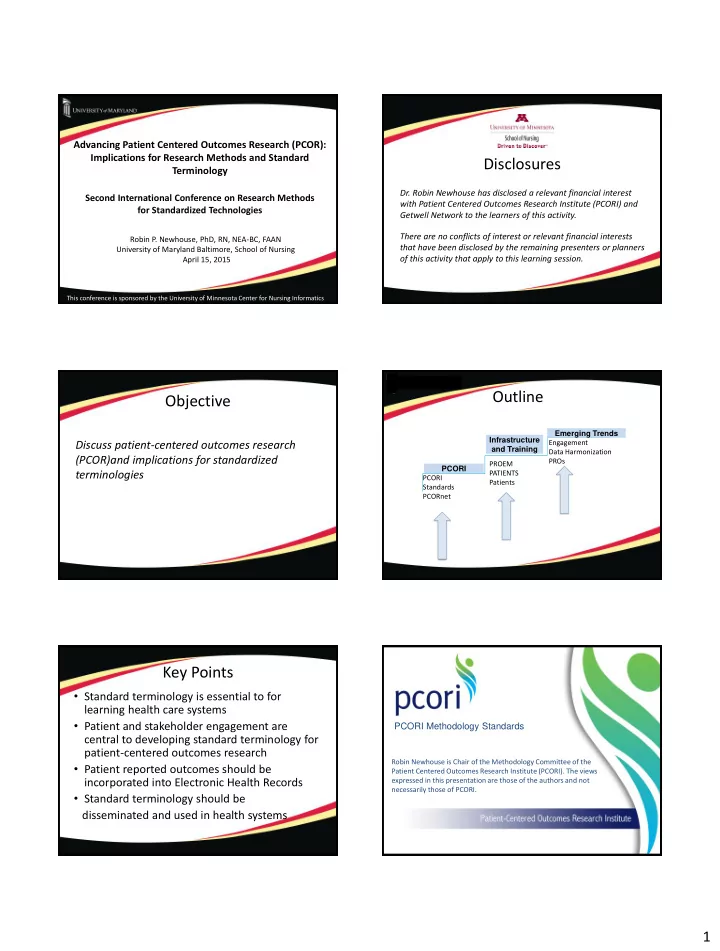
Advancing Patient Centered Outcomes Research (PCOR): Implications for Research Methods and Standard Terminology

Second International Conference on Research Methods for Standardized Technologies

Robin P. Newhouse, PhD, RN, NEA-BC, FAAN University of Maryland Baltimore, School of Nursing April 15, 2015

This conference is sponsored by the University of Minnesota Center for Nursing Informatics

Disclosures

  • Dr. Robin Newhouse has disclosed a relevant financial interest

with Patient Centered Outcomes Research Institute (PCORI) and Getwell Network to the learners of this activity. There are no conflicts of interest or relevant financial interests that have been disclosed by the remaining presenters or planners

  • f this activity that apply to this learning session.

Objective

Discuss patient-centered outcomes research (PCOR)and implications for standardized terminologies

PCORI Infrastructure and Training Emerging Trends

Outline

PCORI Standards PCORnet Engagement Data Harmonization PROs PROEM PATIENTS Patients

Key Points

  • Standard terminology is essential to for

learning health care systems

  • Patient and stakeholder engagement are

central to developing standard terminology for patient-centered outcomes research

  • Patient reported outcomes should be

incorporated into Electronic Health Records

  • Standard terminology should be

disseminated and used in health systems

PCORI Methodology Standards

Robin Newhouse is Chair of the Methodology Committee of the Patient Centered Outcomes Research Institute (PCORI). The views expressed in this presentation are those of the authors and not necessarily those of PCORI.

slide-2
SLIDE 2

2

We Fund Research That…

Studies the benefits and harms of interventions and strategies delivered in real- world settings Compares at least two alternative approaches Adheres to PCORI’s Methodology Standards Is based on health outcomes that are meaningful to the patient population Engages patients and other stakeholders at every stage Is likely to improve current clinical practices

We Focus Attention On…

Conditions

  • Conditions that affect large numbers of

people across a range of populations

  • Conditions that place a heavy burden on

individuals, families, specific populations, and society

  • Rare diseases, which are difficult to study

Populations

  • Racial and ethnic minorities
  • Older adults
  • Low-income and rural populations
  • Children

The Research We Fund is Guided by Our National Priorities for Research

Assessment of Prevention, Diagnosis, and Treatment Options

Improving Healthcare Systems Communication & Dissemination Research Addressing Disparities Accelerating PCOR and Methodological Research

We Target Specific, High-Priority Topics

Assessment of Prevention, Diagnosis and Treatment Options

  • PCOR Treatment Options in Uterine Fibroids*

Improving Healthcare Systems

  • Clinical Trial of a Multifactorial Fall Injury Prevention Strategy in Older

Persons**

  • Effectiveness of Transitional Care

Addressing Disparities

  • Treatment Options for African Americans and Hispanics/Latinos with

Uncontrolled Asthma

  • Obesity Treatment Options Set in Primary Care for Underserved

Populations

  • Clinical Interventions to Address Hypertension Disparities

* Administered by AHRQ ** Administered by the National Institute on Aging

We Follow a Unique Proposal Review Process

Impact of the condition on the health of individuals/populations Potential for the study to improve healthcare and

  • utcomes

Technical merit Patient-centeredness Patient and stakeholder engagement

Applications are reviewed against five criteria:

  • Applications are reviewed

by a panel of two scientists, one patient, and one other stakeholder.

  • PCORI’s Board of

Governors makes funding decisions based on merit review and staff recommendations.

  • Formulating Research Questions
  • Patient-Centeredness
  • Data Integrity and Rigorous

Analyses

  • Preventing/Handling Missing

Data

  • Heterogeneity of Treatment

Effects

We Work to Improve Research Methodology

In any study, methods matter. That’s why we’ve developed methodology standards that all research should follow, at a minimum.

  • Data Networks
  • Data Registries
  • Adaptive and Bayesian

Trial Designs

  • Causal Inference
  • Studies of Diagnostic

Tests

  • Systematic Reviews

Methodology Standards: 11 Broad Categories

slide-3
SLIDE 3

3

Role of the Standards in PCORI Applications

The Methodology Standards and report are tools for applicants in preparing their applications. Applications must demonstrate adherence to PCORI’s Methodology Standards. Not all standards apply to all studies. The standards do NOT dictate specific study designs. The Methodology Standards map to PCORI’s merit review criteria. PCORI technical reviewers assess the methodological rigor of each study’s methods.

Methodology Standards and Proposals

“In the Research Strategy section of the Research Plan Template, you should describe in detail your research strategy and plan, and you should demonstrate how your proposed study is responsive to the PFA. Include the relevant PCORI Methodology Standard citations (e.g., “PC-3”) as identified in the Methodology Report; you should refer to this report for an explanation on each standard. You do not need to list every standard,

  • nly standards that are relevant to your proposal.”

See http://www.pcori.org/content/faqs- applicants#WHAT%20TO%20INCLUDE

The Standards Help to Craft a Research Question

RQ-1 Identify gaps in evidence

Gap analysis and systematic reviews should be used to support the need for a proposed study. If a systematic review is not available, a systematic review should be performed using accepted standards in the field (see standard SR-1), or a strong rationale should be presented for proceeding without a systematic review. In the case where a systematic review is not possible, the methods used to review the literature should be explained and justified.

RQ-6 Measure outcomes that people representing the population of interest notice and care about

Identify and include outcomes the population of interest notices and cares about (e.g., survival, function, symptoms, health-related quality of life) and that inform an identified health decision. Define outcomes clearly, especially for complex conditions or outcomes that may not have established clinical criteria. Provide information that supports the selection of outcomes as meeting the criteria of “patient-centered,” and “relevant to decision makers” such as patient and decision maker input from meetings, surveys, or published studies. Select outcomes based

  • n input directly elicited from patient informants, people representative of the population of

interest, either in previous studies or in the proposed research.

The Standards Guide Development of Patient-Centered Projects

PC-2 Identify, select, recruit, and retain study participants representative of the spectrum of the population of interest and ensure that data are collected thoroughly and systematically from all study participants PC-3 Use patient-reported outcomes when patients or people at risk of a condition are the best source of information

The Standards Address Missing Data

MD-1 Describe methods to prevent and monitor missing data MD-3 Use validated methods to deal with missing data that properly account for statistical uncertainty due to missingness

Stories Highlight Important Methods Issues

The stories are not intended to endorse specific research approaches; they demonstrate that good methods make a difference.

18

slide-4
SLIDE 4

4

Patient Engagement vs. Patient-Centeredness

  • Patient engagement is about having patients as partners in

research as opposed to merely subjects

  • Active engagement between scientists, patients, and

stakeholders

  • Community, patient, and caregiver involvement already in

existence or a well-thought out plan

  • Patient- Centeredness is a component of what PCOR is looking

for in research applications

  • Does the project aim to answer questions or examine outcomes

that matter to patients within the context of patient preferences?

  • Research questions and outcomes should reflect what is

important to patients and caregivers 19

PCORnet

Rachael Fleurence, PhD Program Director CER Methods and Infrastructure, PCORI *slides used with permission *CDM slide by Rich Platt

20

Pivotal $100M Infrastructure Investment

Provides technical and logistical assistance under the direction

  • f a steering committee and PCORI program staff

System-based networks, such as integrated delivery systems, academic medical centers, federally qualified health centers,

18 Patient-Powered Research Networks (PPRNs)

Participants/patients working together to discover, propose, and answer relevant research questions. Building the tools to engage people more broadly in research from end to end.

11 Clinical Data Research Networks (CDRNs) Coordinating Center

Spring 2015: Coming Into View

PCORnet’s infrastructure built to:

To leverage rich clinical electronic health data linking EHR data with private and public claims data (incl. CMS) Support both large observational studies and embedded randomized clinical trials Support novel models of participant-led research, integrate patient-preference science, and build robust patient-participation Involve patients, clinicians, and health systems leaders in governance and use

  • f the network

DataMarts leveraging the CDRNs Electronic Health Data

Each CDRN Network will have 1-10 DataMarts Total anticipated DataMarts: 75 Annotated Data Dictionaries received: 62 Software installation completed: 30 Nine of 11 CDRNs have transformed data for at least

  • ne million individuals

23

CDRNs Disease Cohorts

Organization Common Cohort Rare Cohort ADVANCE Diabetes Co-infection with HIV and hepatitis C virus CAPriCORN Anemia; Asthma Sickle cell disease; Recurrent C. Difficile colitis Great Plains Collaborative Breast Cancer Amyotrophic Lateral Sclerosis (ALS) Louisiana Clinical Data Research Network Diabetes Sickle Cell Disease, Rare Cancers NYC-CDRN Diabetes Cystic fibrosis Mid-South CDRN Coronary Heart Disease (CHD) Sickle Cell Disease (SCD) PEDSNet Inflammatory bowel disease Hypoplastic left heart syndrome PORTAL Colorectal Cancer Severe Congenital Heart Disease pSCANNER Congestive Heart Failure Kawasaki Disease P2ATH Atrial Fibrillation Idiopathic Pulmonary Fibrosis SCIHLS Osteoarthritis Pulmonary arterial hypertension

24

slide-5
SLIDE 5

5

PCORnet Common Data Model v2.1

25 Data captured from healthcare delivery, direct encounter b Data captured from processes associated with healthcare delivery Fundamental basis

PATID BIRTH_DATE BIRTH_TIME SEX HISPANIC RACE BIOBANK_FLAG DEMOGRAPHIC PATID ENR_START_DATE ENR_END_DATE CHART ENR_BASIS ENROLLMENT PATID ENCOUNTERID SITEID ADMIT_DATE ADMIT_TIME DISCHARGE_DATE DISCHARGE_TIME PROVIDERID FACILITY_LOCATION ENC_TYPE FACILITYID DISCHARGE_DISPOSITION DISCHARGE_STATUS DRG DRG_TYPE ADMITTING_SOURCE ENCOUNTER PATID ENCOUNTERID (optional) MEASURE_DATE MEASURE_TIME VITAL_SOURCE HT WT DIASTOLIC SYSTOLIC ORIGINAL_BMI BP_POSITION VITAL PATID ENCOUNTERID ENC_TYPE (replicated) ADMIT_DATE (replicated) PROVIDERID (replicated) DX DX_TYPE DX_SOURCE PDX DIAGNOSIS PATID ENCOUNTERID ENC_TYPE (replicated) ADMIT_DATE (replicated PROVIDERID (replicated) PX_DATE PX PX_TYPE PROCEDURE PATID RX_DATE NDC RX_SUP RX_AMT DISPENSING PATID ENCOUNTERID (optiona LAB_NAME SPECIMEN_SOURCE LAB_LOINC STAT RESULT_LOC LAB_PX LAB_PX_TYPE LAB_ORDER_DATE SPECIMEN_DATE SPECIMEN_TIME RESULT_DATE RESULT_TIME RESULT_QUAL RESULT_NUM RESULT_MODIFIER RESULT_UNIT NORM_RANGE_LOW MODIFIER_LOW NORM_RANGE_HIGH MODIFIER_HIGH ABN_IND LAB_RESULT PATID ENCOUNTERID (optional) REPORT_DATE RESOLVE_DATE CONDITION_STATUS CONDITION CONDITION_TYPE CONDITION_SOURCE CONDITION PATID ENCOUNTERID (optional) CM_ITEM CM_LOINC CM_DATE CM_TIME CM_RESPONSE CM_METHOD CM_MODE CM_CAT PRO_CM PRESCRIBING

http://www.pcornet.org/resource-center/pcornet-common-data-model/

Technical Analyst

Data Quality Assurance review process

Data Quality Analyst 1 Data Quality Analyst 2 Data Manager

  • 1. Perform Data

Update

  • 9. Review and

finalize report

  • 7. Review #2 of

data quality

  • utput
  • 8. Annotate initial

report of findings

  • 12. Approve

Data Update Data Partner MSOC

Data Quality Analyst

  • 2. Execute data

quality program package

  • 3. Review
  • utput; identify

and resolve issues

  • 4. Deliver

summary output to MSOC

  • 5. Review #1 of

data quality

  • utput
  • 6. Prepare initial

report of findings

  • 10. Review

report; resolve issues, respond to MSOC

  • 11. Review

Data Partner’s response to report; send additional questions if needed

Coming Into View – Funded PCORnet Demonstration Projects

RCT: A Patient-centric Trial Assessing Benefits and Long-term Effectiveness (ADAPTABLE) Trial

  • Comparative effectiveness of 81 vs 325 mg of aspirin for secondary

prevention of cardiac events and serious bleeding Observational CER in the Weight Cohort – one or two large

  • bservational studies
  • Compare bariatric surgery procedures on weight loss, regain, and other
  • utcomes
  • Comparative effect of different antibiotics in children under 2 years on

BMI, patterns of growth, and rates of obesity by ages 3-5 years PPRN Demonstration Projects

  • PCORI will fund CER projects generated by patient communities of the

PPRNs

Guiding principle: Make research easier

Analysis ready data

  • Standard format
  • Harmonized definitions
  • Quality checked in advance

Reusable analysis tools Efficient clinical trial enrollment and follow up mechanisms Simple, pragmatic studies integrated into routine care Administrative simplicity

Goal of demonstration observational and interventional studies

Address questions important to patients and clinicians that require multi- site evaluation Facilitate collaboration between PCORnet’s networks Guide further development of PCORnet policies, procedures, infrastructure Evaluate the readiness of PCORnet’s data and networking capabilities Assess PCORnet’s privacy protecting data infrastructure and analysis capabilities Develop efficient methods for identifying potential clinical trial participants, reaching out to them, enrolling, and obtaining follow up Assess end-to-end functionality, from protocol development through implementation, analysis, and reporting

29

Requirements for Network Participation in Observational Studies

Work with a single IRB of record (1 per project) Complete contracting and data use agreements quickly Have analysis ready data (Common Data Model v2.1)* Use PCORnet’s networking querying capabilities* Execute supplied QC and analytical programs (SAS) without modification* Share relevant data and documentation * Clinical data research networks

30

slide-6
SLIDE 6

6

Find Us Online

www.pcori.org

PCOR Infrastructure and Training

Robin Newhouse, PhD, RN, NEA-BC, FAAN

Chair & Professor, Organizational Systems and Adult Health, School of Nursing

Eleanor Perfetto, PhD

Professor, PHSR Dept, School of Pharmacy PROEM Center Director

  • C. Daniel Mullins, PhD

Professor and Chair, PHSR Dept, School of Pharmacy PATIENTS Program Director

Patient tient-Center Centered ed Resear esearch h for

  • r

Outcomes Outcomes, , Ef Effectiv ectiveness eness and and Measur Measurement ement (PR (PROEM) OEM)

A Center of Excellence in Comparative Effectiveness and Patient-Centered Outcomes Research (CER-PCOR) Training Eleanor M. Perfetto, PhD, MS, Professor Department of Pharmaceutical Health Services Research School of Pharmacy University of Maryland

University of Maryland PROEM Center of Educational Excellence Governance and Relationships Curriculum Committee: Drs. Perfetto, Roghmann, Newhouse, Mullins, Beardsley Internal Advisory Board External Advisory Board External Partners: PCORI, PhRMA, BIO, NPC, CMTP, Pfizer, Merck, Avalere and Others Specific Aim 1: MS/PhD Degree Program, Led by Drs. Perfetto and Beardsley Specific Aim 2: CE Programs and Summer Institute, Led by Dr. Roghmann and Perfetto Specific Aim 3: Engage/Inform/ Dissemination Led by Drs. Mullins and Newhouse Specific Aim 4: Evaluation Led by Dr. Beardsley and Perfetto Experiential sites Conferences Weblinks Program Collaborations Surveys Newsletters UMB CER/PCOR Interest Group Healthcare Professional and Law School Faculties

Clinical Outcomes Assessment Introduction to CER/PCOR Quality and Performance Standardized Terminology X X X Data Harmonization X X X

35

Course Content

Patient Engagement is a Means for:

Empowering and Inspiring the Community Building Trust for Authentic Partnerships Improving Health and Healthcare Decisions Advancing Patient-Driven Scientific Discovery

slide-7
SLIDE 7

7

  • A. PLANNING RESEARCH
  • 1. Topic Solicitation
  • 2. Prioritization
  • 3. Framing the Question
  • B. DOING IT
  • 4. Selection of Comparators and Outcomes
  • 5. Creation of Conceptual Framework
  • 6. Analysis Plan
  • 7. Data Collection
  • C. DELIVERING SOLUTIONS
  • 8. Reviewing & Interpreting Results
  • 9. Translation

10.Dissemination *Based on: Mullins CD, Adbulhalim AM, Lavallee DC. Continuous Patient Engagement in Comparative Effectiveness Research. JAMA 2012; 307(15): 1587-8.

10-STEP FRAMEWORK FOR CONTINUOUS PATIENT ENGAGEMENT IN RESEARCH*

  • Meet networks where they are
  • Capitalize on diversity of networks
  • Specify the “must have narrow neck”; make everything

else modular

  • Pay special attention to patient-generated data
  • Maximize transparency
  • Leverage existing standards and support institutional

priorities

  • Ground the approach in iteration and validation

38

Data Harmonization for Patient- Centered Clinical Research

  • IOM. (2014). Data Harmonization for Patient-Centered Clinical Research. Available at:

http://www.iom.edu/~/media/Files/Activity%20Files/Quality/VSRT/Data-Harmonization/ VSRT-WIB-DataHarmonization.pdf

“The Committee on Core Metrics for Better Health at Lower Cost will conduct a study and prepare a report directed at exploring measurement of individual and population health

  • utcomes and costs, identifying fragilities and gaps in

available systems, and considering approaches and priorities for developing the measures necessary for a continuously learning and improving health system.” 39

Committee on Core Metrics for Better Health at Lower Cost

  • IOM. (2015). The Committee on Core Metrics for Better Health at Lower Cost. Available at

http://iom.edu/Activities/Quality/CoreMetricsForBetterHealth.aspx

  • A.5. Develop interoperable open data platforms and web

tools that can interface with EHRs, to encourage standardized large-scale PRO assessment and evaluation across many health care systems (including non-integrated health care delivery systems).

  • A.6. Establish minimum standards for PRO measure

development, use and interpretation.

  • A.7. Develop PRO measurement sets that serve multiple

needs in multiple settings. 40

PC PCORI P ORI Patient tient-Repor eported ted Ou Outcomes tcomes (PR (PRO) Infr O) Infrastr astructur ucture e Wor

  • rkshop

kshop “Integrating PROs into EHRs”

Available at: http://www.pcori.org/sites/default/files/PCORI-PRO-Infrastructure-Workshop%20Report-111913.pdf Newhouse, R.P., Barksdale, D., Miller, J. Research Done Differently: The Patient-Centered Outcomes Research Institute (PCORI). (2015). Nursing Research, 64(1), 72-77.

PCOR and Nursing Science

Key Points

  • Standard terminology is essential to for

learning health care systems

  • Patient and stakeholder engagement are

central to developing standard terminology for patient-centered outcomes research

  • Patient reported outcomes should be

incorporated into Electronic Health Records

  • Standard terminology should be

disseminated and used in health systems

slide-8
SLIDE 8

8

References

Fleurence, R., Whicher , D, Dunham, K. , Gerson, J., Newhouse, R., Luce, B. (2015). The Patient-Centered Outcomes Research Institute’s Role in Advancing Methods for Patient-Centered Outcomes Research. Medical Care, 53(1), 2-8. Doi: 10.1097/MLR.0000000000000244. Methodology Committee of the Patient-centered Outcomes Research Institute. Aronson, N., Basch, E. Berg, A., Flum, D., Goodman, S.N., Helfand, M. Ioannidis, J.P., Lauer, M., Meltzer, D., Mittman, B., Newhouse, R., Schneeweiss, S., Slutsky, J., Tinetti, M., Yancy, C. (2013). Hickam, D. Totten, A., Berg, A., Rader, K., Goodman, S., Newhouse, R. (eds.). PCORI Methodology Report. Available at: http://www.pcori.org/assets/2013/11/PCORI-Methodology-Report.pdf See summary of PCORI study results and related papers at:

http://www.pcori.org/content/pcori-literature

Using the PCORI Methodology Standards available at:

http://www.pcori.org/events/2013/using-pcori-methodology-standards

Robin Newhouse, PhD, RN newhouse@son.umaryland.edu