Disclosures First, Do No (Financial) Harm I do not have any relevant - - PDF document

disclosures
SMART_READER_LITE
LIVE PREVIEW

Disclosures First, Do No (Financial) Harm I do not have any relevant - - PDF document

10/21/2013 Disclosures First, Do No (Financial) Harm I do not have any relevant financial Christopher Moriates, MD relationships or commercial interests to disclose UCSF Division of Hospital Medicine Keynote Address, Primary Care Medicine


slide-1
SLIDE 1

10/21/2013 1

First, Do No (Financial) Harm

Christopher Moriates, MD UCSF Division of Hospital Medicine Keynote Address, Primary Care Medicine October 30, 2013

CMoriates@medicine.ucsf.edu Twitter: @ChrisMoriates

Disclosures

  • I do not have any relevant financial

relationships or commercial interests to disclose

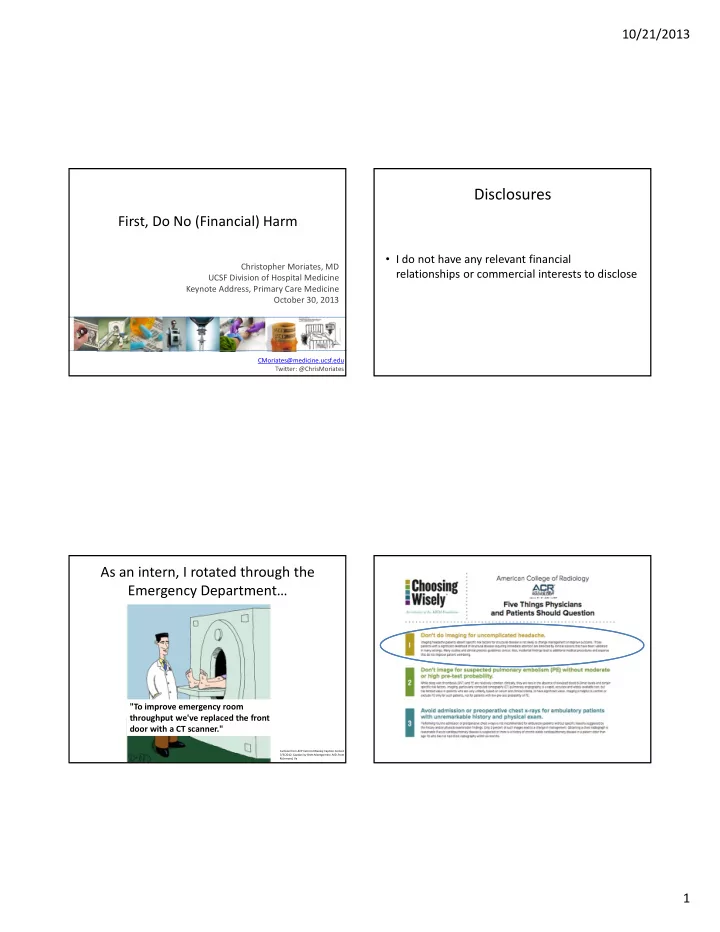
As an intern, I rotated through the Emergency Department…

"To improve emergency room throughput we've replaced the front door with a CT scanner."

Cartoon from ACP Internist Weekly Caption Contest 7/3/2012. Caption by Brett Montgomery, MD, from Richmond, Va

slide-2
SLIDE 2

10/21/2013 2

Why Do We Do This?

Are We Treating The Patient In Front of Us?

Cartoon by T. McCracken www.mchumor.com

How much does this cost?

Illustration by Peter Arkle Bloomberg.com 7/ 11/ 11

Image from: Wired Magazine, 2012

Prices have been traditionally hidden from physicians and the public…

Today’s Agenda

  • Why Physicians (Should) Care About

Healthcare Costs

  • How Are We Teaching Physicians?

– The UCSF Cost Awareness curriculum – An example case presentation

  • How Do You Operationalize These Ideals at the

Bedside?

– Highlight an example High‐Value Care Project

  • Conclusions
slide-3
SLIDE 3

10/21/2013 3

Why show physicians the costs?

  • It is part of physicians’ professional responsibility

to use healthcare resources judiciously

  • Physicians lack basic understanding of healthcare

costs and value -- they need to be trained about healthcare costs

  • Astounding amount of healthcare waste and

“unnecessary testing”

  • It is important to the patient in front of us

Slide showing % of GDP goes here?

It Is About The Patient In Front of Us!

Side‐Effects May Include: Financial Ruin

  • Medical bills are the leading cause

for personal bankruptcy in the United States

  • >75% were insured!
  • More Americans than ever before

are now on High‐Deductible Insurance plans

Himmelstein DU, Warren E, Thorne D, Woolhandler S. MarketWatch: Illness And Injury As Contributors To Bankruptcy. Health Affairs, no.W5(63), 2005. Himmelstein DU, Thorne D, Warren E, Woolhandler S. Medical bankruptcy in the United States, 2007: results of a national study. Am J Med 2009;122(8):741–6.

An Uninsured Patient’s Perspective

Clip courtesy of This American Life from WBEZ Chicago

slide-4
SLIDE 4

10/21/2013 4

It is About the Patient In Front of Us: Putting Off Care Because of Cost

Percent who say they or another family member living in their household have done each of the following because

  • f the cost:

Not filled a prescription for a medicine Cut pills in half or skipped doses of medicine Skipped dental care or checkups Put off or postponed getting health care needed Had problems getting mental health care Relied on home remedies or over-the-counter drugs instead of going to see a doctor Skipped a recommended medical test or treatment

Source: Kaiser Family Foundation Health Tracking Poll (conducted May 8-14, 2012).

‘Yes’ to any of the above 58% 8% 16% 25% 24% 29% 35% 38%

Your Patients Are Reading This

Screenshot from The Daily Show, 3/13/13

Two separate motivations to consider costs:

  • 1. Macroeconomic resource stewardship
  • 2. Financial safety of the patient in front of us1
  • 1. Moriates, Shah, Arora. First, Do No (Financial) Harm. JAMA, 2013
slide-5
SLIDE 5

10/21/2013 5

The Sweet Spot: Where these two motivations align Good for Society Good for Individuals

For example: Generic Drugs

Generic Drugs

  • Approximately 4 of 10 physicians report they

“sometimes or often” prescribe brand‐name drugs when a generic is available

– “Acquiescing to patient demands” – Certain physician‐industry relationships were significantly associated with prescribing brand‐ name drugs

References: Cambell EG, Pham-Kanter G, Vogeli C, Iezzoni LI. JAMA Internal Medicine 2013; 173(3):237-239 Shrank WH, Liberman JN, Fischer MA, et all. Ann Pharmacother. 2011;45(1):31-38

The Case of Statins

  • 8 statins currently on the market: 5 are

available as generics

  • In 2011, fewer prescriptions for generic

Simvastatin written than for Lipitor (Pfizer)

  • U.S. Primary Care physicians’ use of branded

statins results in $5.8 Billion excess annual spending

Atorvastatin

References: Green JB, Ross JS, Jackevicius CA, et al. JAMA Int Med 2013, 173(3):229-232

Sources of $750B of Waste and Excess in Healthcare

IOM (Institute of Medicine). 2012. Best care at lower cost: The path to continuously learning health care in America. Washington, DC: The National Academies Press.

slide-6
SLIDE 6

10/21/2013 6

The Patient In Front of You…

You look at your schedule and see that your next patient is coming in with a complaint of… LOW BACK PAIN

Patient Presentation – Mr. P

  • 45 year old man with 2 weeks of low back pain:

– Aching with intermittent sharp pain, originating in lower spine – Radiating to the left and right of his spine – Worse with bending and standing, and after lying down for long periods – Denies radiation to the legs, weakness, numbness, bowel or bladder incontinence, or any other neurological symptoms. – Improves with ice, and heat packs. He has taken Tylenol 350 mg PO twice a day x 5 days with limited improvement

Patient Presentation (Continued)

Vitals: Normal Back Exam:

  • Normal visual appearance
  • Tender over L4‐L5 spinus

processes, and adjacent muscles

  • No muscular spasm
  • Limited motion in all 6 plains,

secondary to pain Neuro Exam:

  • Strength: 5/5 throughout
  • Sensation: Normal light touch
  • Reflexes: 2+ symmetric at Pateller,

ankle.

  • Gait: Normal. Able to walk

tandom, tip toes, and heals

Some physicians may be resigned to a reality that financial adverse effects are a known and unavoidable harm of medical care. However, the same argument had been made previously about central line infections, yet recent data highlight that central line infections are almost universally avoidable through specific actions of physicians.

slide-7
SLIDE 7

10/21/2013 7 Step 1: Screen for Financial Harm

“Are you worried about how your medical care will be paid for?” “Are you having trouble paying for your medications at home?”

Moriates, Shah, Arora. “First Do No (Financial) Harm.” JAMA, August 2013

Step 2: Adopt a Universal Approach

Most back pain like yours gets better on its own within 4‐6 weeks. The risks of radiation and the high cost outweigh any possible benefits.

Moriates, Shah, Arora. “First Do No (Financial) Harm.” JAMA, August 2013

“Even though your insurance will cover it, I don’t think that back imaging will help us. What were you hoping to find out with a scan?”

Step 3: Understand financial ramifications and value of recommendations

“Physical therapy has been shown to be beneficial in some back pain cases like yours if the pain lasts more than 4 weeks. I could refer you to physical therapy if you are interested, but it may not be covered by your insurance and would likely cost you up to a couple hundred dollars out‐of‐

  • pocket. Would that be ok with you?...”

Moriates, Shah, Arora. “First Do No (Financial) Harm.” JAMA, August 2013

Step 4: Optimize care plans for individual patients

“Your insurance will not cover physical therapy, but you could go to your local Yoga class if you want for much cheaper. Yoga has also been shown to be helpful for low back pain. Do you think that you would want to try that?”

Moriates, Shah, Arora. “First Do No (Financial) Harm.” JAMA, August 2013

slide-8
SLIDE 8

10/21/2013 8

Previously widely ignored in medical training:

“The reasons for this silence are historical, philosophical, structural, and cultural. ...Combating such forces is a tall order, but I believe that medical educators have an

  • bligation to address cost.”
  • Dr Molly Cooke (2010)

Reference: Cooke M. Cost consciousness in patient care‐‐what is medical education's responsibility? N Engl J Med 2010;362:1253‐5 :

What We Are Up Against…

Teaching Value Project, Costs of Care, 2013 Video: “Overrun with Overuse, Part 2”

slide-9
SLIDE 9

10/21/2013 9

Introduction to the UCSF Cost Awareness Curriculum

Introduction “Core” topic and case assigned Interns divide into two groups

Guideline Review

  • Review literature
  • Find evidence based best‐practice

guidelines

  • Suggest cost effective workups

Case Analysis

  • Review recent case from our institution
  • Analyze hospital bill, and clinical chart to

evaluate care provided

  • Reflect on our own clinical behaviors

Case review debrief Case based noon conference for ALL residents

Process: How the curriculum is delivered

Providing “Value” in Health Care

Quality Cost VALUE =

UCSFCost Awareness Curriculum: Evaluation

  • Highly relevant to their clinical practices

(mean, 4.6 +/‐ 0.6 on a 5‐point Likert scale; median, 5)

  • Likely to change their ordering behaviors

(mean, 4.3 +/‐ 0.7; median, 4)

  • Pilot: 176 evaluations from 10 conferences

Moriates, et al. JAMA Int Med, 2013

slide-10
SLIDE 10

10/21/2013 10

http://www.nejm.org/doi/full/10.1056/NEJMp1205634

Through modules detailing common admission diagnoses, he emphasizes the principles of evidence-based medicine and provides information about associated costs…

Two residents’ experience with the curriculum: …the purpose of this curriculum is not to teach rationing health care; it’s to teach rational health care. By learning the fundamentals

  • f evidence-based medicine,

but keeping the best interests of the patient in mind, we’ve learned how to use the most current guidelines to provide individualized yet cost- effective care.

http://primarycareprogress.org/blogs/16/191

Resources for Training Physicians

www.highvaluecarecurriculum.org Cost Awareness Curriculum JAMA Intern Med. 2013;173(4):308‐310 Costs of Care / ABIMF “Teaching Value” Project www.teachingvalue.org

Example: (Abbreviated) Case Presentation from UCSF Cost Awareness Curriculum

slide-11
SLIDE 11

10/21/2013 11

A Patient Was Admitted to the Medicine Service Last Winter…

Patient presentation: Ms. J.

  • 65 year‐old woman with a recent diagnosis of COPD
  • Started on albuterol inhaler 1 month ago by primary doctor
  • She has “attempted to use the inhaler” but has noted

increased wheezing and productive cough

  • In the Emergency Department:

– Started on continuous nebulized bronchodilator therapy – Given Solumedrol 125mg IV – Chest X‐ray – CT Chest

How much does this cost?

Illustration by Peter Arkle Bloomberg.com 7/ 11/ 11

Disclaimers

  • The “costs” listed are estimates.

– There are a lot of complexities to how things are priced and how much a specific patient is charged – The goal is to give an idea of magnitude – Costs are reported as “Hospital Charges”

  • Clinical reasoning and individualized care is very

important

  • Cost‐effective care is NOT about discouraging

nor denying beneficial services

slide-12
SLIDE 12

10/21/2013 12

Imaging

  • CXR = $251
  • Non‐Con CT Chest:

$2,755

  • Contrast 350mg = $341

Price = Estimated hospital charge from actual patient’s bill

“Nebs” vs Inhalers The Evidence: Nebs vs Inhalers

  • Systematic reviews: No significant difference

between devices in any efficacy outcome in any patient group

  • Studies: Bronchodilator delivery by an inhaler is

equivalent in acute treatment of adults with airflow obstruction.

Dolovich MB, Ahrens RC, Hess DR, et al Chest. Jan 2005;127(1):335-371. Turner MO, Patel A, Ginsburg S, FitzGerald JM. Archives of internal medicine. Aug 11-25 1997;157(15):1736-1744 Mandelberg A, Chen E, Noviski N, Priel IE. Chest. Dec 1997;112(6):1501‐1505.

Patients Misuse Their Inhalers!

Recent study:

  • 86% of patients misused their

inhalers (some did not even take the cap off!)

  • All of them (100%) were able to achieve mastery

after training!

Press VG, Arora VM, Shah LM, et al. Misuse of respiratory inhalers in hospitalized patients with asthma or COPD. Journal of general internal medicine. Jun 2011;26(6):635‐642.

slide-13
SLIDE 13

10/21/2013 13

So, what happened to our patient?

  • Around‐the‐clock nebulized bronchodilator therapy

(“Nebs”) every 4 hours x 3 days

  • Transitioned to Metered‐Dose Inhalers (MDIs) prior to

discharge on her last hospital day ‐ Never received dedicated inpatient inhaler teaching!

Missed Opportunity Ms J. ‐ Total estimated hospital bill

Summary of current charges Room at $7,277 x4 days $29,108 Pharmacy $3,969 Lab $4,394 Supply/Devices $2,272 Radiology $250 CT Scan $2,755 Respiratory Services $4,605 Emergency Room $2,277 EKG $380 Total of Current Charge

$50,103

NOTE: Physician fees billed separately

If transitioned to inhalers at 24 hours: $1,770 (Could have save AT LEAST $2,835)

Quality Gap

slide-14
SLIDE 14

10/21/2013 14 How Do You Operationalize These Ideals At The Bedside?

The Cost

  • During Fiscal Year 2012, the medicine service

alone spent more than $1MILLION on 25,114 nebulizer treatments for 1200 NON‐ICU patients

  • UCSF Spent >$3.5MILLION hospital‐wide

Nebs No More After 24!

Help us improve transitions from nebulizers to metered dose inhalers (MDIs) and provide patient education about proper MDI use

What Can You Do?  Use MDIs at admission UNLESS there is an indication for nebulizer therapy  Transition your patients from nebs to MDIs after 24 hours, if appropriate, AND write an order for RT to provide MDI teaching

Improving Use of Appropriate Respiratory Therapies A Collaborative Initiative Between Respiratory Therapists, Nurses, and Physicians In Partnership with the Division of Hospital Medicine High-Value Care Committee

 MDIs are as effective as nebulizer treatments!  MDIs provide high value, high quality patient care!  We can teach and train

  • ur patients on correct

MDI use while in the hospital!

Talmadge E. King, Jr., MD Pulmonologist and Chair of UCSF Department of Medicine “Open mouth technique: Hold MDI two finger widths away from your lips.“

Moriates, et al. JAMA IM, 2013

Nebulizer Usage on High‐Acuity Medical Floor Projected Savings on 14M = $250,000 Annually
slide-15
SLIDE 15

10/21/2013 15

UCSF Division of Hospital Medicine High Value Care Committee High‐Value Care Committee: Current Philosophy

  • Focus now on the “low‐hanging fruit”:

interventions with low or no benefit

  • Goal: Reduce inappropriate care that does not

help (or even harms) patients

  • Ultimate outcomes: better patient care, reduced

cost

UCSF Division of Hospital Medicine High Value Care Committee

Current Major Targets: Nebulizer Usage Stress Ulcer Prophylaxis (PPIs) Blood utilization Stewardship (Transfusions) Telemetry Inpatient Echocardiograms Lab Testing

High‐Value Care Projects: Lessons Learned

  • Strategy:

–Stakeholder Recruitment and Buy‐In –“COST” interventions:

  • Culture
  • Oversight
  • Systems
  • Training
  • Like previous QI work, these projects

require an “all‐of‐the‐above” approach

slide-16
SLIDE 16

10/21/2013 16

Why is it more difficult than QI?

Instead of asking providers to start doing more

  • f something they already know they should be

doing (DVT prophylaxis, Hand Hygiene, Checklists) Stop doing something that you already do!

Concentrate on Why This Is Better for Patients

  • Not about “taking things away”

Decreasing Inappropriate Transfusions Blood Utilization Stewardship

Our Future Together

  • THE BEST CARE AT THE LOWEST COSTS for our

patients

  • Help disseminate education

nationally

  • Contribute to the national

movement for better healthcare value

Thank You

Questions / Comments:

  • Chris Moriates, MD

Division of Hospital Medicine, UCSF

  • Cmoriates@medicine.ucsf.edu
  • Twitter: @ChrisMoriates