Disclosures Integrated Approach to Treating CTD-ILD Industry - - PowerPoint PPT Presentation

disclosures integrated approach to treating ctd ild
SMART_READER_LITE
LIVE PREVIEW

Disclosures Integrated Approach to Treating CTD-ILD Industry - - PowerPoint PPT Presentation

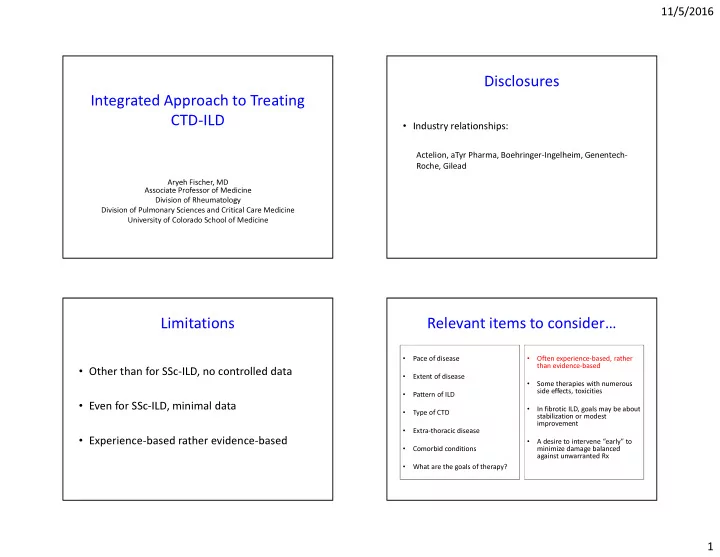
11/5/2016 Disclosures Integrated Approach to Treating CTD-ILD Industry relationships: Actelion, aTyr Pharma, Boehringer-Ingelheim, Genentech- Roche, Gilead Aryeh Fischer, MD Associate Professor of Medicine Division of Rheumatology


slide-1
SLIDE 1

11/5/2016 1

Integrated Approach to Treating CTD-ILD

Aryeh Fischer, MD Associate Professor of Medicine Division of Rheumatology Division of Pulmonary Sciences and Critical Care Medicine University of Colorado School of Medicine

Disclosures

  • Industry relationships:

Actelion, aTyr Pharma, Boehringer-Ingelheim, Genentech- Roche, Gilead

Limitations

  • Other than for SSc-ILD, no controlled data
  • Even for SSc-ILD, minimal data
  • Experience-based rather evidence-based

Relevant items to consider…

  • Pace of disease
  • Extent of disease
  • Pattern of ILD
  • Type of CTD
  • Extra-thoracic disease
  • Comorbid conditions
  • What are the goals of therapy?
  • Often experience-based, rather

than evidence-based

  • Some therapies with numerous

side effects, toxicities

  • In fibrotic ILD, goals may be about

stabilization or modest improvement

  • A desire to intervene “early” to

minimize damage balanced against unwarranted Rx

slide-2
SLIDE 2

11/5/2016 2

Determining impairment

  • Subjective

– Dyspnea – Extra-thoracic disease burden

  • Objective

– PFTs (FVC, DLco) – 6MWT – Disease extent by HRCT

Treat: “clinically-significant”, progressive disease

Clinical realities for SSc-ILD

  • The majority of SSc patients have ILD
  • Clinically progressive disease in ~ 1/3
  • Treatment is not benign (especially CYC and stem cell transplant)
  • Effective therapies only associated with stability or modest

improvement (SLS I, II, FAST, MMF retrospective data)

– (Fear of losing ground)

  • Decisions whether to initiate immunosuppression are individualized

Predictors of progression?

SSc:

– Scl-70 antibody positivity – Isolated nucleolar ANA – “Early” disease – Disease extent by HRCT – Hx of progression

PM/DM:

– tRNA synthetase antibodies (e.g. Jo-1, PL-7, PL-12, etc.) – MDA-5

RA: Men?, CCP?, smokers? Other CTDs: ???

Pulmonary function testing

Although not adequate to diagnose ILD…

  • Ideal modality for assessing progression in those with ILD
  • Reproducible
  • Relatively inexpensive
  • Trend FVC, DLco over time
  • SSc patients: pulmonary vasculopathy

– Disproportionate reduction in DLco – Elevated FVC/DLco ratio (e.g., FVC 80%, DLco 40%)

slide-3
SLIDE 3

11/5/2016 3

Six minute walk test

  • Measures distance walked, HR, oxygen desaturation
  • Reproducible, inexpensive
  • Effort / coach dependent
  • MSK disease impacts performance / results
  • Won’t distinguish ILD from PAH, other causes of

hypoxia

  • Not ideal for clinical trials, but does aid in assessment

in longitudinal care of an individual patient

General approach to Rx

Corticosteroids

  • Often high dose initially
  • Not a good long term
  • ption

Steroid sparing agent

  • Azathioprine
  • Mycophenolate mofetil
  • Cyclophosphamide
  • Tacrolimus
  • Cyclosporine
  • Rituximab – select cases
  • Others?

Current approach to treatment

Idiopathic UIP (IPF) CTD-ILD (ANY pattern) Idiopathic non-UIP Clinical trials Lung transplantation Immunosuppression Immunosuppression Pirfenidone Nintedanib

Non-drug therapy

  • pulmonary rehab
  • use O2 correctly
  • PH assessments
  • GERD / aspiration
  • N-acetylcysteine (NAC)?
  • Pneumocystis prophylaxis
  • vaccines
  • mental health
slide-4
SLIDE 4

11/5/2016 4

Tashkin et al 2006 NEJM 354;2655-66

49% improved 26% improved 51% worsened 74% worsened

CYC Placebo

Scleroderma Lung Study

Tashkin et al AJRCCM 2007;176:1026-1034

Scleroderma Lung Study at 2 years

CYC placebo Hoyles et al. Arthritis Rheum 2006

Fibrosing alveolitis in SSc trial (FAST)

Rx (n=22) Placebo (n=23) Rx (n=19) Placebo (n=18) P FVC 80 81 83 78 0.08 DLCO 53 55 50 52 0.64 TLC 82 77 80 74 0.61

low-dose prednisone, IV CYC x 6 months followed by AZA vs. placebo

BASELINE 1-YR FOLLOW-UP

Mycophenolate mofetil (MMF)

  • Very popular for the treatment of CTD-ILD
  • Numerous retrospective series in CTD-ILD

– mostly scleroderma-ILD – all with few subjects

  • MMF in CTD-ILD appears to be:

– well-tolerated – associated with preservation of lung function

Swigris Chest 2006, Liossis Rheumatology 2006, Gerbino Chest 2008, Zamora Resp Med 2008, Saketkoo Am J Med Sci 2009, Koutroumpas Clin Rheum 2010, Simeon-Aznar Clin Rheum 2011

slide-5
SLIDE 5

11/5/2016 5

MMF start

weeks before and after MMF initiation

Fischer et al. J Rheumatol 2013

MMF in CTD-ILD: retrospective study, 125 subjects, diverse CTDs

mixed-effects model estimates for FVC%

CTD-non-UIP (n=93; SLBx=36)

Plot of mixed-effects model estimates for FVC% in CTD subjects with UIP or non-UIP

FVC%

weeks before and after MMF initiation

Fischer et al. J Rheumatol 2013

CTD-UIP (n=32; SLBx =15)

2 4 6 8 10 12 14 16 18 20 22 24 26 28 30

  • 250
  • 200
  • 150
  • 100
  • 50

50 100 150 200 250

MMF was associated with steroid tapering effects

median prednisone dose: at MMF initiation: 20 mg qd after 9-12 months on MMF: 5 mg qd (p<0.0001)

weeks before and after MMF initiation Mean prednisone dose (mg)

Fischer et al. J Rheumatol 2013

RED=RA (n= 18) BLACK=SSc (n=44) BLUE=PM/DM (n=32) GREEN=LD-CTD (n=19)

MMF in CTD-ILD

  • Well tolerated
  • Low rate (10%) of discontinuation
  • Effective corticosteroid tapering
  • Associated with stabilization or improvement in lung

function

  • A longer term option (than CYC)
  • Warrants prospective study

Fischer et al. J Rheumatol 2013

slide-6
SLIDE 6

11/5/2016 6

Tashkin et al. Lancet Resp Med 2016

SLS II

FVC had modest improvement with both MMF and CYC; no significant between- treatment difference

SLS II: MMF had fewer adverse events, fewer patients in the MMF arm prematurely withdrew from the study (20 vs. 32), and time to stopping treatment was shorter in the CYC group (p=0.019)

Tashkin et al. Lancet Resp Med 2016 Leukopenia!

Other options?

  • Azathioprine

– well tolerated – “familiar” – FAST trial (SSc) – case series suggest role for variety of CTD-ILD

  • Cyclosporine, Tacrolimus

– may be particularly effective in patients with myositis – ILD

  • Rituximab

– Refractory myositis-ILD – “Rescue therapy”

10 subjects enrolled (6 NSIP, 4 UIP), 48 week open label

  • decline in 1, stability in 5 , improvement in 1
  • 3 withdrew, 1 infusion rxn, 2 deaths (CHF, PNA)

Matteson et al, Open J Rheum 2012

slide-7
SLIDE 7

11/5/2016 7

RTX for severe refractory ILD

(CTD-ILD n=33, HP n=6, misc n= 11)

  • Median decline in FVC of 14.3% and

DLCO of 18.8% in the 6–12 months pre-RTX

  • Median improvement in FVC of 6.7%

(P < 0.01) and stability of DLCO (0% change; P < 0.01) in the 6–12 months post-RTX

  • 2 developed serious infections

(pneumonia) requiring hospitalization

  • 10 died from progression of

underlying ILD, a median of 5.1 (1.2– 24.5) months after treatment Keir et al Respirology 2013 Spaghetti plot showing trajectories for FVC% over time for each subject (n=24) and mixed-effects model estimates FVC% over time for the entire cohort

Rituximab in chronic CTD-ILD (9 RA, 15 other CTD)

Chartrand et al. Sarcoidosis Vasculitis and DLD 2016

aaaaa

Non-RA (n=9) RA (n=15)

Figure 3. Spaghetti plot showing trajectories for percentage of FVC% over time for subjects without or with RA

Chartrand et al. Sarcoidosis Vasculitis and DLD 2016

Rituximab in chronic CTD-ILD RA-OP RA-LIP RA-C-NSIP RA-F-NSIP RA-UIP

Are these all treated the same?

Should histopathology impact treatment decisions?

slide-8
SLIDE 8

11/5/2016 8

SSc-NSIP MCTD-NSIP SjS-NSIP SLE-NSIP RA-NSIP

Are these all treated the same?

Should underlying CTD impact treatment decisions?

Individual CTD-ILDs

  • Fischer is totally making it up…

SSc-ILD

  • Early vs. late disease
  • (they all have fibrotic

interstitial pneumonia)

  • Disease extent
  • PFT disconnect / PFT

challenges

  • MMF >>>>> CYC
  • Not very prednisone-

responsive (concerns for renal crisis?)

  • Aspiration, GERD
  • Development of

PH/PAH – FVC/DL ratio

Myositis-ILD (Synthetase-ILD)

  • Window of opportunity
  • “evolution” from NSIP/OP to fibrotic IP
  • Often will use INTENSE corticosteroids

– Pulse dose (1 gram methylpred x 3 days) – Weekly mini-pulses – MMF first line – Early trigger for rituximab

  • IVIg for the myositis component
  • AZA, tacrolimus, cyclosporine
  • Long-term Rx needed
slide-9
SLIDE 9

11/5/2016 9

RA-ILD

  • ILD pattern?

– And these patients get bronchiolitis

  • I do not extend from PANTHER (but I recognize some

do…)

  • AZA is more effective for synovitis than MMF
  • I combine AZA or MMF with biologics
  • Rituximab is a cool thing to recommend

RA-ILD: what’s driving therapy?

disease activity time time disease activity disease activity time time disease activity RA = RED ILD = BLUE

Synovitis often impacts Rx

Joint disease

  • Complex arena with lots
  • f biologic DMARDs

– TNF antagonists – IL-6 antagonist – T-cell agents – B-cell agents – JAK/STAT inhibitors

ILD

  • Not as complex…

– Corticosteroids – AZA, MMF, CYC…

DMARDs proven to be effective in RA

Traditional

  • Methotrexate
  • Sulfasalazine
  • Leflunomide
  • Azathioprine
  • Cyclosporine
  • (Gold)

Biologic

  • Anti-TNFs

– Infliximab (Remicade) – Etanercept (Enbrel) – Adalimumab (Humira) – Golimumab (Simponi) – Certolizumab (Cimzia)

  • Anakinra (Kineret)
  • Abatacept (Orencia)
  • Rituximab (Rituxan)
  • Toclizumab (Actemra)
  • Tofacitinib (Xeljanz)
slide-10
SLIDE 10

11/5/2016 10

DMARDs proven effective in RA-ILD

Controlled trials for RA-ILD

Compared to other CTDs, UIP is disproportionately represented in RA

Kim CHEST 2009 UIP NSIP Other

Survival for RA-UIP = IPF

Moua and Zamora Martinez et al Respiratory Research 2014 IPF n=536 RA-UIP=24

slide-11
SLIDE 11

11/5/2016 11 RA with radiographic UIP has similar survival as IPF

Kim ERJ 2010 RA-non UIP n=62 RA-UIP n=20 IPF n=20

Assayag Respirology 2014

Similar to IPF?

Methotrexate-pneumonitis

  • Incidence of 3.5–7.6% (??)
  • Not dose-dependant, or

duration of Rx

  • Acute onset
  • Peripheral infiltrates on

chest imaging

  • Peripheral eosinophilia in ~

40%

  • BAL lymphocytosis
  • Transbronchial or surgical

lung biopsy:

– may reveal a hypersensitivity pattern – occasionally organizing pneumonia

  • Often, the diagnosis is not

definitive; i.e., exclusionary

Alarcon et al Ann Int Med 1997, Imokawa et al ERJ 2000, Carson et al Sem Arth Rheum 1987, McKendry et al J Rheumatol 1993, Salliot et al Ann Rheum Dis 2009

367 RA-ILD 299 TNF 68 traditional DMARDs Mortality: 70/299 (23%) Median follow-up 3.8 yrs Mortality: 14/68 (21%) Median follow-up 2.1 yrs RA-ILD as cause of death: 15/70 (21%) RA-ILD as cause of death: 1/14 (7%)

Influence of TNFs on mortality in RA-ILD

Dixon et al. Ann Rheum Dis. 2010

slide-12
SLIDE 12

11/5/2016 12

Influence of TNFs on mortality in RA-ILD

  • Mortality in RA-ILD is NOT increased with anti-

TNF therapy

  • Deaths attributable to RA-ILD is higher in

those with anti-TNF therapy

Dixon et al. Ann Rheum Dis. 2010

  • Single center, Japan, 163 patients, retrospective
  • Anti-TNFs administered to more patients with ILD events than without ILD events

(88% vs 60%, p<0.05)

  • No increase in ILD events with tocilizumab or abatacept
  • Of 58 patients with pre-existing ILD, 14 had ILD events, and that proportion was

greater than for those without pre-existing ILD (24% vs. 3%, p<0.001).

  • Of these 14, all were treated with TNF inhibitors

Nakashita T, et al. BMJ Open 2014

  • “at present, insufficient data are available to

differentiate the safety profiles of the different agents licensed in RA”

Jani et al Nature Rev Rheum 2014

Suggested algorithm for monitoring RA-ILD on biologics

Jani et al Nature Rev Rheum 2014

slide-13
SLIDE 13

11/5/2016 13

RA-ILD? IPF?

55 year old man with UIP RF and CCP both high-positive no arthritis

RA-ILD: My approach?

  • I tend to avoid MTX in any patient with any type of significant lung disease
  • Before I use MTX, I like to know if my RA patient has ILD or not – CXR vs.

HRCT

  • I use biologics in my RA patients with ILD – for their RA, not their ILD
  • I make decisions on an individualized basis
  • I use corticosteroids + MMF or AZA mostly – to treat their ILD
  • I combine the MMF or AZA with any of the biologics (like we do with MTX
  • r LEF)

SjS-ILD

  • Depends on histopathology
  • Profound cystic lung disease tends to not be

responsive to immunosuppression

  • (SS-A does not mean they have SjS)
  • These patients get bronchiolitis

SLE-ILD

  • Is it really SLE?
  • Pleuro-parenchymal disease
  • AZA (esp with serositis), MMF, CYC, pred
slide-14
SLIDE 14

11/5/2016 14

LONGITUDINAL ASSESSMENT OF ILD IN CTD SYMPTOMS PHYSICAL EXAM CTD and ILD PHENOTYPIC ASPECTS PULMONARY PHYSIOLOGY DIAGNOSTIC IMAGING EXTRA-THORACIC FACTORS GERD / ASPIRATION PH/PAH COMORIBIDITIES:

CARDIAC DISEASE GAVE OTHERS

Longitudinal assessment

  • Subjective

– Symptoms – Medication tolerance

  • FVC
  • *DLco
  • 6MWT
  • HRCT

FVC DLco

STABILITY = SUCCESS

*In the absence of PH, DLco provides the best overall estimate of HRCT-measured lung disease in SSc Tashkin, Volkmann et al Ann Rheum Dis 2016

A comprehensive approach is needed

Lee & Fischer. Expert Review of Clinical Immunology 2016

Is this where we are heading?

Idiopathic UIP (IPF) CTD-ILD (ANY pattern) Idiopathic non-UIP Clinical trials Lung transplantation Immunosuppression Immunosuppression Pirfenidone Nintedanib CTD-UIP/fNSIP

? ?

slide-15
SLIDE 15

11/5/2016 15

Summary

  • Not every patient with CTD-ILD needs treatment
  • Consider what’s driving need for treatment

– Extra-thoracic vs. intra-thoracic disease activity

  • Determine degree of impairment, pace of the disease

– Treat only those with clinically-significant, progressive ILD

  • Management is not evidence-based
  • Consider underlying CTD and ILD pattern
  • MMF use is popular – warrants further prospective study
  • Desperate need for better therapies

Summary

Longitudinal assessment:

  • CTD and ILD phenotypic aspects

– Pace of disease – ILD extent – PFTs – 6MWT

  • Comorbid conditions

– PH/PAH – Aspiration – CAD

  • Stability = success