Digital Games People who play video games are called gamers An - - PowerPoint PPT Presentation

digital games
SMART_READER_LITE
LIVE PREVIEW

Digital Games People who play video games are called gamers An - - PowerPoint PPT Presentation

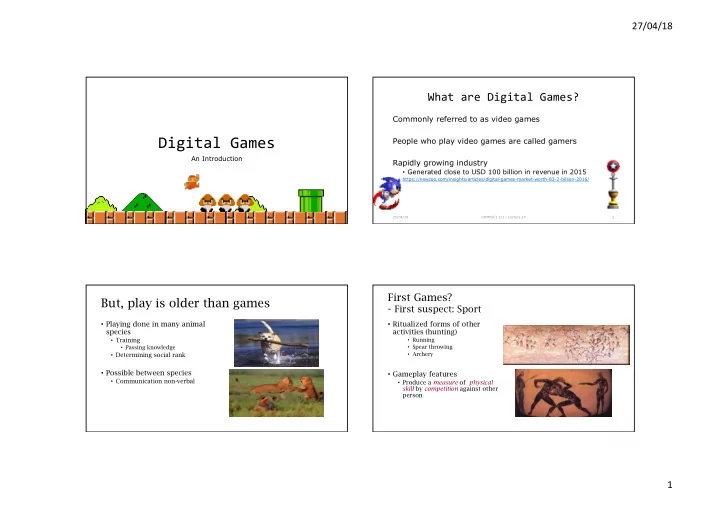
27/04/18 What are Digital Games? Commonly referred to as video games Digital Games People who play video games are called gamers An Introduction Rapidly growing industry Generated close to USD 100 billion in revenue in 2015


slide-1
SLIDE 1

27/04/18 1

Digital Games

An Introduction

What are Digital Games?

Commonly referred to as video games People who play video games are called gamers Rapidly growing industry

  • Generated close to USD 100 billion in revenue in 2015

https://newzoo.com/insights/articles/digital-games-market-worth-83-2-billion-2016/

25/04/18 COMPSCI 111 - Lecture 17 2

But, play is older than games

  • Playing done in many animal

species

  • Training
  • Passing knowledge
  • Determining social rank
  • Possible between species
  • Communication non-verbal

First Games?

  • First suspect: Sport
  • Ritualized forms of other

activities (hunting)

  • Running
  • Spear throwing
  • Archery
  • Gameplay features
  • Produce a measure of physical

skill by competition against other person

slide-2
SLIDE 2

27/04/18 2 First Games?

  • Second suspect: Divination
  • Randomizers
  • Objects used for divination
  • Evidence
  • Staves found in Tutankhamen’s tomb

(~1323 BC) together with gameboard

  • Similar staves found in the royal tombs

at Ur together with another gameboard

  • Mentioned in the Rig Veda (~1500 BC)
  • Gameplay features
  • Produce a random outcome within well-

defined limits and clear states

Source: Parlett, David, The Oxford History of Board Games, Oxford University Press, 1999

First Organized Games

  • Funerals
  • Gladiators
  • Religious festivals
  • Olympic Games, 776 BC
  • Judges
  • Truces between countries,
  • Participants status as religious pilgrims
  • Gladiator Games
  • Celebrate battles at funeral
  • Changed when Julius Caesar organized
  • ne in honor of his dead daughter

Dice Games

  • Inventors
  • Lydians of Asia according to Herodotus
  • Predecessors
  • Binary Lots
  • Astragals
  • Depicted ~800 BC
  • Gameplay features
  • Provide variety of ranges for

randomizers and tie results to abstract measures – numbers

  • Meta game – betting on outcome (but

equally possible from sports)

  • Will of the gods - not taxed!

Board Games

  • Origins
  • traced to keeping track of

player’s scores in dice games

  • Gameplay features
  • Introduced game token to

maintain game state

  • Linked series of actions to

randomized values to manipulate game state

slide-3
SLIDE 3

27/04/18 3

Racing games

  • Interpreting movement on board as physical

movement

  • Ludo (from Pachisi, ~700 BC)
  • Backgammon (from Senet & Mehen, 2650+

BC)

  • Gameplay features
  • Introduction of the concept of a game world
  • Introduction of several game tokens

controlled by one player introduced choice

  • Capturing other tokens meant that effects of

changing one part of the game state by have additional effects – abstract events

Perfect Information Games

  • Removal of randomness from board

games

  • Chess (referred ~600 AD)
  • Go (from Wei-qi, 2000 BC)
  • Gameplay features
  • 2D game world
  • Focus on mental skills
  • Actions defined by tokens
  • Context-dependent actions
  • Functionally different tokens
  • Possible to predict opponent
  • Additional goals based on space control,

space filling, connection, and collection

Imperfect Information Games

  • Making part of the game state

unknown to players

  • Stratego
  • Battleship
  • Blind Chess | Kriegspiel
  • Gameplay features
  • Hidden game state
  • Heterogeneous information

availability

  • Need of umpire for gameplay to

commerce

Skill Games

  • Board games where movement is

determined by successful action or performance

  • Scrabble
  • Trivial Pursuit
  • Pictionary
  • “Normality Game”
  • Balderdash (Rappakalja)
  • Apples to Apples
  • Gameplay features
  • Introduction of variety of skills –

social, artistic, intellectual

slide-4
SLIDE 4

27/04/18 4

Tabletop or Miniature Games

  • Origins in forms of kriegspiel
  • Similar to board games but use

graphically depicted miniatures

  • Warhammer
  • Warhammer 40K
  • Gameplay features
  • Continuous game world
  • Players own game tokens they use
  • Requires players to do extra-game

activities

Card Games

  • Background intertwined with Dominoes

& Mah-Jong tiles

  • Modern variants probably Persian origin
  • Brought to Europe by Arabs 13th

century

  • Specialized decks quite late
  • Gameplay features
  • Game systems
  • Bipartisan
  • Random but fixed distribution
  • Define Game Space

Collectable Card Games

  • Combines card games with idol cards
  • Magic: the gathering
  • Illuminati: new world order
  • Gameplay features
  • Cards have self-contained rules within a

rule framework

  • Physical rarity affects value of game

token

  • Time-limited functionality of cards

Roleplaying Games

  • Expansion from miniature games
  • Dungeons & Dragons, 1974
  • The Basic Roleplaying System
  • Gameplay features
  • Unclear winning conditions
  • Unclear end conditions
  • campaigns
  • Game master
  • Unequal power structure
  • Open-ended rule set
  • Mediates the Game World
  • Character development
  • Roleplaying
  • Novel narrative structure – adventure modules
  • D&D 3rd edition introduced Open Gaming Licenseand id20

Trademark License

  • D&D 4th edition will include online support
slide-5
SLIDE 5

27/04/18 5

Live-Action Roleplaying Games

  • Arose from roleplaying games,

improvisational theatre and re-enactment societies

  • Earlier similar activities
  • re-enactments of battles between Osiris and

Seth in ancient Egypt

  • ‘carrousel’ games at European courts during

the 17th and 18th centuries

  • psychoanalytic methods in the 1920s
  • Gameplay features
  • Players represent their characters
  • Players physically act out what they do in the

game

  • Extra-game activities may take a majority of

time spent

Novelty Games

  • Machines that provide

gameplay or lets players test skills

  • Gameplay features
  • Coin-op
  • Machine controls game flow

Pinball

  • Reaction to games being

banned due to being used for gambling

  • Gameplay features
  • Flippers
  • Electro-mechanical game

system

What do you need to play a digital game?

  • 1. An input device
  • 2. An output, typically video, device

25/04/18 COMPSCI 111 - Lecture 17 20

slide-6
SLIDE 6

27/04/18 6

Input Devices

Commonly used input devices:

  • Keyboard and mouse
  • Gamepad
  • Touchscreen
  • Motion controllers

Other input devices include steering wheels, joysticks, light guns, and rhythm game controllers

25/04/18 COMPSCI 111 - Lecture 17 21

Output Devices

Screens Speakers Controllers

  • Haptic feedback

25/04/18 COMPSCI 111 - Lecture 17 22

Platforms

Personal computers Consoles

  • Home and handheld

Mobile devices Arcade machines

25/04/18 COMPSCI 111 - Lecture 17 23

Media

Cartridges Optical discs

  • CD, DVD, Blu-Ray, Proprietary

User-writable media

  • Floppy discs, cassettes, memory cards

Digital downloads

  • Steam, GOG, XBL, PSN

h t t p : / / w w w . p c w o r l d . c o m / a r t i c l e / 1 9 7 4 2 9 / evolution_of_game_media.html

25/04/18 COMPSCI 111 - Lecture 17 24

slide-7
SLIDE 7

27/04/18 7

1948 – Alan Turing

  • Wrote a program to play chess
  • The algorithm looked 2 moves ahead
  • Doesn’t play chess very well

25/04/18 COMPSCI 111 - Lecture 17 25

A.S. Douglas - 1952

  • Part of Ph.D. thesis in Human-

Computer Interaction

  • Tic-Tac-Toe (noughts & crosses)
  • Play by dialing numbers
  • Computer opponent
  • Emulator
  • http://www.dcs.warwick.ac.uk/

~edsac/

Tennis for Two - 1958

  • William Higinbotham
  • Demonstrate system
  • Analog computer
  • Real-time game

Spacewar! - 1962

  • Stephen "Slug" Russell, MIT
  • DEC PDP-1 assembler in 1962
  • Demonstrate the Type 30 Precision CRT Display
  • “It should demonstrate as many of the

computer's resources as possible, and tax those resources to the limit;

  • Within a consistent framework, it should be

interesting, which means every run should be different;

  • It should involve the onlooker in a pleasurable

and active way -- in short, it should be a game.”

slide-8
SLIDE 8

27/04/18 8

Ralph Baer - 1951

  • Asked to Build the best television set

in the world.

  • Built in several prototypes between

1966-1968

  • Hand controller and light gun
  • Use of sensor
  • Magnavox signed an agreement in

1971 and the first video game system got released in May 1972: Odyssey

Computer Space – 1970 Back to Spacewar

  • Nolan Bushnell decided to

commercialize Spacewar

  • Stand-alone arcade machine

Nolan Bushell - 1972

  • Atari
  • syzygy
  • Pong
  • Arcade version, 1972
  • TV-console, 1975
  • Difficulties getting bank loans

due to association with arcades and mafia

Genres – Platform Games

Primarily involve navigation through environments

  • 2D or 3D
  • Traversal from one platform to the next (Donkey Kong)

25/04/18 COMPSCI 111 - Lecture 17 32

slide-9
SLIDE 9

27/04/18 9

Genres - Shooters

Combat oriented using ranged weapons

  • First-person
  • Third-person
  • Light gun
  • Shoot ‘em ups

25/04/18 COMPSCI 111 - Lecture 17 33

Genres – Fighting Games

Focus on close combat

  • 2D or 3D

Usually involves 2 combatants

  • Player vs. Player
  • Player vs. AI
  • AI vs. AI

25/04/18 COMPSCI 111 - Lecture 17 34

Genres – Role Playing Games

Play the role of one or more characters immersed in a well-defined world

  • Detailed lore
  • Focus on narrative, exploration, and quest completion

25/04/18 COMPSCI 111 - Lecture 17 35

Genres – Sports Games

Emulate real-world sports

  • Degree of realism varies widely
  • Realistic titles are referred to as sims
  • Usually competitive – against AI or other gamers

25/04/18 COMPSCI 111 - Lecture 17 36

slide-10
SLIDE 10

27/04/18 10

Genres - Strategy

Outcome of combat determined by skilful thinking and planning

  • Real-time vs. turn-based
  • Strategy vs. tactics

25/04/18 COMPSCI 111 - Lecture 17 37

Other Notable Genres

Massively multi-player online games Casual games Party games Rhythm/music games Puzzle games Exergames Educational games Adventure games Many games incorporate elements of more than one genre

25/04/18 COMPSCI 111 - Lecture 17 38

The Game Industry

Developer

  • Company specializing in video game development
  • Multi-disciplinary – programming, art, testing etc.
  • E.g. Crystal Dynamics, Rockstar Games, Rare, Naughty Dog

Publisher

  • Company responsible for funding, marketing, and distribution
  • May also develop video games – internal team of developers

referred to as a studio

  • E.g. Electronic Arts, Activision Blizzard, Ubisoft, Take-Two

Interactive

25/04/18 COMPSCI 111 - Lecture 17 39

Business Models

“Packaged” games

  • Purchase game for full access to its features
  • Further monetary outlay unnecessary

Subscription games

  • Playing the game requires paying a subscription fee
  • May require initial purchase as well
  • “Pay-to-play”

Free-to-play games

  • Core game is free
  • Certain game content locked behind in-game currency that is difficult to
  • btain
  • In-game currency can be purchased directly with real world money

25/04/18 COMPSCI 111 - Lecture 17 40

slide-11
SLIDE 11

27/04/18 11

Business Models

Microtransactions

  • Ability to purchase in-game goods using real world money
  • Often used in conjunction with free to play games – “Pay-to-

win”

Downloadable content

  • Additional content released for a game post-release
  • Can include new modes, levels or aesthetic content

25/04/18 COMPSCI 111 - Lecture 17 41

Gamer Demographics

Based on a study by the Entertainment Software Association (ESA) in the US in 2016:

  • 59% of gamers are men. 41% are women
  • The average age of a male gamer is 35. The average age of a

female gamer is 44.

  • The average gamer has been playing video games for 13

years.

  • 63% of households have at least one gamer.

http://essentialfacts.theesa.com/Essential-Facts-2016.pdf 25/04/18 COMPSCI 111 - Lecture 17 42

eSports

Organized video game competition

  • Competitors typically professional
  • Competitions are broadcast
  • Prize money for winners

Genres associated with eSports:

  • Real-time strategy games
  • Fighting games
  • First-person shooters
  • Multiplayer online battle arena games

First established in South Korea

  • Since 2000
  • Now a global phenomenon with an audience of 226 million people in 2015
  • https://newzoo.com/insights/articles/global-esports-market-report-revenues-to-jump-

to-463-million-in-2016-as-us-leads-the-way/

25/04/18 COMPSCI 111 - Lecture 17 43

Controversies

Negative behavioural effects:

  • Heightened aggression, lowered empathy
  • Various studies performed – no consensus

Censorship and regulation Portrayal of women and minorities Online harassment

  • Gamergate

25/04/18 COMPSCI 111 - Lecture 17 44

slide-12
SLIDE 12

27/04/18 12

Future

Virtual Reality

  • Immerses user in a virtual environment
  • User can look around, move and interact with

environment

  • Headsets for VR gaming recently released –

Oculus Rift, HTC Vive

Augment Reality

  • Real-world environment augmented with computer

generated input – imagery, sound etc.

25/04/18 COMPSCI 111 - Lecture 17 45