Diffusion Demo Glass tube filled with water. At time t = 0, add - - PowerPoint PPT Presentation

diffusion demo
SMART_READER_LITE
LIVE PREVIEW

Diffusion Demo Glass tube filled with water. At time t = 0, add - - PowerPoint PPT Presentation

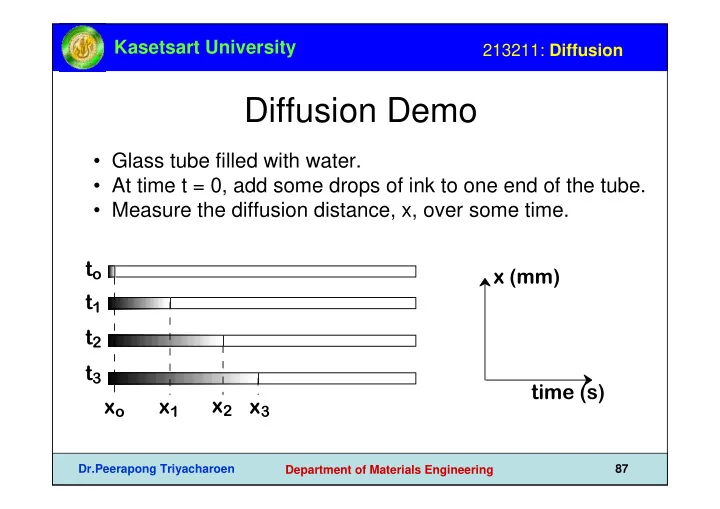
Kasetsart University 213211: Diffusion Diffusion Demo Glass tube filled with water. At time t = 0, add some drops of ink to one end of the tube. Measure the diffusion distance, x, over some time. t o x (mm) t 1 t 2 t 3 time (s) x 2


slide-1
SLIDE 1

Kasetsart University

Dr.Peerapong Triyacharoen Department of Materials Engineering

213211: Diffusion

87

Diffusion Demo

  • Glass tube filled with water.
  • At time t = 0, add some drops of ink to one end of the tube.
  • Measure the diffusion distance, x, over some time.

to t1 t2 t3 xo x1 x2 x3 time (s) x (mm)

slide-2
SLIDE 2

Kasetsart University

Dr.Peerapong Triyacharoen Department of Materials Engineering

213211: Diffusion

88

  • Interdiffusion: In an alloy, atoms tend to migrate from regions
  • f large concentration.

Initially After some time

100% Concentration Profiles Cu Ni 100% Concentration Profiles

Diffusion: The Phenomena

Cu-Ni Diffusion Couple

slide-3
SLIDE 3

Kasetsart University

Dr.Peerapong Triyacharoen Department of Materials Engineering

213211: Diffusion

89

Diffusion: The Phenomena (con.)

  • Self-diffusion: In an elemental solid, atoms also migrate.

Label some atoms After some time

A B C D A B C D

slide-4
SLIDE 4

Kasetsart University

Dr.Peerapong Triyacharoen Department of Materials Engineering

213211: Diffusion

90

Vacancy or Substitutional Diffusion:

  • applies to substitutional impurities
  • atoms exchange with vacancies
  • rate depends on:
  • -number of vacancies
  • -activation energy to exchange.

increasing elapsed time

Diffusion Mechanisms (1)

slide-5
SLIDE 5

Kasetsart University

Dr.Peerapong Triyacharoen Department of Materials Engineering

213211: Diffusion

91

Activation Energy

slide-6
SLIDE 6

Kasetsart University

Dr.Peerapong Triyacharoen Department of Materials Engineering

213211: Diffusion

92

Diffusion Mechanisms (2)

Interstitial Diffusion:

  • atoms migrate from an interstitial position to a neighboring
  • ne that is empty, ex. H, O, C, N atoms
slide-7
SLIDE 7

Kasetsart University

Dr.Peerapong Triyacharoen Department of Materials Engineering

213211: Diffusion

93

  • Case Hardening:
  • -Diffuse carbon atoms into the

host iron atoms at the surface.

  • -Example of interstitial diffusion

is a case hardened gear.

  • Result: The "Case" is
  • -hard to deform: C atoms

"lock" planes from shearing.

  • -hard to crack: C atoms put

the surface in compression.

Processing using Diffusion

slide-8
SLIDE 8

Kasetsart University

Dr.Peerapong Triyacharoen Department of Materials Engineering

213211: Diffusion

94

Modeling Diffusion: Flux

  • Flux: rate of mass transfer

J = 1 A dM dt ⇒ kg m2s ⎡ ⎣ ⎢ ⎤ ⎦ ⎥ or atoms m2s ⎡ ⎣ ⎢ ⎤ ⎦ ⎥

  • Directional Quantity
  • Flux can be measured for:
  • -vacancies
  • -host (A) atoms
  • -impurity (B) atoms

Jx Jy Jz x y z

x-direction Unit area A through which atoms move.

slide-9
SLIDE 9

Kasetsart University

Dr.Peerapong Triyacharoen Department of Materials Engineering

213211: Diffusion

95

Concentration Profiles & Flux

  • Concentration Profile, C(x): [kg/m3]

Fick's First Law:

Concentration

  • f Cu [kg/m3]

Concentration

  • f Ni [kg/m3]

Position, x Cu flux Ni flux

The steeper the concentration profile, the greater the flux!

Jx = −D dC dx

Diffusion coefficient [m2/s] concentration gradient [kg/m4] flux in x-dir. [kg/m2-s]

slide-10
SLIDE 10

Kasetsart University

Dr.Peerapong Triyacharoen Department of Materials Engineering

213211: Diffusion

96

Steady-State Diffusion

  • Steady State: the concentration profile doesn't change with time.

Apply Fick's First Law: Result: the slope, dC/dx, must be constant!

Jx(left) = Jx(right) Steady State:

Concentration, C, in the box doesn’t change w/time.

Jx(right) Jx(left)

x

Jx = −DdC dx

dC dx ⎛ ⎝ ⎜ ⎞ ⎠ ⎟

left

= dC dx ⎛ ⎝ ⎜ ⎞ ⎠ ⎟

right

If Jx)left = Jx)right , then

slide-11
SLIDE 11

Kasetsart University

Dr.Peerapong Triyacharoen Department of Materials Engineering

213211: Diffusion

97

Steady-State Diffusion

slide-12
SLIDE 12

Kasetsart University

Dr.Peerapong Triyacharoen Department of Materials Engineering

213211: Diffusion

98

  • Ex. Steady State Diffusion

2 3 11

10 10 5 8 . 2 . 1 ) 10 3 (

− − −

− × − × − = J

B A B A

x x C C D J − − − =

A plate of iron is exposed to a carburizing atmosphere on one side and a decarburizing atmosphere on the other side at 700°C.

C 1 = 1 . 2 k g / m 3 C 2 = . 8 k g / m 3

Carbon rich gas

10mm

Carbon deficient gas

x1 x2

5 m m D=3x10-11m2/s Steady State = straight line!

s kg/m

2 ⋅

× =

−9

10 4 . 2 J

Fick's First Law:

slide-13
SLIDE 13

Kasetsart University

Dr.Peerapong Triyacharoen Department of Materials Engineering

213211: Diffusion

99

Non Steady-State Diffusion

  • Concentration profile, C(x),

changes w/ time.

  • To conserve matter:
  • Fick's First Law:
  • Governing Eqn.:

Concentration, C, in the box J(right) J(left)

dx

dC dt = Dd2C dx2

− dx = − dC dt J(left) J(right) dJ dx = − dC dt equate

Fick's Second Law

J = − D dC dx

  • r

dJ dx = − D d2 C dx 2

(if D does not vary with x)

slide-14
SLIDE 14

Kasetsart University

Dr.Peerapong Triyacharoen Department of Materials Engineering

213211: Diffusion

100

Case Study: Non Steady-State Diffusion

  • Copper diffuses into a bar of aluminum.
  • General solution:

"error function" Values calibrated in Table 5.1, Callister 6e.

C(x,t) − Co Cs − Co = 1− erf x 2 Dt ⎛ ⎝ ⎜ ⎞ ⎠ ⎟

pre-existing conc., Co of copper atoms Surface conc., Cs of Cu atoms bar

Co Cs position, x

C(x,t)

to t1 t2 t3

slide-15
SLIDE 15

Kasetsart University

Dr.Peerapong Triyacharoen Department of Materials Engineering

213211: Diffusion

101

Error Function Values

=

z y dy

e z erf

2

2 ) ( π

Dt x z 2 = where

slide-16
SLIDE 16

Kasetsart University

Dr.Peerapong Triyacharoen Department of Materials Engineering

213211: Diffusion

102

  • Ex. Carburizing Process

Steel: Co = 0.25 wt% C T = 950°C Cs = 1.20 wt% C How long would it take to achieve a carbon content of 0.80 wt% C at a position 0.5 mm below the surface?

⎟ ⎟ ⎟ ⎠ ⎞ ⎜ ⎜ ⎜ ⎝ ⎛ × × − = − − = − −

− −

t erf C C C C

  • x
  • x

) 10 6 . 1 ( 2 10 5 1 25 . 20 . 1 25 . 80 .

11 4

4210 . 5 . 62 = ⎟ ⎟ ⎠ ⎞ ⎜ ⎜ ⎝ ⎛ t erf 3794 . 4282 . 3794 . 4210 . 35 . 40 . 35 . − − = − − z

z = 0.392 t = 25,400 s = 7.1 hr

slide-17
SLIDE 17

Kasetsart University

Dr.Peerapong Triyacharoen Department of Materials Engineering

213211: Diffusion

103

  • Ex. Non Steady-State Diffusion

Copper diffuses into a bar of aluminum for 10 hours at 600°C and gives desired C(x). How many hours would it take to get the same C(x) if we processed at 500°C? s C(x,t)−Co C − Co = 1− erf x 2Dt ⎛ ⎝ ⎜ ⎞ ⎠ ⎟ Key point 1: C(x,t500C) = C(x,t600C). Key point 2: Both cases have the same Co and Cs.

t500= (Dt)600 D500 = 110hr

4.8x10⁻¹⁴m2/s 5.3x10⁻¹³m2/s 10hrs

(Dt)500°C = (Dt)600°C

slide-18
SLIDE 18

Kasetsart University

Dr.Peerapong Triyacharoen Department of Materials Engineering

213211: Diffusion

104

Diffusion and Temperature

  • Diffusivity increases with T.
  • Experimental Data:

1000K/T D (m2/s)

C i n α

  • F

e C i n γ

  • F

e A l i n A l Cu in Cu Z n i n C u F e i n α

  • F

e F e i n γ

  • F

e 0.5 1.0 1.5 2.0

10-20 10-14 10-8 T(C)

1500 1000 600 300

D has exp. dependence on T Recall: Vacancy does also!

pre-exponential [m2/s] (see Table 5.2, Callister 6e) activation energy gas constant [8.31J/mol-K]

D= Doexp − Qd RT ⎛ ⎝ ⎜ ⎞ ⎠ ⎟ diffusivity

[J/mol],[eV/mol] (see Table 5.2, Callister 6e)

Dinterstitial >> Dsubstitutional C in α-Fe C in γ-Fe Al in Al Cu in Cu Zn in Cu Fe in α-Fe Fe in γ-Fe

slide-19
SLIDE 19

Kasetsart University

Dr.Peerapong Triyacharoen Department of Materials Engineering

213211: Diffusion

105

Diffusion Data

slide-20
SLIDE 20

Kasetsart University

Dr.Peerapong Triyacharoen Department of Materials Engineering

213211: Diffusion

106

  • Ex. Carburizing Process 2

5 . 2 1 25 . . 1 20 . 60 . = ⎟ ⎟ ⎠ ⎞ ⎜ ⎜ ⎝ ⎛ − = − − = − − Dt x erf C C C C

  • x
  • x

4747 . 2 = Dt x

hr s 29.6 106,400 900 5.3 19,000 1050 9.0 32,300 1000 15.9 57,200 950 Time T (°C)

Co = 0.20 wt% Cs = 1.00 wt% Need Cx = 0.60 wt% at 0.75 mm below surface Specify an appropriate heat treatment in terms of temperature and time for temperature between 900°C and 1050°C.

Table 5.1

x = 7.5x10⁻⁴ m Dt = 6.24x10⁻⁷ m2

7 5

10 24 . 6 31 . 8 000 , 148 exp ) 10 3 . 2 (

− −

× = ⎥ ⎦ ⎤ ⎢ ⎣ ⎡− × T

⎟ ⎠ ⎞ ⎜ ⎝ ⎛− = T s t 810 , 17 exp 0271 . ) ( in

slide-21
SLIDE 21

Kasetsart University

Dr.Peerapong Triyacharoen Department of Materials Engineering

213211: Diffusion

107

Diffusion FASTER for...

  • open crystal structures
  • lower melting T materials
  • materials w/secondary

bonding

  • smaller diffusing atoms
  • cations
  • lower density materials

Diffusion SLOWER for...

  • close-packed structures
  • higher melting T materials
  • materials w/covalent

bonding

  • larger diffusing atoms
  • anions
  • higher density materials

Summary: Structure & Diffusion