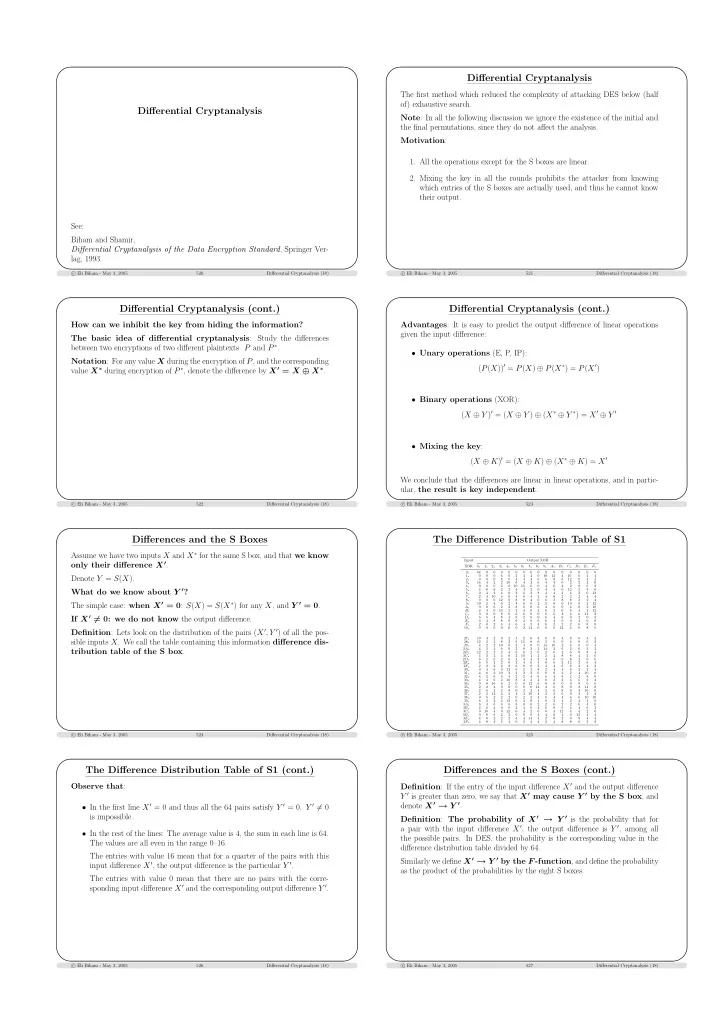
Differential Cryptanalysis The first method which reduced the - - PDF document

differential cryptanalysis
SMART_READER_LITE
LIVE PREVIEW

Differential Cryptanalysis The first method which reduced the - - PDF document

Differential Cryptanalysis The first method which reduced the complexity of attacking DES below (half of) exhaustive search. Differential Cryptanalysis Note : In all the following discussion we ignore the existence of the initial and the final


slide-1
SLIDE 1

Differential Cryptanalysis

See: Biham and Shamir, Differential Cryptanalysis of the Data Encryption Standard, Springer Ver- lag, 1993.

c Eli Biham - May 3, 2005 520 Differential Cryptanalysis (18)

Differential Cryptanalysis

The first method which reduced the complexity of attacking DES below (half

  • f) exhaustive search.

Note: In all the following discussion we ignore the existence of the initial and the final permutations, since they do not affect the analysis. Motivation:

  • 1. All the operations except for the S boxes are linear.
  • 2. Mixing the key in all the rounds prohibits the attacker from knowing

which entries of the S boxes are actually used, and thus he cannot know their output.

c Eli Biham - May 3, 2005 521 Differential Cryptanalysis (18)

Differential Cryptanalysis (cont.)

How can we inhibit the key from hiding the information? The basic idea of differential cryptanalysis: Study the differences between two encryptions of two different plaintexts: P and P ∗. Notation: For any value X during the encryption of P, and the corresponding value X∗ during encryption of P ∗, denote the difference by X′ = X ⊕ X∗.

c Eli Biham - May 3, 2005 522 Differential Cryptanalysis (18)

Differential Cryptanalysis (cont.)

Advantages: It is easy to predict the output difference of linear operations given the input difference:

  • Unary operations (E, P, IP):

(P(X))′ = P(X) ⊕ P(X∗) = P(X′)

  • Binary operations (XOR):

(X ⊕ Y )′ = (X ⊕ Y ) ⊕ (X∗ ⊕ Y ∗) = X′ ⊕ Y ′

  • Mixing the key:

(X ⊕ K)′ = (X ⊕ K) ⊕ (X∗ ⊕ K) = X′ We conclude that the differences are linear in linear operations, and in partic- ular, the result is key independent.

c Eli Biham - May 3, 2005 523 Differential Cryptanalysis (18)

Differences and the S Boxes

Assume we have two inputs X and X∗ for the same S box, and that we know

  • nly their difference X′.

Denote Y = S(X). What do we know about Y ′? The simple case: when X′ = 0: S(X) = S(X∗) for any X, and Y ′ = 0. If X′ = 0: we do not know the output difference. Definition: Lets look on the distribution of the pairs (X′, Y ′) of all the pos- sible inputs X. We call the table containing this information difference dis- tribution table of the S box.

c Eli Biham - May 3, 2005 524 Differential Cryptanalysis (18)

The Difference Distribution Table of S1

Input Output XOR XOR 0x 1x 2x 3x 4x 5x 6x 7x 8x 9x Ax Bx Cx Dx Ex Fx 0x 64 1x 6 2 4 4 10 12 4 10 6 2 4 2x 8 4 4 4 6 8 6 12 6 4 2 3x 14 4 2 2 10 6 4 2 6 4 4 2 2 2 4x 6 10 10 6 4 6 4 2 8 6 2 5x 4 8 6 2 2 4 4 2 4 4 12 2 4 6 6x 4 2 4 8 2 6 2 8 4 4 2 4 2 12 7x 2 4 10 4 4 8 4 2 4 8 2 2 2 4 4 8x 12 8 8 4 6 2 8 8 2 2 4 9x 10 2 4 2 4 6 2 2 8 10 2 12 Ax 8 6 2 2 8 6 6 4 6 4 2 10 Bx 2 4 10 2 2 4 2 6 2 6 6 4 2 12 Cx 8 6 6 6 6 4 6 6 14 2 Dx 6 6 4 8 4 8 2 6 6 4 6 2 2 Ex 4 8 8 6 6 4 6 6 4 4 8 Fx 2 2 4 4 6 4 2 4 8 2 2 2 6 8 8 10x 2 14 6 6 12 4 6 8 6 . . . 27x 10 4 2 2 4 2 4 8 4 8 8 4 4 28x 12 2 2 8 2 6 12 2 6 4 6 2 29x 4 2 2 10 2 4 14 10 2 4 6 4 2Ax 4 2 4 6 2 8 2 2 14 2 6 2 6 2 2 2Bx 12 2 2 2 4 6 6 2 2 6 2 6 8 4 2Cx 4 2 2 4 2 10 4 2 2 4 8 8 4 2 6 2Dx 6 2 6 2 8 4 4 4 2 4 6 8 2 6 2Ex 6 6 2 2 2 4 6 4 6 2 12 2 6 4 2Fx 2 2 2 2 2 6 8 8 2 4 4 6 8 2 4 2 30x 4 6 12 6 2 2 8 2 4 4 6 2 2 4 31x 4 8 2 10 2 2 2 2 6 2 2 4 10 8 32x 4 2 6 4 4 2 2 4 6 6 4 8 2 2 8 33x 4 4 6 2 10 8 4 2 4 2 2 4 6 2 4 34x 8 16 6 2 12 6 8 6 35x 2 2 4 8 14 4 6 8 2 14 36x 2 6 2 2 8 2 2 4 2 6 8 6 4 10 37x 2 2 12 4 2 4 4 10 4 4 2 6 2 2 4 38x 6 2 2 2 2 2 4 6 4 4 4 6 10 10 39x 6 2 2 4 12 6 4 8 4 2 4 2 4 4 3Ax 6 4 6 4 6 8 6 2 2 6 2 2 6 4 3Bx 2 6 4 2 4 6 4 6 8 6 4 4 6 2 3Cx 10 4 12 4 2 6 4 12 4 4 2 3Dx 8 6 2 2 6 8 4 4 4 12 4 4 3Ex 4 8 2 2 2 4 4 14 4 2 2 8 4 4 3Fx 4 8 4 2 4 2 4 4 2 4 8 8 6 2 2 c Eli Biham - May 3, 2005 525 Differential Cryptanalysis (18)

The Difference Distribution Table of S1 (cont.)

Observe that:

  • In the first line X′ = 0 and thus all the 64 pairs satisfy Y ′ = 0. Y ′ = 0

is impossible.

  • In the rest of the lines: The average value is 4, the sum in each line is 64.

The values are all even in the range 0–16. The entries with value 16 mean that for a quarter of the pairs with this input difference X′, the output difference is the particular Y ′. The entries with value 0 mean that there are no pairs with the corre- sponding input difference X′ and the corresponding output difference Y ′.

c Eli Biham - May 3, 2005 526 Differential Cryptanalysis (18)

Differences and the S Boxes (cont.)

Definition: If the entry of the input difference X′ and the output difference Y ′ is greater than zero, we say that X′ may cause Y ′ by the S box, and denote X′ → Y ′. Definition: The probability of X′ → Y ′ is the probability that for a pair with the input difference X′, the output difference is Y ′, among all the possible pairs. In DES, the probability is the corresponding value in the difference distribution table divided by 64. Similarly we define X′ → Y ′ by the F -function, and define the probability as the product of the probabilities by the eight S boxes.

c Eli Biham - May 3, 2005 527 Differential Cryptanalysis (18)
slide-2
SLIDE 2

Differences and the S Boxes (cont.)

Differential cryptanalysis uses the entries with large values, and in particular the 0 → 0 entry and the entries with value 16, and other large values.

c Eli Biham - May 3, 2005 528 Differential Cryptanalysis (18) †

Observation

Given an input and output differences of an S box, it is possible to list all the pairs with these differences. Example: For the entry 09x → 1x the 2 pairs are:

  • 1. 33x, 3Ax
  • 2. 3Ax, 33x

For the entry 01x → Fx the 4 pairs are:

  • 1. 1Ex, 1Fx
  • 2. 1Fx, 1Ex
  • 3. 2Ax, 2Bx
  • 4. 2Bx, 2Ax

The lists of pairs of all the differences can easily be computed in advance.

c Eli Biham - May 3, 2005 529 Differential Cryptanalysis (18)

Example of a Simple Attack

Assume a 3-round DES, in which for some pair of plaintexts P ′ = 01 96 00 18 00 00 00 00x, and T ′ = 41 96 40 1A 48 00 00 00x. We also assume that T = 00 00 00 00 08 00 00 00x and T ∗ = 41 96 40 1A 40 00 00 00x. (We use the notation T for the ciphertexts, as we use C for the third round intermediate values.)

c Eli Biham - May 3, 2005 530 Differential Cryptanalysis (18)

Example of a Simple Attack (cont.)

Then, the differences in the various rounds are

P ′ = 01 96 00 18 00 00 00 00x A′ = 00 00 00 00x a′ = 00 00 00 00x B′ = 48 00 00 00x b′ = 01 96 00 18x = P(02 00 00 08x) C′ = 40 00 40 02x c′ = 48 00 00 00x = P(13 00 00 00x) T ′ = 41 96 40 1A 48 00 00 00x

F F F

c Eli Biham - May 3, 2005 531 Differential Cryptanalysis (18)

Example of a Simple Attack (cont.)

We identify that S1 in the third round accepts difference 09x in the input and

  • utputs difference 1x in the output. Looking at the difference distribution table,

we find only two possible pairs for this combination ((33x, 3Ax) and (3Ax, 33x)). Thus, we get the following equations: S1E ⊕ S1K = 33x or 3Ax S1∗

E ⊕ S1K = 3Ax or 33x.

From the known ciphertexts we know that S1E = 01x S1∗

E = 08x.

Therefore, we can find two possible values for S1K S1K = 32x or 3Bx. (Notice that the difference between these two values is always the input differ- ence, 09x in this case.)

c Eli Biham - May 3, 2005 532 Differential Cryptanalysis (18)

Characteristics (

✂✁☎✄✆✁✞✝✟ )

In differential cryptanalysis we wish to know some statistical information on the differences in intermediate rounds during encryption, given only the plaintext difference. Example: A two-round characteristic with probability 14

64 (In S1, 0Cx →

Ex with probability 14

64):

ΩP = 00 80 82 00 60 00 00 00x A′ = 00 80 82 00x a′ = 60 00 00 00x p = 14 64 = P(E0 00 00 00x) B′ = 0 b′ = 0 p = 1 ΩT = 60 00 00 00 00 00 00 00x

F F

c Eli Biham - May 3, 2005 533 Differential Cryptanalysis (18)

Characteristics (

✠✁✡✄✆✁✡✝☛ ) (cont.)

Informal Definition: Associated with any pair of encryptions are the XOR value of its two plaintexts, the XOR of its ciphertexts, the XORs of the inputs

  • f each round in the two executions and the XORs of the outputs of each round

in the two executions. These XOR values form an n-round characteristic. A characteristic has a probability, which is the probability that a random pair with the chosen plaintext XOR has the round and ciphertext XORs specified in the characteristic. We denote the plaintext XOR of a characteristic by ΩP and its ciphertext XOR by ΩT.

c Eli Biham - May 3, 2005 534 Differential Cryptanalysis (18)

Characteristics (

✠✁✡✄✆✁✡✝☛ ) (cont.)

Definition: An n-round characteristic is a tuple Ω = (ΩP, ΩΛ, ΩT) where ΩP and ΩT are m-bit numbers and ΩΛ is a list of n elements ΩΛ = (Λ1, Λ2, . . . , Λn), each is a pair of the form Λi = (λi

I, λi O) where λi I and λi O are

m/2 bit numbers and m is the block size of the cryptosystem. A characteristic satisfies the following requirements: λ1

I = the right half of ΩP

λ2

I = the left half of ΩP ⊕ λ1 O

λn

I = the right half of ΩT

λn−1

I

= the left half of ΩT ⊕ λn

O

and for every i such that 2 ≤ i ≤ n − 1: λi

O = λi−1 I

⊕ λi+1

I

.

c Eli Biham - May 3, 2005 535 Differential Cryptanalysis (18)
slide-3
SLIDE 3

Characteristics (

✠✁✡✄✆✁✡✝☛ ) (cont.)

Definition: Characteristics can be concatenated if swap(Ω1

T) = Ω2

  • P. The resultant characteristic is

Ω = (Ω1

P, Ω1 Λ||Ω2 Λ, Ω2 T).

Definition: A right pair (

✁ ✂☎✄✝✆✞✁ ✟ ) with respect to a characteristic Ω and a

key K is a pair P, P ∗, which satisfies P ′ = ΩP, and all whose differences in the rounds 1, . . . , n are as predicted by the characteristic.

c Eli Biham - May 3, 2005 536 Differential Cryptanalysis (18)

Characteristics (

✠✁✡✄✆✁✡✝☛ ) (cont.)

Definition: An independent key (

✠ ✁ ✡☞☛✌✠ ☛✍✡☞✎✑✏✒☛✔✓✖✕ ) is a list of subkeys which

is not necessarily derivable from some key via the key scheduling algorithm.

c Eli Biham - May 3, 2005 537 Differential Cryptanalysis (18)

Probability of a Characteristic

Definition: The probability of a characteristic is the probability that a random pair P, P ∗ which satisfies P ′ = ΩP is a right pair with respect to a random independent key. Note: The probability of a characteristic is the product of all the probabilities

  • f the S boxes in the characteristic.
c Eli Biham - May 3, 2005 538 Differential Cryptanalysis (18)

Probability of a Characteristic (cont.)

Note: The probability of characteristics of DES is the probability that any specific pair P, P ∗ (P ′ = ΩP) is a right pair among all random keys. We are more interested in the probability that for a specific (unknown) key, a random pair P, P ∗ (P ′ = ΩP) is a right pair. In practice, the first probability is a good approximation of the second probability.

c Eli Biham - May 3, 2005 539 Differential Cryptanalysis (18)

Examples of One-Round Characteristics

Choose the inputs of the S boxes by the best entries in the difference distribution tables. Example: An one-round characteristic with probability 1 is (for any L′):

ΩP = (L′, 0x) A′ = 0x a′ = 0x p = 1 ΩT = (L′, 0x)

F

c Eli Biham - May 3, 2005 540 Differential Cryptanalysis (18)

Examples of One-Round Characteristics (cont.)

The second best one-round characteristic has probability 1/4, using only one active S box (S2):

ΩP = (L′, 04 00 00 00x) A′ = 40 08 00 00x a′ = 04 00 00 00x p = 16 64 = 1 4 = P(0A 00 00 00x) ΩT = (L′ ⊕ 40 08 00 00x, 04 00 00 00x)

F

There is a similar characteristic using S6.

c Eli Biham - May 3, 2005 541 Differential Cryptanalysis (18)

Examples of One-Round Characteristics (cont.)

The next best characteristic has probability 14

64:

ΩP = (L′, 60 00 00 00x) A′ = 00 80 82 00x a′ = 60 00 00 00x p = 14 64 = P(E0 00 00 00x) ΩT = (L′ ⊕ 00 80 82 00x, 60 00 00 00x)

F

c Eli Biham - May 3, 2005 542 Differential Cryptanalysis (18)

A Three-Round Characteristic

A three-round characteristic with probability 1/16:

Ω1 P = 40 08 00 00 04 00 00 00x A′ = 40 08 00 00x a′ = 04 00 00 00x p = 1 4 B′ = 0x b′ = 0x p = 1 C′ = 40 08 00 00x c′ = 04 00 00 00x p = 1 4 Ω1 T = 40 08 00 00 04 00 00 00x

F F F

c Eli Biham - May 3, 2005 543 Differential Cryptanalysis (18)
slide-4
SLIDE 4

A Five-Round Characteristic

A five-round characteristic with probability about 1/10486:

ΩP = 40 5C 00 00 04 00 00 00x A′ = 40 08 00 00x a′ = 04 00 00 00x p = 1 4 = P(0A 00 00 00x) B′ = 04 00 00 00x b′ = 00 54 00 00x p = 10·16 64·64 = P(00 10 00 00x) C′ = 0 c′ = 0 p = 1 D′ = 04 00 00 00x d′ = 00 54 00 00x p = 10·16 64·64 E′ = 40 08 00 00x e′ = 04 00 00 00x p = 1 4 ΩT = ΩP = 40 5C 00 00 04 00 00 00x

F F F F F

c Eli Biham - May 3, 2005 544 Differential Cryptanalysis (18)

Probabilities Versus Number of Rounds

The probabilities of the characteristics reduces very fast with the number of rounds: Number of rounds Probability 1 1 2 1/4 3 1/16 4 ≈ 1/800 5 ≈ 1/10000 6 ≈ 1/1000000

c Eli Biham - May 3, 2005 545 Differential Cryptanalysis (18)

Probabilities Versus Number of Rounds (cont.)

As the number of rounds is increased, the reduction rate grows. By the table, we may expect that at 9–10 rounds, the probabilities are smaller than 2−56 or 2−64. We are interested in longer characteristics with higher probabil- ities.

c Eli Biham - May 3, 2005 546 Differential Cryptanalysis (18)

Differentials

Usually differential cryptanalysis use only the ΩP and ΩT of the characteristics, but not the intermediate values. Definition: A Differential is a set of all the characteristics with the same ΩP and ΩT. The probability of the differential is the sum of the probabilities of the various characteristics. In most differential attacks we actually use differentials, rather than character-

  • istics. The probabilities of the characteristics serve as lower bounds for the

probabilities of the differentials.

c Eli Biham - May 3, 2005 547 Differential Cryptanalysis (18)

Iterative Characteristics

Characteristics which can be concatenated to themselves are called iterative characteristics. The best iterative characteristic of DES is:

ΩP = (ψ, 0) = 19 60 00 00 00 00 00 00x A′ = 0 a′ = 0 p=1 B′ = 0 b′ = ψ = p = 14·8·10 643 19 60 00 00x ≈ 1 234 ΩT = (0, ψ) = 00 00 00 00 19 60 00 00x

F F

where ψ = 19 60 00 00x. Due to the importance of this iterative characteristic, we call it the iterative characteristic. There is another value ψ† = 1B 60 00 00x for which the iterative characteristic has the same probability.

c Eli Biham - May 3, 2005 548 Differential Cryptanalysis (18)

Iterative Characteristics (cont.)

These two characteristics are the best when iterated to seven or more rounds. Note: In DES, in order to receive the same output of the F-function, two different inputs must differ in the input of at least three S boxes.

c Eli Biham - May 3, 2005 549 Differential Cryptanalysis (18)

Probabilities Versus Number of Rounds

The probability of the iterative characteristic versus the number of rounds: Number of rounds Probability 3 2−7.9 ≈ 1/234 5 2−15.7 ≈ 1/55000 7 2−23.6 9 2−31.5 11 2−39.4 13 2−47.2 15 2−55.1 16 2−62 17 2−63

c Eli Biham - May 3, 2005 550 Differential Cryptanalysis (18)

Differential Attacks

The simplest differential attack (0R-attack) breaks ciphers with the same num- ber of rounds as the characteristic. Using 3-round characteristics we can find key bits of 3-round DES, and using 5-round characteristics we can find key bits

  • f 5-round DES.
c Eli Biham - May 3, 2005 551 Differential Cryptanalysis (18)
slide-5
SLIDE 5

Differential Attacks (cont.)

The basic algorithm:

  • 1. Choose some m = 2p−1 random pairs P, P ∗ such that P ′ = ΩP, and

request the corresponding ciphertexts T and T ∗ under the unknown key K.

  • 2. Choose only the pairs satisfying T ′ = ΩT, and discard the others. About

m(p + 2−64) pairs remain (from the m pairs): mp right pairs and 2−64m wrong pairs. If p ≫ 2−64 we can assume that all the remaining pairs are right pairs.

c Eli Biham - May 3, 2005 552 Differential Cryptanalysis (18)

Differential Attacks (cont.)

  • 3. Each remaining right pair satisfies the difference predictions of the char-

acteristics and its values of T and T ∗ are known. The differences of the inputs and the outputs of the S boxes of the last round are known from T ′ = T ⊕ T ∗ (and from the characteristic). If the input difference is non-zero, not all the inputs are possible, and only a minority of the inputs satisfy the input and output differences: in each pair only about 0–16 possible values for the 6 input bits of the S box are

  • possible. Each value suggests one value for the 6 corresponding key bits.

The right value of the 6 key bits must be suggested by all the right pairs, while other values are suggested arbitrarily by only a few of the pairs. By cutting the sets of keys suggested by all the pairs, we receive two possible values for each 6 key bits; in total we receive 28 = 256 possible values for 48 key bits (if all the eight S boxes are active). If a wrong pair still remains, still the keys suggested by the largest number

  • f pairs are likely to include the right key.
c Eli Biham - May 3, 2005 553 Differential Cryptanalysis (18) †

Difficulty of Application to the Full DES

In order to attack the full DES (16-rounds) we need at least 2 · 262 pairs:

  • 1. Their encryption costs more than exhaustive search.
  • 2. Include all the 264 plaintext blocks (who needs the key in this

case?).

  • 3. The identification of right pairs is not so good, since p ≫ 2−64
c Eli Biham - May 3, 2005 554 Differential Cryptanalysis (18)

Enhancements: *R-Attacks

We observe that characteristics shorter than the cipher can be used. Attacks using characteristics shorter than the cipher by r rounds (in which the charac- teristic predicts the differences in the first n−r rounds of the cipher) are called rR-attacks. 0R-attacks In 0R-attacks (as in the previous slides) we know that T ′ = ΩT, and thus it is easy to identify the right pairs. Then we use the information on the differences inside the characteristic. Still, we cannot identify between two possible values for each S box.

c Eli Biham - May 3, 2005 555 Differential Cryptanalysis (18)

1R-Attacks

In these attacks, the characteristic predicts the differences except in the last round, and ΩT is the predicted difference before the last round. The input difference of the F-function of the last round is known both from the charac- teristic and the ciphertexts (T ′)R = (ΩT)L, and it can be used to discard wrong

  • pairs. On the other hand, the difference of the output of the F-function can be

calculated as (T ′)L ⊕ (ΩT)R. Thus, we can use shorter characteristics with higher probabilities, although the identification of the right pairs is somewhat worse.

c Eli Biham - May 3, 2005 556 Differential Cryptanalysis (18)

2R-Attacks

Allow to use a characteristic shorter than the cipher by two rounds. In these attack, the attacker knows

  • 1. The differences of the input to the last F-function, and the inputs them-

selves.

  • 2. The predicted differences of the input to the F-function in the second-last

round (from the characteristic).

  • 3. The differences of the outputs of the last two F-functions can be calculated

from ΩT and T ′.

c Eli Biham - May 3, 2005 557 Differential Cryptanalysis (18)

2R-Attacks (cont.)

Identification and discarding of wrong pairs For each S box in the last two rounds (total of 16 S boxes) we calculate the predicted input and output differences as above. If for some S box, the in- put difference may not cause the output difference (value 0 in the difference distribution table) the pair cannot be a right pair.

c Eli Biham - May 3, 2005 558 Differential Cryptanalysis (18)

3R-Attacks / Attacking 8 Rounds

Allow to use a characteristic shorter than the cipher by three rounds. Example: Breaking DES reduced to eight rounds using a 3R-attack: Use the 5-round characteristic with probability about 1/10486:

c Eli Biham - May 3, 2005 559 Differential Cryptanalysis (18)
slide-6
SLIDE 6

3R-Attacks / Attacking 8 Rounds (cont.)

ΩP = 40 5C 00 00 04 00 00 00x A′ = 40 08 00 00x a′ = 04 00 00 00x p = 1 4 = P(0A 00 00 00x) B′ = 04 00 00 00x b′ = 00 54 00 00x p = 10·16 64·64 = P(00 10 00 00x) C′ = 0 c′ = 0 p = 1 D′ = 04 00 00 00x d′ = 00 54 00 00x p = 10·16 64·64 E′ = 40 08 00 00x e′ = 04 00 00 00x p = 1 4 ΩT = ΩP = 40 5C 00 00 04 00 00 00x

F F F F F

c Eli Biham - May 3, 2005 560 Differential Cryptanalysis (18)

Attacking 8 Rounds: Brief Description

The attacker chooses pairs P, P ∗ satisfying P ′ = ΩP. With probability p = 1/10486 the difference after five rounds is ΩT. In the sixth round f ′ = (ΩT)L = 40 5C 00 00x: S1:08x, S2:00x, S3:0Bx, S4:38x, S5:00x, S6:00x, S7:00x, S8:00x. Thus, the output differences of S2, S5, S6, S7 and S8 are zero as well. The output differences of S2, S5, S6, S7 and S8 in the last round can be calcu- lated from ΩT, T ′ and these zeroes. The inputs to the last round are known, and thus the inputs to the S boxes are known up to XOR with the last subkey K8.

c Eli Biham - May 3, 2005 561 Differential Cryptanalysis (18) †

Attacking 8 Rounds: Brief Description (cont.)

We can find several possible values for the key bits entering each of the five S boxes in the last round, total of 30 key bits. The right value of these 30 key bits is expected to appear as the most frequent value: it is suggested by all the right pairs (by about 1/10486 of the pairs). Any other value is suggested by about 45

230 = 2−20 = 1 1048576 of the pairs.

The right value will be suggested 100 times more frequently than any other value, and thus is easily identified by counting the frequency of the suggested values. About 100000 pairs (and even less) suffice for this attack.

c Eli Biham - May 3, 2005 562 Differential Cryptanalysis (18)

Attacking 8 Rounds: Detailed Description

  • 1. Choose 100000 pairs P, P ∗ satisfying P ′ = ΩP, and request their cipher-

texts T, T ∗ under the unknown key K.

  • 2. Initialize an array of 230 entries with zeroes.
c Eli Biham - May 3, 2005 563 Differential Cryptanalysis (18)

Attacking 8 Rounds: Detailed Description (cont.)

  • 3. Compute the inputs and the input difference of the last F-function:

h = TR h∗ = T ∗

R

h′ = h ⊕ h∗ and 20 bits of the output difference H′ = (ΩT)R ⊕ F ′ ⊕ T ′

L

where 20 bits of F ′ are known to be zero, and the same 20 bits are calculated for H′: the output of five S boxes.

c Eli Biham - May 3, 2005 564 Differential Cryptanalysis (18)

Attacking 8 Rounds: Detailed Description (cont.)

  • 4. For each of the five S boxes in the last round for which the inputs X, X ∗

as well as the output differences Y ′ are known, calculate all the possible values of their 6 key bits, which satisfy S(X ⊕ k) ⊕ S(X∗ ⊕ k) = Y ′, and create a list of all the possible 30 bits of the key. For each 30-bit value, increment (by one) the corresponding entry in the array.

  • 5. After all the pairs are processed, the highest entry should correspond to

the right value of the 30 key bits.

  • 6. Complete the remaining 26 key bits (by exhaustive search or by a differ-

ential attack).

A variant of this algorithm requires an array of only 218 bytes, and it finds the key within a few seconds on a PC.

c Eli Biham - May 3, 2005 565 Differential Cryptanalysis (18)

Conversion to a Known Plaintext Attack

Differential chosen plaintext attacks can be converted to known plaintext at- tacks with higher complexities:

  • 1. Assume a chosen plaintext attack requires m pairs P, P ∗ with difference

P ′ = ΩP.

  • 2. Request 232√

2m random known plaintexts.

  • 3. There are (232√

2m)2/2 pairs in these plaintexts, which are 264m pairs.

  • 4. Each value of P ′ appears for about 2−64 of the pairs, i.e., for about m

pairs.

  • 5. In particular, there are about m pairs with the plaintext difference P ′ =

ΩP. (These pairs can be identified efficiently using hash tables).

  • 6. The original chosen plaintext attack is executed on these m pairs.
c Eli Biham - May 3, 2005 566 Differential Cryptanalysis (18)

Conversion to a Known Plaintext Attack (cont.)

The number of required chosen plaintexts vs. the number of required known plaintexts: m 232√ 2m 2 233 8 234 27 236 215 240 231 248 255 260

c Eli Biham - May 3, 2005 567 Differential Cryptanalysis (18)
slide-7
SLIDE 7

The Attack on the Full 16-Round DES

Motivation:

  • 1. The 15-round characteristic has probability 2−55.1, and clearly cannot be

used to reduce the complexity of attack below 255.

  • 2. The 14-round characteristic has probability 2−54.1.
  • 3. In order to attack DES, we must then use characteristics of at most 13

rounds.

  • 4. However, 3R-attacks are infeasible, since due to lack of data the right key

cannot be identified.

c Eli Biham - May 3, 2005 568 Differential Cryptanalysis (18)

The Idea

Add an additional round as a first round, not included in the characteristic, and without cost.

c Eli Biham - May 3, 2005 569 Differential Cryptanalysis (18)

The Idea (cont.)

P ′ = (P ′ L, P ′ R) = (v, ψ) A′ = v a′ = ψ One additional round B′ = 0 b′ = 0 ψ = 19 60 00 00x The 13-round characteristic with probability 2−47.2 ψ G′ = h′ = T ′ R g′ = ψ H′ = g′ ⊕ T ′ L = h′ = T ′ R Two rounds for the 2R-attack T ′ L ⊕ ψ T ′ = (T ′ L, T ′ R) F F F F F F F F c Eli Biham - May 3, 2005 570 Differential Cryptanalysis (18)

The Data

  • 1. Let {vj} be the set of 212 possible output values of S1, S2 and S3, after

the P permutation, where all the other 20 bits are zero (assume v0 = 0).

  • 2. Choose the plaintexts in structures of 214, using the two best iterative

characteristics: (a) Choose (random) P0. (b) P1 = P0 ⊕ (0, ψ1), where Ω1

P = (ψ1, 0).

(c) P2 = P0 ⊕ (0, ψ2), where Ω2

P = (ψ2, 0).

(d) P3 = P0 ⊕ (0, ψ1 ⊕ ψ2). (e) For 0 ≤ i ≤ 3, 0 < j < 212: Pi+4j = Pi ⊕ (vj, 0).

  • 3. In this structure, for every Pi there is some unknown Pj whose difference

(before round 2) is Ω1

  • P. Similarly for Ω2

P.

  • 4. Therefore, for each characteristic, there are 213 pairs in the structure, and

in total 214 for both characteristics.

c Eli Biham - May 3, 2005 571 Differential Cryptanalysis (18)

The Data (cont.)

  • 5. Right pairs: the 13-round characteristic probability is 2−47.2. In a struc-

ture there are on average 214 · 2−47.2 = 2−33.2 right pairs.

  • 6. One right pair is expected to exist in 233.2 structures on average, i.e., in

about 247.2 chosen plaintexts.

c Eli Biham - May 3, 2005 572 Differential Cryptanalysis (18)

Identification of Wrong Pairs

ΩT = (ψ, 0), thus the input of the F-function in the second-last round differs by ψ in the right pairs. ψ is non-zero only in the input to S1, S2 and S3. Thus, the 20-bit output difference of S4,S5,S6,S7,S8 is zero. The input difference of the last round must be zero in these 20 bits. This difference can be easily calculated for any pair, and can be used to discard most of the wrong pairs: A wrong pair passes the test with probability 2−20, in total there are 226 pairs in each structure, and thus only about 26 wrong pairs pass the test. These remaining pairs can be found efficiently: Hash the 214 plaintexts by the 20 bits of TR, and process only those hashed to the same entry. It requires only about 214 steps, instead of 226.

c Eli Biham - May 3, 2005 573 Differential Cryptanalysis (18)

Identification of Wrong Pairs (cont.)

We now discard additional wrong pairs by examining the other S boxes in the first, 15th and the 16th, and verifying that their computed input difference may cause their computed output difference. This test discards about 1 −

14

16 · 13 16 · 15 16

2 · 0.88 = 1 − 0.0745 = 92.55% of the remaining wrong pairs. Only

about 26 · 0.0745 = 4.768 wrong pairs from each structure remain after this test. (Consult the book for the exact calculation).

c Eli Biham - May 3, 2005 574 Differential Cryptanalysis (18) †

Finding the Key Using One Right Pair

In previous differential attacks we counted the frequency of the keys, and thus needed several right pairs. We observe that when we count by a large number of bits, it is more efficient to compute a trial encryption to verify key directly. We first find 52-bit values corresponding to the 48 bits of the last subkey plus 4 bits accessible in rounds 1 and 15. For this, We now take into consideration that the subkeys are not independent. Instead of counting on the 52 key bits, we complete the 52 bits to 56 bits (with all the possible values of the additional 4 bits), and compute a trial encryption

  • n each of the 56-bit keys:
c Eli Biham - May 3, 2005 575 Differential Cryptanalysis (18)
slide-8
SLIDE 8

Finding the Key Using One Right Pair (cont.)

  • 1. Given the 247.2 ciphertexts, there is a right pair with a high probability.
  • 2. Discard wrong pairs by the algorithm in the previous slides.
  • 3. For each remaining pair do:
  • 4. Compute all the possible values of the 52 key bits: a total of 48 values
  • n average for the last subkey for each pair, complete additional 4 bits

using rounds 1 and 15, and discard contradicting values. Each analyzed pair proposes about 252 · 2−32

0.88 · 2−12

14 16·13 16·15 16 ·

2−12

14 16·13 16·15 16 = 0.84 values for the 52 bits.

Thus, each structure proposes 4.768 · 0.84 = 4 values on average.

  • 5. Complete the 52 bits to 56 bits by adding all the possible 4-bit values.
c Eli Biham - May 3, 2005 576 Differential Cryptanalysis (18)

Finding the Key Using One Right Pair (cont.)

  • 6. Compute a trial encryption on each of the 4·16 = 64 56-bit keys proposed

by each structure.

  • 7. A total of 247.2/214 · 64 = 239.2 trial encryptions are applied (and it can

be reduced further to 237).

  • 8. During processing of the first right pair, the key must be found. Then,

it can easily be verified with additional tests.

c Eli Biham - May 3, 2005 577 Differential Cryptanalysis (18)

Results

Summary of the cryptanalysis of DES: The number of operations and plaintexts required to break the specified number of rounds.

  • No. of

Dependent Key Independent Key Rounds Chosen Known Chosen Known Plaintexts Plaintexts Plaintexts Plaintexts 4 23 233 24 233 6 28 236 28 236 8 214 238 216 240 9 224 244 226 245 10 224 243 235 249 11 231 247 236 250 12 231 247 243 253 13 239 252 244 254 14 239 251 251 257 15 247 256 252 258 16 247 255 260 261

c Eli Biham - May 3, 2005 578 Differential Cryptanalysis (18)

Additional Results

The effect of modifying the operations on the strength of DES: The P permutation: Cannot strengthen DES, since the iterative characteristic is not affected by P. However, bad choices can crucially reduce the strength (for example the identity permutation). Eliminating E, 4x4 S boxes: 226. Order of E and the subkeys: 244 (32-bit subkeys).

c Eli Biham - May 3, 2005 579 Differential Cryptanalysis (18)

Additional Results (cont.)

The order of the S boxes: Can weaken much (the order S1, S7, S4, . . . weakens to 238). Can strengthen only up to 248. Modifying the S boxes:

  • Random: 218–220.
  • Random permutations: 233–241.
  • Modifying one entry: 233.
  • Uniform difference distribution tables: 226.

S3DES S boxes: This set of replacement S boxes was proposed by Kim et.

  • al. The 2-round iterative characteristics become impractical since they

require the whole eight S boxes to be active to get a zero output difference in the F function. These S boxes (when S1 and S2 are exchanged) are immune against differential and linear cryptanalysis with complexities

  • ver 260. The (Improved) Davies’ attack is not applicable at all.
c Eli Biham - May 3, 2005 580 Differential Cryptanalysis (18)

Additional Results (cont.)

Independent keys:

  • Eight rounds: finds the 384 key bits with the same complexity and

data as in the case of the dependent keys (56 bits).

  • 16 rounds: finds the 768 key bits with 260 chosen plaintexts and 260

complexity, or 261 known plaintexts.

c Eli Biham - May 3, 2005 581 Differential Cryptanalysis (18) †

Extensions of Differential Cryptanalysis

  • 1. Conditional characteristics (Ben-Aroya, Biham)
  • 2. Higher-order differential cryptanalysis (Lai ; Biham)
  • 3. Markov Ciphers (Lai, Massey)
  • 4. Truncated Differentials (Knudsen)
  • 5. Provable Security against Differential Attacks

(Knudsen, Nyberg)

  • 6. Impossible Differentials (1998, Biham, Biryukov, and Shamir).
  • 7. Boomerang, amplified boomerang, and rectangle attacks.
c Eli Biham - May 3, 2005 582 Differential Cryptanalysis (18)