
SLIDE 1
Diagnosis
Greg Wolgamot, MD PhD
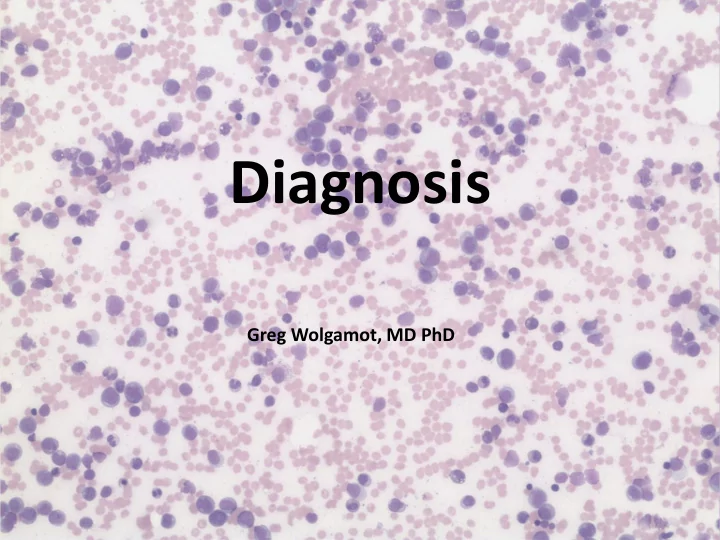
Diagnosis Greg Wolgamot, MD PhD Workup of leukemia: 1.Blood - - PowerPoint PPT Presentation
Diagnosis Greg Wolgamot, MD PhD Workup of leukemia: 1.Blood 2.Lymph node 3.Marrow 4.Prognostic indicators Result Name Result Abnl Normal Range Units WBC 14.7 H 4.0-11.0
Greg Wolgamot, MD PhD
Workup of leukemia: 1.Blood 2.Lymph node 3.Marrow 4.Prognostic indicators
Result Name Result Abnl Normal Range Units WBC 14.7 H 4.0-11.0 K/mm3 RBC 4.51 4.31-5.77 M/mm3 HGB 12.9 L 13.2-17.5 g/dL HCT 38.7 L 38.9-49.9 % MCV 85.8 80.0-100.0 fL MCH 28.6 27.8-33.8 pg MCHC 33.3 31.5-36.5 g/dL RDW 14.0 11.5-14.2 % PLATELET COUNT 126 L 150-400 K/mm3 NEUTRO% 23.6 % LYMPH.% 69.8 % MONO% 5.1 % EOS% 0.6 % BASO% 0.4 % IMM GRAN% 0.5 0-0.5 % Includes myelocytes, metamyelocytes and promyelocytes. NEUTRO# 3.5 1.5-8.0 K/mm3 LYMPH# 10.3 H 1.0-3.5 K/mm3 MONO# 0.7 0.2-1.0 K/mm3 EOS# 0.1 0-0.5 K/mm3 BASO# 0.1 0-0.2 K/mm3 Smudge cells present
PATHOLOGIST INTERPRETATION: Lymphocytosis suggestive of chronic lymphocytic leukemia Flow cytometry would be contributory for further workup John W. Hoyt, MD Pathologist
flourochrome
Borowitz et al (1993) AJCP 100:534-40. Steltzer et al (1993) Ann NY Acad Sci 667:265-280
Wood and Borowitz (2006) Henry’s Laboratory Methods
Wood (2004) Methods Cell Biology 75:559-576
Wood and Borowitz (2006) Henry’s Laboratory Medicine
– Antigens expressed in consistent and reproducible patterns with maturation
– Increased or decreased normal antigens – Asynchronous maturational expression – Aberrant antigen expression – Homogeneous expression
Case 1: Reactive
Case 3: CLL
WOLGAMOT
Lymphoma WOLGAMOT
Further Workup
Core biopsy of cervical lymph node
Case 3
Case 3: CLL
Mutated CLL = good prognosis Unmutated CLL = poor prognosis
FINAL DIAGNOSIS: Cervical lymph nodes, core biopsy: Chronic lymphocytic leukemia/small lymphocytic lymphoma (CLL/SLL). Camilla T. Allen, MD Pathologist
Case 3: CLL
Case 2: Mantle cell lymphoma
Bone marrow aspirate
Case 3: CLL
Result Name Result Abnl Normal Range Units WBC 14.7 H 4.0-11.0 K/mm3 RBC 4.51 4.31-5.77 M/mm3 HGB 12.9 L 13.2-17.5 g/dL HCT 38.7 L 38.9-49.9 % MCV 85.8 80.0-100.0 fL MCH 28.6 27.8-33.8 pg MCHC 33.3 31.5-36.5 g/dL RDW 14.0 11.5-14.2 % PLATELET COUNT 126 L 150-400 K/mm3 NEUTRO% 23.6 % LYMPH.% 69.8 % MONO% 5.1 % EOS% 0.6 % BASO% 0.4 % IMM GRAN% 0.5 0-0.5 % Includes myelocytes, metamyelocytes and promyelocytes. NEUTRO# 3.5 1.5-8.0 K/mm3 LYMPH# 10.3 H 1.0-3.5 K/mm3 MONO# 0.7 0.2-1.0 K/mm3 EOS# 0.1 0-0.5 K/mm3 BASO# 0.1 0-0.2 K/mm3 Smudge cells present
CLL
Abnormality Prognosis Very High risk High risk low risk Very low risk 10 year survival ------> 29% 37% 57% same as controls del 17p13.1 (p53) DCI FISH poor; chemo resistance; consider BMT X p53 mutation poor; chemo resistance X BIRC3 very poor; chemo resistance, mutually exclusive to p53 X ZAP70 expression poor X CD38 expression poor X NOTCH associated with Richter's X del 11q22.3 DCI FISH intermediate risk. Bulky nodes, faster growth, unmutated IgH, requires alkylating drugs (cytoxan, bendamustine) X SF3B1
X trisomy 12 DCI FISH good; low risk. If no NOTCH mutation, low risk X, if NOTCH X, if no NOTCH IgH mutation present good (unmutated is poor) X normal cytogenetics good X del 13q14.3/13q34 DCI FISH good, if isolated X 13p if isolated 13p, good; very low risk X, if isolated t(14;19) ? t(2;14) ?
Prognostic Indicators
Case 1: Would be normal
Case 2: Mantle cell lymphoma
Case 3: CLL
CLL
Abnormality Prognosis Very High risk High risk low risk Very low risk 10 year survival ------> 29% 37% 57% same as controls del 17p13.1 (p53) DCI FISH poor; chemo resistance; consider BMT X p53 mutation poor; chemo resistance X BIRC3 very poor; chemo resistance, mutually exclusive to p53 X ZAP70 expression poor X CD38 expression poor X NOTCH associated with Richter's X del 11q22.3 DCI FISH intermediate risk. Bulky nodes, faster growth, unmutated IgH, requires alkylating drugs (cytoxan, bendamustine) X SF3B1
X trisomy 12 DCI FISH good; low risk. If no NOTCH mutation, low risk X, if NOTCH X, if no NOTCH IgH mutation present good (unmutated is poor) X normal cytogenetics good X del 13q14.3/13q34 DCI FISH good, if isolated X 13p if isolated 13p, good; very low risk X, if isolated t(14;19) ? t(2;14) ?
Prognostic Indicators
1) Probe a specific sequence of DNA or RNA 2) Visualize ‘in situ’ – within the context of tissue 3) Can be performed on interphase cells 4) Can be performed on non-living/fixed cells
Key features:
A C G T A A A G T A C G T A A A G T G G T A G T . . . . . . . . A A G T A G T T C C C T
1) Target (DNA or RNA) 2) Probe (DNA) 3) Detection method
S35 S35 S35 * * *
(radiolabel) (fluorochrome: FISH)
FITC
Peroxidase or phosphatase
(enzyme: CISH)
. . . . . . . .
Fluorochrome-labeled (FISH) Chromogenic (CISH)
alterations
Trisomy 21 by FISH HER2 amplification by FISH CISH for kappa and lambda light chain mRNA t(11;14) translocation by single-fusion FISH Detection of EBV RNA by CISH
Case 2: Mantle cell lymphoma
Fusion Probes vs. Break-Apart Probes for Translocation Detection
involved in a translocation
numerous potential partner genes
Case 2: Mantle cell lymphoma
Fusion probes
Case 3: CLL
CLL
Abnormality Prognosis Very High risk High risk low risk Very low risk 10 year survival ------> 29% 37% 57% same as controls del 17p13.1 (p53) DCI FISH poor; chemo resistance; consider BMT X p53 mutation poor; chemo resistance X BIRC3 very poor; chemo resistance, mutually exclusive to p53 X ZAP70 expression poor X CD38 expression poor X NOTCH associated with Richter's X del 11q22.3 DCI FISH intermediate risk. Bulky nodes, faster growth, unmutated IgH, requires alkylating drugs (cytoxan, bendamustine) X SF3B1
X trisomy 12 DCI FISH good; low risk. If no NOTCH mutation, low risk X, if NOTCH X, if no NOTCH IgH mutation present good (unmutated is poor) X normal cytogenetics good X del 13q14.3/13q34 DCI FISH good, if isolated X 13p if isolated 13p, good; very low risk X, if isolated t(14;19) ? t(2;14) ?
Prognostic Indicators
Question 2: FISH:
chondrichthyes.
specific sequences of DNA.
proteins the cells express.
WOLGAMOT
Lymphoma WOLGAMOT
WOLGAMOT
Lymphoma WOLGAMOT
Ryan Fortna , MD PhD NW Pathology Brent Wood, MD PhD U of Washington Cancer Program at SJH
Special thanks to: