Diabetes in the Outline Young Athlete The Disease The Athlete - - PDF document

diabetes in the
SMART_READER_LITE
LIVE PREVIEW

Diabetes in the Outline Young Athlete The Disease The Athlete - - PDF document

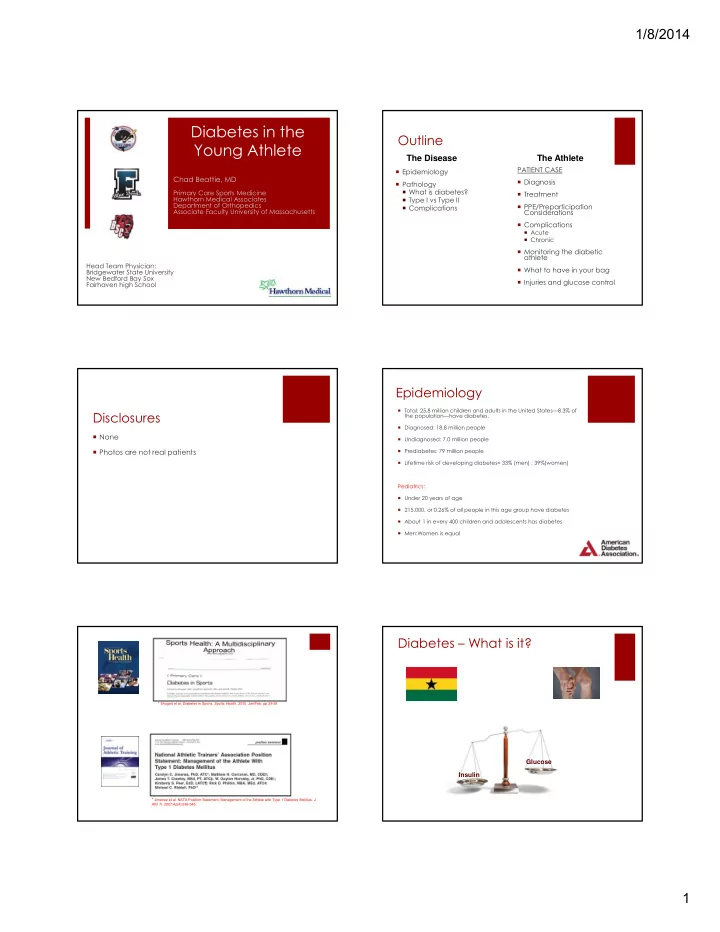
1/8/2014 Diabetes in the Outline Young Athlete The Disease The Athlete PATIENT CASE Epidemiology Chad Beattie, MD Diagnosis Pathology What is diabetes? Primary Care Sports Medicine Treatment Hawthorn Medical Associates


slide-1
SLIDE 1

1/8/2014 1

Diabetes in the Young Athlete

Head Team Physician: Bridgewater State University New Bedford Bay Sox Fairhaven high School

Chad Beattie, MD

Primary Care Sports Medicine Hawthorn Medical Associates Department of Orthopedics Associate Faculty University of Massachusetts

Disclosures

 None  Photos are not real patients

* Shugart et al. Diabetes in Sports. Sports Health. 2010. Jan/Feb: pp 29-38

* Jimenez et al. NATA Position Statement: Management of the Athlete with Type 1 Diabetes Mellitus. J

Athl Tr. 2007;42(4):536-545

Outline

 Epidemiology  Pathology  What is diabetes?  Type I vs Type II  Complications PATIENT CASE  Diagnosis  Treatment  PPE/Preparticipation Considerations  Complications

 Acute  Chronic

 Monitoring the diabetic athlete  What to have in your bag  Injuries and glucose control

The Disease The Athlete

Epidemiology

 Total: 25.8 million children and adults in the United States—8.3% of the population—have diabetes.  Diagnosed: 18.8 million people  Undiagnosed: 7.0 million people  Prediabetes: 79 million people  Lifetime risk of developing diabetes= 33% (men) ; 39%(women) Pediatrics:  Under 20 years of age  215,000, or 0.26% of all people in this age group have diabetes  About 1 in every 400 children and adolescents has diabetes  Men:Women is equal

Diabetes – What is it?

Insulin Glucose

slide-2
SLIDE 2

1/8/2014 2

Types of Diabetes

 Type 1  Type 2

INSULIN

  • AKA
  • Childhood / Adolescent Diabetes
  • Juvenile Diabetes
  • IDDM

 Mean age of onset: 8-12  Pathophysiology:

 Felt to be an autoimmune condition  Alteration in immune response places beta-cells at risk for imflammatory damage  Autoantibodies to Islet cells have been identified

 Commonly Associated Conditions:

 Celiac Disease  Addison Disease  Hypothyroidism Other Autoimmune conditions

Response to INSULIN

  • AKA
  • NIDDM
  • Adult-Onset DM

“Use it or Lose it” Decrease in Beta cell function and Mass = Insulin secretion

slide-3
SLIDE 3

1/8/2014 3

 Risk Factors:

 BMI>25  Hypertriglyceridemia  African american > Latino > Native american > Asian American  Sedentary lifestyle  Family Hx of DM  Gestational diabetes

 Commonly Associated Conditions:  HTN  Hypercholesterolemia  Stroke  ED  Infertility  Pancreatic cancer  Acanthosis nigricans

DM 1 DM 2 Diagnosis

Typically diagnosed in early childhood or adolescence or early adulthood Usually Dx in adulthood, although this is changing

Mechanism

Insulin Deficiency Decreased Insulin utilization

Complications

Hyperglycemia, weight loss, DKA Obesity, HTN, hyperlipidemia

Demographics

Younger, more fit population More common in older,

  • verweight individuals

Where it all starts: The Pancreas

Normal Glucose Metabolism

FOOD Absorption

Abnormal Glucose Metabolism

slide-4
SLIDE 4

1/8/2014 4

Glucose Metabolism during Exercise

 Insulin is suppressed

→ More glucose released from liver  Muscles = ↑ sensitivity to insulin = more efficient glu uptake into muscle  Blood glucose levels decrease

Glucose Metabolism

a fte r Exercise

 Insulin levels rise

→ Excess glucose gets stored in muscle and fat.

Diabetes – so what? Complications

 In 2004:

 70% of all diabetes related deaths were due to cardiac disease  16% of all diabetes related deaths were due to stroke

 Risk of stroke or heart disease is 4 x higher in diabetics  #1 cause of blindness in the US  #1 cause of kidney failure  > 200,000 people a year are on dialysis b/c of diabetic nephropathy  70% of diabetics have neuropathy  #1 cause of atraumatic amputations in the US

The Diabetic Athlete

 One Athletes Story

 A 16yo high school female soccer player and T&F athlete presents for her annual examination and reports feeling well except for increased burning with urination and some urinary frequency over the past 5 days.  Her physical examination is unremarkable and her vital signs, including her blood pressure are within normal limits.  She submits a urine sample

slide-5
SLIDE 5

1/8/2014 5

 The urine analysis shows:

Color Yellow Clarity Clear Spec Grav 1.030 Glucose Positive Ketone Positive Nitrite + Leuk Est + WBC 4-8/hpf Protein Positive

Diagnosis

 Urinary Tract Infection  Question Type 1 DM

Diabetes work-up

 Diagnostic Criteria

 Fasting blood glucose >126 mg/DL  Random blood glucose > 200 mg/DL  HbA1C level >6.5%  Glucose tolerance test: blood glu >200 mg/DL, 2 hours after a glucose load

Diagnosis

Scenario 1 – Incidental Scenario 2 – The symptomatic athlete Scenario 3 – The hospitalized youngster

Kelli Kuehne Gary Hall Jr – Olympic Champion 50m freestyle

Famous Diabetic Athletes

Treatment

Exercise Nutrition Medications (insulin)

slide-6
SLIDE 6

1/8/2014 6

Treatment

 Exercise is Medicine:

 Improves glucose metabolism  Improves insulin sensitivity  Can reduce the use of PO medications and insulin

 Participation in team sports = ↓Macrovasc complication and ↓ mortality *

*LaPorte et al. Pittsburgh Insulin-Dependent Diabetes Mellitus Morbidity and Mortality Study: Physical activity and diabetic complications. Pediatrics. 1986;78:1027-1033

Diet – Glycemic Index Insulin

Insulin Action How to use Length Humalog

Rapid

Bolus in MDI

Minutes

Novolog Humulin

Fast

Bolus in MDI Basal/Bolus in pump

2-4 hours

Novolin Humulin N

Intermediate

Basal dose inj

4-10 hours

Novolin N Lantus

Long

Basal dose inj

1 day

Detemir

Insulin

  • Multiple Daily injections (MDI)

Insulin

Pump

The PPE

 History / Discussion should include:

 Assessment of self-care skills and knowledge of disease  Discuss how exercise will affect blood glucose control  An assessment of current glycemic control (HgbA1c)  Information regarding the presence of DM-related complications

slide-7
SLIDE 7

1/8/2014 7

The PPE

 Physical examination should include:

Complication Examination

Brain Cognitive evaluation Heart Complete cardiovascular examination PVD Peripheral pulses Eyes Dilated ophthalmologic exam annually Kidneys Urinalysis to assess proteinuria annually Nerves Monofilament and reflex exam

Pre-participation Considerations

 ADA guidelines recommend screening for diabetic complications before participation  Diabetic athletes should wear MedicAlert bracelet

Acute Complications

 Hypoglycemia  Hyperglycemia

Common Problems Encountered with Diabetic Athletes

 “Medical”  Hypoglycemia  Immediate  Delayed  Hyperglycemia  Ketoacidosis  Proliferative Retinopathy  Nephropathy  Peripheral Neuropathy  “Orthopedic”  Fascial Disease  Adhesive Capsulitis  Tendon pathology  Flexor tenosynovitis  Nerve entrapments

Hypoglycemia

 Typically only happens to patients who take insulin  Exercise is the #1 cause

  • ↑ Absorption of insulin during exercise
  • ↑ Sensitivity to insulin during exercise
  • Exogenous insulin does Not decrease during

exercise like endogenous insulin does

Hypoglycemia

 Symptoms occur with blood glucose < 70mg/dL  Symptoms:  Tachycardia  Sweating  Palpitations  Hunger  Anxiety  Headache / dizziness  Blurred vision, seizure, coma

slide-8
SLIDE 8

1/8/2014 8

Hypoglycemia

 Treatment = PREVENT IT

→ Blood Glucose Monitoring → Carbohydrate supplementation →Insulin Adjustments

 Treatment = Give Glucose!

Hypoglycemia

Blood Glucose monitoring

 Before Exercise : 2-3 times to check the trend

→ levels <70mg/dL = Postpone exercise

 During exercise: q 30 mins  After: q 2 hrs x 2 to check for Post-Exercise hypoglycemia

Hypoglycemia

Carbohydrate Supplementation

 Pre-Exercise → Carb rich meal 2-4 hours before exercise. → Additional 15-30g of Carbs within 1 hour of exercise  During → Additional 30-100g for every hour of exertion  Post → 1.5g/Kg of CHO per hour x 4 hours → Restart insulin at this meal

Hypoglycemia

Insulin Adjustments

 Insulin Pump:

 ↓ basal rate by 20-50% 1hr before exercise  ↓ Bolus by 50% at meal preceding exercise  Disconnect pump at exercise onset

 Multiple Daily injector

 ↓ Bolus by 50% at meal preceding exercise

Hypoglycemia

Mild Hypoglycemia Athlete following commands

10-15g of glucose tablets

  • r honey

Re-check blood glu in 15 mins 10-15g of glucose tablets or honey Glucagon

Hypoglycemia

Severe Hypoglycemia Athlete unable to follow commands Glucagon

slide-9
SLIDE 9

1/8/2014 9

Normal Glucose Metabolism Hyperglycemia

Why would an athlete get

HYPERglycemic?

Hyperglycemia

Typically occurs with High-Intensity Exercise (70% VO2 max or >85% MHR)

Hyperglycemia

1 – Under-insulinization

↓Insulin = ↑ Hepatic Glucose production

Hyperglycemia

2 - Hormones

HIE = ↑ Catecholamine ↑FFAs ↑ Ketones = ↑ Blood Glu ↓ Muscle utilization of glucose =

Hyperglycemia

3 - Psychological Stress

↑ Stress = ↑ Counterregulatory hormones = ↑ Blood Glu

* Insulin mgmt strategies from practice may not work on game day

slide-10
SLIDE 10

1/8/2014 10

Hyperglycemia

4 - Performance

Competing in a hyperglycemic state: 1) ↑ Risk for dehydration 2) ↓ Performance 3) ↑ Ketosis 4) Does NOT ↓ risk of hypoglycemia

Hyperglycemia

 Symptoms

 Nausea  Dehydration  ↓ Cognition  ↓ Reaction time  Fatigue  Thirst  Increased urination  Kussmaul breathing  Fruity odor on breath

Hyperglycemia

 Guidelines

Blood Glucose Levels Action

> 250 mg/dL

  • Check urine for ketones

+ Ketones = No exercise

  • Ketones = Exercise with caution

> 300 mg/dL

Exercise inadvisable

Chronic Complications Monitoring the DM Athlete

 HgbA1c

 Provides a long-term prospective about glucose control but should NOT be used to make day-to-day decisions.

Diabetes Care Plan

 All DM athletes and their ATCs should have a care plan in place  Which includes:

 Blood glu monitoring guidelines  Insulin therapy guidelines → Dosing and adjustment strategies  Guidelines for Hyper-/Hypoglycemia detection and management  Emergency contact info

slide-11
SLIDE 11

1/8/2014 11 The Sideline Bag: What to have on hand

 Copy of Diabetes care plan  Equipment to monitor blood glucose levels  Supplies to Tx hypoglycemia

 Sugary foods / drinks  Glucagon injection kit (supplied by athlete/parents)

 Supplies for urine ketone testing  Sharps container  Spare batteries / infusion sets for insulin pumps

Injuries and Glucose control

Trauma = ↑ Stress Hormones = ↑ Blood glucose

↑ infection, ↓wound/Fx healing*

Glucose Targets:

  • Premeal = 110 mg/dL
  • Postmeal < 180 mg/dL

* Goodson WH III. Wound healing in experimental diabetes mellitus: importance of early insulin therapy. Surg Forum. 1978;29:95-98 * Flynn JM et al. Closed ankle fractures in the diabetic patient. Foot Ankle Int. 2000;21:311-319

Summary:

Role of the ATC in caring for the diabetic athlete

 Prevent / Recognize / Care of hypo and hyperglycemia  Exercise nutrition  Hydration counseling  Facilitate communication between providers/coaches etc

Thank-you