DFO HERRING SCIENCE AND MANAGEMENT Presented for: Prey Availability - - PowerPoint PPT Presentation

dfo herring science and
SMART_READER_LITE
LIVE PREVIEW

DFO HERRING SCIENCE AND MANAGEMENT Presented for: Prey Availability - - PowerPoint PPT Presentation

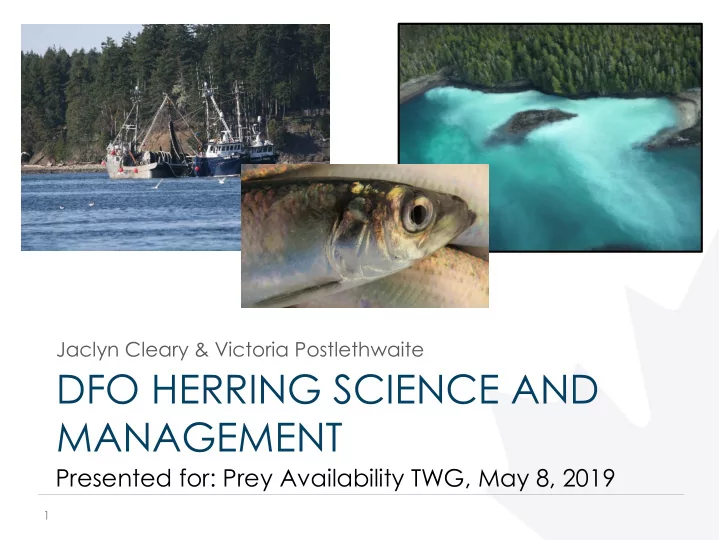
Jaclyn Cleary & Victoria Postlethwaite DFO HERRING SCIENCE AND MANAGEMENT Presented for: Prey Availability TWG, May 8, 2019 1 Annual data and stock assessment programs are conducted coast- wide 5 major and 2 minor stock assessment


slide-1
SLIDE 1

DFO HERRING SCIENCE AND MANAGEMENT

Jaclyn Cleary & Victoria Postlethwaite

1
Presented for: Prey Availability TWG, May 8, 2019

slide-2
SLIDE 2

Annual data and stock assessment programs are conducted coast- wide 5 major and 2 minor stock assessment areas

2

slide-3
SLIDE 3

Southern BC Herring stocks

3

Recent 10 years, the main migratory stock spawns primarily in Areas 14 & 17N; little to no spawning below Dodd Narrows Past 15 years, low spawning levels in Esperanza/ Nuchatlaht; Hesquiat/Ahousat; Barkley Sound

slide-4
SLIDE 4

Spring spawning (inshore) Summer feeding (offshore)

SOG

  • General migratory pattern is for age

2+ herring to move out of SOG post spawning (April/May) and move into the west coast feeding areas

  • Juvenile herring are thought to

remain within the Strait of Georgia until at age 2 WCVI herring share feeding grounds with SOG stock (May – Oct)

Herring Migratory Patterns

4

slide-5
SLIDE 5

Herring Science Key Programs

  • Annual data collections
  • Spawn survey, Biological samples, Catch data
  • Annual stock assessment (Fall)
  • Stock trends, herring spawn distribution
  • Current stock status, 1-year projections
  • Herring MSE
  • Objectives and management procedures

5

slide-6
SLIDE 6

Herring Stock Assessment: goal of stock assessment is to describe past and current status of a fish stock, make predictions about the future in order to make recommendations for sustainable harvest levels ‘model’ Number of fish; current biomass

minus Deaths (mortality and catch) plus New arrivals

Forecast for next spring D A T A

6

Implement decision rules

Is area

  • pen/closed?

What is TAC?

slide-7
SLIDE 7

Strait of Georgia herring: stock trends and reference points

7

LRP (0.3B0) + 90% CI Long- term average biomass

Spawning biomass + 90% confidence interval

slide-8
SLIDE 8

2010 2017

Recent spawn concentrating in 14 & 17N relative to historical periods. *Change in survey methods makes it hard to differentiate changes attributable to changes in survey methods, and those which are biological*

1971-1980* 2001-2010

SOG Spawn Distribution Over Time

slide-9
SLIDE 9

WCVI herring: stock trends and reference points

9

LRP (0.3B0) + 90% CI

Spawning biomass + 90% confidence interval

1950 ‘60 ‘70 ’80 ‘90 2000 ’10

2018

slide-10
SLIDE 10

WCVI Spawn Distribution

10

1950s 2010s

slide-11
SLIDE 11

Annual assessment advice includes:

  • Science advice on:
  • Biomass trends and herring distribution
  • Biology (size and age structure)
  • 1-year biomass forecasts and recommendations

for sustainable harvest levels

  • Communication of uncertainty and risk, e.g.:
  • Biomass + confidence intervals
  • Probability of avoiding conservation limits

11

slide-12
SLIDE 12

Incorporation of Science Advice

  • Fisheries management receives annual science

advice on 5 major herring stock assessment areas

  • Stock biomass and forecast
  • Stock levels compared to biological reference

points (LRP)

  • Catch calculation from application of

management procedures (previously decision tables)

  • Aims to ensure that advice and subsequent

management decisions are robust to uncertainty

12

slide-13
SLIDE 13

Incorporation of Science Advice

  • Management approach incorporated into IFMP
  • Consultation on harvest levels, commercial

allocations, management measures

  • Through advisory board processes and draft IFMP

(mainly in September-December)

13

slide-14
SLIDE 14

Herring Advisory Process

  • Integrated Herring Harvest Planning Committee (IHHPC)
  • First Nations
  • Spawn on kelp fishery
  • Herring Industry Advisory Board
  • Special use fishery
  • Marine Conservation Caucus (MCC)
  • Sport Fishing Advisory Board (SFAB)
  • Province of BC
  • Herring Industry Advisory Board (HIAB)
  • Seine and gillnet representatives
  • Processors
  • First Nations – Bilateral meetings
  • Other groups as needed (e.g. Conservancy Hornby

Island)

14

slide-15
SLIDE 15

Management Measures

  • Harvest levels
  • MSE results to date support continued

application of the 20% harvest rate for the current biomass level in the Strait of Georgia

  • West Coast of Vancouver Island remained

closed to support stock rebuilding

  • Open areas
  • Closure of areas where there is an absence of

spawning herring

  • Closure of First Nations FSC harvest areas

15

slide-16
SLIDE 16

Research

  • Interplay of food supply and predation impact
  • n herring survival and production is complex

and not readily predictable (Schweigert et al. 2010)

  • Biological reference points (limit reference

point, upper stock reference point) have been developed

  • Application of the LRP has been completed
  • Renewal of the management system is
  • ngoing, including a Management Strategy

Evaluation process (first cycle complete for SOG and WCVI)

16