Developing Trends in Vaping Steve Chassman, LCSW, CASAC Executive - - PDF document

developing trends in vaping
SMART_READER_LITE
LIVE PREVIEW

Developing Trends in Vaping Steve Chassman, LCSW, CASAC Executive - - PDF document

10/8/19 Developing Trends in Vaping Steve Chassman, LCSW, CASAC Executive Director Long Island Council on Alcoholism and Drug Wh What parents need to know Dependence 1 The part responsible for reasoning and impulse control develops LAST.


slide-1
SLIDE 1

10/8/19 1

Developing Trends in Vaping

Wh What parents need to know

Steve Chassman, LCSW, CASAC

Executive Director Long Island Council on Alcoholism and Drug Dependence

1

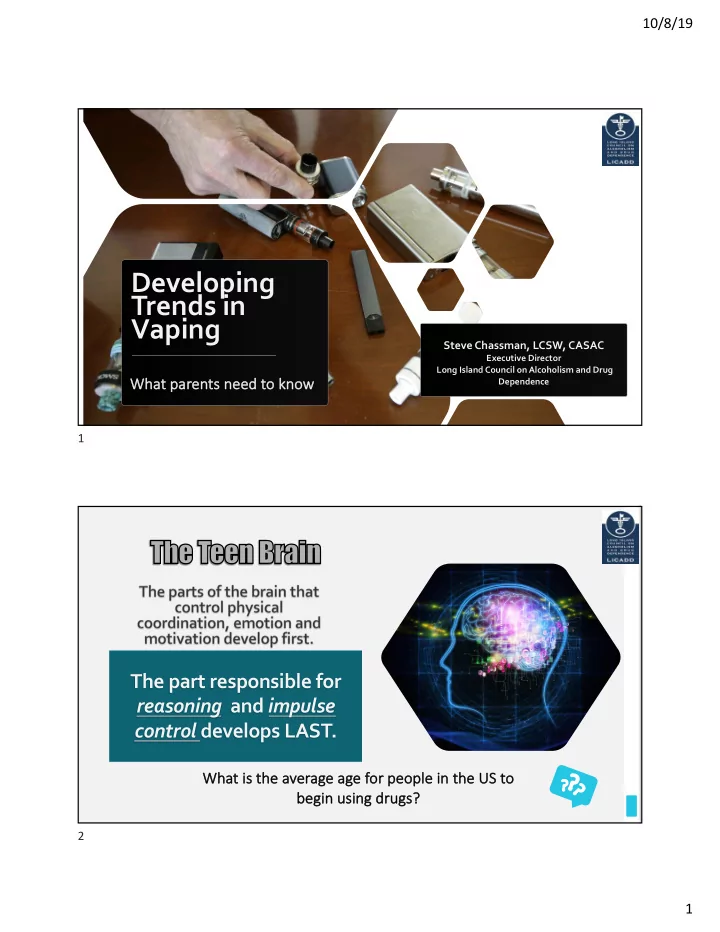
The part responsible for reasoning and impulse control develops LAST.

Wh What is the average age for r people in the US to be begin n us using ng dr drug ugs?

?

?

?

2

slide-2
SLIDE 2

10/8/19 2

Un Understanding t the P Progression

Abstinence I n f r e q u e n t u s e E a r l y a b u s e Abuse Dependence

Intensive Treatment Drug Involvement

Brief intervention:

Schools, courts, pediatric clinics, emergency rooms, mental health clinics Adapted from Broadening the Base of Alcohol Treatment (IOM)

Brief Interventions as supplemental therapy

Research shows that teens who start drinking before the age of 15 are 4 t 4 times es more likely to meet the criteria for alcohol dependence at some point in their lives. – NIH, 2017

3

VAPING

4

slide-3
SLIDE 3

10/8/19 3

https://e-cigarettes.surgeongeneral.gov/

5

  • 1/3 of high school seniors report using some kind of vaping device in the past year

“We are especially concerned because the survey shows that some of the teens using these devices are first-time nicotine users,” Nora D. Volkow, MD, Director of the National Institute on Drug Abuse “Recent research suggests that some of them could move on to regular cigarette smoking, so it is cr critical that we intervene with evidence ce-based efforts to prevent youth from using these product cts.”

  • Marijuana use among high school seniors increased from 35.6 percent in 2016 to 37.1 percent in 2017,

according to U.S. News & World Report.

Th The survey y also found a decrease in high school seniors’ perceptions of the risk k of using ma marijua uana na.

NI NIH Monit nitoring ing the the Futur uture Study tudy, 2017

6

slide-4
SLIDE 4

10/8/19 4

  • A Juul “starter” kit costs

$49.99 if you buy it online from the company. It includes a re-chargeable Juul device, a USB charger, a warranty, and a four-pack of the flavored Juul pods. On its website, the company promises a “powerful vapor experience”.

7

=

8

slide-5
SLIDE 5

10/8/19 5

Re Regulation of E-ci cigarettes

In Nassau County, Vaping products must now be kept behind the counter in stores where they are sold

  • The bill, passed July 9, 2018, also bans advertising vape products at the

counter or nearby any candy or toys in stores

  • The legal age for purchasing vaping products is 21 in Nassau County
  • 2019: Ban of flavored Juul pods in stores

9 10

slide-6
SLIDE 6

10/8/19 6

11

Marijuana

  • AKA bud, grass, oil,

hash, pot, weed, and more

  • Use before age 18 is 4

to 7 times more likely to result in problem use – which 30% of users develop

  • THC

(Tetrahydrocannabinol) is the active agent in the high

  • Impacts mood, reaction

time, motor functions, thinking, problem solving and memory

  • Can lead to long-term

impairment of memory and learning

  • Today’s pot is 300%

as potent as the pot

  • f the 70’s – oil and

dabs are even more potent

  • THC use, especially

at high potency, can lead to psychotic episodes, significant motor impairment, and other MH issues

  • As of 8/26/19,

marijuana is decriminalized in NYS

12

slide-7
SLIDE 7

10/8/19 7

  • A highly conce

centrated ve version of THC known as Bu Butane Hash Oi Oil, Dabs, or Wa Wax is made using highly ex explosive butane.

  • Ex

Extremely po potent; 1-2 d 2 drops

  • f
  • f oi
  • il can equal the amou
  • unt
  • f
  • f 1 joi
  • int.
  • Oi

Oil is th then put t into a Va Vaporizer, E-ci cigarette/g-pe pen, n,

  • r
  • r food
  • od.

D A B S

Wh What to look for: Vape Device ces Large blow torch ch lighters Pi Pipe/bong ng Sw Sweet odors Vapor smoke cl clouds

13

National Institute on Drug Abuse, 2015

14

slide-8
SLIDE 8

10/8/19 8

15

Why do people vape?

  • Tr

Traumatic Events

  • Fe

Feelings of isolation

  • Fe

Feelings of despair

  • Fe

Feeling hopeless

  • Fe

Feeling disconnected

  • Ph

Physical pain

  • Fe

Fear

  • Cu

Curiosity

  • Pl

Pleasure

  • Av

Avoidance

  • Ex

Exper perimen mentation

  • Fe

Feelings of grief

  • St

Stress

  • Di

Difficu culty coping

  • Lo

Low s self-es esteem eem

  • De

Depression

  • An

Anxiety ty

16

slide-9
SLIDE 9

10/8/19 9

What do we do?

Re Recall the reasons why people may use: Th These are the things we must address in our families, co communities and children. Sometimes it is not the ac actual al presence of f a a proble lem, but feelin lings of f grie ief, des despa pair or pa pain n tha hat ma may pr pres esen ent as a pr probl blem. em. Fo For example, when our loved one says, “Y “You don’t love me,” that doesn’t make it true, but th they may feel unl unlovabl ble. e.

Feelings of grief Stress Difficulty coping Low self-esteem Depression Anxiety Traumatic Events Feelings of isolation Feelings of despair Feeling hopeless Feeling disconnected Physical pain Fear

17

Tips for Parents

Ge Get Ri Rid of Old-Sc School Beliefs

  • This is what kids do.
  • It’s just a phase.
  • I turned out ok.
  • What about my kids’ right to privacy?
  • I’d rather they do it in my house than in the street

Te Teach Re Resistance Sk Skills

  • Teach your children appropriate ways to say “no.” also make sure they know who to

call for help. Role play!

Ke Keep Tr Track:

  • Know where they are, who they’re with, and what their doing to prevent “he said /

she said” conversations. Also, be home when they get home!

Se Set Fi Firm Conseq equen ences es:

  • Setting firm consequences for when your rules are broken is actually a help to your

teenager, making it clear what they are to do and not to do. Certainty. 18
slide-10
SLIDE 10

10/8/19 10

How do I know if someone is having a problem with drugs or alcohol?

  • 1. Changes in school work and grades
  • 2. Abrupt change in friends, groups, or actions
  • 3. Physical changes or health problems
  • 4. Deteriorating relationships with family
  • 5. Less open and honest
  • 6. Changes in mood and behavior/unusual flare-ups or outbursts
  • 7. Withdrawal from responsibilities and activities
  • 8. Social or interpersonal problems
  • 9. Psychological problems

19

LICADD SERVICES

  • Individual and family counseling
  • Family support and education
  • Anger Management/Emotional Regulation Counseling
  • Relapse Prevention Counseling
  • Connection to Treatment
  • School-Based Prevention Education
  • Staff Training
  • Naloxone Training
  • Continuing Education for Social Workers and Mental Health

Professionals

  • Community Outreach
  • Advocacy and Community Partnerships
  • 24-hotline Availability

You can reach a LICADD clinician

24/7

516-747-2606 Westbury 631-979-1700 Hauppauge www.licadd.org

20