Developing the Carbon Markets: Overview of Phased Approach Developing - - PowerPoint PPT Presentation

developing the carbon markets overview of phased approach
SMART_READER_LITE
LIVE PREVIEW

Developing the Carbon Markets: Overview of Phased Approach Developing - - PowerPoint PPT Presentation

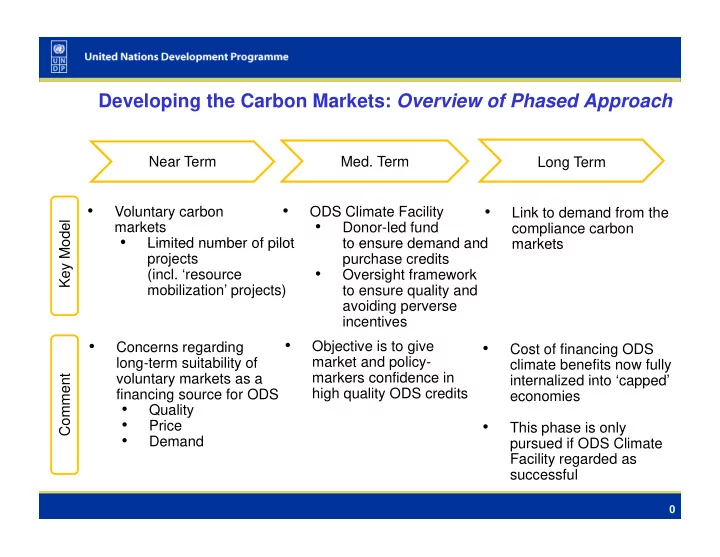
Developing the Carbon Markets: Overview of Phased Approach Developing the Carbon Markets: Overview of Phased Approach Near Term Med. Term Long Term Voluntary carbon ODS Climate Facility Link to demand from the odel


slide-1
SLIDE 1

Developing the Carbon Markets: Overview of Phased Approach Developing the Carbon Markets: Overview of Phased Approach

Near Term

  • Med. Term

Long Term

  • del
  • Voluntary carbon

markets

  • Limited number of pilot
  • ODS Climate Facility
  • Donor-led fund

to ensure demand and

  • Link to demand from the

compliance carbon markets Key Mo

  • Limited number of pilot

projects (incl. ‘resource mobilization’ projects) to ensure demand and purchase credits

  • Oversight framework

to ensure quality and avoiding perverse markets nt

  • Concerns regarding

long-term suitability of voluntary markets as a

  • Objective is to give

market and policy- markers confidence in g p incentives

  • Cost of financing ODS

climate benefits now fully internalized into ‘capped’ Commen voluntary markets as a financing source for ODS

  • Quality
  • Price
  • Demand

markers confidence in high quality ODS credits internalized into capped economies

  • This phase is only

pursued if ODS Climate p Facility regarded as successful

slide-2
SLIDE 2

Voluntary Markets Concerns: Supply/Demand Voluntary Markets Concerns: Supply/Demand

Current TOTAL Voluntary Market Estimated Annual Emissions from Developing Country ODS Banks – Low and Medium Effort (2)

(1)

300 - 350 - 400 -

Voluntary Market Low and Medium Effort ( )

t CO2e) 150 - 200 - 250 - missions (Mt 50 - 100 - 150 Annual E 2010 2011 2012 2013 2014 2015 2016 2017 2018 2019 2020 2007 2008

The voluntary market is unlikely to be able to absorb

1

Source: (1) State of the Carbon Markets 2009. Project -based voluntary carbon markets; (2) TEAP Decision XX/7 Report , Phase 2. Combined ‘Total Appliances & Foams’ and ‘Other Refrigerants’ categories

The voluntary market is unlikely to be able to absorb the supply of ODS credits.

slide-3
SLIDE 3

ODS Climate Facility: Potential Architecture ODS Climate Facility: Potential Architecture

Technical A i t Demand Oversight /Q tifi ti Supply Assistance Demand /Quantification Supply ODS Climate Facility Oversight Framework Fund (MLF MLF MLF Implementing Individual

Credits Credits Credits

ODS Climate Facility Framework (MP bodies) (MLF or MLF

  • Imp. Agencies)

Implementing Agencies projects

$ $ $ $ $ $ $

Architectural components of ODS Climate Facility addressed in issues paper:

  • Possible structural configurations
  • Project types

2

  • Fund’s investment approach
  • Oversight framework
  • Co-financing
  • Timing
slide-4
SLIDE 4

ODS Climate Facility: Considerations for ExCom ODS Climate Facility: Considerations for ExCom

The ODS Climate Facility in a ‘Nutshell’

  • A facility to develop and establish the compliance carbon markets as the source
  • f financing for ODS climate benefits. It recognizes that the voluntary carbon

markets may not be sufficient.

  • Precedents exist e g UN REDD; Prototype Carbon Fund (CDM)
  • Precedents exist, e.g. UN-REDD; Prototype Carbon Fund (CDM)

For Donors

  • It is not an open commitment to fund all future costs of ODS climate benefits
  • It is a limited fund to ‘prime the pump’ with the aim that the compliance carbon
  • It is a limited fund to prime the pump , with the aim that the compliance carbon

markets will subsequently finance ODS climate benefit costs

  • The fund will cover the climate benefit cost of a defined number of high quality,

diverse demonstration carbon projects. Payment from the fund will be p j y incremental-cost based, in the form of the accounting units of carbon credits For A5 Parties

  • It will not require mandatory participation

3

  • It is an optional, non-obligatory, mechanism, similar to the CDM, whereby projects

in A5 Parties can freely choose to fund activities through this financial incentive