Develop, test, deploy: accessible templates for an entire state Jay - - PowerPoint PPT Presentation

develop test deploy accessible templates for an entire
SMART_READER_LITE
LIVE PREVIEW

Develop, test, deploy: accessible templates for an entire state Jay - - PowerPoint PPT Presentation

Develop, test, deploy: accessible templates for an entire state Jay Wyant | Chief Information Accessibility Officer Kim Wee | Accessibility Coordinator, Webmaster Jennie Delisi | Accessibility Analyst Introducing the Challenge Jay Wyant Chief


slide-1
SLIDE 1

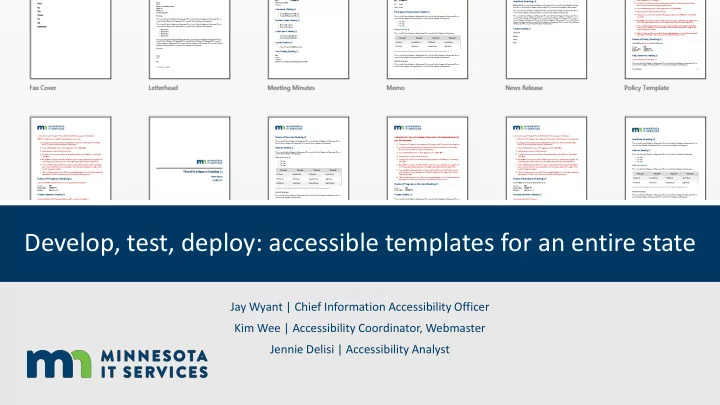
Develop, test, deploy: accessible templates for an entire state

Jay Wyant | Chief Information Accessibility Officer Kim Wee | Accessibility Coordinator, Webmaster Jennie Delisi | Accessibility Analyst
slide-2
SLIDE 2

Introducing the Challenge

Jay Wyant Chief Information Accessibility Officer

slide-3
SLIDE 3

Quick Quiz

What is the most common type of content created by individuals in an

  • rganization?
slide-4
SLIDE 4

The Content Distribution Challenge

slide-5
SLIDE 5

Bad email signature examples

slide-6
SLIDE 6

The Situation

  • Federated agencies
  • One or two agencies with accessible

MS Office 2010 templates

  • One agency with experience in

deploying document templates

  • No consistent email signature
  • Communications departments were

siloed

slide-7
SLIDE 7

Opportunity

Multi-year branding initiative/process led by Governor’s office

  • Coordinated through agency communications leaders
  • Rollout on two levels
  • Institutional communications: agency branding and website
  • Individual communications: email and documents
  • Minnesota IT Services (MNIT) volunteered to be first
slide-8
SLIDE 8

New State Logo

slide-9
SLIDE 9

Refurbished state portal

slide-10
SLIDE 10

Email Template

slide-11
SLIDE 11

Document Templates

slide-12
SLIDE 12

The Players

The Expert Central Desktop Support Network Support Agency Desktop Support Designer Accessibility Coordinator Governor’s Branding Team Office of Accessibility MNIT Communications

slide-13
SLIDE 13

The Objectives

  • Consistent accessible email signature used by all state

employees

  • Accessible document templates available when
  • pening application for all state employees
slide-14
SLIDE 14

Getting into the weeds!

Kim Wee Webmaster and Accessibility Coordinator

slide-15
SLIDE 15

Tools

  • Active Directory
  • Users and Computers
  • Group Policy Management
  • Group Policy Objects
  • Organizational Units
slide-16
SLIDE 16

Agency Word and PowerPoint Template Distribution

slide-17
SLIDE 17

Step 1 – Create Templates

slide-18
SLIDE 18

Step 2 – Save Templates

slide-19
SLIDE 19

Step 3 – Create Organizational Unit Active Directory, users and computers management tool

slide-20
SLIDE 20

Step 4 – Create Group Policy

Group Policy Objects

Create a “User Configuration” Group Policy to deploy template to all users via a batch file to run under (Logon/Logoff)

slide-21
SLIDE 21

Step 5 – Create the Script

Use a basic group policy logon script that copies the templates into the users’ template folder: xcopy normal.dotm "%userprofile%\AppData\Roaming\Microsoft\Templates\" /Y xcopy MDEPPT.ppt "%userprofile%\AppData\Roaming\Microsoft\Templates\" /Y:exit

slide-22
SLIDE 22

Step 6 – Link

Organizational Units

slide-23
SLIDE 23

Agency Email Signature Distribution

slide-24
SLIDE 24

Distribution Challenges

slide-25
SLIDE 25

Outcomes

Jennie Delisi Accessibility Analyst

slide-26
SLIDE 26

Branded, Accessible Email Signatures

  • Text colors meet contrast requirements
  • Images have proper alt text
  • Automatically sent to all users so they

just need to customize with name, title, address, phone number

slide-27
SLIDE 27

Branded, Accessible Microsoft Word Templates

  • Text colors meet contrast requirements
  • Logos have proper alt text
  • Automatically sent to all users so they

just need to select the template they want to use

slide-28
SLIDE 28

Branded, Accessible PowerPoint Templates

  • Good color contrast, logos with alt text
  • Available automatically to all users
  • Slide designs are also branded, tested

for accessibility

  • Light options
  • Dark options
  • 47 slide layouts!!!!
slide-29
SLIDE 29

Instructions/Toolkit

  • Accessible style guide for brand made

implementation smoother

  • Template Testing Protocol: used with

volunteer testers

  • Communications team created internal

toolkit for agencies to adapt the templates to meet their specific needs

  • Instructions created for IT staff assigned to

agencies for pushing out document and email signature templates to all staff

slide-30
SLIDE 30

Yammering on Yammer, in Groups, Everywhere!

  • Visibility of templates and signatures = more people aware of need for

accessible documents and emails

  • More communities of practice within the state discussing accessibility

(not just accessibility focused ones!)

  • More training requests, more project review requests, more groups

requesting a community of practice

  • More discussions on Yammer (our networking site) and in meetings

about accessibility

slide-31
SLIDE 31

But, it is more than that…Bigger Conversations

One brand encouraged:

  • more role-based cross-agency collaboration
  • encouraged people to talk across silos
  • Example: design leadership group meetings

(and groups within these groups such as web design people)

slide-32
SLIDE 32

Other Big Conversations

  • Review of webpages for branding sparked conversations about website

accessibility

  • Code and Cascading Style Sheets (CSS) were now able to be consistent,

more consistently included accessibility reviews

  • Because style guide has specific values for colors, then all the CSS will match at

each agency

  • Because MNIT took the lead, smaller agencies could use lots of what was

already created (less internal resources like designers, less ability to learn new technical components due to time constraints)

slide-33
SLIDE 33

$1,666,667 per year

Estimated cost savings potential

Based upon 32,000 state employees

  • 10,000 of them create 50 docs per year (estimate).
  • Probably spend 10 minutes looking for a correct document template, formatting

the layout and styles, and then remediating the document for accessibility afterward.

  • Saves over 5,000,000 minutes, or 83,000 staff hrs.
  • If paid average of $20/hr

= savings of around $1,666,667 per year in labor.

slide-34
SLIDE 34

Challenges/Lessons Learned

Jennie Delisi Accessibility Analyst

slide-35
SLIDE 35

The Challenges

  • Staggered rollout out: Hard to tell why some things were not implemented

correctly

  • Needed more time than anticipated for little challenges that "appeared" and

were not part of the plan

  • Too many players to do this frequently – wanted it as close to perfect as

possible

  • Agencies took the templates, altered them before pushing them out
  • Could this have changed accessibility of the templates?
  • Hard to forecast very specific template needs
slide-36
SLIDE 36

The Big Picture Challenges

  • There were also impacts on related things like content management systems at

some agencies

  • Did not have a governance structure prior to rollout out, and this would have

provided:

  • more info about each agency’s needs
  • better info as rollout proceeded (e.g. support needs)
  • change management plan for future iterations of document templates
slide-37
SLIDE 37

Our recommendation:

Do it!

slide-38
SLIDE 38

But wait, there’s more!

Our website

(mn.gov/mnit/accessibility) Blog post (about this talk)

Subscribe to our newsletter

slide-39
SLIDE 39

Thank You!

Jay Wyant

jay.wyant@state.mn.us

Kim Wee

kim.wee@state.mn.us

Jennie Delisi

jennie.delisi@state.mn.us