Determining the PSF over the Full FoV of LSST using Anisotropic - - PowerPoint PPT Presentation

determining the psf over the full fov of lsst using
SMART_READER_LITE
LIVE PREVIEW

Determining the PSF over the Full FoV of LSST using Anisotropic - - PowerPoint PPT Presentation

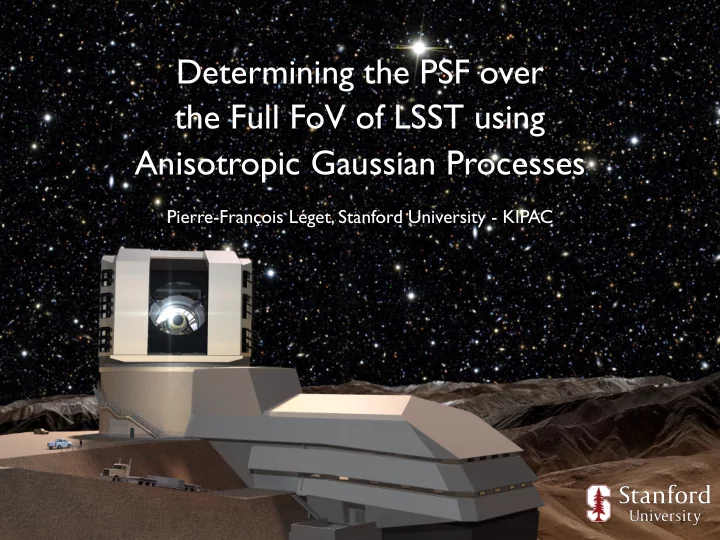
Determining the PSF over the Full FoV of LSST using Anisotropic Gaussian Processes Pierre-Franois Lget, Stanford University - KIPAC Gaussian process (GP) interpolation: Gaussian processes are a non-parametric way to interpolate data


slide-1
SLIDE 1

Determining the PSF over the Full FoV of LSST using Anisotropic Gaussian Processes

Pierre-François Léget, Stanford University - KIPAC

slide-2
SLIDE 2
  • Gaussian processes are a non-parametric way to

interpolate data

  • Interpolation is driven by the correlation function (aka

kernel) described by «hyperparameters»; for example,

  • amplitude of the fluctuations
  • correlation length
  • Basic steps in GP interpolation:
  • Choose a correlation function (kernel)
  • Fit hyperparameters
  • Compute interpolated values
  • Best Linear Unbiased Estimator.

➡ GP may be optimal interpolation method for atmospheric PSF parameters

Gaussian process (GP) interpolation:

2

slide-3
SLIDE 3
  • Atmosphere introduces anisotropy

(preferential direction) in spatial variation

  • f PSF’s parameters
  • It means that the spacial variation in the

case of a anisotropic gaussian random field are characterized by a 2D 2-point correlation function

  • For the anisotropic GP

, 4 hyperparameters:

  • Amplitude of spatial fluctuations
  • Correlation length
  • « g1 »
  • « g2 »
  • Need to estimate those hyperparameters to

predict the PSF over the FoV using GP

Gaussian process (GP) interpolation:

3

Same parametrization as in shape measurement

Davis et al. 2016

Anisotropic Gaussian random field Anisotropic Correlation function

slide-4
SLIDE 4
  • Generated realistic atmospheric PSFs across

FoV using GalSim.

  • Phase screens generated with

Von Kármán power spectrum (Kolmogorov with finite

  • uter scale).
  • Each screen corresponds to different wind

speed & direction, & outer scale.

  • 6 screens between 0.1 km & 15 km
  • Wind speed increases in with altitude
  • Dominant wind direction
  • Assumes 30-sec exposures for an LSST
  • like

aperture and obscuration (no optical PSF).

  • 20 000 stars on LSST FoV:
  • fit with elliptical Kolmogorov profile.
  • Fit parameters: size, g1, g2.

Realistic simulation of atmospheric PSF

4

slide-5
SLIDE 5
  • Two interpolations are made on simulation:
  • GP interpolation with anisotropic

Von-Kármán kernel (over the full FoV)

  • Second-order polynomial interpolation (for each CCD)
  • 80% of stars are used for training (16 000).
  • 20% of stars are kept for validation (4 000).

Interpolation of atmospheric PSF

5

slide-6
SLIDE 6

Results: Anisotropic 2-point correlation function fit on PSF parameters

6

  • Compute for each PSF’s parameter the

anisotropic 2-point correlation function (left plots)

  • Estimate the covariance matrix with an

internal method (bootstrapping)

  • Fit each measured anisotropic 2-point

correlation function with an anisotropic Von-Karman correlation function.

slide-7
SLIDE 7
  • For each interpolation, we compute “Rowe statistics”, which are ingredients

in the calculation of the systematic error in the shear correlation function due to errors in the PSF model.

  • Rowe statistics computed for stars in validation sample (4 000 stars).
  • Rowe statistics are lower for GP than for polynomial interpolation by a factor
  • f ~3 for all 𝜍 statistics
  • Next step: apply to real data (DES)

Results:

Gaussian processes with anisotropic Von-Kármán kernel (FoV) 2nd order polynomial interpolation (per CCD)

7