Astrophysical Probes of Dark Matter Overview Keith Bechtol LSST - - PowerPoint PPT Presentation

astrophysical probes of dark matter overview keith
SMART_READER_LITE
LIVE PREVIEW

Astrophysical Probes of Dark Matter Overview Keith Bechtol LSST - - PowerPoint PPT Presentation

Astrophysical Probes of Dark Matter Overview Keith Bechtol LSST Project and Community Workshop 2018 August 16, 2018 LSST Commissioning Review Tucson August 2-3 LSST Commissioning Review Tucson August 2-3 1 Premise LSST data


slide-1
SLIDE 1

1

LSST Commissioning Review • Tucson • August 2-3 LSST Commissioning Review • Tucson • August 2-3
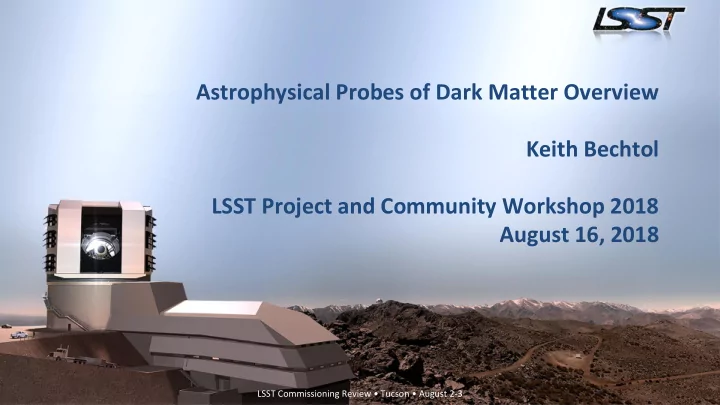
Astrophysical Probes of Dark Matter Overview Keith Bechtol LSST Project and Community Workshop 2018 August 16, 2018

slide-2
SLIDE 2

2

LSST Commissioning Review • Tucson • August 2-3

LSST data will enable and enhance multiple astrophysical probes of dark matter particle properties both through (1) measuring the abundance, clustering, and density profiles/shapes of dark matter halos over an enormous range of physical scales and by (2) improving our knowledge of the local distribution of dark matter The associated observational/analytical/theoretical techniques span several of the eight currently existing LSST Science Collaborations recognized by LSSTC We organized this session (and other related efforts) because we believe there is value in combining/coordinating efforts across the LSST scientific community to maximize the dark matter science coming out of LSST

Premise

slide-3
SLIDE 3

3

LSST Commissioning Review • Tucson • August 2-3

(1) Highlight a few of the exciting opportunities for dark matter science with LSST (2) Identify promising paths forward for working together and the organizational structures needed to facilitate this coordination / collaboration (3) Encourage broader involvement

  • Slack channel: #desc-dark-matter
  • Monthly telecons
  • Face-to-face meetings (next in late October 2018)

Goals of the Session

slide-4
SLIDE 4

4

LSST Commissioning Review • Tucson • August 2-3

  • Overview (5 min) - Keith Bechtol
  • Science Talks:
  • Dwarf galaxies throughout the Local Volume w/ LSST (15 min) - Jeff Carlin
  • Microlensing & black hole dark matter (15 min) - Will Dawson
  • Summary of Pittsburgh Face-to-Face Meeting (15 min) - Alex Drlica-Wagner
  • Guided discussion (remainder of time)

Session Agenda

slide-5
SLIDE 5

5

LSST Commissioning Review • Tucson • August 2-3

Hi all, We are excited to announce open registration for the next LSST Dark Matter Workshop October 29-31 hosted by Lawrence Livermore National Lab. Details about the meeting can be found here: https://lsstdarkmatter.github.io/ and the meeting registration form can be found here: https://goo.gl/forms/6zp9y9e4DRqFWXDp2 If you are interested in attending, we ask that you please register by ***September 4th***. Please let us know if you have any questions or feedback on the meeting. Best, LSST Dark Matter workshop meeting organizers

Next F2F Meeting 29-31 Oct @ LLNL

https://lsstdarkmatter.github.io/

slide-6
SLIDE 6

6

LSST Commissioning Review • Tucson • August 2-3

Some policy considerations:

  • It is possible for individuals to join multiple Science Collaborations
  • By design, each of the Science Collaborations is self-governing
  • Membership to a Science Collaboration is currently required to access

some LSST resources (e.g., Slack)

  • Agency research funding priorities are to some degree part of the LSST

dark matter discussion

Guided Discussion

slide-7
SLIDE 7

7

LSST Commissioning Review • Tucson • August 2-3

A few possible paths forward:

  • Maintain status quo / dark matter probes working “in parallel”
  • Create joint projects between Science Collaborations on ad hoc basis
  • Create new Dark Matter Science Collaboration (LSSTC is defining a formal

policy for this procedure)

  • Establish multi-collaboration MoU to hold several dark matter projects

(by design, each Science Collaboration is self-governing)

  • Dark Matter science primarily resides within a single existing

collaboration

  • Dark Matter science primarily resides within a single existing

collaboration AND facilitate external collaborator agreements (individuals or groups; broader scope MoUs or per-project basis)

Guided Discussion