detected by sender! Listen for carrier sense before transmitting - - PDF document

detected by sender listen for carrier sense before
SMART_READER_LITE
LIVE PREVIEW

detected by sender! Listen for carrier sense before transmitting - - PDF document

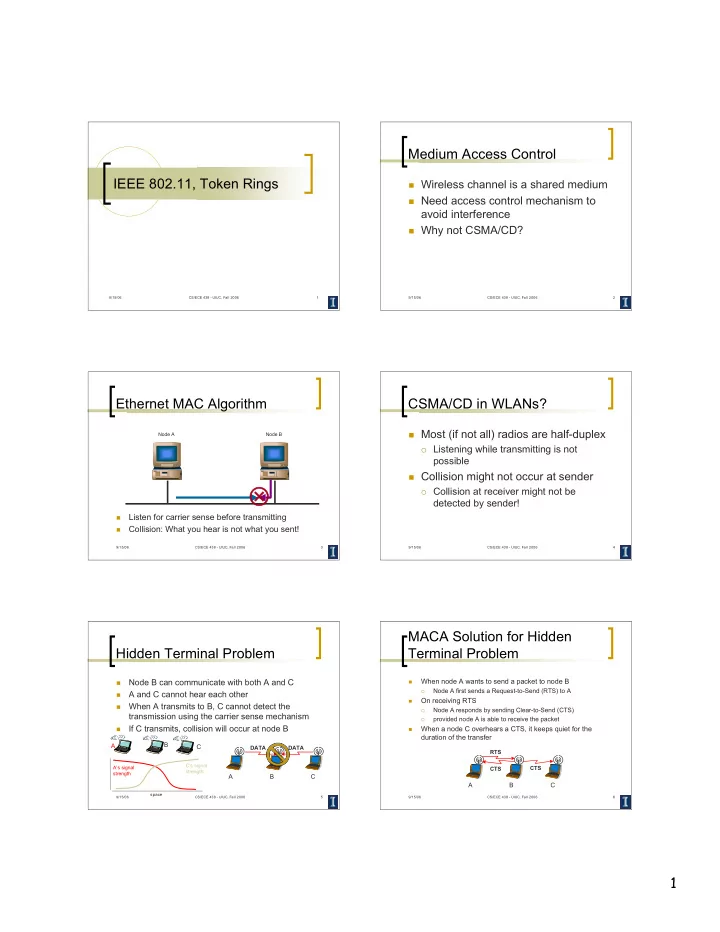
Medium Access Control IEEE 802.11, Token Rings Wireless channel is a shared medium Need access control mechanism to avoid interference Why not CSMA/CD? 9/15/06 CS/ECE 438 - UIUC, Fall 2006 1 9/15/06 CS/ECE 438 - UIUC, Fall 2006 2


slide-1
SLIDE 1

1

9/15/06 CS/ECE 438 - UIUC, Fall 2006 1

IEEE 802.11, Token Rings

9/15/06 CS/ECE 438 - UIUC, Fall 2006 2

Medium Access Control

 Wireless channel is a shared medium  Need access control mechanism to

avoid interference

 Why not CSMA/CD?

9/15/06 CS/ECE 438 - UIUC, Fall 2006 3

Listen for carrier sense before transmitting

Collision: What you hear is not what you sent!

Ethernet MAC Algorithm

Node A Node B

9/15/06 CS/ECE 438 - UIUC, Fall 2006 4

CSMA/CD in WLANs?

 Most (if not all) radios are half-duplex

 Listening while transmitting is not

possible

 Collision might not occur at sender

 Collision at receiver might not be

detected by sender!

9/15/06 CS/ECE 438 - UIUC, Fall 2006 5

Hidden Terminal Problem

Node B can communicate with both A and C

A and C cannot hear each other

When A transmits to B, C cannot detect the transmission using the carrier sense mechanism

If C transmits, collision will occur at node B

A B C

DATA DATA

A B C

A’s signal strength

space

C’s signal strength

9/15/06 CS/ECE 438 - UIUC, Fall 2006 6

MACA Solution for Hidden Terminal Problem

When node A wants to send a packet to node B

Node A first sends a Request-to-Send (RTS) to A

On receiving RTS

Node A responds by sending Clear-to-Send (CTS)

provided node A is able to receive the packet

When a node C overhears a CTS, it keeps quiet for the duration of the transfer

RTS CTS CTS

A B C

slide-2
SLIDE 2

2

9/15/06 CS/ECE 438 - UIUC, Fall 2006 7

Exposed Terminal Problem

 B talks to A  C wants to talk to D  C senses channel and finds it to be busy  C stays quiet (when it could have ideally

transmitted)

CTS RTS RTS

A B C D

9/15/06 CS/ECE 438 - UIUC, Fall 2006 8

MACA Solution for Exposed Terminal Problem

 Sender transmits Request to Send (RTS)  Receiver replies with Clear to Send (CTS)  Neighbors

See CTS - Stay quiet

See RTS, but no CTS - OK to transmit

CTS RTS RTS RTS

A B C D

9/15/06 CS/ECE 438 - UIUC, Fall 2006 9

Collisions

Still possible

RTS packets can collide!

Binary exponential backoff

Backoff counter doubles after every collision and reset to minimum value after successful transmission

Performed by stations that experience RTS collisions

RTS collisions not as bad as data collisions in CSMA

Since RTS packets are typically much smaller than DATA packets

9/15/06 CS/ECE 438 - UIUC, Fall 2006 10

Reliability

 Wireless links are prone to errors

 High packet loss rate detrimental to

transport-layer performance

 Mechanisms needed to reduce packet

loss rate experienced by upper layers

9/15/06 CS/ECE 438 - UIUC, Fall 2006 11

A Simple Solution to Improve Reliability - MACAW

 When node B receives a data packet from

node A, node B sends an Acknowledgement (ACK)

 If node A fails to receive an ACK

Retransmit the packet

RTS CTS CTS

A B C

DATA ACK ACK

9/15/06 CS/ECE 438 - UIUC, Fall 2006 12

Revisiting the Exposed Terminal Problem

Problem

Exposed terminal solution doesn't consider CTS at node C

With RTS-CTS, C doesn’t wait since it doesn’t hear A’s CTS

With B transmitting DATA, C can’t hear intended receiver’s CTS

C trying RTS while B is transmitting is useless

CTS RTS RTS

A B C D

RTS CTS

slide-3
SLIDE 3

3

9/15/06 CS/ECE 438 - UIUC, Fall 2006 13

Revisiting the Exposed Terminal Problem - MACAW

 One solution

Have C use carrier sense before RTS

 Alternative

B sends DS (data sending) packet before DATA:

Short packet lets C know that B received A’s CTS

Includes length of B’s DATA so C knows how long to wait

9/15/06 CS/ECE 438 - UIUC, Fall 2006 14

Deafness

For the scenario below

Node A sends an RTS to B

While node C is receiving from D,

Node B cannot reply with a CTS

B knows that D is sending to C

A keeps retransmitting RTS and increasing its own BO timeout

RTS RTS

A B C D

CTS CTS

9/15/06 CS/ECE 438 - UIUC, Fall 2006 15

Interframe Spacing

Interframe spacing

Plays a large role in coordinating access to the transmission medium

Varying interframe spacings

Creates different priority levels for different types of traffic!

802.11 uses 4 different interframe spacings

t medium busy SIFS PIFS DIFS DIFS next frame contention direct access if medium is free ≥ DIFS

9/15/06 CS/ECE 438 - UIUC, Fall 2006 16

IEEE 802.11 - CSMA/CA

Sensing the medium

If free for an Inter-Frame Space (IFS)

Station can start sending (IFS depends on service type)

If busy

Station waits for a free IFS, then waits a random back-off time (collision avoidance, multiple of slot-time)

If another station transmits during back-off time

The back-off timer stops (fairness)

t

medium busy DIFS DIFS next frame contention window (randomized back-off mechanism) slot time direct access if medium is free ≥ DIFS

9/15/06 CS/ECE 438 - UIUC, Fall 2006 17

Types of IFS

 SIFS

 Short interframe space  Used for highest priority transmissions  RTS/CTS frames and ACKs

 DIFS

 DCF interframe space  Minimum idle time for contention-based

services (> SIFS)

9/15/06 CS/ECE 438 - UIUC, Fall 2006 18

Types of IFS

 PIFS

 PCF interframe space  Minimum idle time for contention-free

service (>SIFS, <DIFS)

 EIFS

 Extended interframe space  Used when there is an error in

transmission

slide-4
SLIDE 4

4

9/15/06 CS/ECE 438 - UIUC, Fall 2006 19

Backoff Interval

 When transmitting a packet, choose a

backoff interval in the range [0,cw]

cw is contention window

 Count down the backoff interval when

medium is idle

Count-down is suspended if medium becomes busy

 When backoff interval reaches 0, transmit

RTS

9/15/06 CS/ECE 438 - UIUC, Fall 2006 20

DCF Example

data wait B1 = 5 B2 = 15 B1 = 25 B2 = 20 data wait

B1 and B2 are backoff intervals at nodes 1 and 2 cw = 31

B2 = 10

9/15/06 CS/ECE 438 - UIUC, Fall 2006 21

Backoff Interval

 The time spent counting down backoff

intervals is a part of MAC overhead

 Large cw

 Large backoff intervals  Can result in larger overhead

 Small cw

 larger number of collisions (when two

nodes count down to 0 simultaneously)

9/15/06 CS/ECE 438 - UIUC, Fall 2006 22

Backoff Interval

 The number of nodes attempting to

transmit simultaneously may change with time

 Some mechanism to manage contention

is needed

 IEEE 802.11 DCF

 Contention window cw is chosen

dynamically depending on collision

  • ccurrence

9/15/06 CS/ECE 438 - UIUC, Fall 2006 23

Binary Exponential Backoff in DCF

 When a node fails to receive CTS in

response to its RTS, it increases the contention window

 cw is doubled (up to an upper bound)

 When a node successfully completes

a data transfer, it restores cw to Cwmin

 cw follows a sawtooth curve

9/15/06 CS/ECE 438 - UIUC, Fall 2006 24

Token Ring

 Example Token Ring Networks

IBM: 4Mbps token ring

IEEE 802.5: 16Mbps

slide-5
SLIDE 5

5

9/15/06 CS/ECE 438 - UIUC, Fall 2006 25

Token Ring

Focus on Fiber Distributed Data Interface (FDDI)

100 Mbps

Was (not is) a candidate to replace Ethernet

Used in some MAN backbones (LAN interconnects)

Outline

Rationale

Topologies and components

MAC algorithm

Priority

Feedback

Token management

9/15/06 CS/ECE 438 - UIUC, Fall 2006 26

Token Ring

 Why emulate a shared medium with point-

to-point links?

 Why a shared medium?

Convenient broadcast capabilities

Switches costly

 Why emulation?

Simpler MAC algorithm

Fairer access arbitration

Fully digital (802.3 collision detection requires analog)

9/15/06 CS/ECE 438 - UIUC, Fall 2006 27

Token Ring: Topology and Components

 Relay

 Single Relay  Multistation access units

Host Host Host Host From Previous MSAU To Next MSAU

Host Relay

From Previous Host To Next Host

Host Relay

From Previous Host To Next Host

9/15/06 CS/ECE 438 - UIUC, Fall 2006 28

Token Ring: Dual Ring

 Example Token Ring Networks

FDDI: 1000Mbps

 Fiber Distributed Data Interface

9/15/06 CS/ECE 438 - UIUC, Fall 2006 29

FDDI

 Dual ring configuration

 Self-healing  Normal flow in green direction  Can detect and recover from one failure

9/15/06 CS/ECE 438 - UIUC, Fall 2006 30

Multistation Access Unit

 Each station imposes a delay

 E.g. 50 ms

 Maximum of 500 Stations  Upper limit of 100km

 Need 200km of fiber

 Uses 4B/5B encoding  Can be implemented over copper

slide-6
SLIDE 6

6

9/15/06 CS/ECE 438 - UIUC, Fall 2006 31

Token Ring: Basic Concepts

Frames flow in one direction

Upstream to downstream

Token

Special bit pattern rotates around ring

Stations

Must capture token before transmitting

Must remove frame after it has cycled

Must release token after transmitting

Service

Stations get round-robin service

9/15/06 CS/ECE 438 - UIUC, Fall 2006 32

Token Ring: Basic Concepts

 Immediate release

 Used in FDDI  Token follows last frame immediately

 Delayed release

 Used in IEEE 802.5  Token sent after last frame returns to

sender

9/15/06 CS/ECE 438 - UIUC, Fall 2006 33

Token Release

Delayed Release Early Release

9/15/06 CS/ECE 438 - UIUC, Fall 2006 34

Token Ring: Media Access Control Parameters

Token Holding Time (THT)

Upper limit on how long a station can hold the token

Each station is responsible for ensuring that the transmission time for its packet will not exceed THT

Token Rotation Time (TRT)

How long it takes the token to traverse the ring.

TRT ≤ ActiveNodes x THT + RingLatency

Target Token Rotation Time (TTRT)

Agreed-upon upper bound on TRT

9/15/06 CS/ECE 438 - UIUC, Fall 2006 35

802.5 Reliability

 Delivery status

 Trailer  A bit

Set by recipient at start of reception

 C bit

Set by recipient on completion on reception

9/15/06 CS/ECE 438 - UIUC, Fall 2006 36

802.5 Monitor

Responsible for

Inserting delay

Token presence

Should see a token at least once per TRT

Check for corrupted frames

Check for orphaned frames

Header

Monitor bit

Monitor station sets bit first time it sees packet

If monitor sees packet again, it discards packet

slide-7
SLIDE 7

7

9/15/06 CS/ECE 438 - UIUC, Fall 2006 37

Token Maintenance: 802.5

 Monitoring for a Valid Token

 All stations should periodically see valid

transmission (frame or token)

 Maximum gap  = ring latency + max frame < = 2.5ms  Set timer at 2.5ms  send claim frame if timer expires

9/15/06 CS/ECE 438 - UIUC, Fall 2006 38

Timing Algorithm: 802.5

Each node measures TRT between successive tokens

If measured-TRT > TTRT

Token is late

Don’t send

If measured-TRT < TTRT

Token is early

OK to send 

Worse case:

2xTTRT between seeing token

Back-to-back 2xTTRT rotations not possible

9/15/06 CS/ECE 438 - UIUC, Fall 2006 39

Traffic Classes: FDDI

 Two classes of traffic  Synchronous

 Real time traffic  Can always send  Asynchronous  Bulk data  Can send only if token is early

9/15/06 CS/ECE 438 - UIUC, Fall 2006 40

Timing Algorithm: FDDI

Each station is allocated Si time units for synchronous traffic per TRT

TTRT is negotiated

S1 + S2 + … + SN + RingLatency ≤ TTRT

Algorithm Goal

Keep actual rotation time less than TTRT

Allow station i to send Si units of synchronous traffic per TRT

Fairly allocate remaining capacity to asynchronous traffic

Regenerate token if lost

9/15/06 CS/ECE 438 - UIUC, Fall 2006 41

Timing Algorithm: FDDI

When a node gets the token

Set TRT = time since last token

Set THT = TTRT – TRT

If TRT > TTRT

Token is late

Send synchronous data

Don’t send asynchronous data

If TRT < TTRT

Token is early

OK to send any data

Send synchronous data, adjust THT

If THT > 0, send asynchronous data

9/15/06 CS/ECE 438 - UIUC, Fall 2006 42

FDDI example

Assume

RingLatency=12 µs

Three active stations

Each with Si=20 µs

TTRT=100 µs

Stations have unlimited supply of asynchronous traffic.

slide-8
SLIDE 8

8

9/15/06 CS/ECE 438 - UIUC, Fall 2006 43

FDDI example

Arrival time

TRT s/a

Arrival time

TRT s/a

Arrival time

TRT s/a 0 0 0/0 12 12 20/88 172 160 20/0 252 140 20/0 344 132 20/0 432 120 20/0 4 0 0/0 124 120 20/0 196 92 20/8 276 80 20/20 368 92 20/8 456 88 20/12 8 0 0/0 148 140 20/0 228 120 20/0 320 112 20/0 400 92 20/8 492 92 20/8

9/15/06 CS/ECE 438 - UIUC, Fall 2006 44

FDDI example

Arrival time TRT A Arrival time TRT A Arrival time TRT A 4 8 12 12 88 124 120 148 140 172 160 196 92 8 228 120 252 140 276 80 20 320 112 344 132 368 92 8 400 92 8 432 120 456 88 12 492 92 8 524 112 548 92 8 580 88 12 616 104 640 92 8 672 92 8 704 92 8 736 96 4 764 92 8 796 92 8 828 92 8 860 96 4 888 92 8 920 92 8 952 92 8 984 96 4 1012 92 8 1044 92 8 1076 92 8 1108 96 4 1136 92 8 1168 92 8 1200 92 8 1232 96 4 1260 92 8 1292 92 8 1324 92 8 1356 96 4 1384 92 8 1416 92 8 1448 92 8 1480 96 4 1508 92 8

9/15/06 CS/ECE 438 - UIUC, Fall 2006 45

FDDI Performance

 Synchronous traffic may consume one

TTRT worth of time

 TRT > TTRT

 Worst case

 TRT < 2*TTRT  Any asynchronous traffic plus

RingLatency ≤ TTRT

 Synchronous traffic < TTRT

9/15/06 CS/ECE 438 - UIUC, Fall 2006 46

FDDI Performance

 Can’t have two consecutive TRT =

2*TTRT

 After a cycle with TRT = 2*TTRT, no

asynchronous traffic will be sent

9/15/06 CS/ECE 438 - UIUC, Fall 2006 47

Token Maintenance: FDDI

 Lost Token

No token when initializing ring

Bit error corrupts token pattern

Node holding token crashes

 Monitoring for a valid token

Should see valid transmission (frame or token) periodically – within 2*TTRT

Maximum gap = RingLatency + MaxFrame ≤ 2.5ms