Drafting Motor Carrier Agreements: Anticipating and Addressing Cargo - - PowerPoint PPT Presentation

drafting motor carrier agreements anticipating and
SMART_READER_LITE
LIVE PREVIEW

Drafting Motor Carrier Agreements: Anticipating and Addressing Cargo - - PowerPoint PPT Presentation

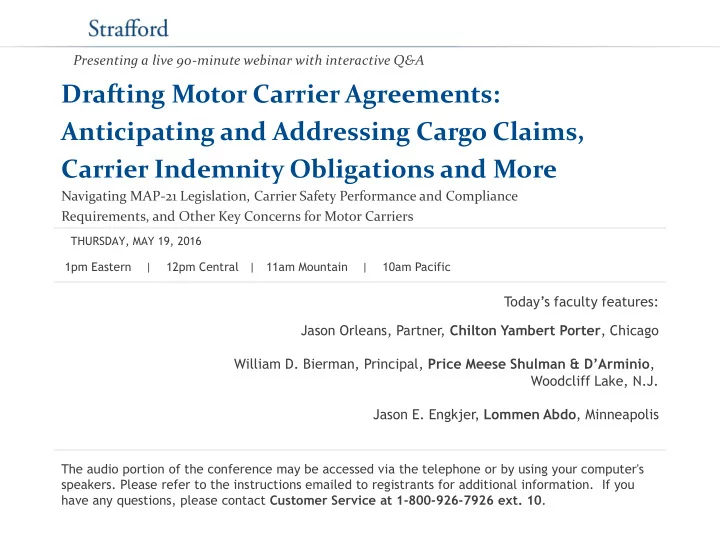
Presenting a live 90-minute webinar with interactive Q&A Drafting Motor Carrier Agreements: Anticipating and Addressing Cargo Claims, Carrier Indemnity Obligations and More Navigating MAP-21 Legislation, Carrier Safety Performance and


slide-1
SLIDE 1

The audio portion of the conference may be accessed via the telephone or by using your computer's

  • speakers. Please refer to the instructions emailed to registrants for additional information. If you

have any questions, please contact Customer Service at 1-800-926-7926 ext. 10.

Presenting a live 90-minute webinar with interactive Q&A

Drafting Motor Carrier Agreements: Anticipating and Addressing Cargo Claims, Carrier Indemnity Obligations and More

Navigating MAP-21 Legislation, Carrier Safety Performance and Compliance Requirements, and Other Key Concerns for Motor Carriers Today’s faculty features:

1pm Eastern | 12pm Central | 11am Mountain | 10am Pacific THURSDAY, MAY 19, 2016

Jason Orleans, Partner, Chilton Yambert Porter, Chicago William D. Bierman, Principal, Price Meese Shulman & D’Arminio, Woodcliff Lake, N.J. Jason E. Engkjer, Lommen Abdo, Minneapolis

slide-2
SLIDE 2

Tips for Optimal Quality

Sound Quality If you are listening via your computer speakers, please note that the quality

  • f your sound will vary depending on the speed and quality of your internet

connection. If the sound quality is not satisfactory, you may listen via the phone: dial 1-866-961-8499 and enter your PIN when prompted. Otherwise, please send us a chat or e-mail sound@straffordpub.com immediately so we can address the problem. If you dialed in and have any difficulties during the call, press *0 for assistance. Viewing Quality To maximize your screen, press the F11 key on your keyboard. To exit full screen, press the F11 key again.

FOR LIVE EVENT ONLY

slide-3
SLIDE 3

Continuing Education Credits

In order for us to process your continuing education credit, you must confirm your participation in this webinar by completing and submitting the Attendance Affirmation/Evaluation after the webinar. A link to the Attendance Affirmation/Evaluation will be in the thank you email that you will receive immediately following the program. For additional information about continuing education, call us at 1-800-926-7926

  • ext. 35.

FOR LIVE EVENT ONLY

slide-4
SLIDE 4

Program Materials

If you have not printed the conference materials for this program, please complete the following steps:

  • Click on the ^ symbol next to “Conference Materials” in the middle of the left-

hand column on your screen.

  • Click on the tab labeled “Handouts” that appears, and there you will see a

PDF of the slides for today's program.

  • Double click on the PDF and a separate page will open.
  • Print the slides by clicking on the printer icon.

FOR LIVE EVENT ONLY

slide-5
SLIDE 5

STRAFFORD WEBINAR Drafting Motor Carrier Agreements: Anticipating and Addressing Cargo Claims, Carrier Indemnity Obligations and More. May 19, 2016

slide-6
SLIDE 6

KEY PROVISIONS

Presented By:

William D. Bierman, Esq.

Price, Meese, Shulman & D’Arminio, P.C. 50 Tice Boulevard Woodcliff Lake, NJ 07677 Tel: 201-391-3737 WBierman@PriceMeese.com

6

slide-7
SLIDE 7

I. INTRODUCTION

Preparation – Preparation – Preparation

Before you put pen to paper or keystroke to computer consider following which apply to all Contracts discussed today: 1. Contract goals for either party 2. Value of Contract in terms of dollar and customer relations

7

slide-8
SLIDE 8

Preparation – Preparation – Preparation

…Continued… 3. Discuss issues with company groups who will carry

  • ut Contract:

a)

  • perations

b)

financial

c)

claims

d) sales:

Contract is not only legal document it is an operational

  • financial – claims liability blueprint.

8

slide-9
SLIDE 9

Preparation – Preparation – Preparation

…Continued… 4. Use detailed checklist previously throughout to avoid missing important items; 5. Beware of copying another Contract as law and issues change and may not apply to your Agreement;

9

slide-10
SLIDE 10
  • 6. Use detailed checklist previously throughout to avoid

missing important items;

10

slide-11
SLIDE 11

Remember A fairly negotiated Contract will address both Shipper and Carrier concerns in advance providing for discussion and compromise to foster an anticipated partnership for the beneficial working relationship between the parties.

11

slide-12
SLIDE 12
  • 7. Identify unique issues underlying transaction such as:

a) unique commodity b) geographic scope c) specific equipment to name a few.

12

slide-13
SLIDE 13
  • 8. Understand charges:

a) freight b) accessorial c) fuel surcharge d) detention e) payment terms

13

slide-14
SLIDE 14
  • 9. Transportation Documents:

a) bill of lading b) tariffs c) rules d) exclusive contract terms

14

slide-15
SLIDE 15
  • 10. General Contract Language: Always try to be “the

Drafter” of the Contract: a) simple straight forward b) legalize only when necessary c) avoid ambiguities d) avoid internal inconsistencies

15

slide-16
SLIDE 16
  • 11. 800 Pound Gorilla Contracts. Throw all reason and rules
  • ut the window!
  • 12. Many of these important and preliminary suggestions

will apply to all transportation Contracts referred to throughout this discussion.

16

slide-17
SLIDE 17

II. FIRST IMPORTANT KEY PROVISION:

Will Contract be the entire Agreement between the parties? 49 U.S.C. §14101 (b) Will Contract Waive all rights, duties and obligations under 49 U.S.C. §14101 (b)

17

slide-18
SLIDE 18

PROS v. CONS OF WAIVER

PROS OF WAIVER: Parties can make any Agreement and Waive all federal legislation except: NOT WAIVE

  • Registration
  • Insurance
  • Safety Fitness

18

slide-19
SLIDE 19

PROS v. CONS OF WAIVER

CONS OF WAIVER: Be careful what you wish for. IMPORTANT REASON NOT TO WAIVE…

19

slide-20
SLIDE 20

REASONS NOT TO WAIVE NOT EXHAUSTIVE

  • 1. No Carmack Liability § 14706
  • 2. National Uniformity and Consistency of Statute
  • 3. Predictability v. State Law
  • 4. Special and Consequential Damage Interpretation
  • 5. Removal to Federal Court 28 U.S.C. § 1337
  • 6. Venue Flexibility 49 U.S.C. §14705(a)

20

slide-21
SLIDE 21

REASONS NOT TO WAIVE NOT EXHAUSTIVE

  • 7. Forum of Non-Conveniens – Right to transfer to

convenient forum 28 U.S.C. § 1391

  • 8. Burden of Proof for negligence transfer to shipper
  • 9. Presumption of good order and case law
  • 10. Consignee duty to accept shipment unless practically

worthless and to mitigate damages

  • 11. Preemption trumps state law causes of action

21

slide-22
SLIDE 22

REASONS NOT TO WAIVE NOT EXHAUSTIVE

  • 12. Written claims requirements:

a) regulations on claims – 370.3 (c) b) minimum claims requirements – 370.3 (b) c) response to claims – 370.5 and 370.7 ( c ) d) claims v. offset

22

slide-23
SLIDE 23

REASONS NOT TO WAIVE NOT EXHAUSTIVE

  • 13. Bill of lading and standard provisions waived
  • 14. Loss of released rate, notice and inadvertence clause and
  • pportunity to declare higher rate;
  • 15. Back side terms and conditions of bill of lading omitted

23

slide-24
SLIDE 24

REASONS NOT TO WAIVE NOT EXHAUSTIVE

Reasonable Dispatch Five Classic Defenses  Act of God  Act of Public Enemy  Authority of Law  Inherent Vice  Act or Omission of Shipper

24

slide-25
SLIDE 25

REASONS NOT TO WAIVE NOT EXHAUSTIVE

  • 16. 9-month claim filing
  • 17. 2-years to file suit – 49 U.S.C. 14706 (e)(1)
  • 18. carrier liens for freight charges
  • 19. conversion to warehouseman status upon wrongful

rejection

  • 20. salvage and on hand provision

25

slide-26
SLIDE 26

REASONS NOT TO WAIVE NOT EXHAUSTIVE

  • 21. no extraordinary value
  • 22. hazmat protocol
  • 23. payment of freight charges/ liability of consignor and

consignee

  • 24. shipper load and count provisions and presumption on

shortage and damage claim waived

26

slide-27
SLIDE 27
  • III. BALANCE OF CONTRACT PROVISIONS

Once Determine Waiver or Not Waiver Balance of Contract still contains important terms. Obviously with Waiver Drafter must consider all terms. Outside Interstate Commerce Act to Complete Transaction. A provision becomes KEY if not covered properly.

27

slide-28
SLIDE 28

SPECIAL ITEMS

WAIVER OF SUBROGATION ADDITIONAL INSURED INDEMNITY VALUATION COMMERCIAL CONTRACT v. TRANSPORTATION AGREEMENT

28

slide-29
SLIDE 29

TERMS

TERMS TO ADDRESS

TERMINATION SCOPE OF AGREEMENT RATE CHARGES AND PAYMENT FREIGHT DOCUMENTS INSURANCE REFUSED SHIPMENT AND WAREHOUSE LIABILITY

29

slide-30
SLIDE 30

TERMS

TERMS TO ADDRESS

CARGO LIABILITY SEALED SHIPMENTS SALVAGE INDEMNIFICATION HAZMAT FORCE MAJEURE

30

slide-31
SLIDE 31

GENERAL BUT IMPORTANT PROVISIONS

  • GOVERNING LAW
  • VENUE
  • ARBITRATION
  • INCORPORATION BY REFERENCE

TARIFFS, CLASSIFICATIONS, RULES

31

slide-32
SLIDE 32

Conclusion…

A well drafted Contract can anticipate and plan for problems before they happen. On the other hand a poorly drafted Contract can create problems that may not have existed before. To copy a real estate mantra – location – location – location. In Contracts it is Preparation – Preparation – Preparation. Don’t do things because they are easy. Prepare to represent your clients by knowing, using and negotiating the key provisions of your Contract.

32

slide-33
SLIDE 33

Preparation – Preparation – Preparation

Price, Meese, Shulman & D’Arminio, P.C. By: William D. Bierman, Esq.

…Conclusion

33

slide-34
SLIDE 34

STRAFFORD CONTINUING EDUCATION MAY 19, 2016 THE BR THE BROK OKER/C ER/CAR ARRIE RIER R CO CONTRA NTRACT CT CHILTON YAMBERT PORTER LLP CHICAGO, IL Presented by: Jason Orleans jorleans@cyp-law.com

slide-35
SLIDE 35

INTR INTRODUC ODUCTION: TION:

BROKER – MOVING FREIGHT FOR SHIPPER – MAY HAVE SHIPPER’S INTEREST AT HEART, BUT CANNOT EXIST WITHOUT USE OF EFFECTIVE MOTOR CARRIERS CARRIER – WANTS THE FREIGHT – MAY HAVE LESS BARGAINING POWER SOUND CONTRACT HELPS AN EQUAL PLAYING FIELD

35

slide-36
SLIDE 36

OUTLINE OF KEY PROVISIONS:

KEY CONRACTUAL TERMS AND OBSERVATIONS FROM BROKER SIDE/FROM CARRIER SIDE

 BROKER DEFINITION AND EXPLANATION OF

ROLE

  • PAYMENT OF FREIGHT CHARGES

WAIVER OF CARRIER’S LIEN WAIVER OF RIGHT OF CARRIER TO RECOVER PAYMENT FROM SHIPPER

 NO DOUBLE BROKERING  FREIGHT CLAIMS/LIMITATION OF LIABILITY

OFFSET PROVISION LIMITATION OF LIABILITY CARMACK WAIVERS

 INSURANCE  INDEMNIFICATION

ANTI-INDEMNFICATION STATUTES AND TRENDS

 NO BACK SOLICITATION  FOOD SAFETY/TRAILER SEAL CONSIDERATION

36

slide-37
SLIDE 37

 BR

BROKER OKER MUS MUST T ONL ONLY Y REP REPRES RESENT ENT THA THAT T IT IT ARRAN ARRANGES GES FOR FOR TRA TRANSP NSPOR ORTATI TION ON OF OF PR PROPE OPERTY TY BY BY MO MOTOR OR CARRIE CARRIER R FOR FOR COMP COMPENS ENSATI TION ON (49 49 USC USC § 13 1310 102(2 2(2)) ))

BROKER DOES NOT WANT TO CONTROL OR HAVE RIGHT TO CONTROL MOTOR CARRIER – CONCERN FOR VICARIOUS LIABILITY/JOINT VENTURE FAST ACT OF 2015 – REMOVED CRASH INDICATOR FROM PUBLIC VIEW ON FMCSA – SMS – WEBSITE. SUPPORTS BROKER’S LIMITED INTEREST IN ONLY ASCERTAINING THE MOTOR CARRIER IS LICENSED, INSURED AND HAS SATISFACTORY SAFETY RATING.

37

slide-38
SLIDE 38

SHIPPER EXPECTS BROKER TO SEE THE PROPERTY IS MOVED FROM A TO B. REALITY IS THAT SHIPPER EXPECTS SOME LEVEL OF CONTROL MOTOR CARRIER MAY VIEW BROKER AS REPRESENTATIVE AGENT OF THE SHIPPER BROKER MAY ISSUE BILLS OF LADING AS SHIPPER’S AGENT (BUT CONTRACT MAY SAY THAT THIS IS FOR INFORMATIONAL PURPOSES ONLY) BROKER MAY SOMETIMES BE LISTED AS CARRIER ON BILL OF LADING (BUT CONTRACT MAY STATE THAT THIS IS FOR “CONVENIENCE ONLY”) BROKER MAY OBTAIN ASSIGNMENT FROM THE SHIPPER TO ASSERT CARGO CLAIM BROKER MAY BE ALIGNED WITH SHIPPER (SHIPPER IS ITS SOURCE OF BUSINESS) BROKER SHOULD BE CAREFUL TO CONVEY LOAD INFORMATION/INSTRUCTIONS, ISSUANCE OF BILL OF LADING AS A “CONVENIENCE” ONLY OR AS “FACILITATOR” OF INFORMATION

38

slide-39
SLIDE 39

FREIGHT FREIGHT CHAR CHARGES: GES:

 BROKER/CARRIER AGREEMENTS

TYPICALLY PROVIDE THAT THE BROKER SHALL PAY THE CARRIER THE RATE SET FORTH IN THE RATE CONFIRMATION

 TYPICALLY MOTOR CARRIER AGREES NOT

TO SEEK PAYMENT FROM THE SHIPPER AND WILL WAIVE BROKER’S LIEN ON THE PROPERTY SHIPPED

 MOTOR CARRIER - WILL NOT WANT TO

WAIVE RECOURSE AGAINST THE SHIPPER

 BROKER - WILL NOT WANT MOTOR

CARRIER FROM HAVING ANY COMMUNICATION WITH THE SHIPPER

39

slide-40
SLIDE 40

NO NO DO DOUB UBLE LE BR BROKERIN OKERING: G: MOTOR CARRIER SUBCONTRACTING FREIGHT TO ANOTHER MOTOR CARRIER

PR

PROH OHIB IBITE ITED D UN UNDER DER MAP MAP – 21 21 . FINE OF $10,000 PER OCCURRENCE

 MOTOR CARRIER - MAY WANT

FREEDOM TO “INTERLINE” – ESPECIALLY WITH LTL MOVEMENTS

 BROKER - HAS LIABILITY CONCERN

AS MAY BE HELD RESPONSIBLE FOR UNKNOWN MOTOR CARRIER.

40

slide-41
SLIDE 41

FREIGH FREIGHT T CLAIMS CLAIMS/LIMIT /LIMITATION TION OF OF LIAB LIABILITY ILITY:

CLAIMS GOVERNED BY CARMACK AMENDMENT (49 USC § 14706)

  • ALLOWS FOR MOTOR CARRIER TO LIMIT

LIABILITY AND PRESCRIBES MANNER IN WHICH CLAIMS MUST BE PRESENTED, PROVED, MITIGATED, AND RESOLVED

  • LIMITS DAMAGES GENERALLY TO FAIR

MARKET VALUE OF PROPERTY/GOODS - NO LOST PROFITS, CONSEQUENTIAL DAMAGES, OR ATTORNEY’S FEES

BROKER/CARRIER AGREEMENT MAY WAIVE CARMACK UNDER 49 USC § 14101(b), BUT WAIVER MUST BE EXPRESS. WAIVER COULD OPEN UP CLAIMS FOR LOST PROFITS, CONSEQUENTIAL DAMAGES, ATTORNEYS’ FEES

BE CAREFUL OF CONTRACT WITH WAIVER PROVISION THAT LEAVES IN CARMACK TERMS FOR HANDLING FREIGHT CLAIMS UNDER 49 CFR § 370,

  • et. seq.

41

slide-42
SLIDE 42

MOTOR CARRIER - WILL NOT WANT CARMACK WAIVER (BUT WANTS BUSINESS FROM THE BROKER)

 BROKER – WILL WANT CARMACK WAIVER – SO

IF BROKER PAYS SHIPPER FOR DAMAGES, IT CAN RECOVER FULLY FROM MOTOR CARRIER

 BROKER – WILL WANT BILL OF LADING TO BE

SUBORDINATE TO THE BROKER/CARRIER CONTRACT

 BROKER – WILL WANT RIGHT TO

OFFSET/WITHHOLD PAYMENT OF FREIGHT CHARGES TO SATISFY CARGO CLAIM/DAMAGE

42

slide-43
SLIDE 43

INSU INSURANCE RANCE REQUIREMENTS: REQUIREMENTS:

 TYPICALLY CONTRACT REQUIRES $100,000

IN CARGO INSURANCE TO BE MAINTAINED BY THE MOTOR CARRIER.

 IN INSTANCES WHERE CARGO VALUE

EXCEEDS $100,000, CONTRACT MAY LIMIT MOTOR CARRIER’S LIABILITY TO $100,000

 MOTOR CARRIER - WILL WANT LIABILITY

LIMITED TO INSURANCE PROCEEDS

 BROKER - WILL WANT GREATER

INSURANCE LIMITS

43

slide-44
SLIDE 44

INDEMNIFICATION:

CONTRACTS WILL USUALLY REQUIRE THE MOTOR CARRIER DEFEND AND INDEMNIFY THE MOTOR CARRIER AGAINST CLAIMS FOR DAMAGES

STATE TRANSPORTATION ANTI-INDEMNIFICATION LAW - MOST STATES NOW HAVE STATUTES RENDERING ANY CONTRACT RELATED TO TRANSPORTATION SERVICE THAT PURPORTS TO INDEMNNIFY THE INDEMNITEE FOR ACTS OF ITS OWN NEGLIGENCE VOID

BROKER – WILL WANT BROAD INDENNIFICATION LANGUAGE, BUT STATUTE LEVELS PLAYING FIELD UNRESOLVED ISSUES: WHAT CONTRACTUAL INDEMNIFICATION LANGUAGE SURVIVES THE STATUTES?

  • THE BROKER SHOULD ONLY BE INDENNIFIED TO THE

EXTENT THE DAMAGES ARE “CAUSED BY THE ACT OF THE MOTOR CARRIER.”

  • ARE STATE ANTI-INDEMNIFICATION STATUES PREEMPTED

BY FEDERAL LAW? (“FAAAA – PREEMPTION” – 49 USC 14501(c)(1))

44

slide-45
SLIDE 45

NO NO BACK CK SOLICIT SOLICITATION TION:

 A

A NON NON-COM COMPE PETE TE - KEE KEEPS PS BR BROKER OKER FR FROM OM SOLI SOLICITI CITING L NG LOAD ADS FR S FROM OM SHI SHIPP PPERS ERS DIRECTL DIRECTLY Y - TYPI TYPICA CALL LLY FOR Y FOR UP T UP TO A O A YEAR YEAR FR FROM OM END OF B END OF BROKER/C OKER/CAR ARRIER RIER CONTRA CONTRACT CT

 TYP

TYPICAL ICAL PE PENAL ALTY I TY IS S A PE A PERCENT CENTAGE GE (1 (10-20% 20%) ) OF OF ANY ANY FREIGHT FREIGHT CHA CHARGE P GE PAID T AID TO THE O THE MO MOTOR OR CA CARR RRIE IER R OWED T WED TO THE O THE BR BROKER OKER

 PR

PROVISI VISIONS ARE V ONS ARE VALID ALID BR BROKER OKER - WILL WILL WANT F WANT FAR AR REA REACHING CHING PR PROVISI VISION ON MO MOTOR OR CA CARR RRIE IER R - MA MAY Y TR TRY Y TO LIMIT O LIMIT REA REACH O CH OF F PR PROVISI VISION ON

  • DUR

DURATI TION ON

  • PE

PERCENT CENTAGE GE T TO BE P O BE PAID AID

45

slide-46
SLIDE 46

FOOD FOOD SAFETY SAFETY RULES ULES - SEAL SEAL PR PROVISIO VISIONS: NS:

ON APRIL 5, 2016 CONGRESS ISSUED THE “FINAL RULE” REGARDING TRANSPORTATION OF FOOD PRODUCT APPLICABLE TO TRANSPORTATION ENTITIES (INCLUDING BROKERS) – RULE TO TAKE EFFECT IN JUNE 2017 (SMALL MOTOR CARRIERS ARE EXEMPT) (SEE, 21 CFR PART I)

SHIPPERS MUST ENSURE THE SAFE TRANSPORT OF FOOD PRODUCT – IMPLEMENT CONTROLS TO PREVENT CONTAMINATION/ADULTERATION OF FOOD PRODUCT

SHIPPERS MAY ASSIGN RESPONSIBILITY FOR TRANSPORTATION OF FOOD PRODUCT IN COMPLIANCE WITH THE FINAL RULE TO BROKERS AND MOTOR CARRIERS – BROKERS MAY ASSIGN TO MOTOR CARRIERS

NEW AREA OF CONTRACT

NEW PROVISIONS TO DEVELOP

IMPLEMENTATION OF CONTROLS - A NEW PROCESS – CONTROLS MAY BECOME PART OF CONTRACT

BROKER/MOTOR CARRIER CONTRACTS MAY DEFINE DAMAGE TO CARGO AS A BROKEN TRAILER SEAL - BUT WITHOUT ANY EVIDENCE OF PHYSICAL DAMAGE TO CARGO

46

slide-47
SLIDE 47

MO MOTOR OR CA CARR RRIE IER - WILL WILL ONL ONLY WA Y WANT T NT TO BE O BE LIABLE LIABLE FOR A FOR ACTU CTUAL AL DAM AMAGE GE TO O PR PROPE OPERTY TY AS AS UNDERST UNDERSTOOD OOD UNDER UNDER CA CARM RMACK CK BR BROKER OKER - WILL WILL WANT B WANT BROAD AD DEFINI DEFINITI TIONS ONS OF OF DAM AMAGE GE TO APPL O APPLY A Y AS BR S BROKERS OKERS WILL WILL HA HAVE VE TO O PAY Y SHI SHIPP PPER ER CLA CLAIMS IMS FOR POSS FOR POSSIBLE IBLE CONT CONTAM AMIN INATI TION ON

47

slide-48
SLIDE 48

DRAFTING MOTOR CARRIER AGREEMENTS:

ANTICIPATING AND ADDRESSING CARGO CLAIMS, CARRIER INDEMNITY OBLIGATIONS AND MORE

JASON E. ENGKJER

jengkjer@lommen.com (612) 336-9303

slide-49
SLIDE 49

BEGIN WITH UNDERSTANDING

THE OWNER-OPERATOR

RELATIONSHIP

  • RELATIONSHIP DIFFERENCES BETWEEN

OWNER-OPERATORS AND EMPLOYEES

  • CONTRACTUAL REQUIREMENTS
  • MISCLASSIFICATION

TODAY THE FOCUS IS ON THE CONTRACT:

  • CONTRACT HAULING AGREEMENTS
  • EQUIPMENT LEASE AGREEMENTS

49

slide-50
SLIDE 50

CONTRACTUAL

OWNER-OPERATORS & TRUTH-IN-LEASING A common problem is failing to understand the importance of operating a proper Owner- Operator program

A troubling number of “Owner-Operators” do not have properly drafted contracts with the carrier!

CLASSIC OWNER-OPERATOR RELATIONSHIP:

1. Owner-Operator provides the equipment;

  • 2. Operates under the motor carrier’s authority; and
  • 3. Under a written contract.

50

slide-51
SLIDE 51

CONTRACTUAL

OWNER-OPERATORS & TRUTH-IN-LEASING

  • The most common problems with

Owner-Operator programs is compliance (or non-compliance) with the Truth-in-Leasing (TIL) regulations, 49 CFR § 376.1, et al.

– Adopted and enforced by the Federal Motor Carrier Safety Administration (FMCSA)

  • If you engage in interstate commerce

and operate an owner-operator program, then you must comply with TIL regulations.

51

slide-52
SLIDE 52

CONTRACTUAL

OWNER-OPERATORS & TRUTH-IN-LEASING

  • TIL governs the “lease” of equipment by an owner-operator to the authorized motor carrier. 49

CFR § 376.1(a)

– Also governs the “interchange” of equipment between motor carriers. 49 CFR § 376.1(b)

  • Owner-Operator relationships must be governed by a written lease agreement, commonly

referred to as a Contract Hauling Agreement (CHA). 49 CFR § 376.11(a)

  • Owner-Operator is the “lessor” of the equipment, while the motor carrier leases the equipment

as the “lessee”

  • Owner-Operator runs under the motor carrier’s authority. 49 CFR § 376.11(c)

THE BASICS

52

slide-53
SLIDE 53

CONTRACTUAL

OWNER-OPERATORS & TRUTH-IN-LEASING

Generally, the written lease must: 1. Identify the parties and detail the use of the equipment; 2. Identify the equipment and the length of time (including start and end dates) that the lease covers; and 3. State that the carrier shall have “exclusive possession, control and use” of the equipment for the duration of the lease. 49 CFR § 376.12(a)-(c)

HOW DOES THE “CONTROL” REQUIREMENT EFFECT INDEPENDENT

CONTRACTOR STATUS?

DOES IT RAISE QUESTIONS OF MISCLASSIFICATION?

53

slide-54
SLIDE 54

CONTRACTUAL

OWNER-OPERATORS & TRUTH-IN-LEASING

“Receipts” dictate the time and possession of the equipment by the motor carrier. The Owner-Operator “checks-in” and “checks-out” with the carrier. 1. When checking in, the receipt identifies the equipment subject to the lease, with the date and time the lease was activated; and 2. When checking out, the receipt identifies the equipment, with the date and time possession of the equipment ends.

49 CFR § 376.11(b)

“CHECKING IN” AND “CHECKING OUT”

54

slide-55
SLIDE 55

CONTRACTUAL

OWNER-OPERATORS & TRUTH-IN-LEASING

COMPENSATION

The CHA must clearly state: 1. How compensation is paid; and 2. How deductions are administered

Compensation can be “expressed as percentage of gross revenue, a flat rate per mile, variable rate depending on the direction traveled or the type of commodity transported, or by any other method of compensation mutually upon by the parties.” 49 CFR § 376.12(d) IF CONSIDERING ANOTHER “METHOD OF COMPENSATION,” CONSIDER HOW THAT

MAY AFFECT THE INDEPENDENT CONTRACTOR’S STATUS AS AN OWNER-OPERATOR.

55

slide-56
SLIDE 56

CONTRACTUAL

OWNER-OPERATORS & TRUTH-IN-LEASING

Deductions and final settlements are an area where motor carriers tend to struggle. Lease must clearly state who is responsible, the owner-operator or carrier, for all charges associated with the contract, including:

DEDUCTIONS

  • Fuel and fuel taxes
  • Empty mileage
  • Permits
  • Tolls and ferries
  • Detention
  • Base plates
  • Licenses
  • Insurance / Cargo

Damage

  • Administrative fees
  • ANY unused portion
  • f such items

49 CFR § 376.12(j), (h)

56

slide-57
SLIDE 57

CONTRACTUAL

OWNER-OPERATORS & TRUTH-IN-LEASING

Carrier is obligated to maintain insurance coverage for the protection of the public. Carrier’s responsibility for insurance must be clearly specified in the lease. Deductions for insurance, whether deductible for primary or chargebacks for insurance purchased through the motor carrier, must be clearly specified.

INSURANCE

49 CFR § 376.12(j)

DOES RESPONSIBILITY FOR INSURANCE SEEM COUNTERINTUITIVE TO THE

INDEPENDENT CONTRACTOR RELATIONSHIP?

57

slide-58
SLIDE 58

CONTRACTUAL

OWNER-OPERATORS & TRUTH-IN-LEASING

Money deposited by the lessor with either a third party or the lessee to guarantee performance, to repay advances, to cover repair expenses, to handle license and State permit costs, and for any other purposes mutually agreed upon must be deposited in an escrow fund.

  • CARRIER MUST PROVIDE ACCOUNTINGS / INDIVIDUAL SETTLEMENT SHEETS

REFLECTING DEDUCTIONS FROM THE FUND.

  • OWNER-OPERATOR CAN DEMAND ACCOUNTINGS ANY TIME.
  • CARRIER MUST ACCOUNT FOR AND PAY INTEREST ON THE FUND TO THE OWNER-

OPERATOR.

  • LEASE MUST CLEARLY SPECIFY THE CONDITIONS UNDER WHICH FUNDS ARE

DEDUCTED AND RETURNED.

ESCROW FUND

49 CFR § 376.12(K)

58

slide-59
SLIDE 59

CONTRACTUAL

OWNER-OPERATORS & TRUTH-IN-LEASING

  • A motor carrier’s violation of the Truth-in-Leasing Regulations

entitles the Owner-Operator to a “private right of action”

– 49 U.S.C. § 14702

  • Allows the Owner-Operator to collect actual damages, as well

as attorney’s fees and costs

TRUTH-IN-LEASING: PRIVATE RIGHT OF ACTION

59

slide-60
SLIDE 60

CONTRACTUAL

OWNER-OPERATORS & EQUIPMENT LEASE AGREEMENTS

Many owner-operators do not own equipment or have the financial ability to purchase equipment. Result is an Equipment Lease arrangement between the owner-

  • perator and equipment owner (carrier or affiliated equipment

leasing company) The Equipment Lease and CHA are separate contracts with differing sets of rights and obligations. Can be interrelationship between an Equipment Lease and CHA.

EQUIPMENT LEASE AGREEMENTS

60

slide-61
SLIDE 61

CONTRACTUAL

OWNER-OPERATORS & EQUIPMENT LEASE AGREEMENTS

  • Lease payments with a combined option to purchase the equipment

at termination for the stated “termination value.”

  • Title remains with the “Lessor.”

– Do not confuse a “Lessor” under an Equipment Lease with the “Lessor” under a CHA.

  • May include warranty disclaimer, indemnity and events of default.

– Installment contract option. – Arguably not a lease?

EQUIPMENT LEASE TERMS

61

slide-62
SLIDE 62

CONTRACTUAL

OWNER-OPERATORS & EQUIPMENT LEASE AGREEMENTS

  • Establishment of an escrow fund.

– TIL compliance.

  • Pledge a CHA with the identified motor carrier.

– Authorizes Motor Carrier deductions from final settlements under the CHA to fund the lease payments. – Authorizes additional security payment (e.g. 20% of the termination value) in the event of termination. – Can require consent of the equipment lessor for a substituted carrier with combined authorization for direct payments.

EQUIPMENT LEASE SECURITY

62

slide-63
SLIDE 63

THE DECLINE OF THE OWNER-OPERATOR?

1. Organization

– Is the client properly organized to facilitate lease arrangements and help limit liability?

2. Contractual

– Does the client have proper CHAs and Equipment Lease Agreements that comply with applicable laws and regulations, including Truth-In-Leasing regulations?

3. Relational

– Does the client have proper mechanisms in place to ensure that contractors are treated like contractors, and employees like employees?

OPERATING AN OWNER-OPERATOR PROGRAM

63

slide-64
SLIDE 64

THANKS!

I’M HAPPY TO ANNOUNCE I’VE CHANGED FIRMS: JASON ENGKJER 1000 INTERNATIONAL CENTRE 920 2ND AVENUE SOUTH MINNEAPOLIS, MN 55402 TOLL FREE (800) 752-4297 DIRECT: (612) 336-9303 E-MAIL: JENGKJER@LOMMEN.COM

64