Detec&ng Jupiter Analogues Caroline Caldwell - - PowerPoint PPT Presentation

detec ng jupiter
SMART_READER_LITE
LIVE PREVIEW

Detec&ng Jupiter Analogues Caroline Caldwell - - PowerPoint PPT Presentation

Detec&ng Jupiter Analogues Caroline Caldwell University of Texas at Aus&n Collaborators:


slide-1
SLIDE 1 ¡ ¡ ¡ ¡ ¡ ¡ ¡ ¡ ¡ ¡ ¡ ¡ ¡ ¡ ¡ ¡ ¡ ¡ ¡ ¡ ¡ ¡ ¡ ¡ ¡

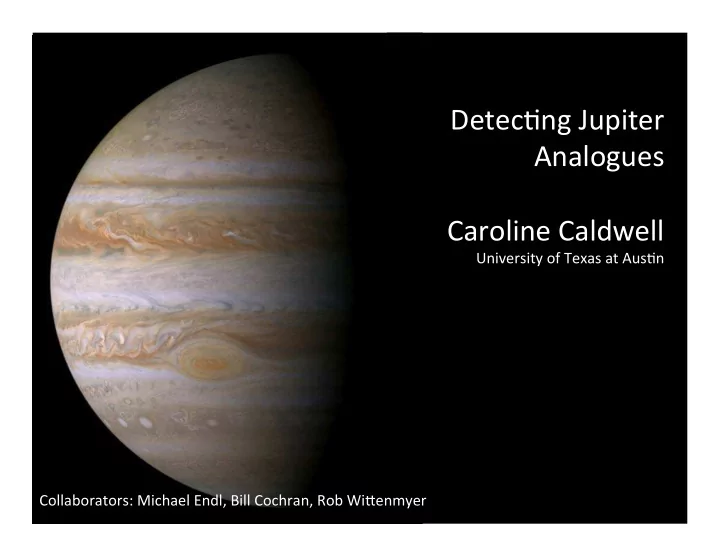
Detec&ng ¡Jupiter ¡ Analogues ¡ ¡ Caroline ¡Caldwell ¡

University ¡of ¡Texas ¡at ¡Aus&n ¡ Collaborators: ¡Michael ¡Endl, ¡Bill ¡Cochran, ¡Rob ¡WiEenmyer ¡
slide-2
SLIDE 2
  • Are ¡there ¡other ¡solar ¡systems ¡like ¡ours? ¡– ¡

Solar ¡System ¡structure ¡and ¡evolu&on ¡

  • 12 ¡years ¡of ¡observa&ons ¡
  • How ¡well ¡can ¡we ¡detect ¡Jupiter ¡analogues? ¡
slide-3
SLIDE 3

Sample ¡

All ¡data ¡was ¡collected ¡at ¡the ¡McDonald ¡Observatory ¡2.7m ¡Harlan ¡J. ¡Smith ¡Telescope ¡ using ¡the ¡Tull ¡High ¡Resolu&on ¡Spectrograph ¡from ¡1998 ¡to ¡2011. ¡Our ¡sample ¡consists ¡of ¡ 81 ¡stars ¡that ¡do ¡not ¡have ¡known ¡companions. ¡They ¡have ¡luminosity ¡classifica&ons ¡ near ¡that ¡of ¡our ¡sun ¡(no ¡giant ¡stars), ¡and ¡at ¡least ¡a ¡4330 ¡day ¡(one ¡Jupiter ¡period) ¡
  • bserva&on ¡&me ¡line. ¡Outlying ¡observa&ons ¡and ¡some ¡with ¡significantly ¡high ¡error ¡
have ¡been ¡removed ¡on ¡an ¡individual, ¡star-­‑by-­‑star ¡basis. ¡Linear ¡or ¡quadra&c ¡trends ¡ produced ¡by ¡binary ¡stars ¡have ¡been ¡removed ¡when ¡necessary. ¡
slide-4
SLIDE 4 F/F0 ¡= ¡c/(c±vS) ¡ Radial ¡Velocity ¡ Doppler ¡Shia ¡Equa&on ¡ Above, ¡the ¡radial ¡velocity ¡of ¡ the ¡Sun ¡from ¡a ¡point ¡co-­‑ planar ¡in ¡our ¡solar ¡system. ¡ ¡ ¡ K ¡(Jupiter) ¡= ¡12.4 ¡m/s ¡ P ¡(Jupiter) ¡= ¡12 ¡years ¡ a ¡(Jupiter) ¡= ¡5 ¡A.U. ¡ ¡ The ¡smaller ¡perturba&on ¡in ¡ the ¡signal ¡is ¡caused ¡by ¡Saturn. ¡ ¡ K ¡≡ ¡radial ¡velocity ¡semi-­‑amplitude ¡= ¡2πa ¡sin ¡I ¡ ¡ ¡ ¡ ¡ ¡ ¡ ¡ ¡ ¡ ¡ ¡ ¡ ¡ ¡ ¡ ¡ ¡ ¡ ¡ ¡ ¡ ¡ ¡ ¡ ¡ ¡ ¡ ¡ ¡ ¡ ¡ ¡ ¡ ¡ ¡ ¡ ¡ ¡ ¡ ¡ ¡ ¡ ¡ ¡ ¡ ¡ ¡ ¡ ¡ ¡ ¡ ¡ ¡ ¡ ¡ ¡ ¡ ¡ ¡ ¡ ¡ ¡ ¡P√ ¡(1− ¡e2) ¡
slide-5
SLIDE 5 Star ¡only ¡ Iodine ¡gas ¡
  • nly ¡
Star ¡+ ¡Iodine ¡= ¡High ¡Precision ¡(a ¡few ¡m/s) ¡Radial ¡Velocity ¡Measurements ¡ ¡
slide-6
SLIDE 6
  • 1. ¡Add ¡a ¡“Jupiter ¡signal” ¡to ¡the ¡data. ¡ ¡
Jupiter ¡Signal= ¡ 4 ¡and ¡5 ¡AU ¡ 1, ¡2, ¡3, ¡and ¡4 ¡M ¡(Jupiter) ¡ 8 ¡Phases ¡ ¡
  • 2. ¡Detect ¡period ¡of ¡injected ¡signal ¡with ¡periodogram ¡
slide-7
SLIDE 7 Injected ¡Keplerian ¡ ¡ Orbit ¡Parameters ¡ 5AU ¡ 4AU ¡ T= ¡4330 ¡ days ¡ T=2930 ¡ v(1M)=12.4 ¡ v(1M)=14.2 ¡ v(2M)=25 ¡ v(2M)=28.4 ¡ v(3M)=37 ¡ v(3M)=42.6 ¡ v(4M)=51 ¡ v(4M)=56.8 ¡
slide-8
SLIDE 8

¡ ¡

slide-9
SLIDE 9

¡ ¡

ý

slide-10
SLIDE 10

¡ ¡

ý þ

slide-11
SLIDE 11

Detec&on ¡Limits ¡

  • “True” ¡Jupiter ¡detec&on ¡limit ¡is ¡2.5%. ¡
  • 4AU, ¡3M ¡limit ¡is ¡75%. ¡
  • 5AU ¡limit ¡will ¡be ¡improved ¡by ¡extending ¡the ¡observa&onal ¡&meline.
4AU ¡limit ¡saturated ¡by ¡signal ¡to ¡noise. ¡
slide-12
SLIDE 12 0 ¡ 10 ¡ 20 ¡ 30 ¡ 40 ¡ 50 ¡ 60 ¡ 70 ¡ 80 ¡ 90 ¡ 5au1m4/8 ¡ 5au2m4/8 ¡ 5au3m4/8 ¡ 5au4m4/8 ¡ 4au1m4/8 ¡ 4au2m4/8 ¡ 4au3m4/8 ¡ 4au4m4/8 ¡ 4/8 ¡Detec&on ¡
  • At ¡the ¡lowest ¡level ¡(5AU,1M) ¡we ¡recover ¡%50 ¡of ¡the ¡phases, ¡%50 ¡percent ¡
  • f ¡the ¡&me. ¡
  • S&ll ¡need ¡to ¡increase ¡the ¡observa&on ¡&me ¡line ¡and ¡improve ¡S/N. ¡
slide-13
SLIDE 13 Conclusion: ¡
  • 1. We ¡detect ¡2.5% ¡of ¡true ¡Jupiters ¡in ¡our ¡
sample ¡of ¡81 ¡stars. ¡It ¡may ¡improve ¡once ¡ more ¡of ¡the ¡signal ¡has ¡been ¡recorded. ¡ ¡
  • 2. The ¡recovery ¡rate ¡increases ¡un&l ¡it ¡
reaches ¡4AU ¡3M, ¡where ¡it ¡becomes ¡ saturated ¡indica&ng ¡a ¡signal ¡to ¡noise ¡
  • problem. ¡
¡ ¡ Future: ¡
  • 1. Con&nue ¡observing ¡to ¡add ¡more ¡stars ¡to ¡
sample, ¡and ¡improve ¡detec&on ¡of ¡lower ¡ signal ¡long ¡period ¡candidates. ¡
  • 2. Try ¡to ¡improve ¡signal ¡to ¡noise ¡of ¡new ¡data ¡
  • points. ¡
  • 3. Experiment ¡with ¡other ¡methods ¡of ¡
detec&ng ¡periods ¡and ¡compare ¡results. ¡ ¡ The ¡End. ¡