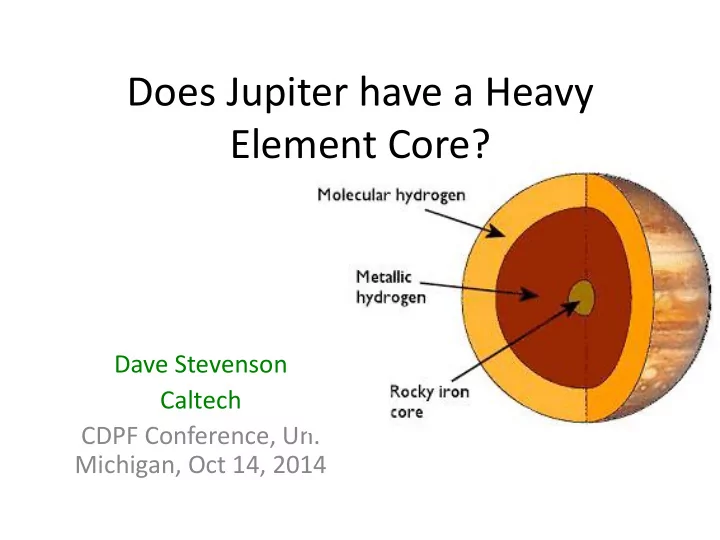
Does Jupiter have a Heavy Element Core? Dave Stevenson Caltech - - PowerPoint PPT Presentation

does jupiter have a heavy element core
SMART_READER_LITE
LIVE PREVIEW

Does Jupiter have a Heavy Element Core? Dave Stevenson Caltech - - PowerPoint PPT Presentation

Does Jupiter have a Heavy Element Core? Dave Stevenson Caltech CDPF Conference, Un. Michigan, Oct 14, 2014 or to state the question more precisely: Can we determine the mass or existence of Jupiters core even if we have perfect


slide-1
SLIDE 1

Does Jupiter have a Heavy Element Core?

Dave Stevenson Caltech CDPF Conference, Un. Michigan, Oct 14, 2014

slide-2
SLIDE 2

…or to state the question more precisely: Can we determine the mass or existence of Jupiter’s core even if we have perfect knowledge of the equation of state (EOS)

(The previously imperfect knowledge/ disagreements about the EOS is a major reason for different estimates, ranging from ~0 to ~15 Earth masses)

slide-3
SLIDE 3

Some Definitions

  • By “core” I mean a central concentration of

elements heavier that H and He

  • This core does not have to be solid (it probably is

not)

  • This core does not have to be rock & iron (it could

also contain ice)

  • This core need not have a sharp boundary (it

probably does not)- in this respect it is fundamentally different from earth’s core

  • This core could contain some H and He mixed into

it (and I will argue that it does)

slide-4
SLIDE 4

Why is this an Interesting Question?

  • Presence of core could tell us about the

formation process

– This was a major part of the justification for Juno, which will arrive at Jupiter on July 4, 2016. – Jupiter may define solar system architecture

  • Persistence of a core may tell us thermodynamics
  • f mixtures within Jupiter & the convective state

– Relevant to the heat flow – Possibly relevant to the dynamo

slide-5
SLIDE 5

Why might a Planet have a Core?

Bottom Up Accrete outer layer Top Down Differentiate

slide-6
SLIDE 6

Why might a Planet have a Core?

Bottom Up Accrete gas Top Down Differentiate Popular Giant Planet Picture Well established Terrestrial Planet Picture

slide-7
SLIDE 7

Small effect for Jupiter

slide-8
SLIDE 8

“Oh that this too too solid flesh would melt, Thaw and resolve itself into a dew!”

  • Shakespeare, Hamlet

Wilson & Militzer, 2011,2012

slide-9
SLIDE 9

Two Reasons Why the Core is not Sharply Defined

  • It was not sharply defined during accretion

because the accretion temperatures predict that incoming planetesimals will break up and dissolve in the planetary envelope

  • It is even less sharply defined because

convection will mix up material from the core during subsequent evolution

– Double diffusive convection (cf. Stevenson, 1985; LeConte and Chabrier, 2012)

slide-10
SLIDE 10

We would like to know the structure at early time (end of accretion) The structure we see now is not necessarily the same Smaller core Enriched envelope

slide-11
SLIDE 11

Core accretion model (“Standard” Case)

Pollack et al, 1996; Lissauer et al , 2009

Embryo formation (runaway) Embryo isolation Rapid gas accretion Truncated by gap formation

slide-12
SLIDE 12

"Just the place for a Snark! I have said it twice: That alone should encourage the crew. Just the place for a Snark! I have said it thrice: What I tell you three times is true.

  • Lewis Carroll
slide-13
SLIDE 13

Incoming planetesimals encounter enough gas to break up when the core is only ~1ME Atmospheric basal T is ~4000K when core is 1ME, sufficient to dissolve all the incoming material

slide-14
SLIDE 14

Density Radius STANDARD PICTURE ~10ME core

slide-15
SLIDE 15

Density Radius STANDARD PICTURE CORRECT PICTURE ~1ME of central concentration, the rest is somewhat dispersed. Total core of heavies is uncertain (but need not be 10ME)

slide-16
SLIDE 16
  • Energy of formation for 10ME is enough to

vaporize the ice and rock ten times over.

  • Energy is enough to raise internal T to

120,000K

  • Radiation into a vacuum creates a core

“surface” T of ~1200K for the Lissauer et al model.

– But it’s not a vacuum: Nebula gas ensures a T~GMμ/4kr (Radiative zero solution, Stevenson, 1982). This is ~15,000K at the “surface”(of the core) for H/He. – But there’s no surface! This T is well above vaporization (and critical T) for both ice & rock. This makes T even larger!

slide-17
SLIDE 17

A Likely Picture

  • Incoming planetesimals disrupt because of ram pressure
  • vercoming self-gravity (or strength). Occurs at P~0.1bar

(R/10km)2

  • Constituents sublime (ice higher up, rock deeper down). Only

very large bodies can go all the way.

  • Result is probably a stable molecular weight gradient , high

molecular weight at the base; T ~tens of thousands K.

  • Compositional gradient prevents direct convection but double

–diffusive convection is possible.

  • Much larger hydrogen addition as well as heavy elements.
slide-18
SLIDE 18
slide-19
SLIDE 19

Double-Diffusive Staircase

An example of thermohaline convection in Earth’s oceans The steps develop naturally and evolve over time so that transport of both heat and composition are much enhanced over pure molecular diffusion.

slide-20
SLIDE 20

Thermal Evolution

  • It seems that Lord Kelvin was right for Jupiter (but not for

earth or for the Sun)…we can understand the heat flow now simply by assuming a hot start. Timescale ~ heat content/luminosity. But even for Jupiter, one suspects this is somewhat fortuitous.

  • For Jupiter with a core, Egrav ≅ -0.75(1+2Mc/M)GM2/R (nearly

exact for n=1 polytrope)

  • Mixing up this core requires the equivalent of cooling the

planet by at least 1000K, mass averaged (probably much more) and so is unlikely

slide-21
SLIDE 21

R=radius Ro=radius for pure H-He MZ= total mass of heavies (core & envelope) α=C/MR2 ; αo =value fro pure H-He (≅0.262) Mc =core mass defined to be only the original enrichment of heavies!

n=1 polytrope (new results)

slide-22
SLIDE 22

0.2 0.4 0.6 0.8 1.0 0.5 1.0 1.5

K(z) K0(z)

Change in planet radius is remarkably insensitive to the distribution of heavy elements radius

slide-23
SLIDE 23

Gravity field Magnetic Field Water Abundance Nature and extent of heavy element enrichment in Jupiter’s core What happened when our planets formed?

slide-24
SLIDE 24

Conclusions

  • We will be able to tell whether Jupiter has a core and

even establish the mass of that core provided we define the core to be the excess of heavy elements

– Assumes good understanding of hydrogen equation of state

  • We will not be able to establish the nature of that core

with any confidence (i.e., the extent to which it is dispersed rather than concentrated) by “conventional” techniques (gravity moments)

– Unconventional includes tidal response, normal modes and perhaps magnetic field