Design Concepts July 26, 2005 Ehrenkrantz Eckstut & Kuhn - - PowerPoint PPT Presentation

design concepts
SMART_READER_LITE
LIVE PREVIEW

Design Concepts July 26, 2005 Ehrenkrantz Eckstut & Kuhn - - PowerPoint PPT Presentation

EE&K Architects GW- Foggy Bottom Campus and Neighborhood study Julyan & Julyan Design Concepts July 26, 2005 Ehrenkrantz Eckstut & Kuhn Architects Julyan & Julyan 1 EE&K Architects Presentation Outline Julyan &


slide-1
SLIDE 1

EE&K Architects Julyan & Julyan 1
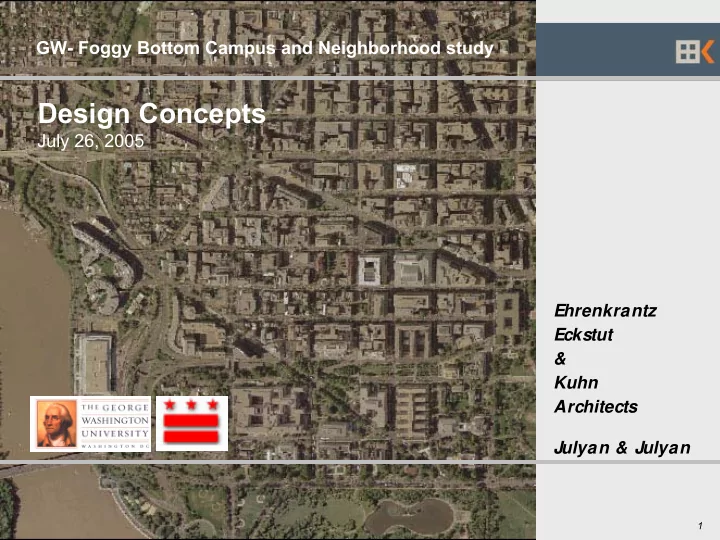
Design Concepts

July 26, 2005 GW- Foggy Bottom Campus and Neighborhood study

Ehrenkrantz Eckstut & Kuhn Architects Julyan & Julyan

slide-2
SLIDE 2

EE&K Architects Julyan & Julyan 2

Presentation Outline

  • OP’s Design Goals
  • Design concepts for campus and its relationship with Foggy Bottom/West End
  • GW Development Program
  • 5 Places:
  • Pennsylvania Avenue, “Washington Circle” and 23rd street
  • “College Walk” or H Street
  • G Street
  • F Street
  • “The Town Center”: Square 54 and I Street Retail Corridor
  • Summary
slide-3
SLIDE 3

EE&K Architects Julyan & Julyan 3

OP Goals: Review and Recap

  • Process – creating a transparent and accessible planning process that increases communication

between all stakeholders and addresses their concerns and issues

  • Planning coordination – maintaining an open and frank dialogue with all District and Federal

agencies to make sure that strategies for growth are consistent with other plans for the District

  • GW Development Program - Identifying a guide for growth that demonstrates that GW can

accommodate its projected academic, housing and administrative requirements within the existing campus boundary, including for each site projected square footage, massing and uses

  • Land Use – demonstrating use of current land use planning principles endorsed by the District,

such as protecting residential neighborhoods, Transit Oriented Development, and establishing a neighborhood town center and retail area in Foggy Bottom / West End

  • Environment - Ensuring that additional development in the Foggy Bottom/West End area will

maintain or improve existing acceptable levels of air quality

slide-4
SLIDE 4

EE&K Architects Julyan & Julyan 4

OP Goals : Review and Recap

  • Regulations and compliance – establishing a regulatory mechanism that guarantees the strategy

for growth will be adhered to

  • Design – incorporating exceptional design and sustainable practices (i.e. green buildings, LEED

certification, etc.) in all new construction

  • Historic Preservation – retaining historic resources in the District and incorporating them in plans

for new development

  • Open Space – increasing the amount of and access to open space that can be used by all District

residents

  • Community Benefits – enhancing access and amount of cultural and academic benefits, as well

as employment opportunities, available to residents of the District

slide-5
SLIDE 5

EE&K Architects Julyan & Julyan 5

Potomac Riverfront Kennedy Center Rock Creek Park National Mall White House Washington Circle

Open Space

Design Principle:

  • Planning and streetscape

design for the neighborhood to promote improved access to important places just outside the neighborhood, such as the Kennedy Center, Rock Creek Park and the Potomac Riverfront

slide-6
SLIDE 6

EE&K Architects Julyan & Julyan 6

Washington Circle Potomac River I Street Metro James Monroe Park Lafayette Park National Mall Farragut Square

Open Space

Design Principle: The Foggy Bottom/West End neighborhoods are enhanced by pedestrian pathways both within the neighborhoods and leading to green spaces and parks at the neighborhood perimeters

Pedestrian path between H & I Streets

Pathway thru Academic Center Washington Circle

slide-7
SLIDE 7

EE&K Architects Julyan & Julyan 7

Architectural Character

Design Principle:

  • Preserve and enhance contributing structures

with distinct and/or historic architectural character (e.g. Law School addition) to the greatest extent possible, and build new facilities that are compatible with the scale and character of the neighborhood (e.g. Townhouse Row)

Law School Addition from 20th & G Streets Townhouse row

slide-8
SLIDE 8

EE&K Architects Julyan & Julyan 8

Environment

San Mateo Library Conceptual “Green” section

Design Principle:

  • State-of-the-art sustainable architectural

design principles should be explored in the design and construction of all new building projects on the campus.

slide-9
SLIDE 9

EE&K Architects Julyan & Julyan 9

Environment

Design Principle:

  • Physical design and

programming promotes more pedestrian access and less reliance on the automobile

  • Promote alternate means of

transportation that reduces the need for car use

slide-10
SLIDE 10

EE&K Architects Julyan & Julyan 10

Design

Design Principle:

  • New projects maximize opportunities for “positive

surveillance” and reduce places where “unviewed” activities could occur

slide-11
SLIDE 11

EE&K Architects Julyan & Julyan 11

GW Development Program

  • Concept: 2.0 million GSF of

future growth for GW at identified sites

  • Academic uses include:

classrooms, labs, offices, support spaces and other university facilities Design Principle:

  • Accommodate GW

forecasted academic and housing space needs inside campus boundary

slide-12
SLIDE 12

EE&K Architects Julyan & Julyan 12

GW Development Program

Design Principle:

  • Emphasize GW identity in

areas where university uses are more intense

campus core

Concept:

  • New GW academic and

housing growth is within campus boundaries and concentrated in areas where university uses are more intense

slide-13
SLIDE 13

EE&K Architects Julyan & Julyan 13

GW Development Program campus core

Concept:

  • GW’s activities are

concentrated in areas where university uses are more intense

  • Branding becomes prominent

in areas where university uses are more intense

slide-14
SLIDE 14

EE&K Architects Julyan & Julyan 14

Potential Parking Sites

Concept:

  • Potential University parking

underground at Square 54

  • Parking underground at other

sites, with easy access to commuter routes Design Principles:

  • Parking structures are sized

throughout the campus to minimize impact on surrounding neighborhoods and provide convenient access to major commuting routes

slide-15
SLIDE 15

EE&K Architects Julyan & Julyan 15

Potential Parking Sites and Loading Entries

Design Principle:

  • Loading docks and entries to

parking garages are located and/or screened to minimize negative effects on existing residential streets Design Principle:

  • Vents are located to

minimize negative impact on public places and air quality in general

slide-16
SLIDE 16

EE&K Architects Julyan & Julyan 16

Branding and Identity

Concept:

  • “Branding” with special

lighting, signage, paving, materials, etc…

  • Toward the campus

boundaries, those elements become more consistent with standard city design Design Principle:

  • Effort to concentrate GW

branding in areas where university uses are more intense

slide-17
SLIDE 17

EE&K Architects Julyan & Julyan 17

Concept:

  • Comes in many forms; with

buildings, signage, statutes, busts, landscape, etc…

Branding and Identity

slide-18
SLIDE 18

EE&K Architects Julyan & Julyan 18

All potential Sites

Concept:

  • University future growth in

2,000,000 gsf of academic and residential uses (active uses)

  • Concentrate future university

development in areas where university uses are more intense

  • New student housing is

designed to minimize direct impact on existing private residential buildings

campus core

slide-19
SLIDE 19

EE&K Architects Julyan & Julyan 19

All potential Sites

Concept:

  • +/- 1,000 beds on a

combination of buildings on existing open sites and new construction where there are existing buildings

campus core

slide-20
SLIDE 20

EE&K Architects Julyan & Julyan 20

Places

Places:

  • Pennsylvania Avenue, “Washington Circle” and 23rd Street
  • “College Walk” or H Street
  • G Street
  • F Street
  • “The Town Center”: Square 54 and I Street Retail Corridor
slide-21
SLIDE 21

EE&K Architects Julyan & Julyan 21

F Street I Street G Street H Street P e n n . A v e .

5 Streets

Design Principle:

  • New buildings are designed

to complement the character

  • f the Foggy Bottom-West

End area and the GW Campus

G Street Character H Street Character F Street I Street Foggy Bottom Historic District

slide-22
SLIDE 22

EE&K Architects Julyan & Julyan 22

5 Streets

  • Make the new places

distinct from one another

  • Square 54 and I Street retail

corridor - the mixed use, town center

  • College Walk – Main Street
  • Campus street - the

alternative

  • Penn. Avenue & F Street

G Street

I Street Town Center College Walk Campus Street F Street G Street H Street P e n n . A v e .

slide-23
SLIDE 23

EE&K Architects Julyan & Julyan 23

5 Streets

Concept:

  • Develop diverse streets
  • Concentrate East / West

Streets for the pedestrian environment

  • Maintain North/South

streets for traffic movement Design Principle:

  • Five main streets provide

variety of character and use within the campus and along its boundaries

I Street F Street G Street H Street P e n n . A v e .

slide-24
SLIDE 24

EE&K Architects Julyan & Julyan 24

K Street New Hampshire Ave P e n n s y l v a n i a A v e n u e Washington Circle

Design Principle:

  • The approaches to

Washington Circle provide a safe environment with streets that are convenient and easy to cross

Short crossings at Dupont Circle Difficult access to Washington Circle

Concept:

  • Redesign Washington Circle
  • New design to include

ground-level uses, improved traffic flow, crosswalks and arrangement of the park itself

Pennsylvania Ave, Washington Circle and 23rd St.

slide-25
SLIDE 25

EE&K Architects Julyan & Julyan 25

K Street New Hampshire Ave P e n n s y l v a n i a A v e n u e Washington Circle

One Washington Circle Hotel View south on New Hampshire Avenue Washington Circle Seating Historic Facades

Concept:

  • Buildings are higher and

more dense

  • Office / retail / civic
  • “Part of the city”

23rd Street

Pennsylvania Ave, Washington Circle and 23rd St.

slide-26
SLIDE 26

EE&K Architects Julyan & Julyan 26

Special emphasis should be put in the use of:

  • Furniture
  • Landscape
  • Shading structures

Playing chess at Dupont Circle No gathering areas at Washington Circle The Fountain at the center of Dupont Circle concentrates visitors’ attention All benches at Washington Circle back to the monument in the center

Design Principles:

  • Washington Circle is

designed to accommodate a variety of individual and group activities

Pennsylvania Ave, Washington Circle and 23rd St.

slide-27
SLIDE 27

EE&K Architects Julyan & Julyan 27

Design Principle:

  • 23rd Street remains an

important vehicular street for the region yet could be supported by an improved pedestrian environment at Square 54 and the Metro station Concept:

  • Density is highest adjacent to

the Foggy Bottom Metro station along 23rd Street, Washington Circle and Pennsylvania Ave.

23RD Street and I, looking north

Square 54 Increased height Up to 130’ Increased height Up to 110’

Pennsylvania Ave

Pennsylvania Ave, Washington Circle and 23rd St.

slide-28
SLIDE 28

EE&K Architects Julyan & Julyan 28

Office & Retail

Pennsylvania Ave, Washington Circle and 23rd St.

  • Tall buildings up to 130’ on Pennsylvania Ave and Washington Circle, transition to up to

110’ down 23rd Street

  • Active ground levels
  • Improved crosswalks at Circle
  • Square 54 frontage and ground level design helps to define a new Washington Circle

Section line

slide-29
SLIDE 29

EE&K Architects Julyan & Julyan 29

H Street - College Walk

H Street Concept

  • Preferred location of future

academic facilities and some limited residential

  • Location of Marvin Center,

Library, Academic Center, Law School, Main campus uses

  • Future sites for continued

development of the academic center

H Street and 21st, NE corner H Street and 21st, NW corner

slide-30
SLIDE 30

EE&K Architects Julyan & Julyan 30

G Street

School Without Walls G Street Character

Quigley’s Pharmacy

G Street Concept

  • Future uses

both academic and residential

  • Retain architectural character
  • Include diverse scales and sizes
  • Combine residential and

academic

slide-31
SLIDE 31

EE&K Architects Julyan & Julyan 31

F Street

F Street and 21st Street F Street Aerial at 21st St (looking north)

F Street

F Street Concept:

  • Future use for residential

halls and some academic facilities

  • Buildings up to 90’
  • New student housing is

designed to minimize direct impact on existing private residential buildings

23rd 22nd 21st 20th

slide-32
SLIDE 32

EE&K Architects Julyan & Julyan 32

College Mews – Pathways & Linkages

  • Informal paths thru campus
  • Pedestrian only
  • Small scale spaces and

landscapes

  • Access to University

buildings

  • Intimate scale
  • Out of classroom learning
  • Quality landscape

Yale Courtyard Harvard Yard Harvard Internal Path Mizner Park, Florida

slide-33
SLIDE 33

EE&K Architects Julyan & Julyan 33

Town Center: Square 54 & I Street Retail Corridor

Design Principles:

  • The town center provides

variety in architecture, community-serving retail and activities

  • Designs for Square 54 and I

street promote an improved pedestrian environment on all sides

slide-34
SLIDE 34

EE&K Architects Julyan & Julyan 34

Square 54

Foggy Bottom Metro Station

I Street

Washington Circle Office + Retail Retail + Residential

Draft Design Principle:

  • Square 54 and Metro plaza

at 23rd and I Street make a new town center square that is supported by new neighborhood retail

Town Center: Square 54 & I Street Retail Corridor

Town Center

slide-35
SLIDE 35

EE&K Architects Julyan & Julyan 35

Town Center: Square 54 & I Street Retail Corridor

I Street Concept:

  • Transforms to become

extension of town center with new retail on both sides of the street as the university redevelops

  • Anchored at 2000 Penn and

the metro station

Town Center 2000 Penn Shops Hospital Ross

23rd 22nd 21st

slide-36
SLIDE 36

EE&K Architects Julyan & Julyan 36

  • Concentrate retail to make a

critical mass

  • Ground level of GW buildings

facing I Street have retail

P e n n . A v e . I Street 23rd Street Town Center Square 54

Town Center: Square 54 & I Street Retail Corridor

slide-37
SLIDE 37

EE&K Architects Julyan & Julyan 37

Town Center Square 54 I Street Retail Onassis Hall

Concept:

  • Square 54 and I Street Retail Corridor are the Town Center
  • Active and Passive Uses on the square
  • As University rebuilds along I Street, new retail is included at ground levels.

SECTION LINE 23rd Street Town Center I Street

Town Center: Square 54 & I Street Retail Corridor

slide-38
SLIDE 38

EE&K Architects Julyan & Julyan 38

Summary

  • University development and

most active uses concentrated in areas where university uses are more intense

  • Square 54 and I Street retail

add significant community benefits

  • Architectural character is

enhanced through distinct streets and places throughout campus and neighborhood

slide-39
SLIDE 39

EE&K Architects Julyan & Julyan 39

Summary

  • Open spaces improve Foggy

Bottom / West End pedestrian connectivity

  • University concentrates

image in areas where university uses are more intense

  • New buildings grow with

predictable height and density according to their location in the city neighborhood and the campus

slide-40
SLIDE 40

EE&K Architects Julyan & Julyan 40

Design Concepts

July 26, 2005 GW- Foggy Bottom Campus and Neighborhood study

Ehrenkrantz Eckstut & Kuhn Architects Julyan & Julyan