Description Logics in one example : TBox TEACHES . Course - - PowerPoint PPT Presentation

description logics in one example
SMART_READER_LITE
LIVE PREVIEW

Description Logics in one example : TBox TEACHES . Course - - PowerPoint PPT Presentation

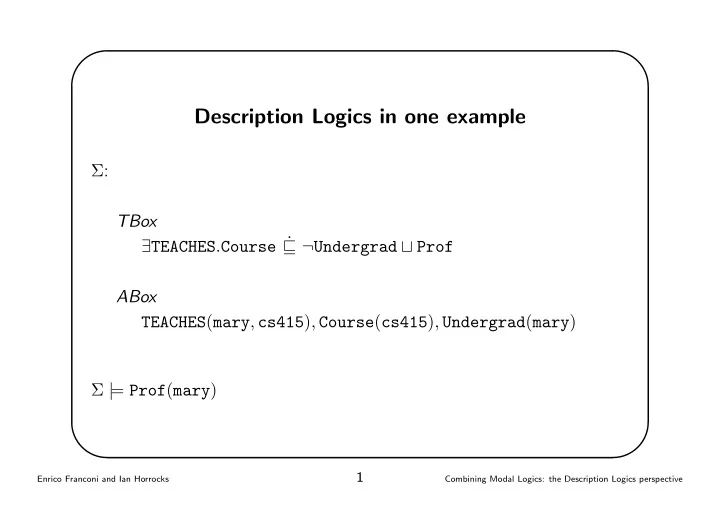
Description Logics in one example : TBox TEACHES . Course Undergrad Prof ABox TEACHES ( mary , cs415 ) , Course ( cs415 ) , Undergrad ( mary ) | = Prof ( mary ) 1 Enrico Franconi and Ian Horrocks


slide-1
SLIDE 1

✬ ✫ ✩ ✪

Description Logics in one example

Σ: TBox ∃TEACHES.Course ˙ ⊑ ¬Undergrad ⊔ Prof ABox TEACHES(mary, cs415), Course(cs415), Undergrad(mary) Σ | = Prof(mary)

Enrico Franconi and Ian Horrocks

1

Combining Modal Logics: the Description Logics perspective

slide-2
SLIDE 2

✬ ✫ ✩ ✪

Correspondence with Modal Logics

ALC K(m) CI

is a set of individuals

αI

C

is a set of worlds

RI

is a set of pairs of individuals

R is an accessibility relation A PA C ⊓ D αC ∧ αD C ⊔ D αC ∨ αD ¬C ¬αC ∀R.C

  • R αC

∃R.C ♦

R αC

  • ∈ CI

I, o | = αC ∃T.C _ ⊑ ¬U ⊔ P ♦TC → ¬U ∨ P U(m), T(m, c), C(c)

c m T {U} {C}

Σ | = P(m)

c m T {C} {U,P}

Enrico Franconi and Ian Horrocks

2

Combining Modal Logics: the Description Logics perspective

slide-3
SLIDE 3

✬ ✫ ✩ ✪

Combining Modal Logics in the Description Logics perspective

  • DLs extend modal logic in interesting ways:

– Reasoning in DLs is always reasoning with theories. – Nominals.

  • Studying the effects of augmenting the expressivity is central:

– adding operators cab be seen as combining modal logics with the basic K(m); – if the basic logic is expressive enough (e.g., PDL), possible reductions are studied; – more typical combinations are also important, such as combinations with tense logic or modal logic with concrete domains.

Enrico Franconi and Ian Horrocks

3

Combining Modal Logics: the Description Logics perspective

slide-4
SLIDE 4

✬ ✫ ✩ ✪

Combining Modal Logics vs Reductions

  • Combining the basic K(m) with a modal logic having:

– inverse, or graded, or deterministic modalities, . . .

  • Reducing a complex combination to the basic PDL:

– DCPDL to PDL, CPDL + nominals to PDL, . . .

  • The combination approach may be more interesting than the

reduction approach; example: – PDL versus KH

(m) ∪ S4,

– the combination can be seen as the FOL fragment of PDL, – same complexity class, – different algorithmic properties (cut rule).

Enrico Franconi and Ian Horrocks

4

Combining Modal Logics: the Description Logics perspective

slide-5
SLIDE 5

✬ ✫ ✩ ✪

Combining Modal Logics in the Description Logics perspective

  • Decidability,
  • complexity class,
  • (how to extend) algorithms,
  • (how to re-adapt) strategies and optimisations.

Enrico Franconi and Ian Horrocks

5

Combining Modal Logics: the Description Logics perspective

slide-6
SLIDE 6

Combining Modal Logics in the Description Logics perspective (Continued)

✬ ✫ ✩ ✪ Some examples of how combining modalities with different properties can affect:

  • Complexity class
  • Algorithmic complexity
  • Decidability

Enrico Franconi and Ian Horrocks

6

Combining Modal Logics: the Description Logics perspective

slide-7
SLIDE 7

Combining Modal Logics in the Description Logics perspective (Continued)

✬ ✫ ✩ ✪

  • Decision problems for KH

(m) and S4(m) known to be in PSpace

  • Combination allows use of universal modality to internalise arbitrary

set of axioms: – Define new transitive modality u that includes all other modalities – Satisfiability of φ w.r.t. ψ1 → ϕ1, . . . , ψn → ϕn equivalent to satisfiability of φ ∧ u((ψ1 → ϕ1) ∧ . . . ∧ (ψn → ϕn))

  • Decision problem w.r.t. arbitrary set of axioms known to be in

ExpTime even for K(m)

Enrico Franconi and Ian Horrocks

7

Combining Modal Logics: the Description Logics perspective

slide-8
SLIDE 8

Combining Modal Logics in the Description Logics perspective (Continued)

✬ ✫ ✩ ✪

  • Decision problem for KH

(m) ∪ S4(m) in ExpTime, but tableaux

algorithm presents no special problems: – For transitive modalities, propogate iφ terms along i modalities – Use simple blocking technique to check for cycles caused by e.g. i♦iφ – Cycle in algorithm ⇒ valid cyclical model

Enrico Franconi and Ian Horrocks

8

Combining Modal Logics: the Description Logics perspective

slide-9
SLIDE 9

Combining Modal Logics in the Description Logics perspective (Continued)

✬ ✫ ✩ ✪

  • Decision problem for KH

(m) combined with deterministic and

converse modalities still in PSpace and solvable with simple tableaux algorithm (no blocking)

  • Combination no longer has finite model property — requires new

blocking technique to detect cycles implying valid but non-finite models, e.g. for: ¬φ ∧ [R⌣]S⌣φ where R is transitive, S is deterministic and R includes S

Enrico Franconi and Ian Horrocks

9

Combining Modal Logics: the Description Logics perspective

slide-10
SLIDE 10

Combining Modal Logics in the Description Logics perspective (Continued)

✬ ✫ ✩ ✪

  • Decision problem for KH

(m) ∪ S4(m) in ExpTime

  • Decision problem for KH

(m) combined with graded modalities in

PSpace

  • Decision problem for KH

(m) ∪ S4(m) combined with graded

modalities is undecidable — shown by reduction of domino problem

  • Representing I

N × I N grid (the tricky bit) uses combination of H, transitive and non-transitive modalities and graded modalities

  • Decidability restored by restricting the way transitive and graded

modalities can be combined

Enrico Franconi and Ian Horrocks

10

Combining Modal Logics: the Description Logics perspective