
SLIDE 1
Deprojecting astronomical surveys
Brice Ménard
Johns Hopkins University Kavli IPMU, Tokyo University
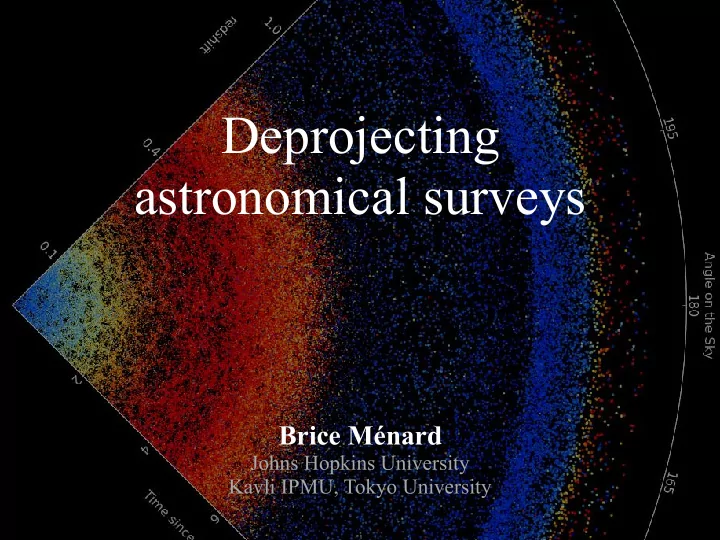
Deprojecting astronomical surveys Brice Mnard Johns Hopkins - - PowerPoint PPT Presentation
Deprojecting astronomical surveys Brice Mnard Johns Hopkins University Kavli IPMU, Tokyo University photometry 10 10 10 9 spectroscopy Number of 10 8 sources 10 7 10 6 10 5 10 4 time 2000 2005 2017 2025 2MASS SDSS Sumire Euclid
Johns Hopkins University Kavli IPMU, Tokyo University
105 106 107 108 109 1010 104
Number of sources time
2000 2MASS 2005 SDSS 2017 Sumire 2025 Euclid
photometry spectroscopy
F wavelength wavelength Spectroscopic redshift Photometric redshift
flux
wavelength
spectroscopy
F1 F2 F5 imaging F3 F4
wavelength
lookback time [billion years]
Mendez & Ménard
reduced photometric space brightness ra,dec size ellipticity … N~4 colors
main data product: pixel based working environment:
The photometric space
Dimensionality ~ 10-20
How much information goes into the catalogs?
DECaLS survey
PIs: Dey & Schlegel Visualization: D. Lang
PIs: Dey & Schlegel Visualization: D. Lang
DECaLS survey
PIs: Dey & Schlegel Visualization: D. Lang
Huge dimensionality reduction DECaLS survey
Photometric space
Dim ~ 10
redshift space
Dim = 1
p( z | photometry )
brightness ra,dec size ellipticity … N~4 colors
Mapping the photometric space to redshift space
redshift space
Dim = 1
Mapping the photometric space to redshift space
Photometric space
Dim ~ 10
brightness ra,dec size ellipticity … N~4 colors
Photometric Redshifts
p( z | colors, SED templates )
redshift space
Dim = 1
Mapping the photometric space to redshift space
Photometric space
Dim ~ 10
brightness ra,dec size ellipticity … N~4 colors
Photometric Redshifts
p( z | colors, SED templates )
Hildebrandt et al.
redshift space
Dim = 1
Mapping the photometric space to redshift space
Clustering Redshifts
p( z | photometry, density field )
Photometric space
Dim ~ 10
brightness ra,dec size ellipticity … N~4 colors
Photometric Redshifts
p( z | colors, SED templates )
fingerprint minutiae
Galton (1892)
Probability for two different fingerprints to match ~ 1/68 billion
We can locate the unknown sample through a series of angular cross-correlations with a reference, spectroscopic sample
redshift redshift b(z) dN/dz
Applications of clustering redshifts
~100 million galaxies at
spectroscopic galaxy sample r < 18 mag 1 million objects
x ∆z
2MASS near infrared SDSS
WISE infrared Planck millimetric
Rahman, BM et al. (2015)
Rahman, BM et al. (2015)
sample 1: 0.5 < g-r < 0.6 sample 2: 1.3 < g-i < 1.4 sample 3: 1.2 < g-r < 1.3 ~ 6,300 galaxies ~ 10,000 galaxies ~ 2,500 galaxies
= 1
Photometrically-selected galaxies
Rahman, BM et al. (2015)
Rahman, BM et al. (2015)
= 1
Generalization to one million galaxies
40
Rahman, BM et al. (2015)
Generalization to one million galaxies
SDSS KD-tree photometric redshifts
sample 2 sample 3
Rahman, BM et al. (2015)
Applications of clustering redshifts
~100 million galaxies at
x ∆z
Entire photometric sample r < 22 mag 100 million objects
2MASS near infrared SDSS
WISE infrared Planck millimetric
sample 1: 0.53 < r-i < 0.54 sample 3: 0.90 < r-i < 0.92 1.6 million galaxies
Photometrically-selected galaxies
Rahman et al. (2015)
sample 3: 0.60 < r-i < 0.62 1.2 million galaxies 0.2 million galaxies
color clustering redshift
clustering redshift color
Redshift distribution of 100 million SDSS galaxies
Applications of clustering redshifts 2MASS K < 14 mag 1.5 million extended sources 470 million point sources J H K
λ [µm]
1.0 1.5 2.0 2.5
2MASS near infrared SDSS
WISE infrared Planck millimetric
Observations: 1997-2001, J, H & K bands
Skrutskie et al. (2006)
mean cluster-z
extended extended sources
extended point sources
Applications of clustering redshifts PSF ~ 6 arcsec mostly point sources W1(3 µm) < 16 mag millions of objects
2MASS near infrared SDSS
WISE infrared Planck millimetric
Full sky survey 500,000,000 sources:
Wright et al.
Clustering redshifts as a function of color: W1-W2 > preliminary (Alex Mendez, Donghui Jeong)
clustering redshift W1 - W2
Applications of clustering redshifts PSF ~ 6 arcsec mostly point sources W1(3 µm) < 16 mag millions of objects
2MASS near infrared SDSS
WISE infrared Planck millimetric
Schmidt, Ménard et al. (2014)
Planck CMB - SMICA map cross-correlation signal redshift
Schmidt, Ménard et al. (2014)
Planck CO map J=0-1 cross-correlation signal redshift
Schmidt, Ménard et al. (2014)
Planck dust opacity map cross-correlation signal redshift
SDSS
2MASS near infrared WISE infrared Planck millimetric
redshift 1 2 3 4 5
UV (GALEX), radio (FIRST, NVSS, …), Gamma rays (Fermi), … as well as combinations of datasets
Clustering redshifts
We have a new tool in hand to estimate the redshifts of photometric sources
redshift Photometric space Photo-z
Cluster-z
summary
We do not have to rely on source colors to estimate redshifts. We now have two independent estimation techniques.
Clustering redshifts
We have a new tool in hand to estimate the redshifts of photometric sources
redshift Photometric space Photo-z
Cluster-z
summary
color color color color cluster-z
We can now “deproject” any photometric dataset, at any wavelength.