Deposition Techniques and Strategies: p q g Beyond the Basics - - PowerPoint PPT Presentation

deposition techniques and strategies p q g beyond the
SMART_READER_LITE
LIVE PREVIEW

Deposition Techniques and Strategies: p q g Beyond the Basics - - PowerPoint PPT Presentation

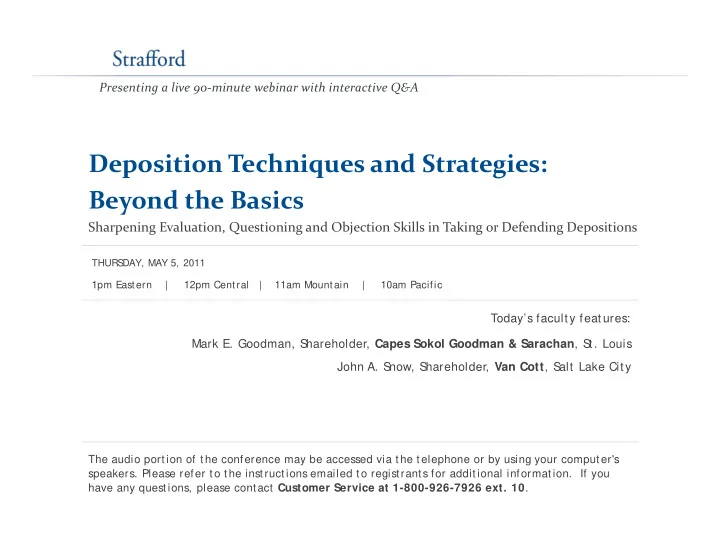
Presenting a live 90 minute webinar with interactive Q&A Deposition Techniques and Strategies: p q g Beyond the Basics Sharpening Evaluation, Questioning and Objection Skills in Taking or Defending Depositions THURS DAY, MAY 5, 2011


slide-1
SLIDE 1

Presenting a live 90‐minute webinar with interactive Q&A

Deposition Techniques and Strategies: p q g Beyond the Basics

Sharpening Evaluation, Questioning and Objection Skills in Taking or Defending Depositions

T d ’ f l f

1pm Eastern | 12pm Central | 11am Mountain | 10am Pacific THURS DAY, MAY 5, 2011

Today’s faculty features: Mark E. Goodman, S hareholder, Capes Sokol Goodman & Sarachan, S

  • t. Louis

John A. S now, S hareholder, Van Cott, S alt Lake City

The audio portion of the conference may be accessed via the telephone or by using your computer's

  • speakers. Please refer to the instructions emailed to registrants for additional information. If you

have any questions, please contact Customer Service at 1-800-926-7926 ext. 10.

slide-2
SLIDE 2

Conference Materials

If you have not printed the conference materials for this program, please complete the following steps:

  • Click on the + sign next to “ Conference Materials” in the middle of the left-

hand column on your screen hand column on your screen.

  • Click on the tab labeled “ Handouts” that appears, and there you will see a

PDF of the slides for today's program.

  • Double click on the PDF and a separate page will open.

Double click on the PDF and a separate page will open.

  • Print the slides by clicking on the printer icon.
slide-3
SLIDE 3

Continuing Education Credits

FOR LIVE EVENT ONLY

For CLE purposes, please let us know how many people are listening at your location by completing each of the following steps:

  • Close the notification box
  • In the chat box, type (1) your company name and (2) the number of

attendees at your location

  • Click the blue icon beside the box to send
slide-4
SLIDE 4

Tips for Optimal Quality

S d Q lit S

  • und Quality

If you are listening via your computer speakers, please note that the quality of your sound will vary depending on the speed and quality of your internet connection. If the sound quality is not satisfactory and you are listening via your computer speakers, you may listen via the phone: dial 1-866-258-2056 and enter your PIN when prompted Otherwise please send us a chat or e mail when prompted. Otherwise, please send us a chat or e-mail sound@ straffordpub.com immediately so we can address the problem. If you dialed in and have any difficulties during the call, press *0 for assistance.

Viewing Qualit y

To maximize your screen, press the F11 key on your keyboard. To exit full screen, press the F11 key again press the F11 key again.

slide-5
SLIDE 5

Deposition Techniques and Strategies, Beyond the Basics

Mark E. Goodman

Capes, Sokol, Goodman & Sarachan, PC

  • St. Louis, Missouri

(314) 721‐7701 goodman@capessokol.com

5

slide-6
SLIDE 6

PREPARING FOR DEPOSITIONS

6

slide-7
SLIDE 7

Developing a Discovery Strategy Developing a Discovery Strategy

  • Think of this stage as the creation of a plan

Think of this stage as the creation of a plan which is “theory” based.

  • Consider the elements of the cause of action
  • Consider the elements of the cause of action

pleaded. C d f b i i d

  • Create a road map for obtaining documents

and “staging” depositions.

7

slide-8
SLIDE 8

Order of Depositions can be crucial d h ld b “ d” d d and should be “mapped” and staged.

Some examples: Some examples: di l li

  • Medical Negligence
  • Complex business cases
  • Piercing the Corporate Veil

8

slide-9
SLIDE 9

Be prepared to set aside conventional d h k f h b wisdom: think out of the box!

  • Mix it up

Mix it up k i l i “ f h i ”

  • Take a potential witness “out of their”

game(s).

  • The cardinal rule: The deposition is not about

p you…be prepared to be a good listener.

9

slide-10
SLIDE 10

Be Ready for Plan B Be Ready for Plan B

  • The best laid plans

The best laid plans . . . ’ f ll i b i “ illf ll li d ”

  • Don’t fall into being “Willfully Blind.”
  • Be prepared for that which makes us

uncomfortable and unsettles.

10

slide-11
SLIDE 11

Determining Whether or not to take a Deposition

  • To preserve or not to preserve – just one

To preserve or not to preserve just one question.

  • The education of your opponent: pros and

cons.

11

slide-12
SLIDE 12

The Financial Dynamic in Today’s l Climate

  • Necessity vs Luxury

Necessity vs. Luxury C d d C i

  • Case Management and Budgetary Constraints

– Contingency Cases – Corporate and insurance coverage litigation guidelines.

12

slide-13
SLIDE 13

Strategy Thought: Strategy Thought:

When we confront facts and fears we When we confront facts and fears, we achieve real power and unleash our it f h capacity for change.

13

slide-14
SLIDE 14

Preparing for the Personality Dynamics h d l – the Witness and Opposing Counsel

  • Be smart

Be smart.

  • Be competent.
  • Be nice.

14

slide-15
SLIDE 15

If the goal is to truly discover facts, an h f f h b f d atmosphere of free exchange must be fostered.

  • Employ Psychology 101: If one is attacked he

Employ Psychology 101: If one is attacked, he

  • r she will default to defensiveness.
  • Do some investigation about a witness.

– Lay witnesses – Experts – usually have track records.

  • Find out about opposing counsel.

pp g

15

slide-16
SLIDE 16

Conclusion: Personality Dynamics can be Conclusion: Personality Dynamics can be the most difficult thing to prepare for, so b d f th t d be prepared for the unexpected.

  • Review strategies to overcome adverse

dynamics – remind yourself of the purpose of the Deposition.

  • Be prepared to use the Rules to keep control.

16

slide-17
SLIDE 17

Preparing the Witness Preparing the Witness

Lay v Expert: Obvious Differences Lay v. Expert: Obvious Differences

17

slide-18
SLIDE 18

Preparation of Lay Witnesses Preparation of Lay Witnesses

  • Explanation of Purpose/Pitfalls

Explanation of Purpose/Pitfalls

  • Explanation of Mechanics

i f l d

  • Review of relevant documents
  • Review of discovery and case status
  • Focus on “trouble” areas
  • Psychological preparation: establish a comfort

Psychological preparation: establish a comfort level – avoid pressure.

18

slide-19
SLIDE 19

Preparation of Lay Witnesses Preparation of Lay Witnesses

Rehearsal: Pros and Cons Rehearsal: Pros and Cons C l i C f d i i Conclusion: Comfort and Preparation is a winning combination.

19

slide-20
SLIDE 20

Preparation of Expert Witnesses Preparation of Expert Witnesses

  • Investigation of former testimony

Investigation of former testimony (land mines?) i

  • Face‐to‐Face meeting
  • Discussion of case theory
  • Discussion of adverse case theory
  • Familiarize with documentary evidence

Familiarize with documentary evidence.

  • Familiarize with prior Depositions.

20

slide-21
SLIDE 21

Preparation of Expert Witness ( l ) (Conclusion)

Just because they “know the game ” don’t Just because they know the game, don t assume they can carry the ball across the l li ith t ti goal line without preparation.

21

slide-22
SLIDE 22

CONDUCTING THE CONDUCTING THE CONDUCTING THE CONDUCTING THE DEPOSITION DEPOSITION

22

slide-23
SLIDE 23

John A Snow John A. Snow Van Cott, Bagley, Cornwall & McCarthy S lt L k Cit Ut h Salt Lake City, Utah (801) 237-0204 j @ tt jsnow@vancott.com

23

slide-24
SLIDE 24

Objectives/Style Objectives/Style: Objectives/Style Objectives/Style:

Discovering facts and opinions known or held by the opponent and third parties third parties

Evaluating credibility, appearance, competence, personality

Obtaining concessions and admissions from the witness that support matters favorable to the case atte s a o ab e to t e case

Obtaining potential direct testimony of an adverse party

Preserving testimony for trial

Obtaining information which can be used for impeachment

Revealing parts of your case for settlement purposes

Establishing facts known within an entity by use of a Rule 30(b)(6) deposition Establishing the universe of information known or unknown by the

Establishing the universe of information known or unknown by the witness

Laying the foundation for documents or other evidence

Discovering or excluding contradictory evidence g g y

Potential Motions

24

slide-25
SLIDE 25

Style of questioning depends in significant Style of questioning depends in significant part on the purpose or objective of the deposition and personality of those deposition, and personality of those present.

25

slide-26
SLIDE 26

Usable Questioning Usable Questioning: Usable Questioning Usable Questioning:

 A deposition can become unusable for purposes

p p p

  • f trial if the questions become too complicated
  • r meandering.

 For purpose of using a deposition for either  For purpose of using a deposition for either

direct testimony or impeachment, questions which are short and uncomplicated are easier for the jury to follow and understand the jury to follow and understand.

 Leading question on matters that will be used at

trial is an effective way of questioning a witness l

  • n trial points.

 Use documents when available to

“coach/control” a difficult witness coach/control a difficult witness

26

slide-27
SLIDE 27

Usable Responses Usable Responses: Usable Responses Usable Responses: :

 A deposition can become unusable for purposes of trial if the

ti b t li t d d i questions become too complicated or meandering.

 When the witnesses gives long, convoluted or complex

answers:

 Allow the information to be given by the witness  Allow the information to be given by the witness  Return to the substance of the answer and dissect it with simple

questions

 A usable answer does not always need to be “yes” or “no.”

A usable answer does not always need to be yes or no.

 Listen to the answer and reflect on how it will sound to a trier

  • f fact.

 Every question does not need to be asked and every

y q y argument does not need to be made. Remember: Questions are revealing

27

slide-28
SLIDE 28

Listen Listen: Listen Listen: :

 Frequently a witness will volunteer information

q y that needs to be clarified.

 A witness’ answer is ambiguous and needs to be

clarified clarified.

 Make sure an answer to a question is made;

witnesses do respond with statements that they d t b ti t b t i f t deem to be pertinent, but are in fact nonresponsive. Be fluid and prepared to pursue pertinent Be fluid and prepared to pursue pertinent information provided by the witness, even if it was not requested by the question.

28

slide-29
SLIDE 29

Exhibits Exhibits: Exhibits Exhibits: :

 When using exhibits in a deposition, clearly

g p , y identify the document.

 Re-identify the exhibit: an answer about a

document that is identified several pages earlier document that is identified several pages earlier in a deposition is difficult to clearly present to the jury. C t l f diffi lt it

 Control of a difficult witness.  Refresh recollection – even if not a witness

document. document.

 Consider the use of exhibit if the witness does

not attend trial.

29

slide-30
SLIDE 30

Points for Conducting the Deposition Points for Conducting the Deposition: Points for Conducting the Deposition Points for Conducting the Deposition:

 Strategy of Questioning - Purpose  Strategy of Questioning

Purpose

 Form of Questions - Leading/Open-

ended, ambiguity ended, ambiguity

 Form of Answer - Complete/ambiguous  Questions not asked  Questions not asked  Order of Questions

Identifi tion nd U e of E hibit

 Identification and Use of Exhibits  Listen

30

slide-31
SLIDE 31

DEFENDING THE DEPOSTIONS DEFENDING THE DEPOSTIONS

31

slide-32
SLIDE 32

Preparation Preparation

Restatement (Third) Of The Law Governing Lawyers §176, comment (b): Restatement (Third) Of The Law Governing Lawyers §176, comment (b):

Ascertaining and discussing the witness's recollection and the probable facts.

Discussing probable lines of hostile cross-examination the witness should be prepared to meet. prepared to meet.

Rehearsing the witness's testimony.

Discussing a witness's prior testimony to refresh the witness's recollection.

Discussing and revealing the testimony of other witnesses and asking the witness to reconsider his or her recollection of events in that light (except witness to reconsider his or her recollection of events in that light (except when the rule on exclusion has been invoked during a hearing or trial).

Suggesting a choice of words solely to clarify a witness's testimony (but not to change substantive testimony or to cause the witness to testify falsely regarding a material fact). regarding a material fact).

Informing the witness regarding applicable law and its relation to the events at issue (but not for the purpose of inducing a witness to misrepresent the facts).

Discussing the possible inclusion of testimony regarding factual matters not

Discussing the possible inclusion of testimony regarding factual matters not initially mentioned by the witness, but only if the witness has an actual recollection regarding the matter.

Inviting the witness to provide truthful testimony that may be favorable to the lawyer's client. y

Reviewing with the witness the factual context into which the witness's testimony will fit.

Discussing courtroom or deposition demeanor and procedure.

32

slide-33
SLIDE 33

Ethical Preparation Ethical Preparation: :

Rule 4.1 of the Model Rules Of Professional Conduct:

 In the course of representing a client a lawyer shall not knowingly:

(a) make a false statement of material fact or law to a third person; (a) make a false statement of material fact or law to a third person;

  • r

(b) fail to disclose a material fact to a third person when disclosure is necessary to avoid assisting a criminal or fraudulent act by a client, unless disclosure is prohibited by Rule 1.6. client, unless disclosure is prohibited by Rule 1.6.

Rule 4.2 of the Model Rules Of Professional Conduct:

 In representing a client, a lawyer shall not communicate about the

subject of the representation with a party the lawyer knows to be represented by another lawyer in the matter unless the lawyer has represented by another lawyer in the matter, unless the lawyer has the consent of the other lawyer or is authorized by law to do so.

Rule 4.3 of the Model Rules Of Professional Conduct

 In dealing on behalf of a client with a person who is not

t d b l l h ll t t t i l th t th represented by counsel, a lawyer shall not state or imply that the lawyer is disinterested. When the lawyer knows or reasonably should know that the unrepresented person misunderstands the lawyer's role in the matter, the lawyer shall make reasonable efforts to correct the misunderstanding to correct the misunderstanding.

33

slide-34
SLIDE 34

Defending Your Witness Defending Your Witness Defending Your Witness Defending Your Witness

 Review with the facts of the case

 Review both your own and opposition discovery

responses

 Know the factual and legal issues that will be  Know the factual and legal issues that will be

addressed

 Extent of refreshing recollection

R i th t ti l hibit

 Review the potential exhibits  Potential for Impeachment  Privilege and Waiver  Privilege and Waiver  Instructing a witness not to answer a question

 Seeking Court Intervention

 Potential Motions

34

slide-35
SLIDE 35

Witness “Rules” Witness “Rules”: Witness Rules Witness Rules : :

  • 1. “Be yourself”
  • 2. Dress appropriately

3.

Be polite

4.

Posture and body language S k

5.

Speak up

6.

Don't argue or be an advocate

7.

Wait for the entire question before answering A l th ti th it l i t th i ht

8.

Answer only the question; the witness can explain at the right time

9.

Never answer a question with a question

10

A witness may ask counsel to rephrase a question Never

10.

A witness may ask counsel to rephrase a question. Never answer a question that is not understood

11.

Always review a document or exhibit before answering questions about it – But documents can be wrong

35

slide-36
SLIDE 36

Witness “Rules” (Continued) Witness “Rules” (Continued): Witness Rules (Continued) Witness Rules (Continued): :

  • 12. Remain firm unless convinced to the contrary.

13.

Avoid equivocal and pompous language.

14.

"I don't know" can be appropriate - "I don't know" is different from "I don't remember.“

15.

Be honest; tell the whole truth within the parameters

  • f the question.

16.

Listen to objections.

16.

Listen to objections.

17.

Do not adopt the language of the examiner asking leading questions.

18

The witness is not there to explain/help unless asked -

18.

The witness is not there to explain/help unless asked

  • Do not explain any of your answers unless requested

to do so.

19.

A deposition is not a conversation.

19.

A deposition is not a conversation.

36

slide-37
SLIDE 37

Attorney “Rules” Attorney “Rules”: Attorney Rules Attorney Rules : :

 Do not embarrass the witness  Do not embarrass the witness  Do not be condescending to the witness

D t “i t t” th it

 Do not “instruct” the witness  Do not raise your voice at the witness  Avoid unnecessary tension  Provide assurances to the witness  Provide assurances to the witness

37

slide-38
SLIDE 38

Instructions by Opposing Counsel Instructions by Opposing Counsel: Instructions by Opposing Counsel Instructions by Opposing Counsel: :

 Such as:

 Be certain you answer each question I ask you because if your

answer is not responsive, I will ask that question again.

 If you need to expand any answer feel free to do so.  If you should wish to add anything feel free to do so  If you should wish to add anything, feel free to do so.  If you need to explain an answer, feel free to do so.  If you don't know an answer say so, but I will assume that if you

answer my question, you understood it as I asked it. y q , y

 Do not concern yourself with the objections

 Inform the witness that the instruction will be given, but

witness is to proceed as instructed in preparation, and p p p , not as instructed by the opposing attorney.

 Counsel also can/should note that the instructions are

unfair, not contemplated by the Rules.

38

slide-39
SLIDE 39

Objections Objections

Rule 30(c) Examination and Cross-Examination; Record of the Examination; Objections; Written Questions.

(1) Examination and Cross-Examination. The examination and cross- examination of a deponent proceed as they would at trial under the Federal p p y Rules of Evidence, except Rules 103 and 615. After putting the deponent under oath or affirmation, the officer must record the testimony by the method designated under Rule 30(b)(3)(A). The testimony must be recorded by the officer personally or by a person acting in the presence and under the direction of the officer under the direction of the officer.

(2) Objections. An objection at the time of the examination--whether to evidence, to a party's conduct, to the officer's qualifications, to the manner

  • f taking the deposition, or to any other aspect of the deposition--must be

noted on the record but the examination still proceeds; the testimony is noted on the record, but the examination still proceeds; the testimony is taken subject to any objection. An objection must be stated concisely in a nonargumentative and nonsuggestive manner. A person may instruct a deponent not to answer only when necessary to preserve a privilege, to enforce a limitation ordered by the court, or to present a motion under Rule 30(d)(3) 30(d)(3). ....

(d) Duration; Sanction; Motion to Terminate or Limit.

(2) Sanction. The court may impose an appropriate sanction--including h bl d ' f i d b the reasonable expenses and attorney's fees incurred by any party--on a person who impedes, delays, or frustrates the fair examination of the deponent.

39

slide-40
SLIDE 40

Waiver of Objections Waiver of Objections

(d) Waiver of Objections. (1) T h N i A bj i i l i i

(1) To the Notice. An objection to an error or irregularity in a deposition notice is waived unless promptly served in writing on the party giving the notice.

(2) To the Officer's Qualification. An objection based on ( )

  • t e O

ce s Qua cat o

  • bject o

based o disqualification of the officer before whom a deposition is to be taken is waived if not made:

(A) before the deposition begins; or (B) promptly after the basis for disqualification becomes known

(B) promptly after the basis for disqualification becomes known

  • r, with reasonable diligence, could have been known.

(3) To the Taking of the Deposition.

(A) Objection to Competence, Relevance, or Materiality. An ( ) j p , , y

  • bjection to a deponent's competence--or to the competence,

relevance, or materiality of testimony--is not waived by a failure to make the objection before or during the deposition, unless the ground for it might have been corrected at that time. g g

40

slide-41
SLIDE 41

Waiver of Objections (Continued) Waiver of Objections (Continued)

(B) Objection to an Error or Irregularity. An objection to an error or irregularity at an oral examination is waived if: (i) it l t t th f t ki th d iti th

(i) it relates to the manner of taking the deposition, the form of a question or answer, the oath or affirmation, a party's conduct, or other matters that might have been corrected at that time; and

(ii) it is not timely made during the deposition.

(C) Objection to a Written Question. An objection to the form of a written question under Rule 31 is waived if not served in writing on the party submitting the question within the time in writing on the party submitting the question within the time for serving responsive questions or, if the question is a recross- question, within 7 days after being served with it.

(4) To Completing and Returning the Deposition. An objection ( ) p g g p j to how the officer transcribed the testimony--or prepared, signed, certified, sealed, endorsed, sent, or otherwise dealt with the deposition--is waived unless a motion to suppress is made promptly after the error or irregularity becomes known or, with promptly after the error or irregularity becomes known or, with reasonable diligence, could have been known.

41

slide-42
SLIDE 42

 If a question is “leading ” the grounds for  If a question is leading, the grounds for

the objection can be easily cured or

  • bviated and the objection is waived if
  • bviated, and the objection is waived if

not made. Assoc. Bus. Tel. Sys. Corp. v. Greater Capital Corp 729 F Supp 1488 Greater Capital Corp., 729 F. Supp. 1488, 1500 (D.N.J. 1990); Roy v. Austin Co., 194 F 3d 840 844 (7th Cir 1999) 194 F.3d 840, 844, (7th Cir., 1999) (leading objection must be made);

42

slide-43
SLIDE 43

 Argumentative objections are also curable  Argumentative objections are also curable

and are waived if not made. Bahamas Agricultural Industries Ltd v Riley Stoker Agricultural Industries, Ltd v. Riley Stoker Corp., 526 F.2d 1174, 1180 (6th Cir. 1975) (argumentative objection waived if 1975) (argumentative objection waived if not asserted at the deposition).

43

slide-44
SLIDE 44

 Presumably irrelevant evidence cannot be  Presumably irrelevant evidence cannot be

“cured” to become relevant, and the failure to make the objection on relevancy failure to make the objection on relevancy grounds would not be a waiver. United States v Irvin 127 F R D 169 170 n 2 States v. Irvin, 127 F.R.D. 169, 170 n.2 (C.D. Cal. 1989) (relevancy objection not waived); but see Kirschner v Braodhead waived); but see Kirschner v. Braodhead, 671 F.2d 1034, 1038 (7th Cir. 1982) (relevancy objection waived) (relevancy objection waived).

44

slide-45
SLIDE 45

“C t ” bj ti i t b i d if t

 “Competency” objections is not be waived if not

made during the objection. Cronkrite v. Fahrbach, 853 F. Supp. 257, 259-60, 262 (W.D. Fahrbach, 853 F. Supp. 257, 259 60, 262 (W.D.

  • Mich. 1994) (medical expert); Osborne v.

Wenger, 572 N.E.2d 1343 (Ind. App. 1991)(medical expert) The courts seem to 1991)(medical expert). The courts seem to generally support the position that objections based upon relevancy and competency are p y p y reserved without an objection made at the

  • deposition. Hall v. Clifton Precision, 150 F.R.D.

525 528 n 3 (E D Pa 1993); Thomas v 525, 528 n.3 (E.D. Pa. 1993); Thomas v. Hoffmann-LaRoache, Inc., 126 F.R.D. 522, 523- 24 & n.1 (N.D. Miss. 1989).

45

slide-46
SLIDE 46

 A non-responsive objection is waived if  A non responsive objection is waived if

not made. Kirschner v. Braodhead, 671 F 2d 1034 1038 (7th Cir 1982) F.2d 1034, 1038 (7th Cir. 1982).

46

slide-47
SLIDE 47

Control Control: :

If the opposing attorney is interrupting the depositions with unnecessary objections, making “speaking objection,” giving instructions to the witness, or otherwise acting in a manner that is disruptive to the process, or, if an examiner is acting disruptive to the process, or, if an examiner is acting inappropriately, there are a few actions that can be taken:

 Make a record before taking any action, such as allow the

attorney some opportunity to establish that he or she is in fact disruptive and otherwise acting inappropriately disruptive and otherwise acting inappropriately

 Ignore the disruptions if in fact the quality of the deposition will

not be compromised

 Provide notice that intervention from the court will be sought  If appropriate, use some humor  Avoid unnecessary argument over the quality of the objections

  • r questions, but make a record

Video tape the depositions

 Video tape the depositions  Aggressive response  Court Intervention  Breaks in the depositions  Breaks in the depositions  Assurances to the witnesses

47

slide-48
SLIDE 48

Attorney Attorney-

  • Client Privilege

Client Privilege

United States Supreme Court Standard 503:

(a)-- Definitions--As used in this rule: (1) A ''client'' is a person public officer or corporation association or (1)-- A ''client'' is a person, public officer, or corporation, association, or

  • ther organization or entity, either public or private, who is rendered

professional legal services by a lawyer, or who consults a lawyer with a view to obtaining professional legal services from him. (2)-- A ''lawyer'' is a person authorized, or reasonably believed by the client to be authorized, to practice law in any state or nation. (3)-- A ''representative of the lawyer'' is one employed to assist the lawyer i th diti f f i l l l i in the rendition of professional legal services. (4)-- A communication is ''confidential'' if not intended to be disclosed to third persons other than those to whom disclosure is in furtherance of the rendition of professional legal services to the client or those reasonably rendition of professional legal services to the client or those reasonably necessary for the transmission of the communication.

48

slide-49
SLIDE 49

Attorney Attorney-

  • Client Privilege (Continued)

Client Privilege (Continued)

(b)-- General rule of privilege.--A client has a privilege to refuse to disclose and to prevent any other person from disclosing confidential communications made for the purpose of facilitating the diti f f i l l l i t th li t (1) b t rendition of professional legal services to the client, (1) between himself or his representative and his lawyer or his lawyer's representative, or (2) between his lawyer and the lawyer's representative, or (3) by him or his lawyer to a lawyer representing th i tt f i t t (4) b t another in a matter of common interest, or (4) between representatives of the client or between the client and a representative of the client, or (5) between lawyers representing the client. (c)-- Who may claim the privilege.--The privilege may be claimed by the client, his guardian or conservator, the personal representative

  • f a deceased client, or the successor, trustee, or similar

t ti f ti i ti th i ti representative of a corporation, association, or other organization, whether or not in existence. The person who was the lawyer at the time of the communication may claim the privilege but only on behalf of the client. His authority to do so is presumed in the absence of e idence to the cont a absence of evidence to the contrary.

49

slide-50
SLIDE 50

Using Deposition Testimony Using Deposition Testimony

  • Take Inventory

Take Inventory h G d h d d h l

  • The Good, The Bad and The Ugly
  • Review with Lay and Expert Witnesses

50

slide-51
SLIDE 51

Post‐Deposition Strategies Post Deposition Strategies

  • Theming the case

Theming the case d l di d i i l

  • Reduce Pleadings and Discovery to Logical

Anchors

  • View Discovery from 30,000 Feet

y ,

51

slide-52
SLIDE 52

Consider the Use of Focus Groups after l Discovery is Complete

  • Concept Focus Groups – Pros and Cons

Concept Focus Groups Pros and Cons k i l / i i

  • Mock Trials/Variations

– Use of deposition testimony – Videotape depositions

52

slide-53
SLIDE 53

Depositions for Use in the Formulation f

  • f Motions in Limine
  • Inclusion of Transcript Portions

Inclusion of Transcript Portions i i f i b i h Depositions for use in Daubert Motions or other Motions to Strike

  • Good opportunity for education of Judge

53

slide-54
SLIDE 54

Using Deposition Testimony during Discovery

  • Depositions are cumulative and fluid: dealing

Depositions are cumulative and fluid: dealing with changing facts

  • Fill in gaps
  • Compare testimony and final explanations

p y p

54

slide-55
SLIDE 55

Using Depositions during Discovery Using Depositions during Discovery

  • Organization of testimony

Organization of testimony

  • Creating of “Issue Chart”

H l f l t i t ti – Helpful to organize testimony – Awareness of land mines

  • Consider Motions for Summary Judgment
  • Consider Motions to Strike

55

slide-56
SLIDE 56

Using Deposition Testimony during l Trial

Video Depositions Video Depositions

  • Decisions on when and how to use
  • Editing/Motion Practice

56

slide-57
SLIDE 57

Using Depositions During Trial Using Depositions During Trial

  • Witness Preparation

Witness Preparation

  • Voir Dire – Introduce Testimony

O i S

  • Opening Statement

– Knowledge of Testimony – Explanation of Use in Depositions

  • Observance of Rules Governing Use

57

slide-58
SLIDE 58

Using Deposition Testimony during l Trial

  • Impeachment – The Golden Opportunity

Impeachment The Golden Opportunity

  • Common Mistake – The Deposition Testimony

doe not impeach the testimony from the doe not impeach the testimony from the witness stand U f “ELMO” h i l id i h

  • Use of “ELMO” or other visual aids in the

courtoom

58

slide-59
SLIDE 59

Using Deposition Testimony During l Trial

  • Admissions against Interest/FRE 801(d)(2)

Admissions against Interest/FRE 801(d)(2) h f d i l / 6 3

  • Lay the foundation properly/FRE 613

59

slide-60
SLIDE 60

Using Deposition Testimony Using Deposition Testimony

CONCLUSION CONCLUSION

  • Take Inventory
  • Evaluate – use with witnesses for Preparation
  • Be creative

Be creative

60