
SLIDE 1
Delft Cooperation on Intelligent Systems
The Human in the loop: a crisis-continuation factor?
Christiaan Huygens Symposium 13 March 2008
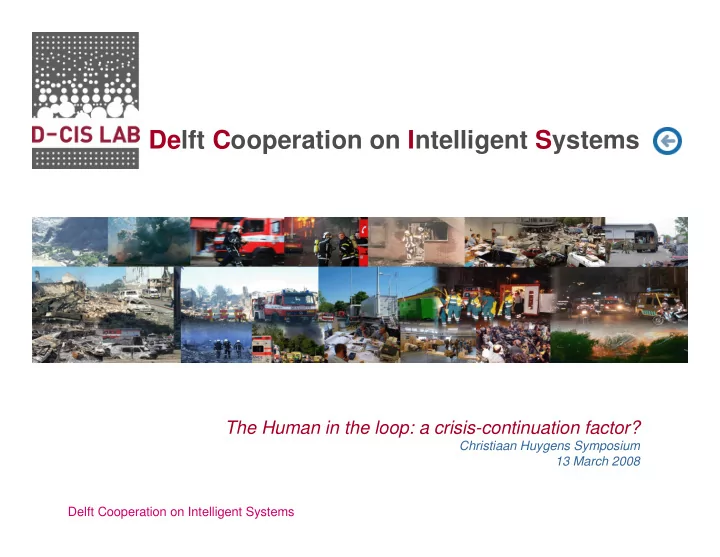
Delft Cooperation on Intelligent Systems The Human in the loop: a - - PowerPoint PPT Presentation
Delft Cooperation on Intelligent Systems The Human in the loop: a crisis-continuation factor? Christiaan Huygens Symposium 13 March 2008 Delft Cooperation on Intelligent Systems Introduction The speaker The D-CIS Lab 8 0 0 2 / 3 0 /
Delft Cooperation on Intelligent Systems
Christiaan Huygens Symposium 13 March 2008
2
2 6 / 3 / 2 8
Delft Cooperation on Intelligent Systems
3
2 6 / 3 / 2 8
Delft Cooperation on Intelligent Systems
3
2 6 / 3 / 2 8
Delft Cooperation on Intelligent Systems
Integrated Framework Consortium integration
Joined Program Activities Partners’ portfolio Start of the project
Expanding the partnership: UT, UM, RU, RUG, Shell,..
Integrated Framework Consortium integration
Joined Program Activities Partners’ portfolio Start of the project Integrated Framework Consortium integration
Joined Program Activities Partners’ portfolio Start of the project
Expanding the partnership: UT, UM, RU, RUG, Shell,..
2007/2008 2005/2006 2003/2004
4
2 6 / 3 / 2 8
Delft Cooperation on Intelligent Systems
4
2 6 / 3 / 2 8
Delft Cooperation on Intelligent Systems
Real-time Chaotic Complex S-o-S Information intense Smart OODA Humans in the loop
5
2 6 / 3 / 2 8
Delft Cooperation on Intelligent Systems
5
2 6 / 3 / 2 8
Delft Cooperation on Intelligent Systems
Applied Research: Demand Articulation & Solution Provisioning = Transillitation Business Units AUAV/swarming A A valorisatiegebied
6
2 6 / 3 / 2 8
Delft Cooperation on Intelligent Systems
7
2 6 / 3 / 2 8
Delft Cooperation on Intelligent Systems
Man-made disaster Natural disaster Pandemic disaster
Man-made disaster Natural disaster Pandemic disaster
8
2 6 / 3 / 2 8
Delft Cooperation on Intelligent Systems
9
2 6 / 3 / 2 8
Delft Cooperation on Intelligent Systems
9
2 6 / 3 / 2 8
Delft Cooperation on Intelligent Systems
Actor-Agent Communities (AACs) are complex self-
proactive problem solving in dynamic and unpredictable environments. The main application of AACs is to find optimized solutions for otherwise intractable problems, for example in areas such as command & control and collaborative decision making. They contain two distinct types of interacting information processing components: people (the actors) and software agents (the agents) that proactively collaborate, guided by a shared interest. These AAC systems comply with the theoretical concepts and technical specifications described in the Actor-Agent Community Paradigm and supporting documents, published by the D-CIS Lab, the research partnership of Thales Nederland, Delft University of Technology, TNO and the University of Amsterdam
ACTOR ACTOR-
AGENT COMMUNITIES
10
2 6 / 3 / 2 8
Delft Cooperation on Intelligent Systems
11
2 6 / 3 / 2 8
Delft Cooperation on Intelligent Systems
12
2 6 / 3 / 2 8
Delft Cooperation on Intelligent Systems
13
2 6 / 3 / 2 8
Delft Cooperation on Intelligent Systems
i h i h class
i i
14
2 6 / 3 / 2 8
Delft Cooperation on Intelligent Systems
GasX CondC SC1
1
Smell Sympt SC1
2
SC2
3
EC1
1
EC1
m
EC1
m+1
EC1
n
T H EC2
1
EC2
1
E4
p
E5
1
E5
q
C1 C2 C3
3
C2
3
C1
3
15
2 6 / 3 / 2 8
Delft Cooperation on Intelligent Systems
16
2 6 / 3 / 2 8
Delft Cooperation on Intelligent Systems
17
2 6 / 3 / 2 8
Delft Cooperation on Intelligent Systems
!"# $ % $ &' 9!: % 9!; &( !"# $ % $ &) 9!7 % 9!< &* + ,+
18
2 6 / 3 / 2 8
Delft Cooperation on Intelligent Systems
19
2 6 / 3 / 2 8
Delft Cooperation on Intelligent Systems
0.6 0.2 e2 0.4 0.8 e1 c2 c1 P(E|C) 0.99 0.45 e2 0.01 0.55 e1 c2 c1 P(E|C)
0.8 0.1 e2 0.2 0.9 e1 c2 c1 P(E|C)
+ ,+
20
2 6 / 3 / 2 8
Delft Cooperation on Intelligent Systems
21
2 6 / 3 / 2 8
Delft Cooperation on Intelligent Systems
26
T h e i n f l u e n c e
m
c h a n g e b l i n d n e s s
22
26
T h e i n f l u e n c e
m
c h a n g e b l i n d n e s s
23
26
T h e i n f l u e n c e
m
c h a n g e b l i n d n e s s
24
26
T h e i n f l u e n c e
m
c h a n g e b l i n d n e s s
25
26
T h e i n f l u e n c e
m
c h a n g e b l i n d n e s s
26
26
T h e i n f l u e n c e
m
c h a n g e b l i n d n e s s
27
26
T h e i n f l u e n c e
m
c h a n g e b l i n d n e s s
28
1%
26
T h e i n f l u e n c e
m
c h a n g e b l i n d n e s s
29
?@A 8@A
26
T h e i n f l u e n c e
m
c h a n g e b l i n d n e s s
30
BCD!9=
th e
th e
th e
th e
th e
th e
th e
th e
39
2 6 / 3 / 2 8
Delft Cooperation on Intelligent Systems